 Ten Toe Express

Right then, picture this: it's the small hours of 5 February 1958, over the Georgia coast, and a six-engine B-47 bomber has just been hit by a fighter and is dropping out of the sky. Somewhere nearby, the fighter pilot is dangling from a parachute. And tucked inside the bomber is a 7,600-pound Mark 15 hydrogen bomb that the crew is about to drop into the sea off Tybee Island, Georgia.
The bomb hit the water of Wassaw Sound. Nobody saw it explode. Nobody has seen it since. It is, officially, still out there, which makes the Tybee Island bomb one of the more awkward things the United States Air Force has ever mislaid.
The night a Sabre met a Stratojet
The story starts as a training exercise, not a disaster. A B-47 Stratojet from the Strategic Air Command, flying out of Homestead Air Force Base in Florida, was on a simulated combat mission that included a practice bombing run. On board were pilot Howard Richardson and two other crew members, named in one account as Bob Lagerstrom and Leland Woolard. Also on board, for realism, was a Mark 15 bomb.
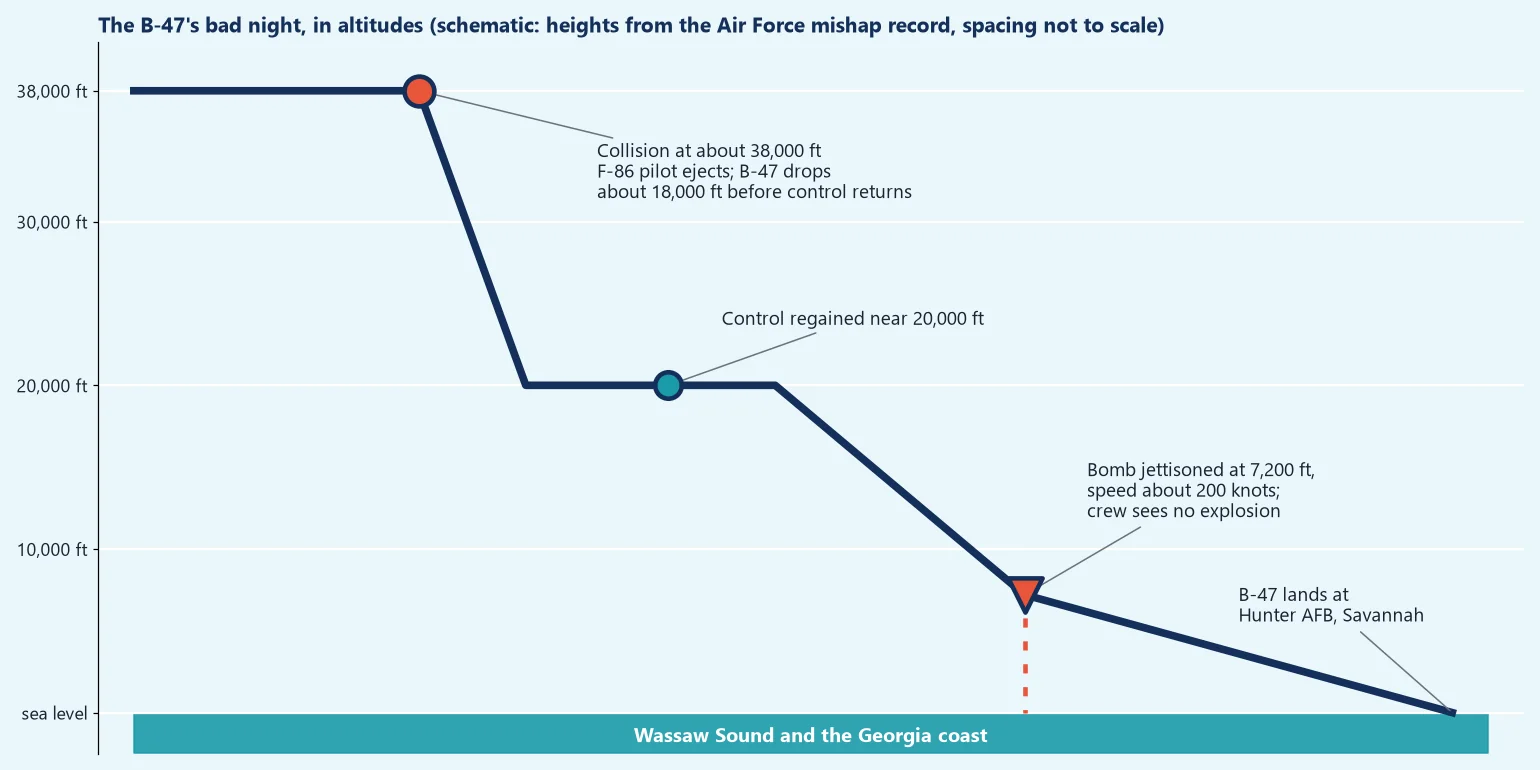
Meanwhile an F-86L Sabre fighter was up on its own exercise, hunting for bombers. Its pilot, Lt. Clarence Stewart, did not see the B-47 on radar and descended straight into it. The Sabre's left wing was torn off. The bomber was flying at about 38,000 feet, and the collision damaged its fuel tanks and knocked it into a fall of roughly 18,000 feet before Richardson got it back under control near 20,000.
Stewart ejected and came down in a swamp near Estill, South Carolina, unhurt. The B-47 was a different problem. It was crippled, it was carrying a very large bomb, and the nearest runway belonged to Hunter Air Force Base at Savannah.
Why the crew dropped the bomb
Richardson's worry was simple and entirely reasonable. A damaged bomber, an emergency landing and a heavy bomb that might break loose on touchdown is not a combination anybody wants. The crew asked for permission to jettison the weapon, and permission was granted. One account adds that Hunter's single runway was under repair, which is the sort of detail that makes a bad night worse.
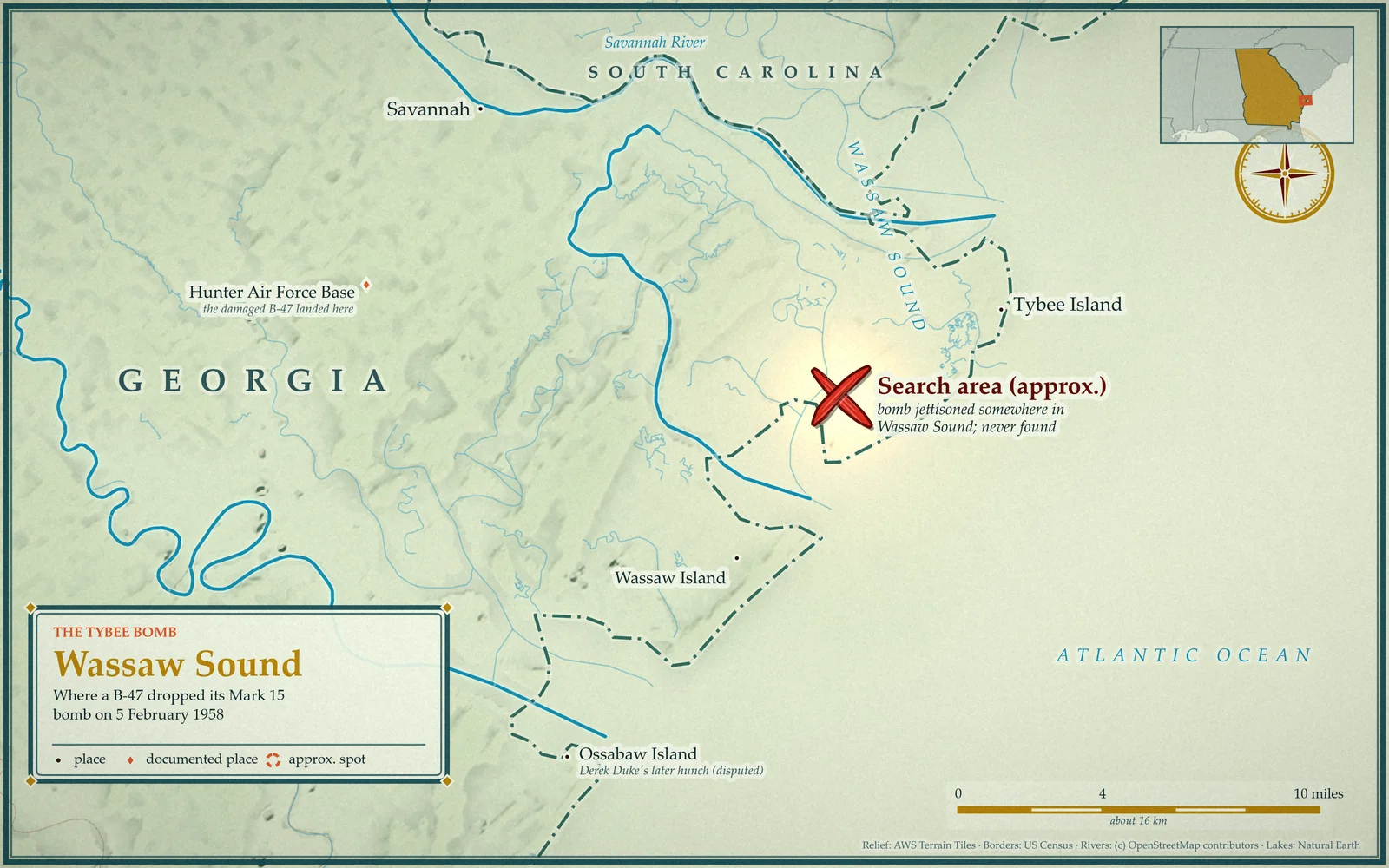
The bomb went out at about 7,200 feet while the B-47 flew at roughly 200 knots, over Wassaw Sound. The crew reported no explosion when it hit the water. Richardson landed the bomber at Hunter, was later awarded the Distinguished Flying Cross, and the B-47 never flew again.
The search: two months, no bomb
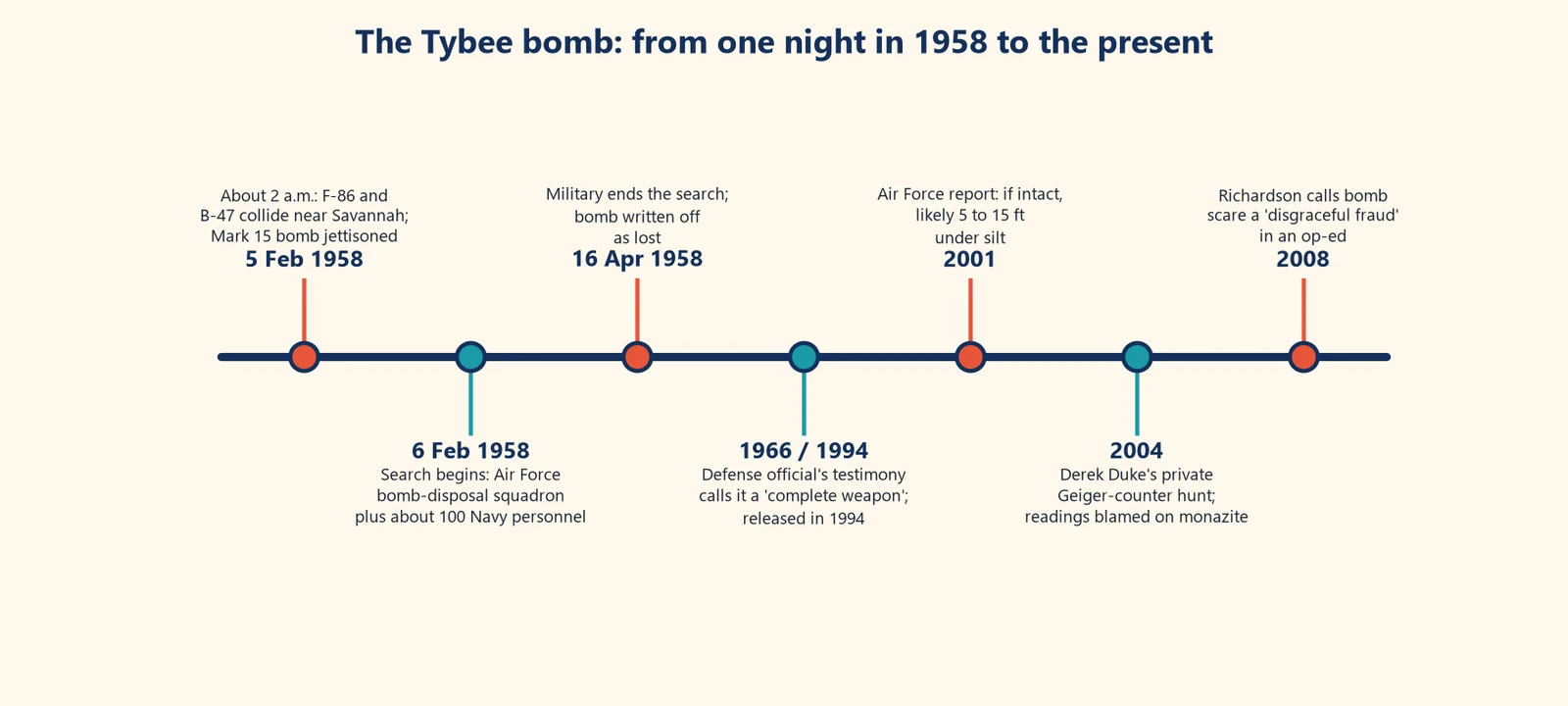
The hunt began the next day, 6 February. The Air Force's 2700th Explosive Ordnance Disposal Squadron worked with about 100 Navy personnel, using handheld sonar and cable sweeps in the sound. The water is shallow, murky and tidal, which is rather like looking for a dropped coin in a cup of tea with the cup moving. On 16 April 1958 the military called it off and wrote the bomb down as lost.
Later estimates put the water at roughly 8 to 40 feet deep. An Air Force report in 2001, built on a hydrographic survey, reckoned that if the bomb is still there it lies under 5 to 15 feet of mud and sand. That report called the weapon "irretrievably lost" and concluded that the best course was to stop looking and leave it be.
Was it actually a nuclear bomb?
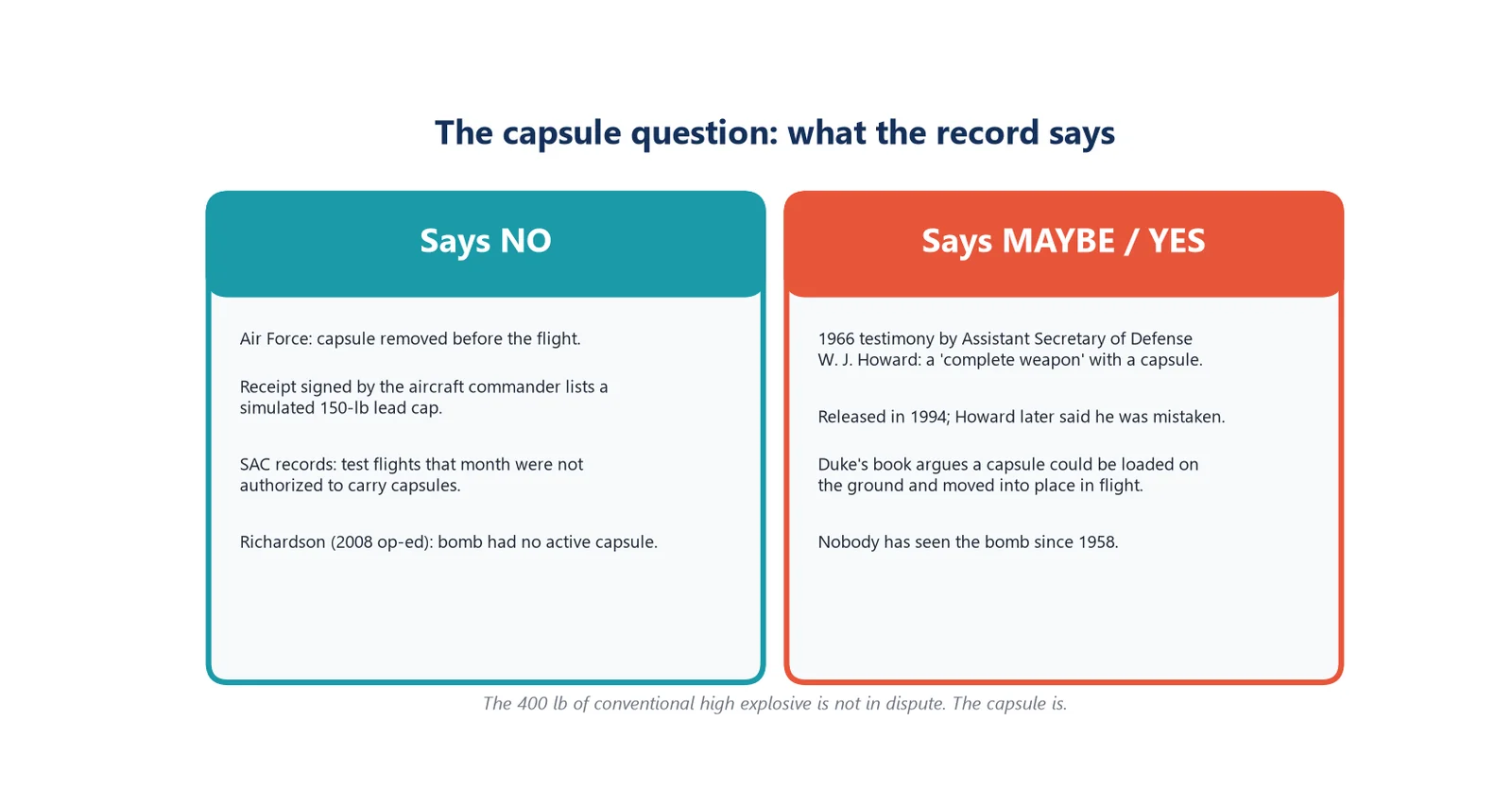
This is the part where the mystery stops being about the sea and starts being about paperwork. A Mark 15 carried about 400 pounds of conventional high explosive wrapped around a nuclear weapon, with a yield of up to 3.8 megatons, roughly 190 times the Fat Man bomb dropped on Nagasaki. The big question is whether the nuclear capsule, the part that makes it a hydrogen bomb rather than a very large firework, was on board.
The Air Force has said for decades that it was not. The capsule was taken out before the flight, and a receipt signed by the aircraft commander lists a simulated 150-pound lead cap in its place. Strategic Air Command records also indicate that test flights that month were not authorized to carry capsules. Richardson himself, by then a retired colonel, wrote an op-ed in 2008 calling talk of a possible nuclear explosion a "disgraceful fraud".
Then came 1966. In testimony to Congress, Assistant Secretary of Defense W. J. Howard described the Tybee weapon as a complete bomb with a nuclear capsule. That testimony was released in 1994, and plenty of people noticed. Howard is reported to have said later that he was mistaken, and that the bomb was not complete. Which version you believe rather depends on whether you trust a receipt or a recollection.
Legends, locals and a Geiger counter
Where there's a lost bomb, there's local lore. One tale, passed along through a friend of a Tybee shrimper named Bubba Smith (who died in 2006), has Smith snagging something heavy in his net around 1960. A diver is said to have declared it a bomb, and they supposedly left it near the old Coast Guard station. Another shrimper reportedly rang Hunter airfield about it and was pointed to the Tybee Island Police Department. It is a lovely story. It is also a story with no documents behind it.
Then there is the Soviet submarine rumour, the sort of thing that appears in every lost-bomb tale like an uninvited uncle at a wedding. Accounts agree there is no evidence for it.
The better documented chapter is Derek Duke, a retired Air Force lieutenant colonel who went looking on his own in 2004. Towing a Geiger counter behind a boat, he and a partner recorded radiation above normal in Wassaw Sound; accounts of how far above range from about four to ten times. Duke narrowed things to an area around the size of a football field and later wrote a book, Chasing Loose Nukes, arguing the capsule could have been loaded on the ground and moved into place in flight. In time he came to doubt the Smith story and to suspect the bomb is in the marsh behind Ossabaw Island instead.
The Air Force was unmoved. An adviser on nuclear weapons put the readings down to monazite, a naturally radioactive mineral that is common in the sands of the area. A government search in 2004 found nothing, and a 2005 Air Force report found no trace of the bomb, saying the varying readings came from natural elements in the sediment. A 2007 check of the regional aquifer by the Georgia Department of Natural Resources found no unusual artificial contamination, beyond the naturally high levels already blamed on monazite.
Could it go off?
The honest answer from the 2001 Air Force report is no, with homework. If the bomb is intact and lacks a capsule, the explosive is no hazard sitting in the mud. The report also described what would happen if a plutonium trigger were present and the bomb somehow detonated above water: a fireball more than a mile across. That is a worst case from a report, not a prediction, and the AP summary of the 2005 findings states plainly that the bomb cannot explode.
Where it stands today
The Tybee Island bomb is still on the books as lost. The Air Force's view is that disturbing it would bring risks of its own, from the conventional explosives to the environment, so it advises leaving the thing exactly where it is. Wassaw Sound is open tidal water and salt marsh, so there is nothing to see from the beach, and nothing to dig. What is here is a story, a very good one, and a rather large hole in the paperwork.
...and if you find it, remember who encouraged your questionable life choices.
The short version of this story is on YouTube at @TenToeExpress.
Deep dive yourself
- 1958 Tybee Island mid-air collision · Wikipedia
- Fact Sheet: The Missing Tybee Bomb · Center for Arms Control and Non-Proliferation
- The Saga of the Tybee Bomb · Garden & Gun
- B-47B/F-86L Aircraft Mishap Report, 5 February 1958 · The Black Vault
- No Sign of Long-Lost Nuke · CBS News (AP)