 Ten Toe Express

Right then: a fur trader loses everything to the French, gets cross, rows into a Maine trading post with a boat full of mates, and walks off with the lot. That is the short version of Dixie Bull's pirate treasure, and it is one of the oddest first chapters in American pirate history. Bull is the first pirate known to have preyed on New England shipping, and he did it in 1632, about eighty years before Blackbeard made the job look glamorous.
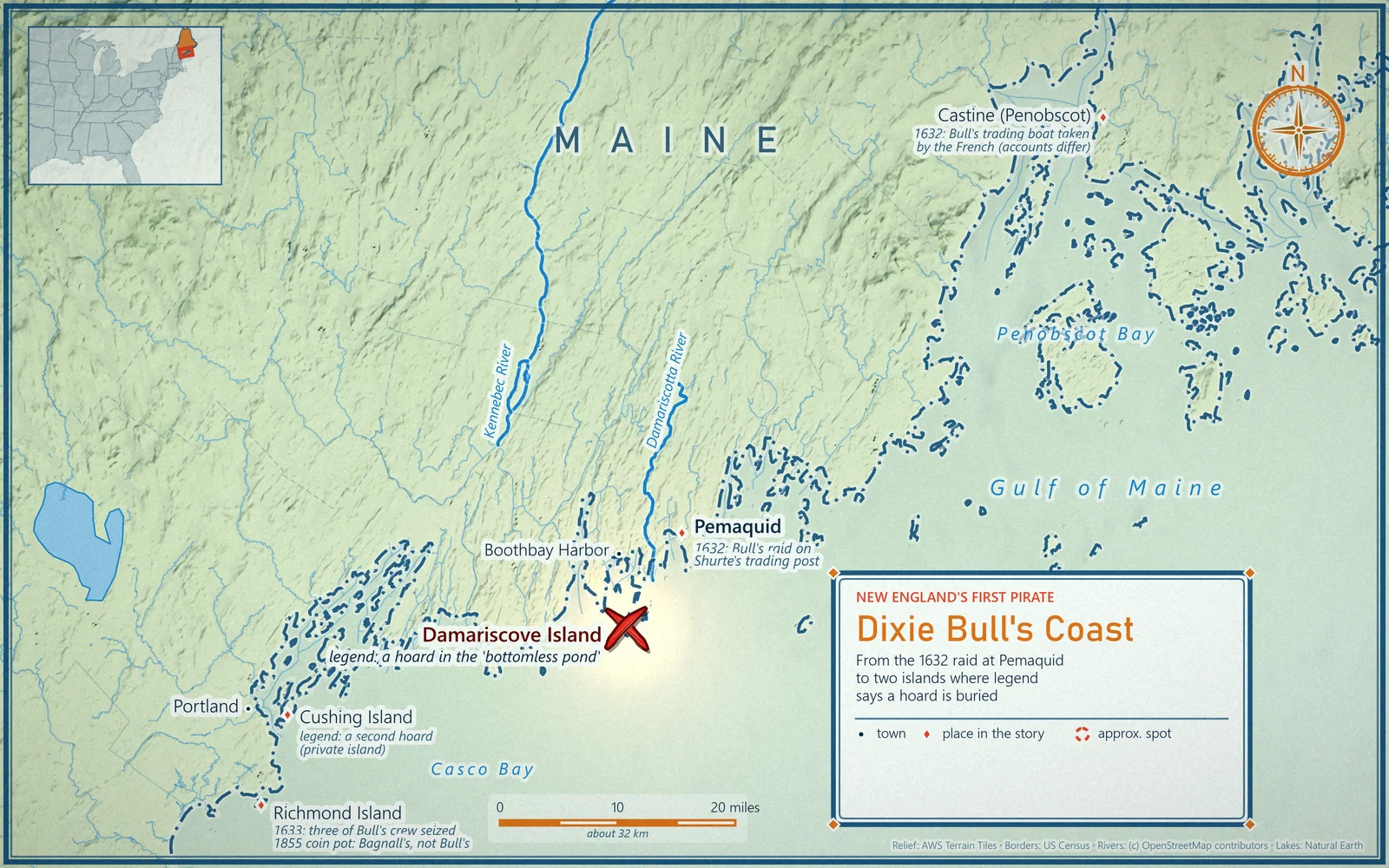
Then comes the treasure bit. Local legend says Bull buried a hoard on two Maine islands, Damariscove off Boothbay Harbor and Cushing in Casco Bay. Sounds thrilling. The records, as you are about to see, have some rather inconvenient things to say about that.
Who was Dixie Bull?
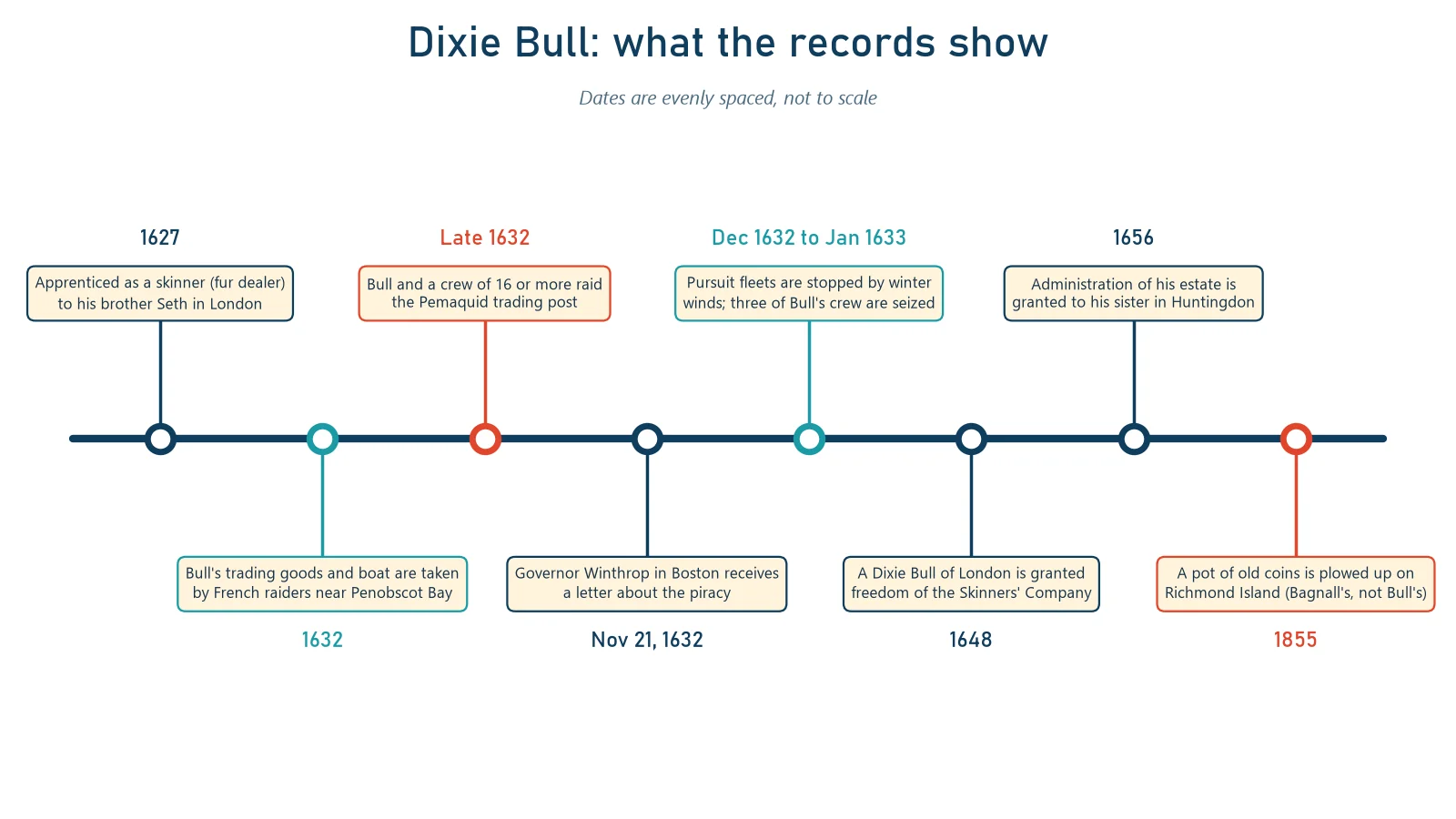
Dixie (sometimes Dixey or Dixy) Bull was born in Huntingdon, England, around 1611. In 1627 he was apprenticed to his elder brother Seth, a London skinner, which is a dealer in furs. That detail matters, because it explains why a young Englishman turned up on the Maine coast swapping knives and beads for beaver pelts.
He crossed to Massachusetts Bay in the early 1630s (sources disagree on whether it was 1631 or 1632) and began trading along the coast of Maine. So far, a perfectly ordinary young man with a boat and a business plan. Then 1632 happened.
How a fur trader became a pirate
Accounts vary on the details, but they agree on the outline. In 1632, around Penobscot Bay, a party of French raiders took Bull's boat and his trade goods. Some tellings put it at Castine, some in the bay generally, and nobody can pin down the exact spot. Whatever happened, Bull was left with nothing.
He headed back toward Boston and gathered a crew. Estimates of the numbers run from 16 to about 25 men. The plan, at least at first, seems to have been to claw back his losses from the French. There is no record of that going anywhere. Instead, Bull looked at the richer, softer, English targets nearer to hand. Fair play, you might say, if you had no scruples whatsoever.
The raid on Pemaquid, 1632
The big event was Pemaquid, then the busiest fur-trading spot on the Maine coast. It sits on the peninsula between the Kennebec River and Penobscot Bay, and the first documented permanent home there dates to 1628. The target was the stockaded post of trader Abraham Shurte, built around 1630 or 1631 to guard against the French.
Popular tellings have Bull sailing in with three ships and guns blazing. A more careful account suggests the raid was probably quieter: the locals knew the English traders on sight, so the crew likely rowed ashore without a fuss and helped themselves to furs and goods. As they weighed anchor, someone at the post got off a lucky shot and killed one of Bull's men. As far as anyone can tell, that was the only death.
What did they carry off? Here the sources cannot agree at all. One gives a figure of £55 (or $2,500, depending on the telling), while another says thousands of pounds' worth of goods and coin. Take your pick, and keep a straight face. The point is that much of it was likely furs and supplies, which tend to be rather hard to bury sensibly.
The hunt for Dixie Bull
News travelled quickly, if not comfortably. On November 21, 1632, Governor John Winthrop in Boston received a letter about the piracy; he understood that Bull and fifteen other Englishmen from the eastern settlements had "turned pirates". Boston and Portsmouth both decided to act.
Portsmouth readied four boats. Winthrop's council agreed on December 5 to send a boat with twenty armed men to join them. Often called the first armed expedition mounted by an English colony in America, it was rather less thrilling than the label suggests. Winter weather turned the Boston boat back at Cape Ann, and it was home again by January 2, 1633. The Portsmouth men reached Pemaquid, where contrary winds then kept them harbor-bound for about three weeks.
On the way home that January they stopped at Richmond Island, off Cape Elizabeth. There they seized three men said to be deserters from Bull's crew, and hanged a local man called Black Will for the murder of a trader named Walter Bagnall. The only source for Will's alleged part in that killing is Winthrop, and the archaeologist Bruce Bourque calls the claim unlikely. A purported letter from Bull to the governor later arrived, promising to head south and never to hurt another countryman, and the search was quietly dropped.
What happened to Dixie Bull?
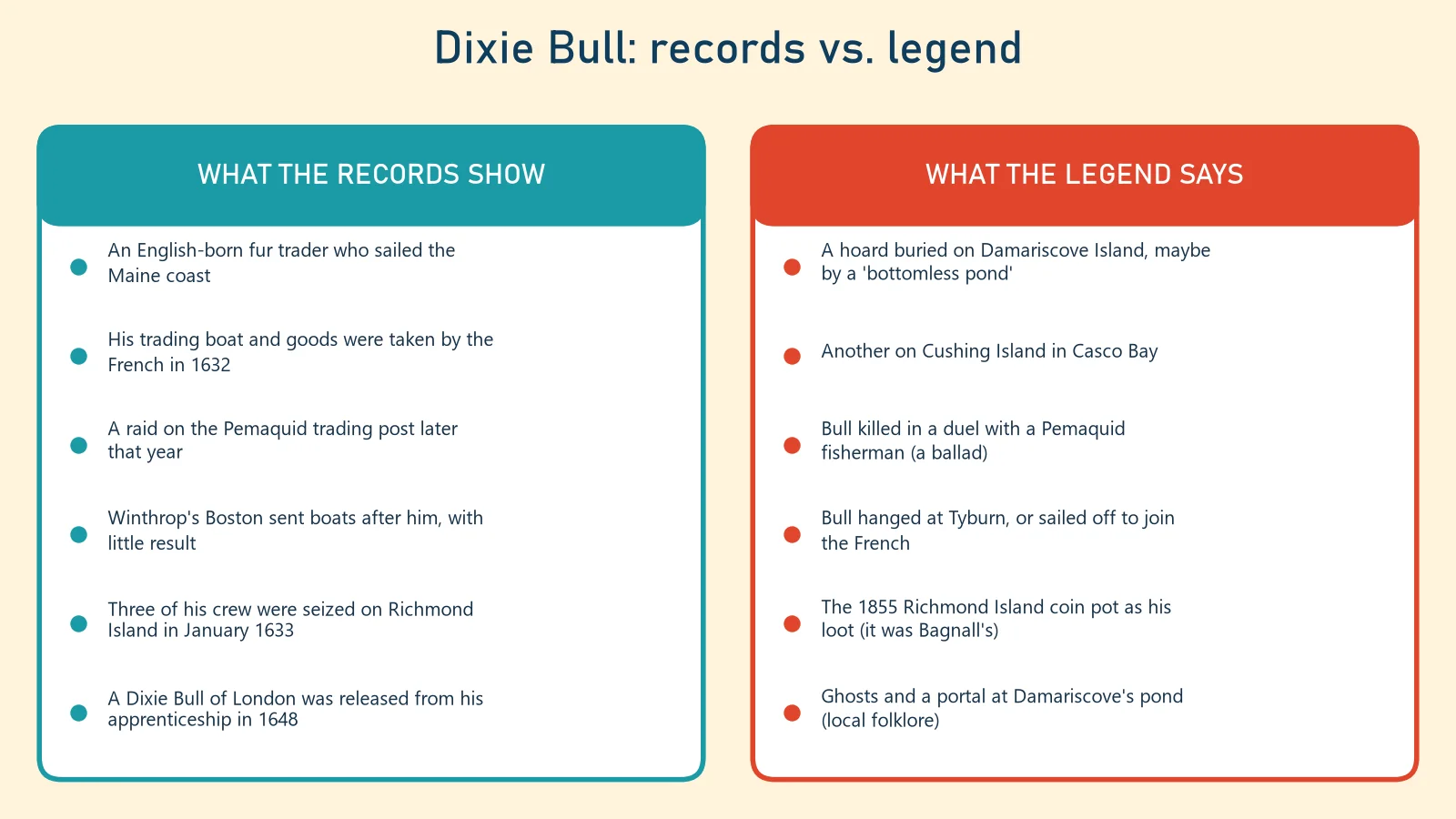
This is where the stories pile up, each more dramatic than the last. Some say Bull joined the French. Some say he was hanged at Tyburn. A ballad called "The Slaying of Dixie Bull", printed in Minstrelsy of Maine in 1927, has him killed in a duel with a Pemaquid fisherman named Daniel Curtis, saving the town. Others have him vanishing south toward Virginia.
The paperwork is rather less exciting, which is usually how you can tell it is real. In 1648 a Dixie Bull of London was granted freedom of the Worshipful Company of Skinners, completing the apprenticeship he began in 1627. In 1656 administration of his estate went to his sister, Susan Kendricks, back in Huntingdon. Taken together, that points to a man who survived his piracy, returned to England and went back to the fur trade. The famous pirate probably died in his bed.
Dixie Bull's treasure: the legend
If Bull's career was short, his treasure story is remarkably durable. Legend says he buried loot on Damariscove Island, a long thin island about two miles long at the mouth of the Damariscotta River, and on Cushing Island in Casco Bay. One local tale places the Damariscove hoard by the island's "bottomless pond", which folklore also credits with a portal for the island's ghosts: a headless man and his dog, and a woman in white. The headless man is said to be Captain Richard Pattishall, killed in a raid in 1689, nearly sixty years after Bull. The ghost story, in other words, has nothing to do with pirates at all, which has not stopped anyone telling it.
The trouble is that both islands were busy places. Damariscove had a year-round fishing settlement, with a fort, by 1622, and the fishermen there famously filled a boat with cod for the starving Pilgrims that spring. Cushing had a blockhouse built there around 1623 or 1624 by the explorer Christopher Levett, who left settlers behind when he sailed home. Burying a haul on an island full of witnesses, with a hunting party after you, is a bold plan. And since the Pemaquid haul was mostly furs and staples, there was very little to bury in the first place.
The Richmond Island coins: a red herring
Treasure legends love a real object, and Maine has one. In May 1855, a farmer plowing on Richmond Island turned up a pot of old English coins about a foot below the surface, along with a signet ring marked "G. V." The coins date from the reigns of Queen Elizabeth, King James and King Charles, which fits the early 1630s nicely, and plenty of people have leapt from there to Dixie Bull.
Hold your horses. The pot was found beside the remains of a building, most likely the trading post of Walter Bagnall, a notoriously sharp fur trader who was murdered there on October 3, 1631, a year before Bull's Pemaquid raid. Winthrop himself called Bagnall a wicked fellow who had cheated the Indians out of a fortune of about £400. So the coins belonged to Bagnall, not to Bull. The hoard is now in the collections of the Maine Historical Society, which is a far more sensible place for it than a hole in the ground.
Where it stands today
No hoard from Dixie Bull has ever been found, and no document or dig has tied one to either island. Your best bet for the real story is Pemaquid itself. Colonial Pemaquid State Historic Site, in Bristol, Maine, holds the reconstructed Fort William Henry, the foundations of the old village and a museum of artifacts dug from the ground, including musket balls, coins and pottery. It was a state park from 1903, is a National Historic Landmark, and drew about 47,700 visitors in 2024. A local writer notes that beside the museum sits the stone foundation of a long warehouse, said to be the one Bull raided.
The islands are a different matter. Damariscove is a protected "forever wild" island, owned by a local land trust since 2005, reached only by boat, and no digging and no dogs are allowed because of the nesting birds. Cushing Island is private property, home to about 45 families in summer. Neither is a place to go prospecting, so the treasure, real or not, is staying exactly where it is.
Which suits the legend perfectly. The first pirate in New England appears to have lost a fur cargo, pinched a bunch of someone else's, and gone home to finish his apprenticeship. The treasure, quite possibly, is just the best story that ever got told about a skinner's brother.
...and if you find it, remember who encouraged your questionable life choices.
The short version of this story is on YouTube at @TenToeExpress.
Deep dive yourself
- Dixie Bull · Wikipedia
- 3 buried pirate treasures that may be in Maine · Bangor Daily News
- Richmond Island's Pot of Gold · Maine Boats, Homes & Harbors
- Coastal History: The infamous pirate Dixie Bull · The Forecaster / Press Herald
- For I am a Pirate King! · Strange Maine
- The Pirate Dixie Bull, Part 2 · Where Is Crusader Rabbit?
- 13 Days of Halloween Tales of Terror: Ghosts of Damariscove · Boothbay Register
- Damariscove Island · Wikipedia
- Cushing Island · Wikipedia
- Colonial Pemaquid State Historic Site · Wikipedia