 Ten Toe Express
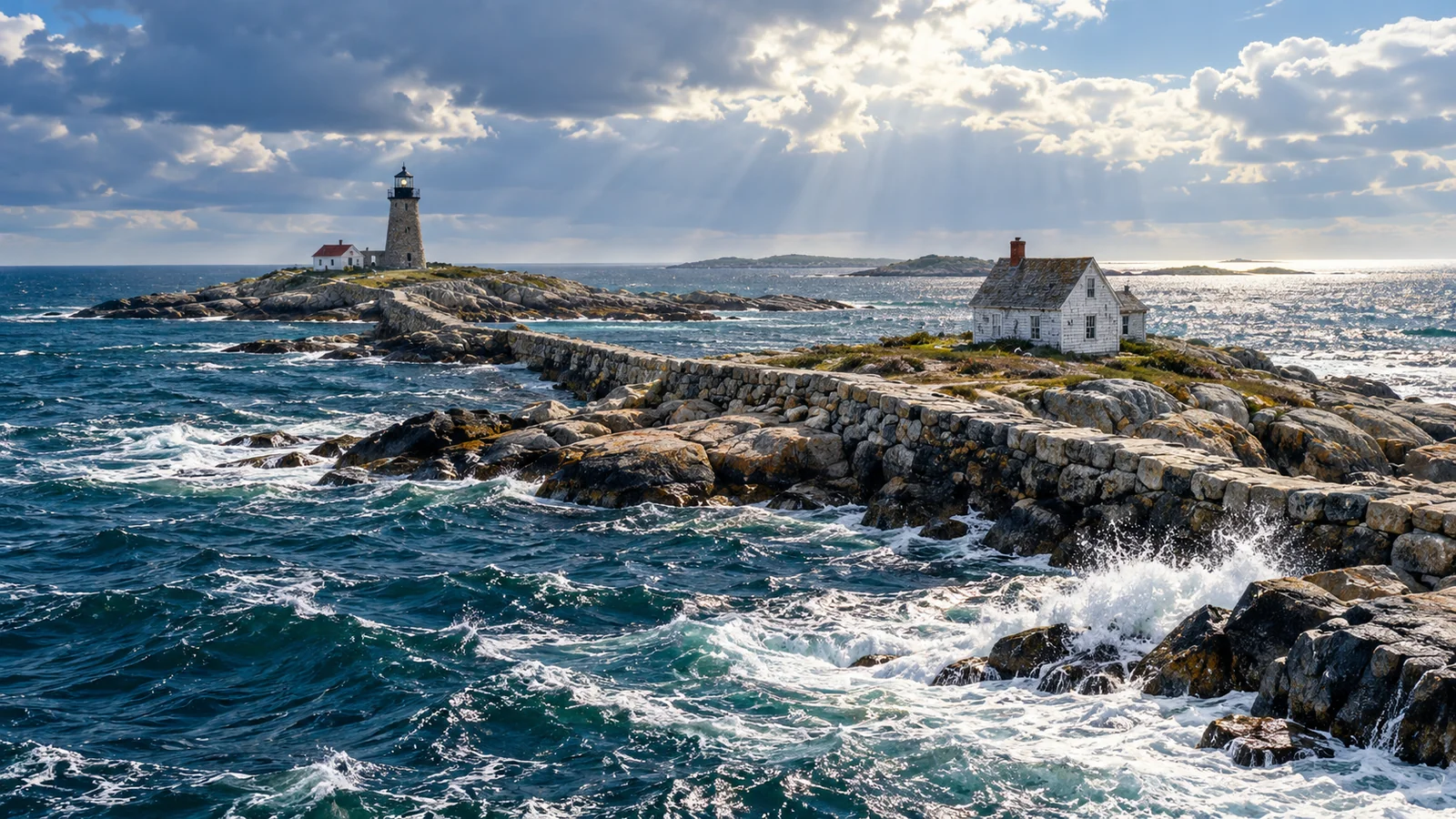
Nine bare granite islands sit about six miles off the New Hampshire coast, scrubbed by wind and salt and almost entirely without soil. This is the Isles of Shoals, and if you believe the stories, they are stuffed with pirate treasure: silver bars under a flat rock, Captain Kidd's chest, Blackbeard's gold and a bride he left behind.
Right then. Pack a shovel? Please don't. The Isles of Shoals pirate treasure is one of those legends where one tale is rock-solid, one is plausible and the rest are pure seaside theatre. Sorting out which is which is the fun part.
The islands that look like the end of the world
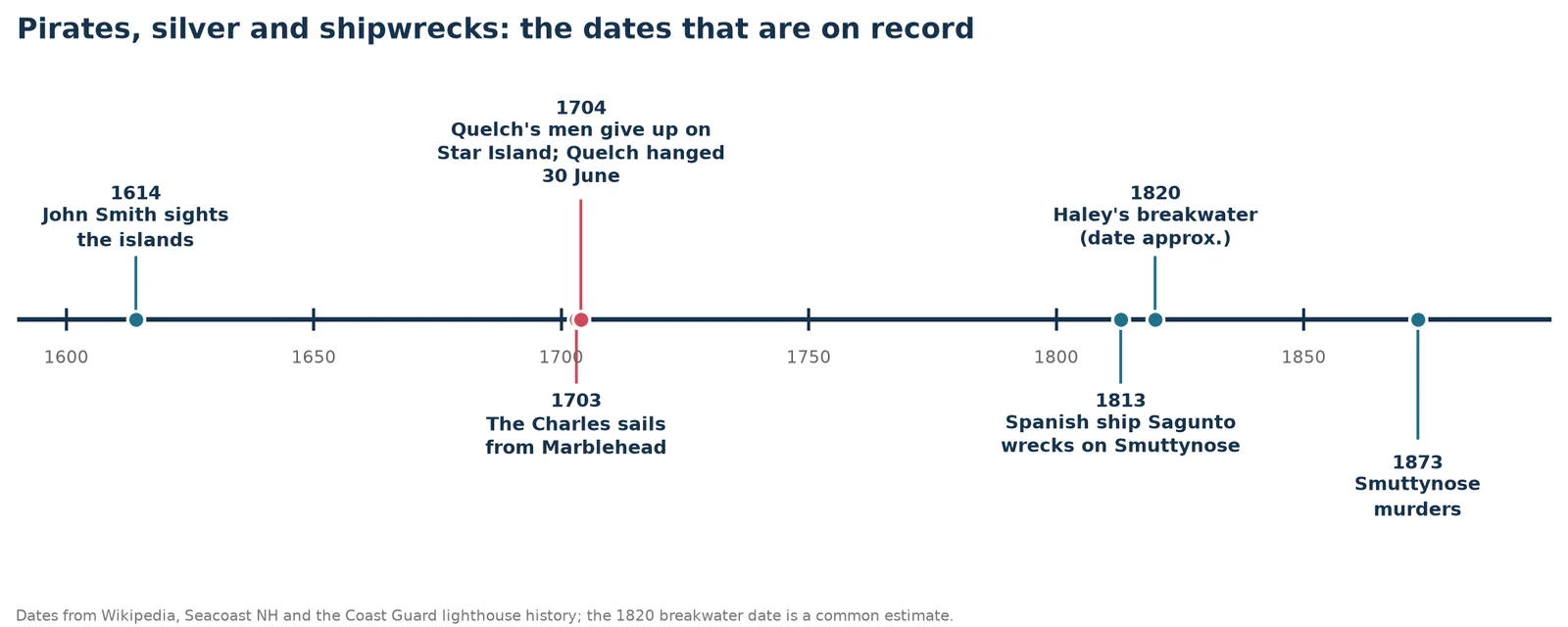
Captain John Smith sighted these rocks in 1614 and called them the "Smith Iles". The name did not last. What stuck is a cluster of islands with names like Star, Appledore, Smuttynose, Cedar, Malaga and Lunging, for fishermen, hermits, poets and the odd smuggler.
For centuries this was a busy fishing station, and a proper one. People lived on Star Island in a community called Gosport until the Revolutionary War, when the islanders were evacuated around 1778. Later, the poet Celia Thaxter held court on Appledore, and the islands became a summer retreat for painters and writers. Smuttynose, a 27-acre scrap of rock named (so the story goes) for seaweed that looked like a sea monster's dirty snout, belongs to the town of Kittery, Maine.
Hold that thought about the topsoil. A treasure hunter wants somewhere to dig. These islands mostly offer granite.
The documented bit: Quelch and the Charles
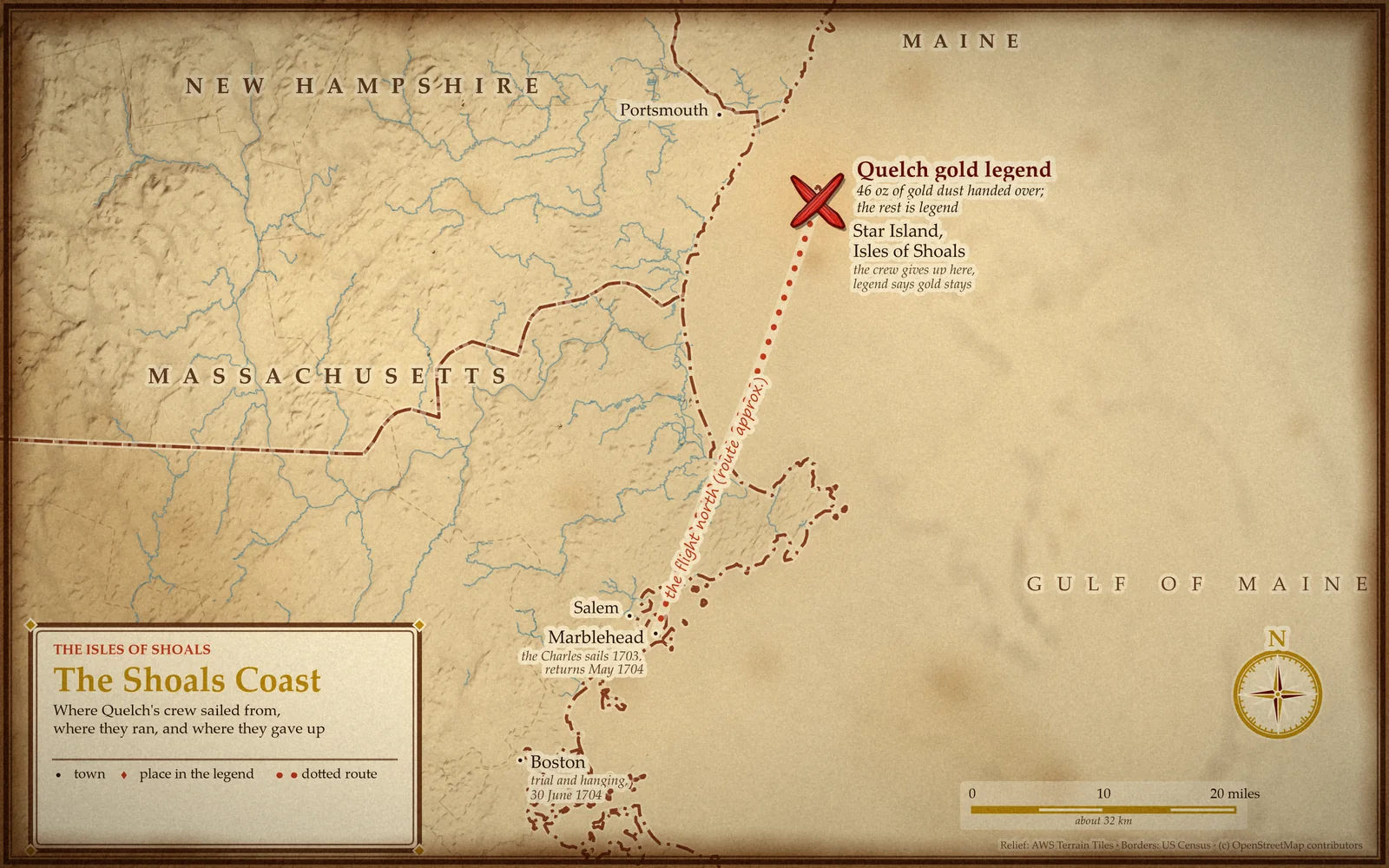
Here is the part with paperwork. In August 1703 the brigantine Charles sailed from Marblehead, Massachusetts, on a privateering mission to hunt French ships. Its captain, Daniel Plowman, was dead within about two days. Whether he died naturally or in a mutiny is unclear, and sources do not agree. His lieutenant, John Quelch, took command and promptly ignored the French altogether.
Instead the crew sailed to Brazil and plundered as many as nine small Portuguese vessels. This was a problem, because England and Portugal were allies. When the Charles limped back to Marblehead in May 1704, it carried gold dust, coins and a cargo of "souvenirs". One account puts the gold dust at 960 ounces. The crew scattered with their shares.
Quelch's cover story, that the gold came from a Spanish wreck, did not survive contact with the Portuguese goods. He was arrested and became the centre of the first admiralty trial held outside England. Quelch was hanged in Boston on 30 June 1704. His parting words to the crowd survive: they should take care how they brought money into New England to be hanged for it.
The dash to the Shoals
Some of Quelch's men did not wait around to be arrested. A band of them fled north by boat, and the Isles of Shoals was where they ended up. Judge Samuel Sewall, who had sat on the Salem witch trials, went after them in a borrowed fishing boat with no cannon. The pirates gave up on Star Island.
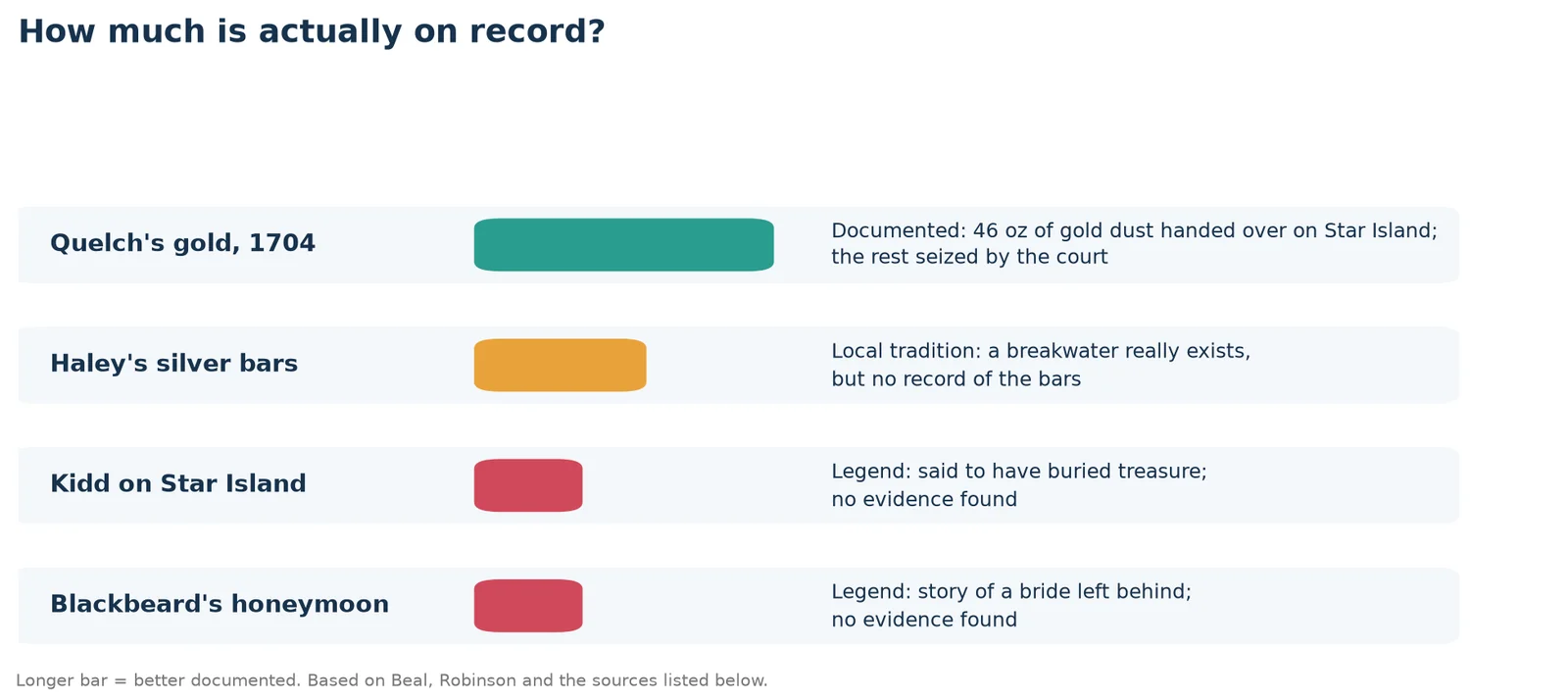
They handed over only 46 ounces of gold dust. That, naturally, started the question that has lasted three centuries: was there more? The legend says the crew buried some on Star Island. It also says gold coins were found hidden in a stone wall there in the 1800s, though that tale has no solid record behind it that these sources could point to.
Historians who have looked hard at this are blunt. Clifford Beal, who wrote the book on the case (Quelch's Gold), treats the hidden-treasure tale as legend, and the Seacoast NH account concludes the gold was recovered and handled by the court in 1704. A governor and his son who prosecuted the case took their legal costs out of the confiscated gold.
Haley's silver: the story with a breakwater
The best-known treasure tale on the islands belongs to Samuel Haley, a sea captain who lived on Smuttynose. The story goes that he found three or four silver bars under a flat rock, and sold them to pay for a breakwater that links Smuttynose to its neighbours.
Parts of this are checkable. The breakwater is real. Wikipedia describes it as "reputed" to have been funded by pirate silver found under a flat rock, and dates it to around 1820. Other versions put the find in 1804, and the dates do not agree.
One account links the silver to a shipwreck instead of a pirate. In January 1813 the Spanish vessel Sagunto, sailing north from Hispaniola, was driven onto the rocks at the southeast end of Smuttynose in a winter gale. The account says fifteen crew survived the wreck and then died of exposure on shore. Haley was the island's only resident and, that spring, supposedly found a cache of silver ingots while exploring the wreck. He used four to pay for his breakwater. Locals later reportedly found silver coins in the rock cracks.
It is a lovely story, and it is mostly unsourced. The same account admits the Sagunto is not listed in two salvage reference works, so even the ship's identity is unconfirmed. Writer J. Dennis Robinson says he knows of no proof the bars ever existed. Whatever Haley found, it was probably a lucky salvage from a wreck, not Blackbeard's pocket money.
Blackbeard's honeymoon and Kidd's chest
Now for the pure legend. The tale says that in 1720 Edward Teach, better known as Blackbeard, arrived on Smuttynose with a young bride, buried treasure, and fled when a British fleet turned up. She waited for him for years. Her ghost is said to haunt the shore, calling out that he will return.
There is one rather inconvenient detail: Blackbeard is generally said to have been killed in 1718, two years before this romantic holiday. The legend has also been told with the bride as his fifteenth, thirteenth or some other wife, which tells you how firmly it is anchored to the facts. The islands do have a "Honeymoon Cottage" on Lunging Island,, and the island's summer resident believes a cave at its narrow neck once held the treasure. That cave idea even landed the island a History Channel treasure hunt. Exact details, as one local writer put it, are hard to pin down.
Captain Kidd gets a cameo too. The Coast Guard's history of the White Island light repeats that he was "said to have buried" treasure on Star Island. The sources found for this article show no evidence that he did. Pirates certainly sailed these waters, and the islands were a fishing hub busy enough to see all sorts, but secret burial is a different matter. Robinson points out that there is almost no topsoil, the "caves" lie below the waterline and a busy fishing station is a dreadful place to dig a hole unnoticed.
What treasure hunters have actually found
Not a lot, which is rather the point. Stories of old coins in stone walls and rock crevices keep circulating, but the sources used here record no confirmed pirate hoard recovered from the Shoals. The one confirmed haul is the 46 ounces of gold dust Quelch's men surrendered in 1704, and that went to Boston.
The theories, weighed
- Quelch's men buried more on Star Island. Possible in theory, since they gave up only a fraction of the gold. But the only evidence is the legend, and Sewall's party did not search the island.
- Haley found a real cache from the Sagunto. Plausible. Wrecks do produce silver, and the breakwater exists. The shipwreck and the silver are told the same way in only some accounts.
- Kidd or Blackbeard buried treasure here. No supporting evidence in any source used here, and the Blackbeard dates do not work.
Where it stands today
Star Island is owned by the Star Island Corporation and runs as a conference and retreat centre; it is the only island with a commercial boat from the mainland. Appledore hosts the Shoals Marine Laboratory, run by Cornell University and the University of New Hampshire. Smuttynose is unpopulated and its two historic houses are looked after by volunteer stewards. Duck Island is a wildlife sanctuary, and Lunging and Cedar are privately owned. White Island's lighthouse is automated and owned by the state of New Hampshire. All of that adds up to private, protected or institutional land, and digging on any of it is not on the menu.
The honest answer is that the best Shoals treasure is the story itself: a doomed pirate captain, a hurried flight across a cold sea, a judge in a leaky boat and a lonely sea captain with a very handy breakwater.
...and if you find it, remember who encouraged your questionable life choices.
More stories like this live on YouTube at @TenToeExpress.
Deep dive yourself
- Pirate Gold Recovered at Isles of Shoals · SeacoastNH.com
- Seeking Blackbeard's Pirate Treasure · SeacoastNH.com
- Sagunto wreck and Haley's silver · NUMA
- Isles of Shoals · Wikipedia
- Smuttynose Island · Wikipedia
- John Quelch (pirate) · Wikipedia
- Isle of Shoals Light · U.S. Coast Guard Historian's Office
- Quelch's Gold: Piracy, Greed, and Betrayal in Colonial New England · Clifford Beal, Praeger