 Ten Toe Express
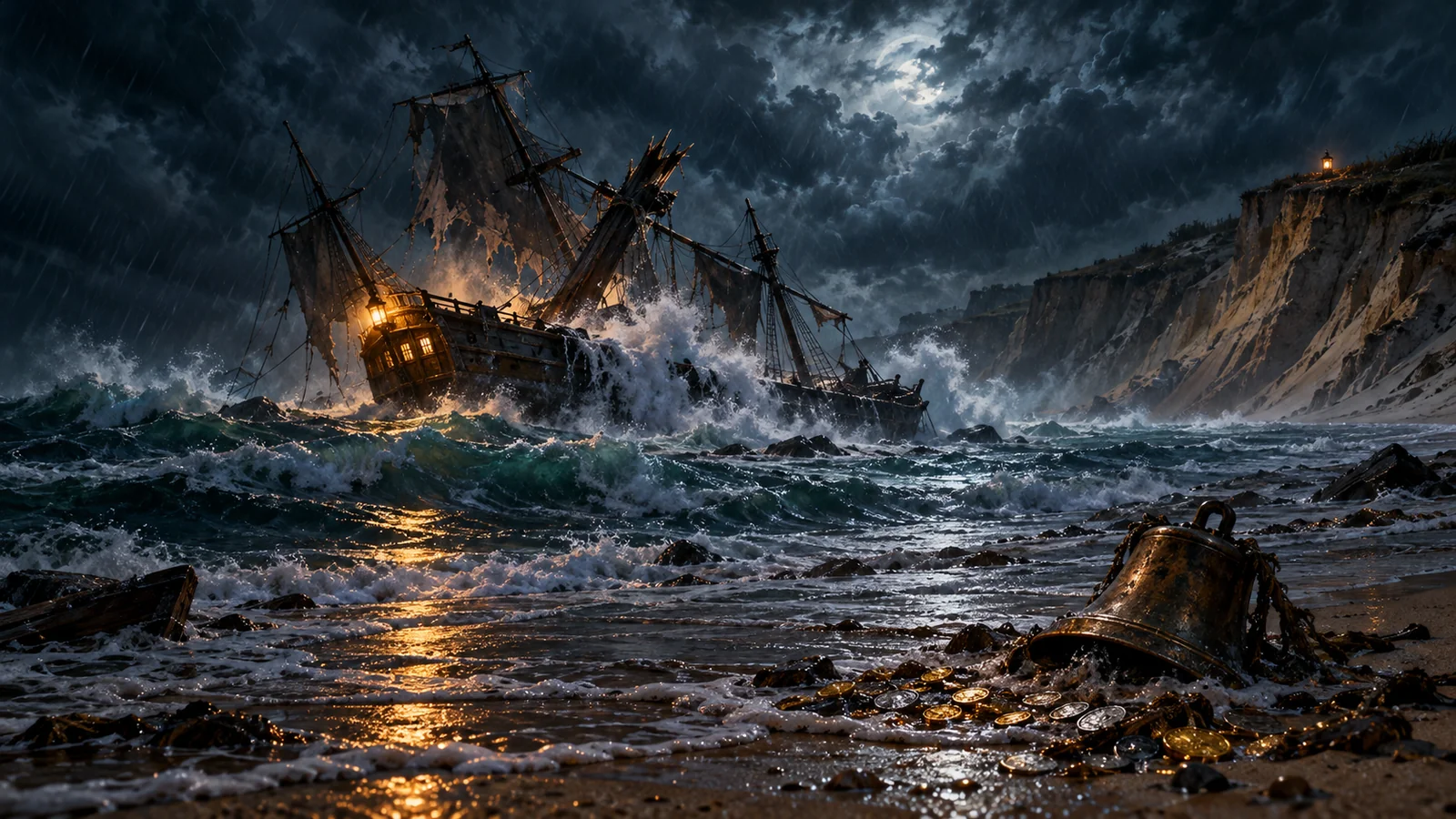
April 26, 1717. Night falls on the outer arm of Cape Cod, and a nor'easter comes screaming in off the Atlantic. Somewhere out in the dark, a big three-masted ship is being shoved toward the sandbars off Wellfleet, Massachusetts. She is the Whydah, and her captain is the most successful pirate of his day, a 28-year-old Englishman named Samuel Bellamy. Below her decks, by the crew's own later account, sit something like four and a half tons of gold and silver.
By morning, the Whydah is matchwood. Of roughly 146 men aboard, two crawl out of the surf alive. And the treasure of Black Sam Bellamy goes to the bottom, where most of it, as far as anyone can prove, still is.
That is the rare treasure tale with a real wreck at the end of it. The ship has been found, its bell has been raised and thousands of coins have come up out of the sand. So why is everyone still looking? Right then: pull on a jumper, it's cold on that beach.
Who was Black Sam Bellamy?
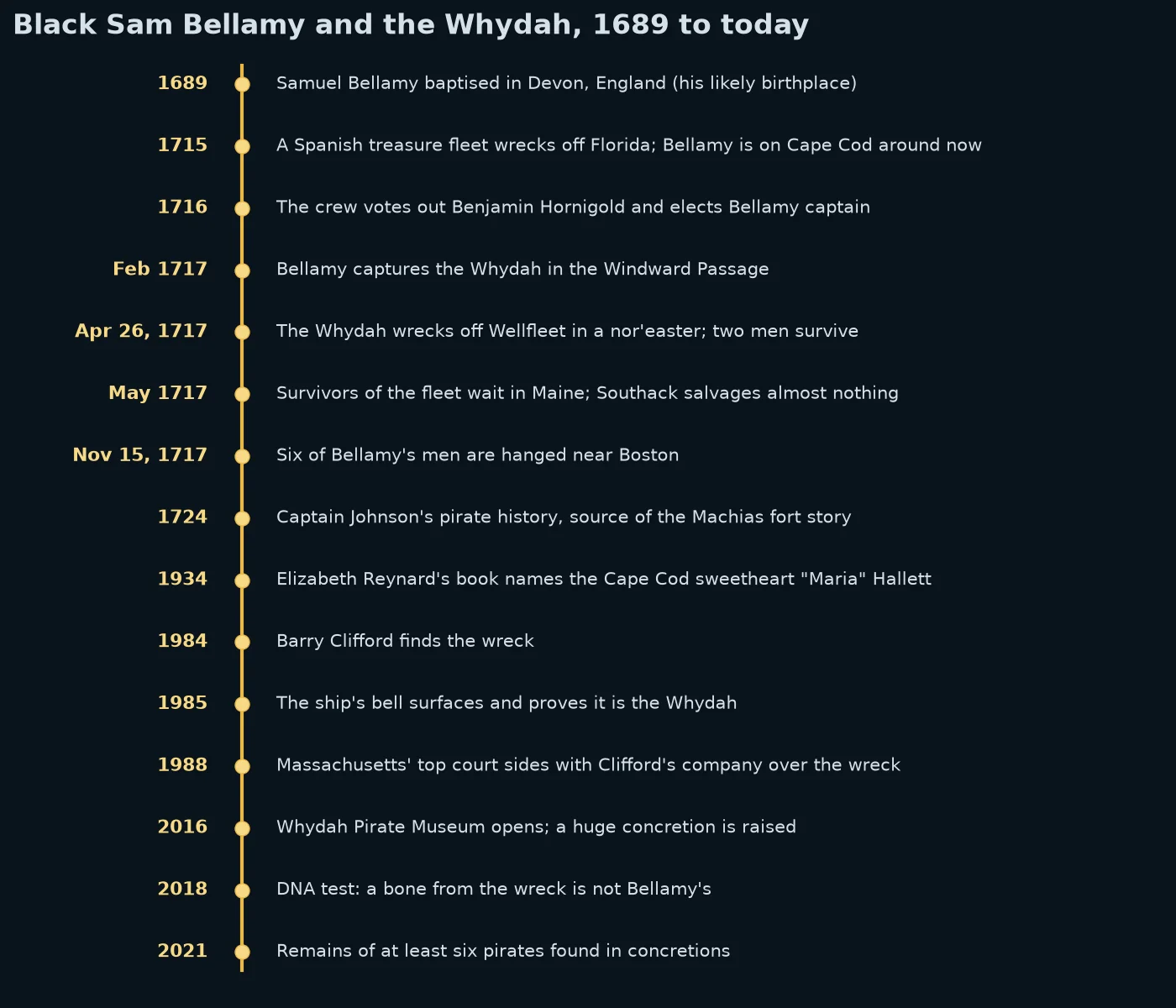
The records on Bellamy's early life are thin, which suits a pirate. He was probably born in the parish of Hittisleigh in Devon, England, where a Samuel Bellamy was baptised on March 18, 1689. A sailor he later captured said Bellamy described himself as a Londoner, so even that comes with an asterisk. He went to sea young and is said to have served in the Royal Navy in his late teens.
Around 1715 he turned up on Cape Cod. In that same summer, a Spanish treasure fleet was smashed by a hurricane off the east coast of Florida, scattering silver along the shallows. Bellamy teamed up with Paulsgrave Williams, a well-off jeweller and the son of a Rhode Island attorney general, who helped pay for an expedition to go and fish some of it out. Early in 1716 they sailed south. They arrived too late to get rich salvaging, and so, like a fair few disappointed treasure hunters of the era, they went into a more direct line of work.
They fell in with the crew of Benjamin Hornigold, whose first mate at the time was a certain Edward Teach, later known as Blackbeard. In the summer of 1716 the crew got fed up with Hornigold's refusal to attack English ships, voted him out, and elected Bellamy captain. Pirate crews ran on votes. This one clearly fancied its chances.
And they were right. In about a year and a half, Bellamy's company is credited with capturing more than 50 vessels, often without a shot. Later writers called him "Robin Hood of the Sea" and the "Prince of Pirates." Folklore says the "Black Sam" bit came from his own black hair, tied back with a bow instead of hidden under a powdered wig. None of those nicknames can be traced to records from his own time, so file them under "lovely, if true."
The famous speeches you'll find quoted all over the internet, where Bellamy lectures a captured captain about rich men robbing the poor under cover of law, come from a 1724 book by "Captain Charles Johnson," A General History of the Robberies and Murders of the Most Notorious Pyrates. Historians generally treat those speeches as Johnson's own handiwork. Johnson is a pen name, and who was behind it is still argued about; the old idea that it was Daniel Defoe is now widely doubted. Remember that book. It comes back to cause trouble in Maine.
The Whydah: a slave ship turned pirate flagship
The Whydah (also written Whydah Gally) was built in London and launched in 1716 for the slave trade, named after the West African port of Ouidah. She was a fast, roughly 100-foot, 300-ton ship. On her maiden voyage she carried enslaved Africans across the Atlantic to the Caribbean, and she was heading home with the profits in gold, silver and goods when Bellamy found her.
That was in late February 1717, in the Windward Passage between Cuba and Hispaniola. Bellamy chased her for three days. Her captain, Lawrence Prince, gave up after barely a shot. In an odd bit of pirate etiquette, Bellamy handed Prince one of his own ships, the Sultana, and kept the Whydah as his flagship, mounting her with 28 guns.
It is worth sitting with where her wealth came from for a second. The Whydah's gold started as the proceeds of human suffering, and the crew that took her included men who had escaped slavery themselves. That's a bigger, darker story than any treasure chest.
North to Cape Cod, and the storm
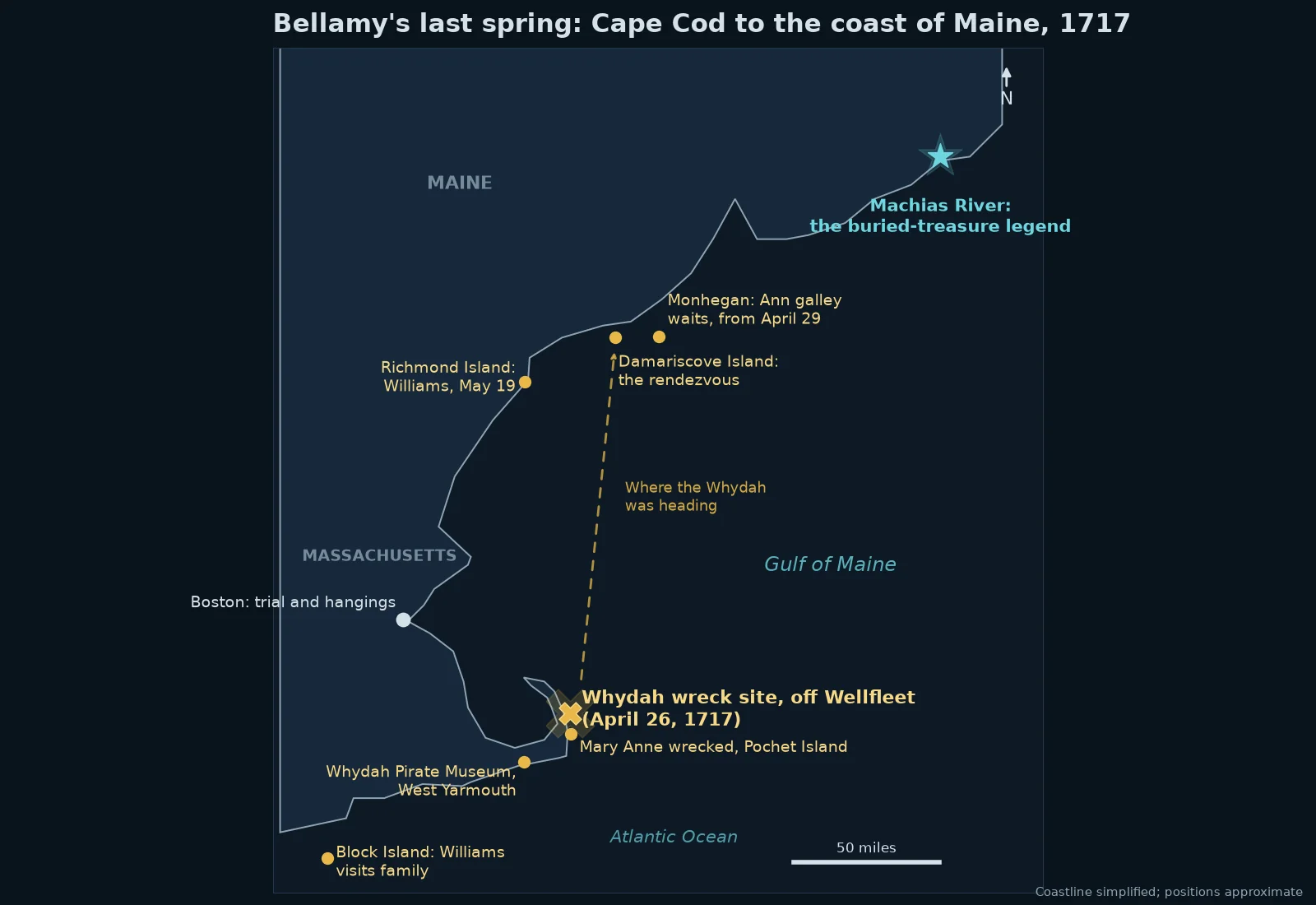
In the spring of 1717 Bellamy's little fleet worked its way up the American coast, picking off ships as it went. Off Virginia, storms and fog separated Williams in his sloop Marianne from the rest. The plan, as far as the depositions show, was to meet up later off the coast of Maine. Williams stopped at Block Island to visit family. Bellamy, with the Whydah and a handful of captured vessels, headed toward Cape Cod.
Why Cape Cod? Nobody knows for certain. He may simply have been on his way to the Maine rendezvous. Local legend has a far more romantic answer, which is coming up shortly.
On April 26, a nor'easter blew up. The Whydah struck a sandbar off Wellfleet, about 500 feet from the beach, in around 16 feet of water. Her mainmast went over the side within a quarter of an hour, according to the survivor Thomas Davis. She rolled, broke apart in the surf and spilled her guns, her men and her cargo across the bottom.
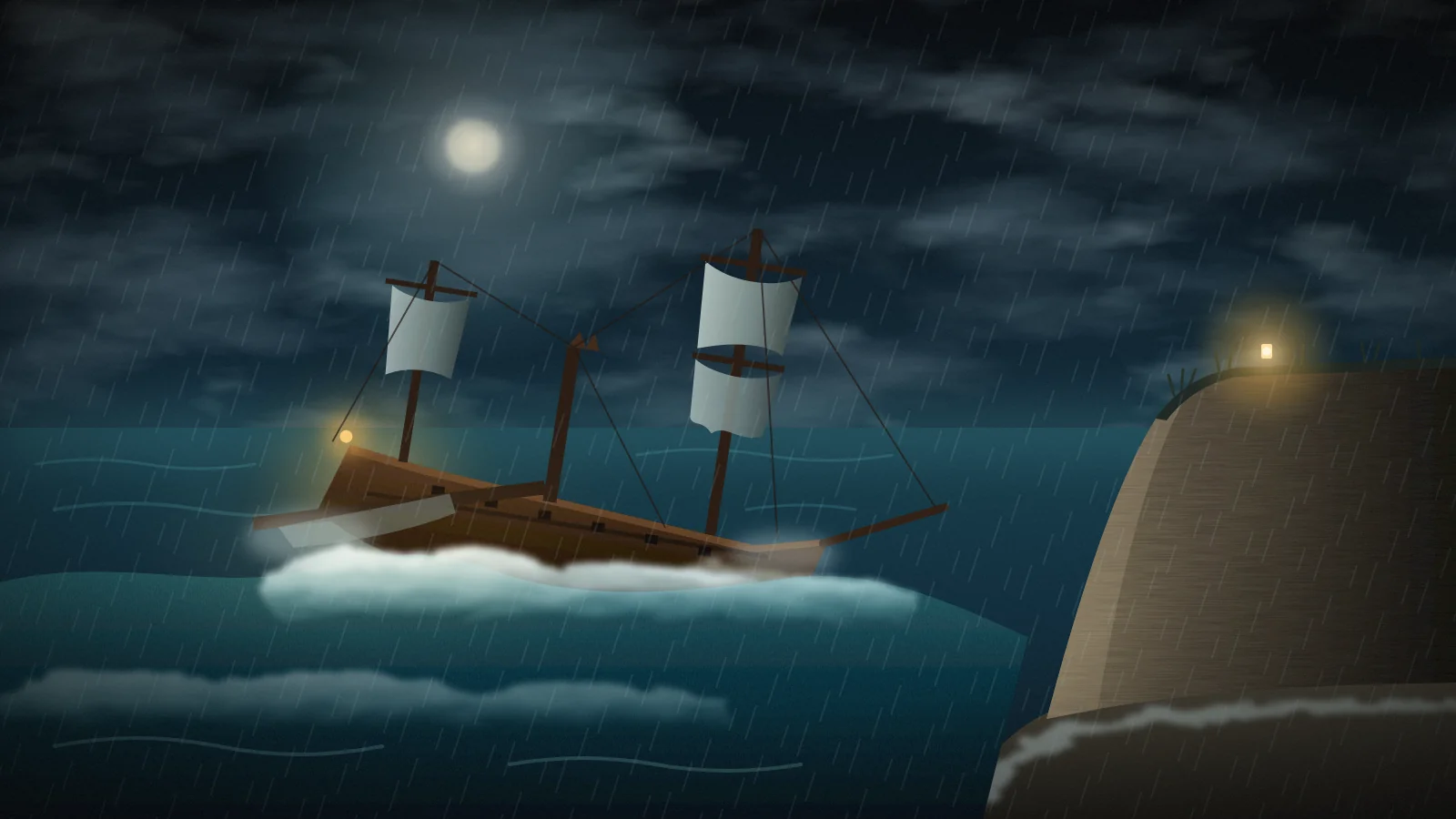
Sources count the dead a little differently, anywhere from about 142 to 146 men and boys. Only two from the Whydah survived: Thomas Davis, a carpenter, and John Julian, a teenage pilot of Miskito heritage from Central America. Among those lost was a boy named John King, thought to have been somewhere between 8 and 11 years old, who had joined the crew from a captured ship. Bellamy was among the dead. His body has never been identified.
The same night, one of Bellamy's prizes, the Mary Anne, ran ashore farther south near Pochet Island. Seven pirates aboard her lived and were rounded up.
The gallows in Boston
Nine of Bellamy's men survived the two wrecks, and colonial Massachusetts was not in a forgiving mood. They were tried for piracy in Boston in October 1717. Thomas Davis and one other man, Thomas South, were acquitted because they'd been forced into the crew. John Julian was not hanged with the others; he is believed to have been sold into slavery. Six men were hanged near Boston on November 15, 1717, with the Puritan minister Cotton Mather on hand to see them off.
Not one of them was swinging from a rope over gold, which is the slightly grim joke of the whole business. The treasure was still out in the surf.
The first treasure hunt, in 1717
Governor Samuel Shute moved fast. He sent Cyprian Southack, a mapmaker and sea captain, to recover the treasure for the Crown. Southack reached the wreck on May 3. More than a hundred bodies had washed up, and he saw to their burial.
The locals had beaten him to it. Southack complained that around 200 men had come from as far as 20 miles away to pick the wreck clean, and they were not keen to hand anything over. What remained of the ship was rolling in the breakers and sinking into the sand. Southack recovered very little of value and concluded, in effect, that the riches and the guns would end up buried under the sand. He was right. He also drew a map of the site, and that map would turn out to be worth more than anything he salvaged.
Meanwhile, in Maine: the fleet that waited
Here's where the Maine side of the story starts, and where it pays to be careful.
What the records show is this. The Ann galley, a prize commanded by Bellamy's quartermaster Richard Noland, rode out the storm at anchor and sailed north the next day, with no idea what had happened to the flagship. It reached Monhegan Island, off the Maine coast, on April 29. Two of its crew later said under oath that they waited there for the Whydah for some time, and she never came. Noland's men went on to seize vessels around Matinicus and Pemaquid, rigged up another sloop and abandoned the Ann.
Williams, running late after his family visit, came north too. He captured a fishing sloop and reached Richmond Island, off Cape Elizabeth, on May 19. He then spent about five days at Damariscove Island near Boothbay, careening his sloop (hauling her over to clean and grease the hull) and waiting for Bellamy. The Boston News-Letter of May 24, 1717, reported two pirate sloops at Damariscove. Governor Shute closed Boston Harbor for a week and sent an armed force after them. Somewhere in there, Williams learned his old partner was dead. He headed south, and before long he was in the Bahamas taking the King's pardon.
So Bellamy's men really were prowling the Maine coast in the spring of 1717, desperate and dodging storms. That much is documented.
The Machias legend: a pirate fort and buried gold
Now the legend. Captain Johnson's 1724 book tells of Bellamy taking his ship up the Machias River in eastern Maine to repair her, and of the pirates digging trenches, raising a fort, building huts and a powder store, with talk of founding a little pirate kingdom of their own. In Machiasport, the story has grown from there: a hideout at the river mouth, a wooden fort long since gone, and a fortune in gold buried somewhere along the shore. Locals point to Pot Head, across from Renshaw Point, as the camp, and some wonder whether little Money Island got its name for a reason. One version even has the gold sealed in a great wooden vault.
Generations of Machiasport kids have dug for it. The founding president of the local historical society said in 1990 that she'd done so herself as a girl. Nobody has found a coin.
And here's the rather inconvenient problem. Bellamy's movements in 1717 are well documented from the Caribbean to the night he died, and the historian Colin Woodard has pointed out that they leave no window for a trip to eastern Maine. The Whydah team's own researchers doubted Johnson's fort could have been built in the time available. The Machiasport Historical Society has said it knows of no documentation that Bellamy or his men ever landed there. Johnson's Bellamy chapter also has a history of muddling him up with other pirates, to the point that later writers invented a whole separate "Charles Bellamy" out of the confusion.
There is one tantalising twist. Woodard notes that the French pirate Olivier Levasseur, known as La Buse, who sailed with Bellamy at times, was seen heading toward Machias in June 1717 and then dropped out of the record for months. So a pirate camp on the Machias River isn't absurd. It just might not have been Bellamy's, and nobody has produced a scrap of evidence that anyone buried treasure there.
The legend of Maria Hallett, the Witch of Wellfleet
Every good wreck needs a ghost, and Cape Cod's is Maria Hallett, also called Goody Hallett. Treat what follows as folklore, because that's what it is.
The story goes that young Sam Bellamy, newly arrived on the Cape, fell for a local girl. Her family didn't think a penniless sailor good enough, so he sailed off to find his fortune in the Spanish wrecks, promising to come back rich and marry her. She was left expecting his child. In the versions that tell it, the baby died, and she was jailed, shamed and pushed out to live alone on the windswept land near the bluffs, where the neighbours decided she was a witch. Some tellings say she struck a bargain with the Devil. On the night of April 26, 1717, so the legend goes, she stood on the cliffs and watched her pirate come home, and either summoned the storm that killed him or simply saw him drown in sight of the shore. Her ghost is still said to walk the dunes, wailing in the wind.
It's a cracking tale. Here's what's under it. The name "Maria" comes from Elizabeth Reynard's 1934 book about Cape Cod folklore, The Narrow Land; there's no record of a Maria Hallett from the period, and other researchers have suggested other first names entirely. Even her age wanders, from a teenager in some versions to an old woman in others. "Goody" was a title for a married woman, which doesn't fit the jilted-girl story at all. And the historian Eric Jay Dolin has pointed out that there's no record showing she and Bellamy ever knew each other. Hallett is a real old Cape Cod family name, and there may be a real woman somewhere at the root of the story. But the romance, the curse and the storm-summoning are legend, told and retold for three centuries by firelight.
Barry Clifford finds the Whydah
For more than 260 years, the Whydah was a story Cape Cod families told their children. One of those children was Barry Clifford, who grew up hearing about Bellamy from his uncle. As an adult and an underwater explorer, he spent years in the archives, including Southack's old map and letters, working out how the coastline had shifted since 1717.
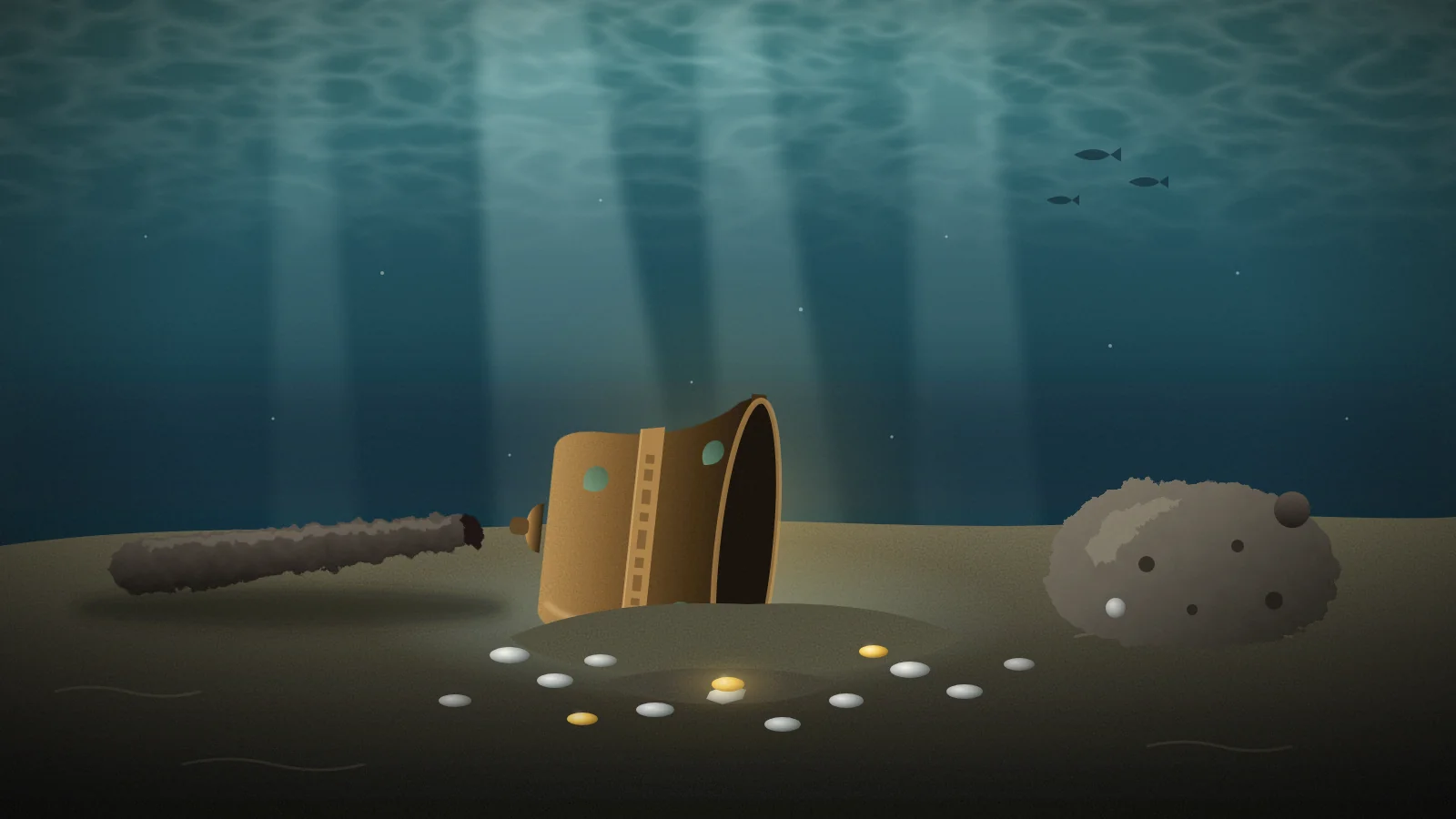
In 1984 his team found a wreck off Wellfleet, under shallow water and a thick blanket of sand. (Some accounts say he first located it a couple of years earlier, with 1984 being when it was made public.) Then, on October 30, 1985, they brought up a bronze ship's bell. Cast into it were the words THE WHYDAH GALLY 1716. That bell settled the question: it was the first fully authenticated Golden Age pirate shipwreck ever found in North America, and the Whydah Pirate Museum calls it the only confirmed pirate shipwreck in the world.
Then came the lawyers. Massachusetts claimed authority over wrecks in its waters and a share of anything recovered. Clifford's company fought it, and in 1988 the state's highest court came down on his side, leaving the company in control of the wreck and what came out of it. Clifford has said he promised never to sell the treasure.
What's been recovered
Quite a lot, it turns out. Reported totals vary with the year and the source, from more than 180,000 to over 200,000 individual pieces, which tells you mostly that counting is hard when your finds come up welded into rock. Among them:
- Coins. Thousands of Spanish silver coins, the famous pieces of eight, plus gold coins. When one concretion was opened at the museum (reported in early 2021), coins from Peru turned up inside.
- Gold. Gold bars and gold dust, and hundreds of pieces of rare African gold jewellery, a reminder of where the ship had been.
- Guns. Dozens of cannons (more than 60 by some counts, a couple of them hauled up in 2009), plus pistols and sword hilts.
- The ship's own name, twice. The bell in 1985, and in 2013 a small brass plate engraved with the ship's name and the date of her maiden voyage.
- The crew. A child's leather shoe, a silk stocking and a small leg bone, thought to be John King's. In 2021 the museum announced it had found remains of at least six more men inside concretions, the rock-hard lumps that form around objects on the seabed.
And is Bellamy himself in there? In 2018 researchers took DNA from a living descendant of the Bellamy family in England and compared it with a thigh bone from the wreck, tested by forensic scientists at the University of New Haven. It wasn't him: the bone belonged to a man with ties to the eastern Mediterranean. The six sets of remains found in 2021 raised hopes of trying again. As of the reports available, Black Sam hasn't been identified.
What's still missing
Here's the bit that keeps the story alive. The crew's own testimony described about 180 bags of gold and silver, each around 50 pounds, roughly four and a half tons in all, the pooled plunder of more than 50 ships. Forbes once put Bellamy at the top of a list of history's highest-earning pirates, at about $120 million in today's money. That list has been criticised for leaving people out, but it does give you an idea of the scale.
Clifford has said his team has brought up less than 10 percent of what ought to be on the ship. In 2016 he announced a large metallic mass on the site that he believed could hold most or all of the remaining treasure, and estimated the ship carried about 400,000 coins. His words at the time: "We think we might be at the end of the rainbow." Breaking that kind of mass apart takes years of slow work with electrolysis and hand tools, and he said he doubted it would be finished in his lifetime. In the lab, around 300 concretions were reported still unopened in 2021, one of them weighing about 13,000 pounds.
Not everyone is convinced. When Clifford announced the mass, a Smithsonian curator called it exciting but unproven, and the chief archaeologist of Massachusetts' underwater archaeology board suggested the pirates might simply have exaggerated their loot. Clifford's record elsewhere hasn't helped: UNESCO experts rejected his 2014 claim to have found Columbus's Santa Maria off Haiti, and found that the "silver" bar from his 2015 claim to Captain Kidd's ship off Madagascar was mostly lead. None of that changes the fact that the Whydah is real and identified. It does mean big numbers about what's left deserve a raised eyebrow.
The theories, weighed
- It's still down there, spread out and buried. The favourite, and the one with the most going for it. Three centuries of storms have scattered the wreck across a wide stretch of seabed under shifting sand, and a lot of what's found comes up locked inside concretions that take years to open.
- The pirates oversold it. The four-and-a-half-ton figure comes from the testimony of men on trial for their lives, and from storytelling that only grew. The real haul may always have been smaller.
- Cape Cod got there first. Hundreds of locals combed the wreck in 1717 before Southack could stop them. Some of the treasure may have quietly left the beach in coat pockets and ended up in Cape Cod households and shops.
- Some of it never went down with the ship. Bellamy sailed with prizes and a consort, and his men were scattered across the coast that spring. This is the idea the Maine legend leans on. There's no record of any of Bellamy's loot being landed or buried in Maine.
The honest answer is probably a bit of all four. Which still leaves, by any count, a great deal of pirate silver under the sand off Wellfleet.
Visiting the Whydah's world today
Fancy a look? Brilliant. Just keep your shovel in the car.
- The Whydah Pirate Museum in West Yarmouth, on Route 28 on Cape Cod, opened in 2016 and holds the recovered collection: coins, the bell, cannons, concretions, a life-size replica of the ship and a lab where you can watch archaeologists at work. Check opening days before you go.
- Marconi Beach in Wellfleet, part of the Cape Cod National Seashore, looks out over the waters where the Whydah went down. It's a fine spot to stand on the bluff in a stiff wind and imagine the rest. Metal detectors aren't allowed in national parks, and the wreck site is covered by the salvage rights of Clifford's company and by Massachusetts rules protecting historic wrecks, so this is a look-don't-touch sort of trip.
- Machias and Machiasport, Maine, for the legend. The Burnham Tavern museum in Machias has a square for Bellamy on its bicentennial quilt. The shore along the Machias River is largely private land, and digging there without the owner's permission is trespassing, however good your map looks.
- Monhegan and the Boothbay region, where Bellamy's fleet really did wait in vain for the Whydah in 1717. They're lovely places to visit for their own sake.
Bellamy didn't live to spend his fortune, and three centuries on, most of it is still keeping its own counsel under the sand off Cape Cod. Somewhere out there, the richest pirate of his age is still waiting to be found.
...and if you find it, remember who encouraged your questionable life choices.
The short version of this story is on YouTube at @TenToeExpress.
Deep dive yourself
- The Whydah Gally: Brief History of a Cape Cod Pirate Ship · Yankee Magazine
- Explorer claims he has located famous pirate ship's treasure (2016) · WBUR
- The deep reveals more treasure from the pirate ship Whydah (2021) · The Boston Globe
- Throwback Thursday: Proof of Sunken Pirate Ship Found near Wellfleet · Boston Magazine
- Remains of at least 6 pirates found at Whydah shipwreck site off Cape Cod (2021) · CBS News
- Real Pirates in Boothbay Harbor, Maine · Boothbay Register
- Legend of pirate Samuel Bellamy spurs hunts for facts, treasure (2024) · The Quoddy Tides
- Artifacts lend credence to tale of pirate utopia (1990) · The Seattle Times
- Whydah Pirate Museum · Whydah Pirate Museum, West Yarmouth
- Samuel Bellamy and Whydah Gally · Wikipedia (good starting points, with references to the trial records, Southack and later historians)