 Ten Toe Express

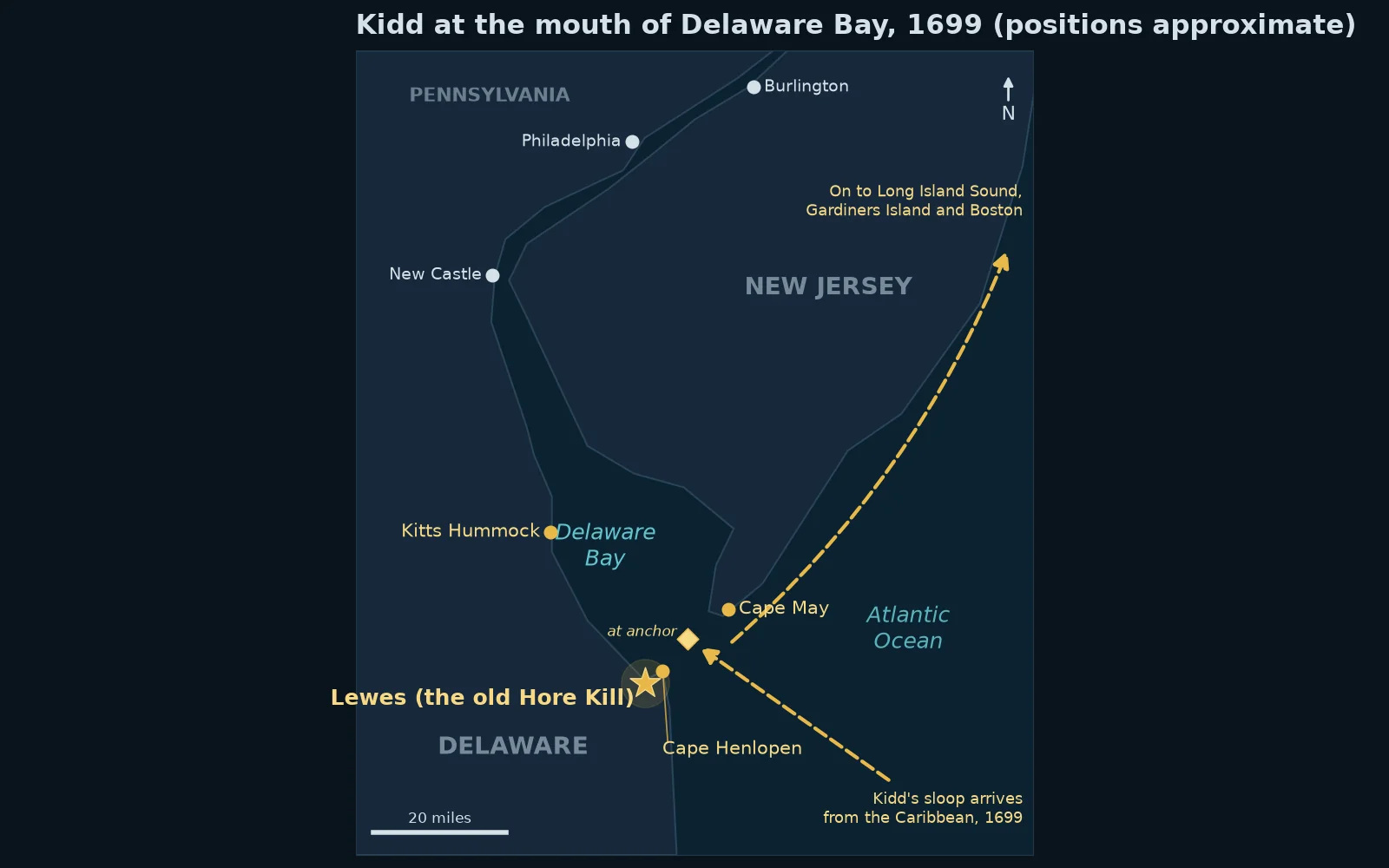
Picture the mouth of Delaware Bay in the early summer of 1699. A small sloop rides at anchor off the sand hills of Cape Henlopen, about forty men aboard, and day after day a boat goes back and forth to the little village of Lewes. Local folk row out to her with supplies. They come back with stories, and possibly a few pockets that jingle more than they did that morning.
The man in charge of that sloop is Captain William Kidd, the most wanted pirate in the English-speaking world, and he is sailing home to talk his way out of a noose. That visit is documented. What came after it is the legend of Captain Kidd's Delaware Bay treasure: the story that, before sailing north, Kidd rowed a chest of gold and jewels onto a small island in the bay and buried it, and that it's still there.
Here's the cheeky twist. A chest really did go ashore in Delaware Bay that summer. It just wasn't Kidd's. Right then, boots on, and mind the horseshoe crabs.
How Captain Kidd ended up off Delaware
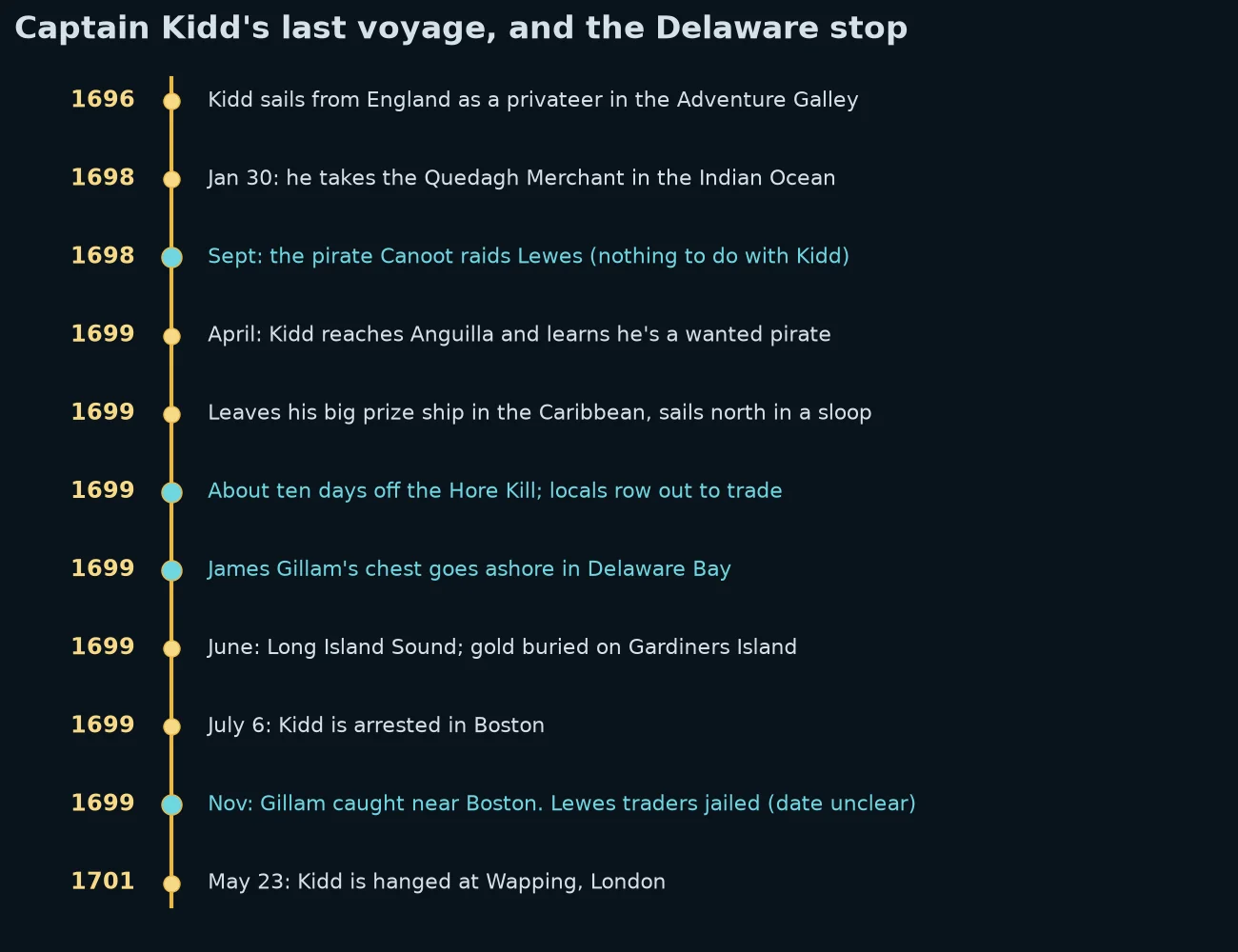
Kidd was a Scottish-born sea captain, born around 1645, who had made a respectable name for himself in New York. In 1696 he sailed from England in the Adventure Galley with a royal commission to hunt pirates and French ships. The voyage was backed by a group of powerful English lords and by Richard Coote, Earl of Bellomont, soon to be governor of New York and Massachusetts. A pirate hunter with friends in very high places. What could possibly go wrong?
Rather a lot, as it turned out. In the Indian Ocean the voyage went sour, and on 30 January 1698 Kidd captured the Quedagh Merchant, a big merchant ship loaded with silks, muslins, gold and silver. Kidd insisted she was a fair prize. Back in London, it looked a lot like piracy, and he was declared a pirate.
When Kidd reached Anguilla in the Caribbean in April 1699, he discovered the bad news: governors up and down the colonies had orders to arrest him. So he left the big prize ship hidden in the Caribbean, bought a smaller and less conspicuous sloop (the records call her the Antonio or San Antonio; accounts differ on where he bought her), loaded his treasure aboard and headed north. His plan was to reach Bellomont, hand over enough loot to look honest, and get a pardon. First, though, he needed food and water. And the first stop on the American coast was the mouth of Delaware Bay.
Lewes in 1699: a small town that knew pirates
Lewes was not a town that scared easily. It sits just inside Cape Henlopen, on the site of Delaware's very first European settlement, the Dutch colony of Swanendael, founded in 1631 and destroyed within a couple of years. The English knew the place as the Hore Kill or Whorekill, and William Penn's government renamed it Lewes in 1682.
By 1699 it was a fishing and farming village at the edge of a colony run from Philadelphia, a long way from any warship. Pirates knew it too. In September 1698, less than a year before Kidd turned up, a pirate called Canoot landed about fifty men, stripped the town of clothes and valuables, took the livestock and made the residents help load his sloop. Pennsylvania's deputy governor, William Markham, wrote that Canoot's crew were "begarly rogues, and will pillage for a trifle." Kidd's men, at least, appear to have paid.
Ten days off the Hore Kill
The best eyewitness to Kidd's Delaware stop is a man who was furious about it. Colonel Robert Quary, the Admiralty judge in Philadelphia, had spent that spring trying to round up pirates and getting nowhere. He wrote to London that Kidd had come into the bay, and his letter is still in print:
He hath been here about ten days. He sends his boat ashore to the Hore Kills where he is supplied with what he wants and the people frequently go on board him.
Quary added that Kidd was in a sloop with about forty men and "a Vast Treasure," and he begged for a man-of-war to come and catch him. None came in time. (The archive copy of the letter carries a date in July 1699, after Kidd had already left; the exact days of the visit are not certain, but most accounts put it in late spring or early summer.)
So the locals rowed out, sold the pirates provisions, climbed aboard and had a good look around. The State of Delaware's own Lewes history timeline says plainly that Kidd "conducted business with several Lewes residents," though it files the visit under 1700. What did they get in return? The records don't list it, and nobody in Lewes was keen to write it down. What is recorded is the hangover: the writer Ralph D. Paine, who worked from the original colonial papers, says five people of Lewes were thrown into jail by the Pennsylvania authorities for trading with Kidd. A Boston newspaper account in 1909 adds that the traders swore Kidd never landed any goods. Well, they would say that, wouldn't they?

The chest that really did go ashore
Now for the twist. Kidd had passengers. Among the men who came home with him from Madagascar was James Gillam, a pirate with a fearsome reputation and no wish whatsoever to meet a magistrate. Another passenger, a sailor named Edward Davis, later gave a sworn statement in Boston about what happened on the voyage. When they reached the Hore Kills in Delaware Bay, he said, a chest belonging to Gillam was put ashore there.
That is the only chest anyone ever swore was landed in Delaware. It belonged to Gillam, not Kidd, and nobody recorded what was in it. Paine, who had little patience for buried-treasure romance, thought the people who took it off Gillam's hands had no reason to bury it at all, since stolen goods were far easier to sell than to hide. And Gillam didn't stay to guard it. He went north under the name James Kelly and was caught that autumn near Boston, after Bellomont's men found the horse he'd ridden into town and then grabbed a man walking home in the dark, who turned out, rather luckily for them, to be Gillam.
So a pirate's chest went ashore near Lewes and was never heard of again. You can see how a legend might grow from that.
Delaware Bay, pirate marketplace
Kidd's stop wasn't a one-off. The summer of 1699 was a busy season for pirates on the Delaware. Quary reported that a ship captained by Giles Shelley of New York had come straight from Madagascar with about sixty pirates aboard, men he described as part of Kidd's old gang. About twenty of them went ashore on the Pennsylvania side, and about sixteen more landed at Cape May in West Jersey, along with a hold full of East India goods and "abundance of money."
Quary caught a few of them, and Pennsylvania arrested four men believed to have served under Kidd. But he complained bitterly that local people had "entertained the Pirates," moved them from place to place, fed them, and even called his searchers enemies of the country for bothering honest men with money to spend. Historians note that some Delaware Valley merchants were happy to look the other way because pirates were good for business.
Not all of Kidd's crew stayed aboard either. According to the Chesapeake Bay Program's history of local pirates, some of them left the ship on the Delaware coast, including a young sailor named Theophilus Turner, who slipped away to Maryland and was later caught on the Severn River.
North to Gardiners Island, and the end of Kidd
After Delaware, Kidd sailed for Long Island Sound, anchored in Oyster Bay and sent messages to Bellomont, who was in Boston. Along the way he left a stash with John Gardiner on Gardiners Island, at the eastern end of Long Island. This is the one Kidd treasure that was certainly buried, and certainly dug up. Bellomont had it fetched and guessed the Gardiner parcel alone was worth about £4,500. The official inventory of everything seized from Kidd, the Gardiners Island bags included, came to 1,111 ounces of gold, 2,353 ounces of silver, about 17 ounces of jewels and precious stones, plus 57 bags of sugar and dozens of bales of cloth.
Bellomont lured Kidd to Boston with talk of a pardon, then had him arrested on 6 July 1699. Kidd was shipped to London, tried, and hanged at Execution Dock in Wapping on 23 May 1701. The rope broke on the first attempt, and he was hanged a second time. His body was left in an iron cage over the Thames as a warning. Whatever he knew, he took with him.
How the Delaware Bay treasure legend grew
Here's the thing about a man who really did bury gold once: after Gardiners Island, everyone assumed he must have done it everywhere. Kidd treasure legends pop up from Nova Scotia to New Jersey, and Delaware has collected a few of its own.
- The island chest. The core legend, told in the Ten Toe Express Short, says Kidd buried a chest of gold and jewels on a small island in Delaware Bay before sailing north. The retellings don't agree on which island, and no record names one.
- Kitts Hummock. This small bayfront community southeast of Dover is said to have first been called "Kidds Hammock," supposedly after rumours that Kidd buried treasure there. A historical marker credits a man named Jehu Curtis with the name in 1738 but doesn't say why he picked it, and the "hammock" is just an old word for a stand of trees.
- Cape Henlopen. One popular local retelling says Kidd, waiting to be tried, offered to reveal treasure he'd hidden at what is now Cape Henlopen, and was turned down. No source for that offer is given, so treat it as legend.
Every one of these stories has the same raw ingredients: a real pirate, a real anchorage, real locals who did real business with him, and a real chest that vanished into the dunes. Add three centuries of campfires and you get buried gold.
The theories, weighed
- Kidd buried a chest in Delaware Bay. The legend's favourite. The trouble: Kidd was heading north to bargain with his treasure, not hide it, and the sworn statements of his crew mention only Gillam's chest going ashore here. Even Paine, writing in 1911, said that whatever the legends claimed, Kidd made no stops along the way to bury treasure.
- Gillam's chest is the real "Kidd treasure." The most likely seed of the story. A pirate's chest was landed at the Hore Kills and never accounted for. Whether it was buried, sold off piece by piece, or quietly shared out among some very cheerful villagers, nobody knows.
- The treasure went into Lewes pockets. Locals traded with the sloop and some went to jail for it. Pirate gold spent in 1699 doesn't leave much of a trail.
- A name that grew a story. Places like Kitts Hummock may simply have collected a famous name, and the treasure came later.
The honest verdict? Kidd was definitely here, money definitely changed hands, and a pirate's chest definitely went ashore. Buried Kidd gold on a Delaware island remains, so far, a cracking story with no shovel marks.
Visiting Lewes and Cape Henlopen today
Fancy standing where the Lewes traders stood? Brilliant. The coast is very visitable.
- Lewes is a charming small town with a historic district full of old houses, and it leans happily into its maritime past. The Lewes Historical Society runs several historic buildings in town.
- The Zwaanendael Museum, run by the State of Delaware, tells the story of the 1631 Dutch settlement and the town's long seafaring history, shipwrecks included.
- Cape Henlopen State Park covers the cape itself: beaches, the Great Dune, trails and the old Fort Miles towers from the Second World War. Delaware's state park rules allow metal detectors only on the ocean beaches east of the dune line, and collecting or digging up historic artifacts is banned without written permission from the parks director. In plain English: bring a towel, not a spade.
- Kitts Hummock, up the bay near Dover, is a quiet beach community with private homes, and its beach is a sanctuary for horseshoe crabs. Look, don't dig.
Stand on the beach at Cape Henlopen at dusk, watch the lights of the ships coming in past the capes, and it's easy to picture a small sloop riding at anchor and a boat full of curious neighbours pulling out to meet her. Whatever was in Gillam's chest, the bay has kept the secret very well indeed.
...and if you find it, remember who encouraged your questionable life choices.
The short version of this story is on YouTube at @TenToeExpress.
Deep dive yourself
- The Book of Buried Treasure, by Ralph D. Paine (1911) · Project Gutenberg
- Proceedings of the Council of Maryland, 1698–1731 (Robert Quary's letter on Kidd in the bay) · Archives of Maryland Online
- Significant Dates (Lewes timeline) · Delaware Division of Historical and Cultural Affairs
- Timeline · Lewes Historical Society
- Pirates, by Tim Hayburn · Encyclopedia of Greater Philadelphia
- Three pirate tales that took place on the Chesapeake Bay · Chesapeake Bay Program
- Captain Kidd, by Mark Cartwright · World History Encyclopedia
- Exploding the myths of Captain Kidd (Boston Globe, 1909) · Click Americana
- William Kidd, Canoot and Kitts Hummock, Delaware · Wikipedia (good starting points)