 Ten Toe Express
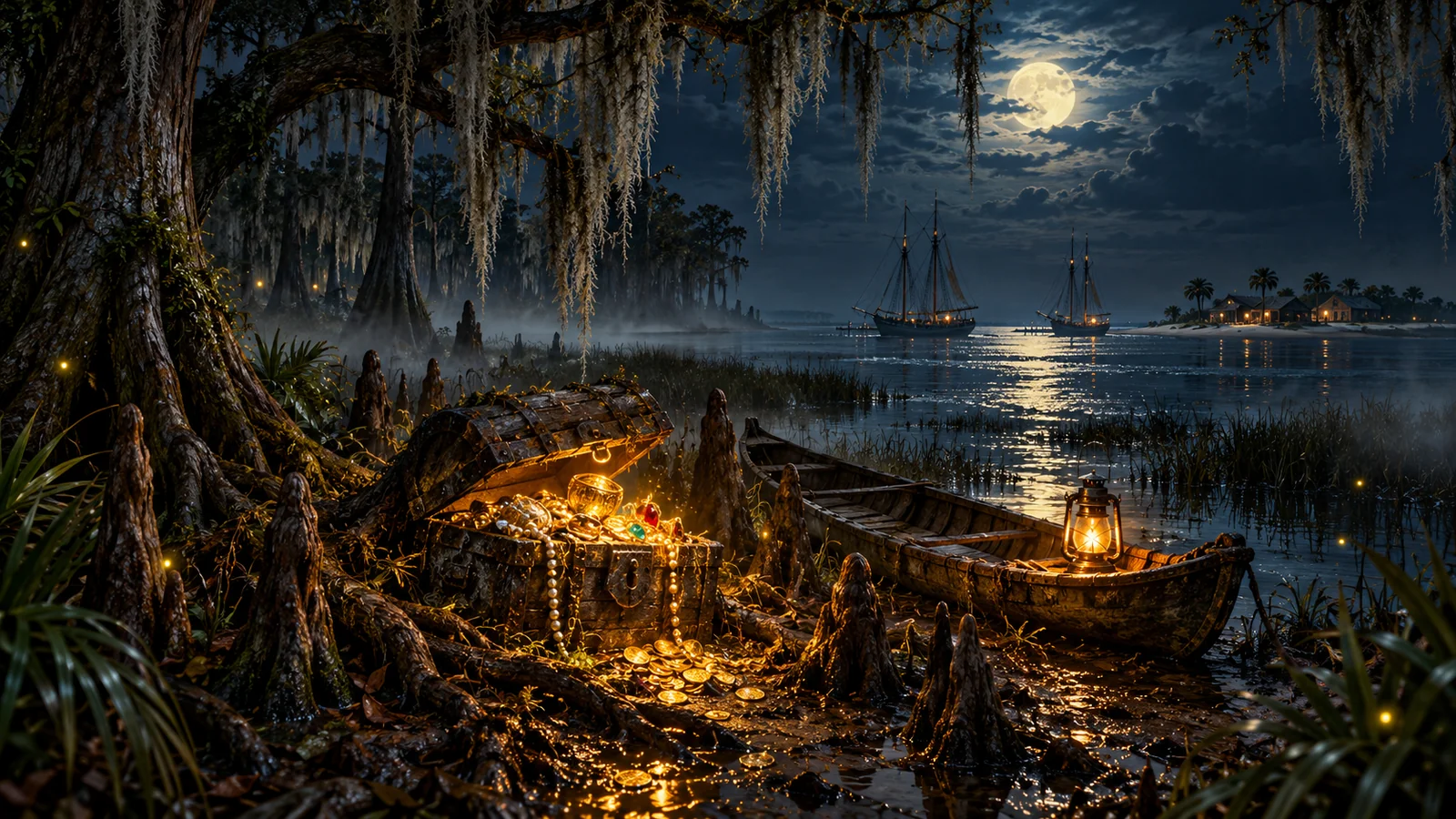
September 1814, Grand Terre, Louisiana. Warships are coming down on a low, sandy island at the mouth of Barataria Bay, and the most famous smuggler in America has a choice to make. He could fight. He could run. Or, if you believe the legend, he could do what every self-respecting pirate does in the stories: grab the best of the loot, row it into the swamp and dig.
The smuggler was Jean Lafitte, boss of the Baratarians, and the treasure he supposedly buried is the Barataria treasure: chests of gold, silver and jewels said to lie somewhere in the bayous, marshes and barrier islands south of New Orleans. More than two centuries on, nobody has dug it up. Plenty of people have tried. One historian reckoned almost every foot of Grand Isle has been turned over at some point, which is a lot of sand to shift for a man who may never have buried a single coin.
Right then. Pull on your wellies, mind the alligators, and let's sort the pirate from the paperwork.
Who was Jean Lafitte?
For a man with towns, a national park and a festival named after him, Jean Lafitte left a surprisingly blurry trail. Even his name is argued over. Many historians spell it Laffite, with two fs, but the rest of the world has gone with Lafitte for two hundred years, so that is what you will see here.
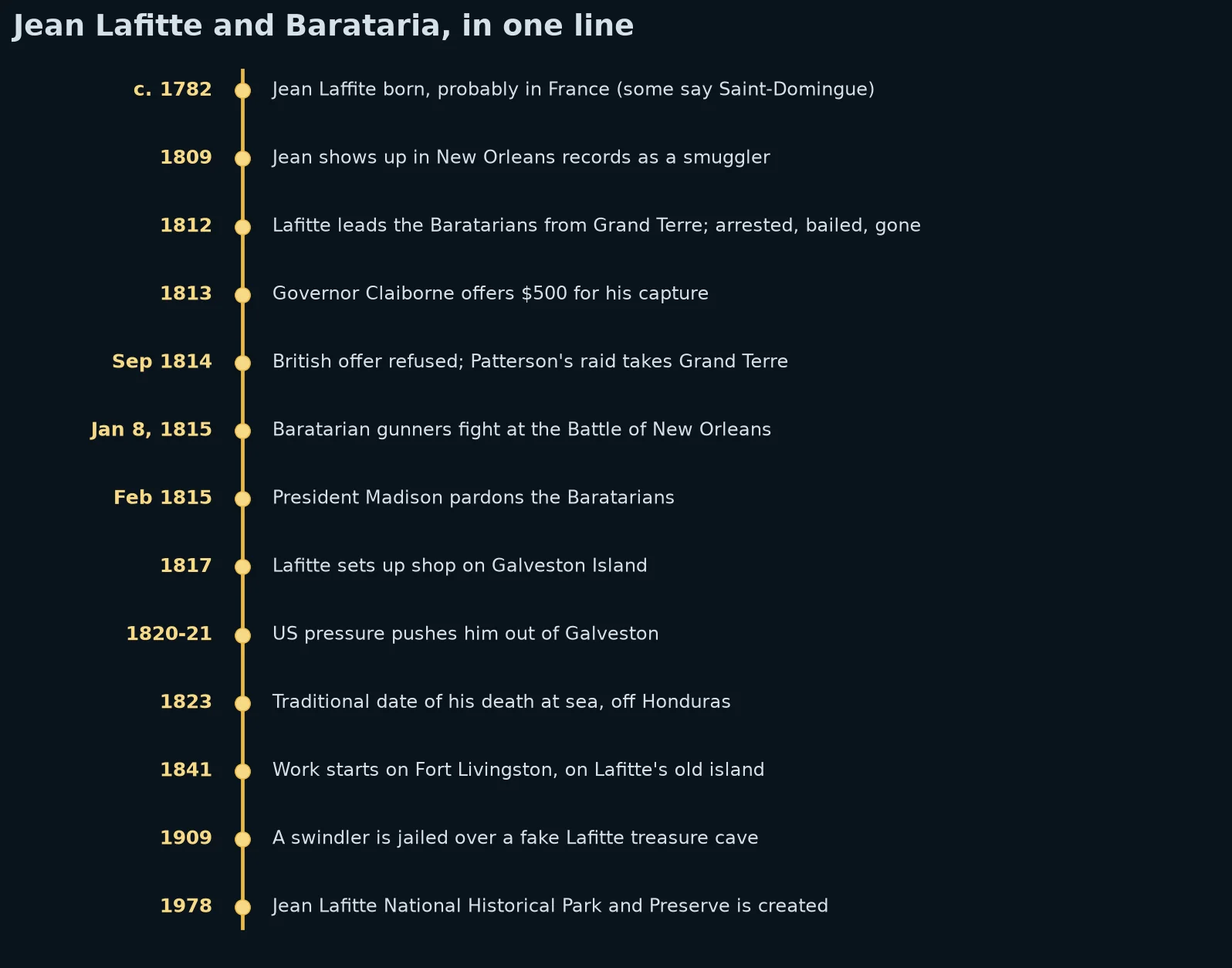
He was probably born in the early 1780s. The National Park Service says France or the French colony of Saint-Domingue (now Haiti). The 64 Parishes encyclopedia of Louisiana, drawing on historian William C. Davis's research, points to Pauillac, a wine town on the Gironde estuary in France, around 1782. His older half-brother Pierre reached New Orleans by 1803 and worked in the slave trade. Jean turns up in New Orleans by 1809, already with a reputation as a smuggler.
Pierre handled the business side in town. Jean ran things out on the water. Between them they built one of the slickest smuggling outfits on the Gulf coast, and the place they built it was Barataria.
Barataria: a smuggler's paradise south of New Orleans
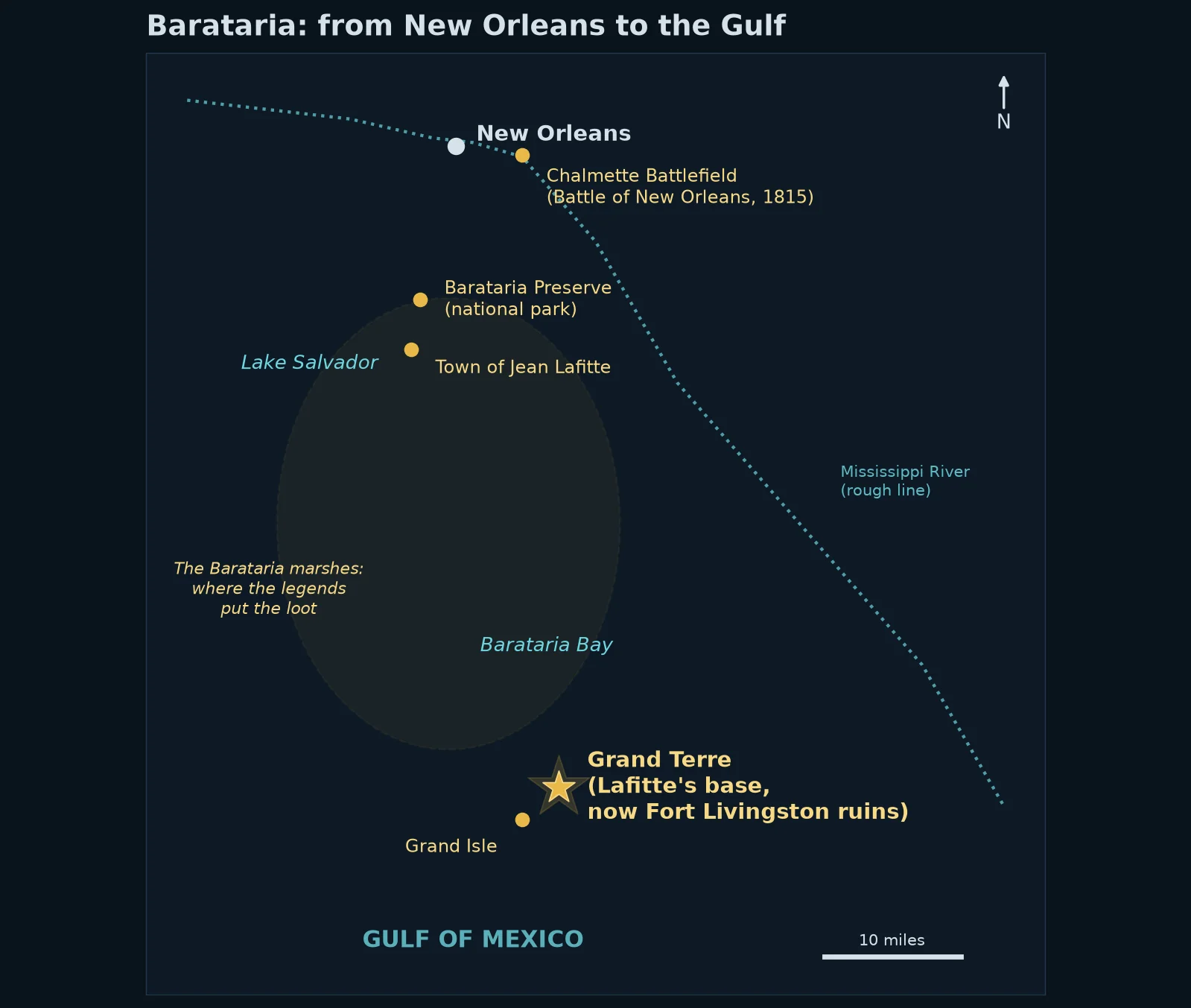
Look at a map of south Louisiana and you will see why. Below New Orleans, the land breaks up into a jigsaw of bayous, lakes, marsh and low wooded ridges, running all the way down to Barataria Bay and the Gulf. Ships could slip in through Barataria Pass, unload into small boats, and the goods could be paddled up the bayous to the back door of the city without ever passing a customs officer. The town of Jean Lafitte's own history notes that the name Barataria was on French maps by 1729, and says it carries the meaning of dishonesty at sea. Couldn't have named it better if they'd tried.
The Baratarians were a going concern by 1810. By 1812, says the Park Service, Lafitte was their leader, and the crews may have numbered as many as 1,000 men. Their headquarters sat on Grand Terre, a barrier island just east of Grand Isle, guarding the deep-water pass into the bay. Local history says they used old Native American shell mounds along the bayous as storehouses, and Lafitte held his own auctions away from the city, including at a spot known as the Temple, where New Orleans merchants came to buy cut-price cargo.
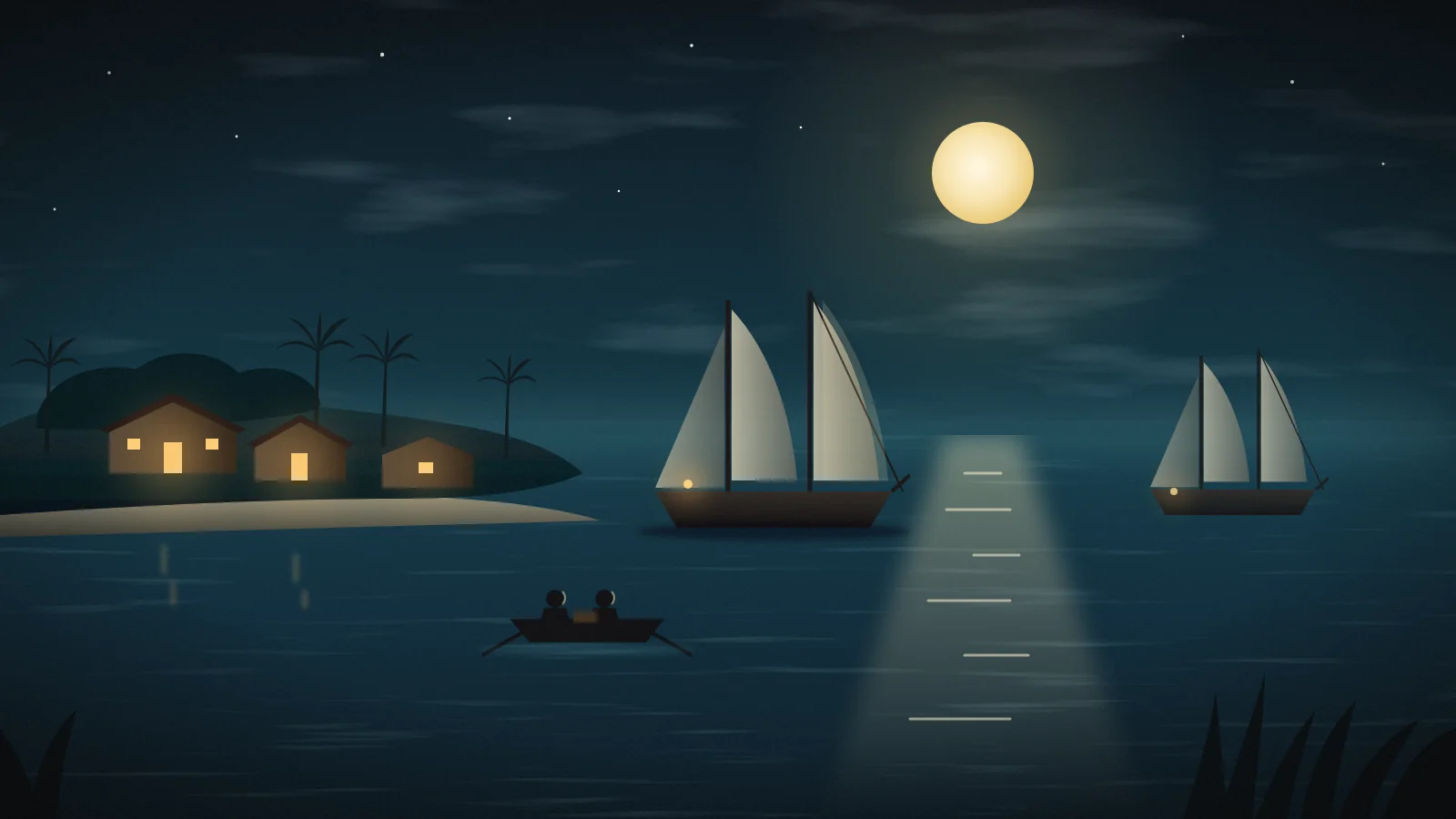
What were they selling? Prize cargo. The Baratarian captains sailed under letters of marque, papers from revolutionary governments like Cartagena (in today's Colombia) that licensed them to seize Spanish ships. The United States didn't recognise those governments, so in American eyes the papers were worthless and the captures were piracy. Some of what they sold was textiles, wine and spices. Some of it was human beings: the brothers trafficked enslaved Africans taken from Spanish ships, in defiance of the 1808 federal ban on importing enslaved people. It is the ugliest part of the story, and it is a real part of it.
The governor, the bounty and a bit of cheek
Louisiana's governor, William C. C. Claiborne, was not amused. In November 1812, soldiers ambushed a party of smugglers and caught both Lafitte brothers. They made bail and simply never came back for trial.
In November 1813, Claiborne offered a $500 reward for Jean's capture. Within days, handbills appeared around New Orleans offering a reward for the arrest of the governor, signed with Lafitte's name. The popular telling says Lafitte offered $1,500 for Claiborne. It is one of the great pirate anecdotes, though at least one Lafitte biographer doubts Jean wrote the handbills himself. Either way, someone in New Orleans had a sense of humour, and the governor's mood did not improve.
Things turned nasty in January 1814, when a revenue officer was killed in a shootout near one of Lafitte's auctions. By that summer, Pierre was behind bars in New Orleans. Then the British turned up, and everything got much more interesting.
The British offer, and the raid on Grand Terre
Britain and the United States had been at war since 1812. On September 3, 1814, the British warship HMS Sophie appeared off Barataria, and its officers came ashore with letters for the "commandant at Barataria." They offered Lafitte and his men British citizenship and land. According to the Park Service, the deal also included a captain's rank in the Royal Navy for Lafitte and $30,000 for his help in attacking New Orleans.
Lafitte asked for two weeks to think it over. Then he did something rather clever: he sent copies of the British letters to the Louisiana authorities, warning them an attack was coming and offering his services. Within days, Pierre had "escaped" from jail, which was terribly convenient.
The Americans were not grateful. Claiborne doubted the warning, and the US Navy had already been planning to shut Barataria down. On September 16, 1814, Commodore Daniel Patterson's flotilla and soldiers under Colonel George Ross descended on Grand Terre. The Baratarians, who had just turned down the British, would not fire on the American flag. Some set fire to their own vessels. Most scattered into the marsh. The Americans took around 80 prisoners, six schooners, a felucca, a brig and 20 cannon, plus goods valued at about $500,000.
Lafitte himself got away into the swamps. And that, right there, is the moment the treasure legend is built on. A pirate king, warned that the navy is coming, with a fortune in his warehouses and a whole wilderness of bayous at his back. What did he do with the money?
From pirate to hero: the Battle of New Orleans
Before the treasure, the twist. In December 1814, General Andrew Jackson arrived to defend New Orleans with too few men, too few guns and a British army on the way. He had called the Baratarians "hellish banditti." He took their help anyway.
Claiborne announced pardons for Baratarians who volunteered, and somewhere between 300 and 400 signed up. They brought what Jackson badly needed: experienced gunners, men who knew every back channel into the city, and, according to 64 Parishes, several thousand musket flints. (The popular story that they also supplied cannon doesn't stand up; their artillery had been lost in the raid.)
At the Battle of New Orleans on January 8, 1815, on the fields of Chalmette Plantation, Baratarian captains Dominique You and Renato Beluche commanded a battery in Jackson's line. Jean guarded a bayou approach; Pierre helped guide the defence on the American right. The British attack collapsed. Historians still argue over how much difference the Baratarians made, but Jackson praised their courage in his orders, and on February 6, 1815, President James Madison granted them a full pardon.
Here is a detail treasure hunters tend to skip. With their pardons in hand, the Baratarians set about reclaiming their seized property, and got back goods worth nearly half a million dollars, according to the Park Service. In other words, a good chunk of Lafitte's "treasure" spent the war sitting in government custody, not under a cypress tree.
The legend of the Barataria treasure
Now for the good stuff. The legend, in its most popular form, goes like this: Lafitte knew the raid was coming. Before the warships arrived, he and his most trusted men loaded chests of gold, silver and jewels into small boats, rowed them into the bayous and barrier islands around Barataria Bay, and buried them. Some versions say he meant to come back. Some say he did, quietly, for years. Most say the hiding places died with the men who dug them.
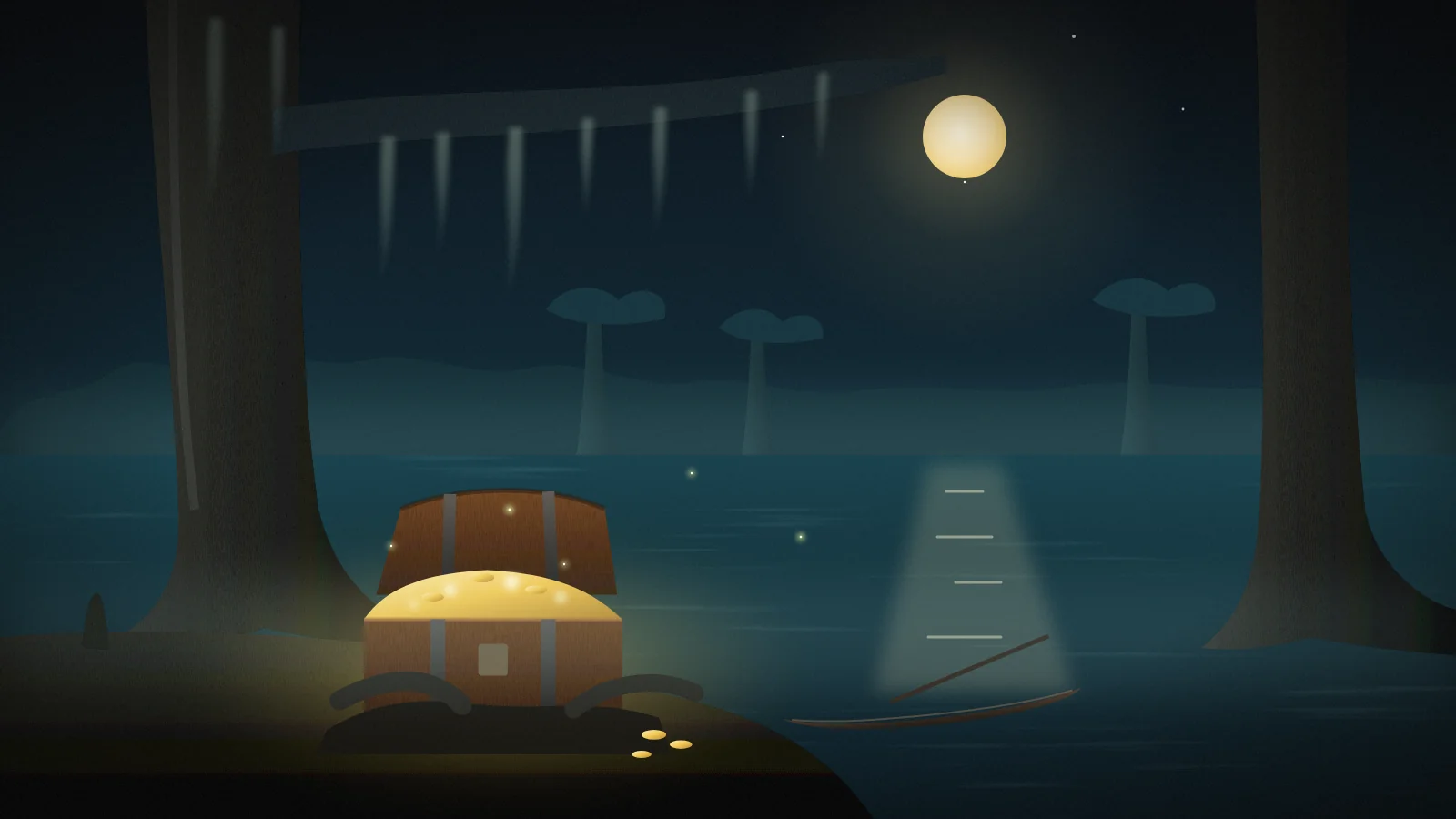
Where, exactly? That depends entirely on who is telling it:
- Grand Terre. The obvious suspect, since it was the base. Its old storehouses and fortifications vanished long ago, and the island has been reshaped by two centuries of storms.
- Grand Isle. The next island west, and the most dug-over. Lafitte biographer Jack Ramsay wrote that almost every foot of it has been searched for pirate gold.
- The bayous and shell mounds. Stories put caches along the bayous between the bay and New Orleans, in the old shell mounds the Baratarians used as storehouses, and around the Temple, their auction ground.
- Further afield. Popular treasure books stretch Lafitte's hiding places up the Mississippi and right across the state. At the far western end of Louisiana, Lake Charles has its own legend about loot buried along Contraband Bayou.
Notice what all of these have in common: no map, no document, no named witness, no date. Just a great deal of very soft ground and a very famous name.
The hunters, the hopefuls and the swindlers
Where there is a legend, there is someone selling shovels. Treasure seekers have poked around the Louisiana coast for Lafitte's gold for generations, and the Lafitte name has been good for business ever since.
The most notorious case came in 1909, when a man named Joseph Choate took around $10,000 from investors by claiming he knew the location of a Lafitte treasure cave. There was no cave. There was, however, a prison sentence for fraud. Consider it a useful lesson in how the Barataria treasure usually changes hands: from the hopeful to the confident.
Then there is the paperwork problem. In 1948, a man named John Andrechyne Laflin produced a French manuscript he claimed was Jean Lafitte's own journal, written decades after Lafitte's supposed death. It fed every theory going, including that Lafitte had faked his death and lived on quietly in the United States. Handwriting experts later tied the manuscript to Laflin himself, who had a history of dodgy documents, and most historians now treat it as a forgery. If someone offers you a page from it with an X on, keep your wallet in your pocket.
What happened to Lafitte (and his money)?
After the war, Lafitte didn't settle down to a quiet life in Barataria. By 1817 he was running a new smuggling base on Galveston Island, then part of Spanish Texas, while also, rather cheekily, being paid as a Spanish spy. American pressure pushed him out around 1820 to 1821, and his men burned the settlement on the way out.
His end is as foggy as his beginning. The traditional account, backed by Davis, says he was mortally wounded in a sea fight with Spanish ships in the Gulf of Honduras in February 1823 and buried at sea. Ramsay put his death on Isla Mujeres off Yucatán a few years later; Davis argues the brother who died there was Pierre, in 1821. Stories of a faked death and a quiet old age in the States keep circulating, but no mainstream historian backs them.
Galveston has its own buried-treasure legends, but those are a separate tale for another day. What matters here is the money: a man who shifted his whole operation to Texas within a couple of years of losing Barataria needed every dollar he had, and historians describe privateers as big spenders, not savers.
The theories, weighed
- Buried before the 1814 raid. The legend's favourite. Lafitte had warning, boats and a swamp. The catch: the Americans still seized half a million dollars in goods, which suggests he didn't have time, or didn't bother, to hide much.
- The treasure was cargo, not coins. Barataria's wealth was mostly bales, barrels and casks, plus the human beings the brothers trafficked. Most of it was sold fast at auction. Much of the seized cargo was later reclaimed after the pardon, then sold and spent.
- Spent, not buried. The historians' verdict. Privateers lived high and died broke. Lafitte needed money for Galveston, for ships, for bribes. Burying it would have been bad business, and the Lafittes were, above all, businessmen.
- Something small, somewhere, lost to the water. Impossible to rule out entirely. Smugglers did stash goods in the marsh, and the Louisiana coast has changed enormously since 1814. If a cache ever existed, it may now be under open water, which is rather inconvenient for anyone holding a shovel.
The honest answer? There is no evidence a Barataria treasure ever existed, and a fair bit of evidence that the money went elsewhere. But the swamp keeps its secrets well, and that is exactly why the legend refuses to sink.
Visiting Lafitte's Barataria today
Fancy a look for yourself? Brilliant. Here's how to do it without upsetting a park ranger, a landowner or an alligator.
- Barataria Preserve, outside Marrero, is part of Jean Lafitte National Historical Park and Preserve: about 26,000 acres of swamp, marsh and bottomland forest, with boardwalks, trails and canoe routes. It is a national park, so digging, metal detecting and taking anything away are off the table. Heads up: from February 2026 the visitor center and most trails are closed for about two years of repairs after Hurricane Ida, with the Twin Canals area open for day use. Check the Park Service page before you go.
- The town of Jean Lafitte, down the bayou in Jefferson Parish, is a fishing community that leans happily into its namesake, and a good base for swamp tours.
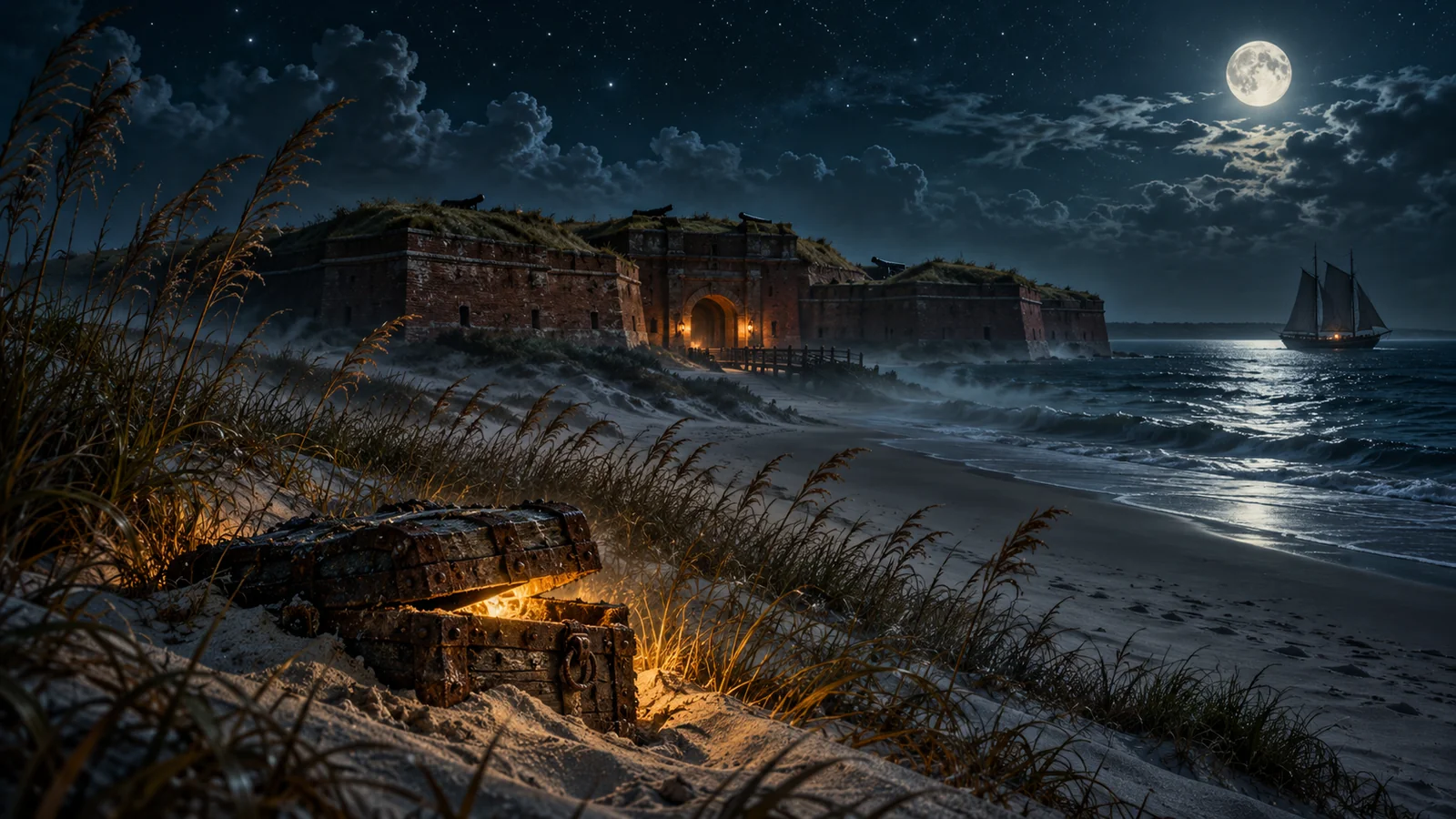
- Grand Terre and Fort Livingston. Lafitte's old island now holds the crumbling brick ruins of Fort Livingston, started in 1841 to guard Barataria Pass. The island is owned by the State of Louisiana, the fort is a State Commemorative Area on the National Register of Historic Places, and you can only get there by boat. Look, photograph, don't dig.
- Grand Isle, next door, has beaches, fishing and a view across the pass to Grand Terre. Most of the island is private homes and land, so stick to public beaches.
- Chalmette Battlefield, just downriver from New Orleans and part of the same national park, is where the Baratarians earned their pardon. Stand on Jackson's line and picture the gunners at work.
And please respect the wildlife: the alligators in Barataria are real, unimpressed by pirate stories and not to be approached or fed.
The gold may never have been buried. The story certainly was, deep in the Louisiana mud, and it has been growing there quite happily ever since.
...and if you find it, remember who encouraged your questionable life choices.
The short version of this story is on YouTube at @TenToeExpress.
Deep dive yourself
- Jean Lafitte: A Pirate's Life · National Park Service, Jean Lafitte National Historical Park and Preserve
- Jean and Pierre Laffite · 64 Parishes (Louisiana Endowment for the Humanities)
- Barataria Island · American Battlefield Trust
- Barataria Preserve · National Park Service
- Pirates don't leave a paper trail. Did Jean Lafitte and crew spend time in Lake Charles? (2024) · The Advocate
- About Us · Town of Jean Lafitte
- Fort Livingston, Louisiana · Wikipedia
- Jean Lafitte · Wikipedia (a good starting point, with references to Davis, Ramsay and other historians)