 Ten Toe Express

Picture the very tip of a long, skinny spit of sand in south Alabama. On one side, the Gulf of Mexico. On the other, Mobile Bay. Sea oats hiss in the wind, and squatting low in the dunes is a great brick star of a fort, built to guard the bay mouth from anyone with ships and bad intentions. Locals will tell you, with a perfectly straight face, that somewhere under all that sand lies the secret stash of the most famous pirate the Gulf ever produced: Jean Lafitte.
The story is that Lafitte's gold is buried near Fort Morgan, Alabama, and that it's worth something like $10 million. It has never been found. Which is exactly what you'd expect from a buried treasure, and also, rather awkwardly, exactly what you'd expect from one that was never there in the first place.
Right then. Let's see what the records say, what the legend says, and why this particular pirate seems to have buried treasure on just about every beach between Texas and Florida.

Who was Jean Lafitte?
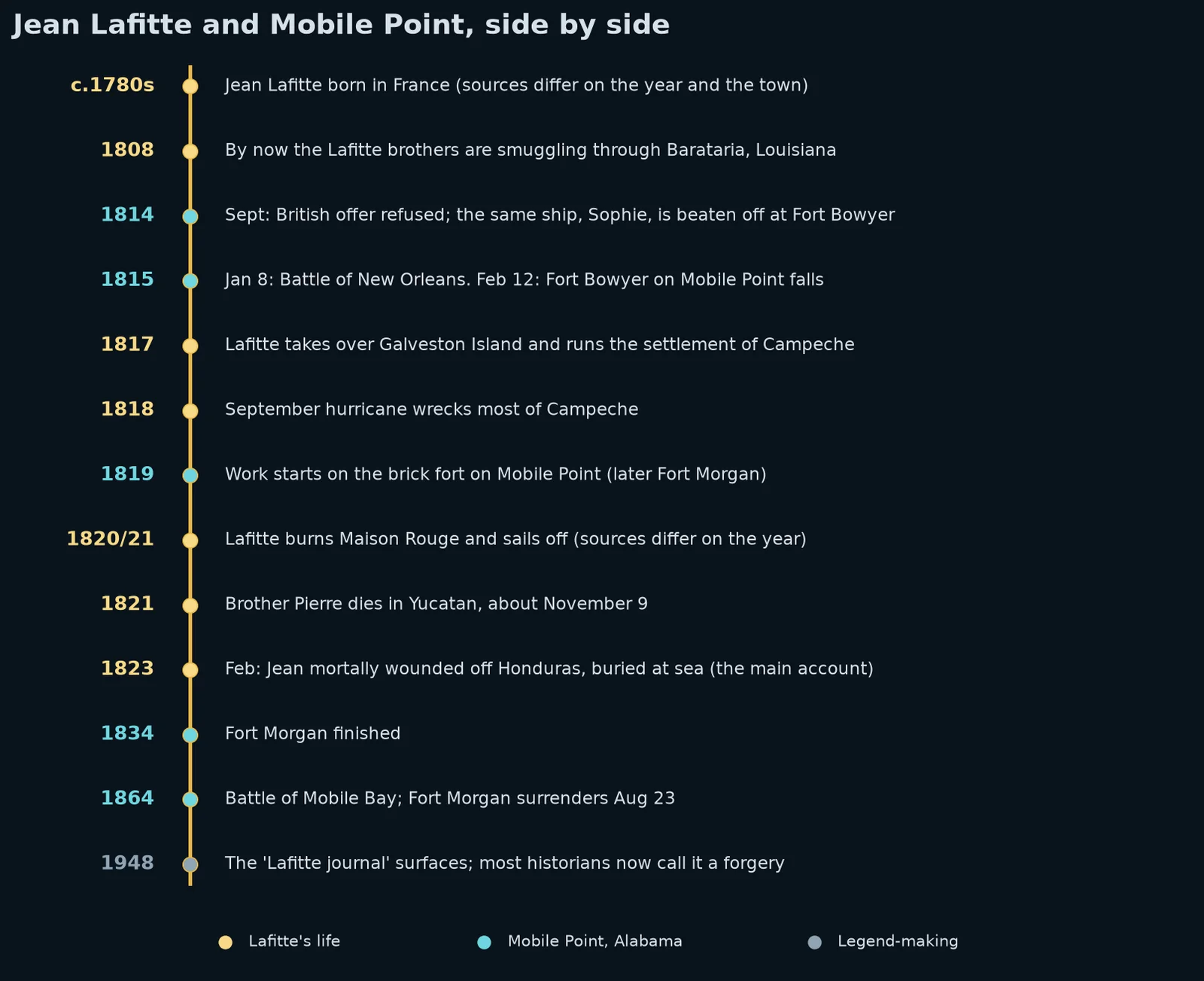
Even the basics are slippery. The Handbook of Texas says Jean was born in Bayonne, France, probably in 1780 or 1781. The Louisiana encyclopedia 64 Parishes says he and his older brother Pierre were born in Pauillac, near Bordeaux, with Jean arriving around 1782. Contemporary papers spelled the name Laffite; most people today write Lafitte. A proper pirate, then: hard to pin down from the very first line.
What's solid is that by 1808 the Lafitte brothers were running a thriving smuggling business out of Barataria Bay, in the bayous south of New Orleans. Privateers brought in captured cargoes, the brothers moved the goods to market, and the authorities fumed. It's worth being clear-eyed about the cargo, too: 64 Parishes records that the brothers smuggled and sold enslaved people as well as silks and sugar. The Barataria years have their own treasure legends, and plenty of them, but that's a story for another day. This one heads east, to Alabama.
The British, a sloop called Sophie and Mobile Point
Here's where the Alabama connection gets interesting, because it's real.
In 1814 Britain and the United States were at war, and the British had set up a base at Pensacola, in what was then Spanish Florida. In early September 1814 (August, in one account), the British sloop Sophie, under Captain Nicholas Lockyer, turned up off Barataria with an offer for Lafitte. Help the British take New Orleans, the letters said, and there would be British citizenship and land for him and his men. One of the letters came from Lieutenant Colonel Edward Nicolls. Lafitte stalled, then refused, and passed the papers to the Americans in the hope of a pardon for his crews.
Now look at what happened next. Within two weeks, the same Sophie was one of four British warships that sailed from Pensacola to attack Fort Bowyer, a small sand-and-log fort on Mobile Point, at the mouth of Mobile Bay. On September 15, 1814, the American garrison under Major William Lawrence beat them off. The British warship Hermes was disabled, ran aground and was blown up by her own crew, and Nicolls, leading the landing force, was wounded in the head. So the officer who wrote to Lafitte and the ship that carried the offer both ended up under the guns at Mobile Point in the same month. That's as close as the records bring Lafitte's story to the spot where the treasure legend sits.
The war rolled on. Lafitte's men fought on the American side at the Battle of New Orleans on January 8, 1815 (in a role 64 Parishes calls "peripheral", the legend calls heroic, and the truth puts somewhere in between). A month later the British came back to Mobile Point in force, with 38 warships and about 1,300 soldiers, and Fort Bowyer surrendered on February 12, 1815. Two days later news arrived that the peace treaty had already been signed. Rather inconvenient for everyone involved.
The Fort Morgan treasure legend
After the war, the government wanted something much tougher than sand and logs on Mobile Point. Work on a new brick fort, designed by the French engineer Simon Bernard, ran from 1819 to 1834, and in 1833 it was named Fort Morgan after the Revolutionary War general Daniel Morgan.
And this is the spot the legend picks. The story goes that Lafitte and his men buried a hoard of gold coins, silver and jewels near Mobile Point to hide it from the authorities, or from rival pirates, or from each other. Some versions tie it loosely to the War of 1812, when this patch of sand was suddenly very busy. The value has crept up nicely with every retelling, as pirate gold tends to do.
Now for the raised eyebrow. No historical record, letter, map or dig report ties Jean Lafitte to burying anything at Mobile Point. The serious encyclopedia entries on Fort Bowyer and Fort Morgan don't mention him at all. The Alabama tale lives in local lore and in modern lists of "treasures hidden in Alabama", where the numbers don't even agree with themselves. That doesn't make it impossible. It just means that if you hear someone describe the exact spot, they are telling you a story, not quoting a document.
Galveston and Campeche: Lafitte's pirate kingdom in Texas
If you want to know why the Lafitte name sticks to treasure stories like barnacles, follow him west to Texas, where he ran the closest thing he ever had to his own kingdom.
After the war, Lafitte didn't get the rewards he wanted, so he found a new employer: Spain, which paid the brothers as secret agents while they carried on smuggling. In the spring of 1817 Jean arrived on Galveston Island, organised a government there in April, and by September was running the island as a base for privateering and smuggling. The settlement was called Campeche. It grew fast, and by one count it peaked at more than 2,000 people and about 120 buildings. Lafitte's own house, the Maison Rouge or Red House, was part of his fort, with its upper storey fitted for cannon.
Then the weather had its say. In September 1818 a hurricane flooded most of the island, killing several people and wrecking four ships and nearly every building. Campeche was rebuilt, but its days were numbered. When Lafitte's captains started attacking American ships, the United States made it plain he had to go. The US schooner Enterprise was sent to see him off, and he left without a fight, burning the Maison Rouge, the fort and the settlement behind him. Many accounts, and the Texas state marker in Galveston, say this was in 1821 (May 7, 1821, in one detailed telling); the Handbook of Texas and 64 Parishes put it in May 1820. Either way, he sailed south, and the Gulf coast never saw him again.

"Lafitte buried it here": the treasure that's everywhere
Fort Morgan is in good company. Lafitte treasure stories turn up all along the Gulf, from Texas to Florida, and the man would have needed a very large shovel and a great deal of free time to dig them all.
- Galveston, Texas. The island where he actually lived is, naturally, supposed to be stuffed with his gold.
- Contraband Bayou, Lake Charles, Louisiana. The story is that Lafitte hid out in what was then a lawless "No Man's Land" and buried treasure along the bayou, which locals say is how it got its name. The city throws a yearly pirate festival, Contraband Days, on the strength of it.
- Grand Isle and Barataria, Louisiana. His old stomping ground. The historian Jack Ramsay wrote that nearly every foot of Grand Isle has been dug for pirate gold.
- Mobile Point, Alabama. The sandy spot under Fort Morgan where this story started.
The legend has had real victims, too, though not from cutlasses. In 1909, a man was sentenced to six years for fraud after taking money from people who believed he knew where Lafitte's treasure was buried. A treasure that's always just over the next dune is a gift to a smooth talker.
The historians, meanwhile, are a bit of a buzzkill. 64 Parishes calls the tales of secret gold and hidden treasure "nonsense", pointing out that pirates and privateers spent what they earned and usually died poor. Smugglers, after all, are in the business of selling things, not burying them.
The mystery of Lafitte's death
If the treasure is a mystery, so is the man's ending, and that's half the reason the legend refuses to lie down.
His brother is the easier case. 64 Parishes records that Spanish forces captured Pierre Lafitte on Isla Mujeres, off the Yucatán coast, on October 30, 1821. He escaped but fell ill, died on or about November 9, 1821, and was buried in the churchyard at Dzidzantún, in Yucatán.
For Jean, the account most historians accept goes like this. In February 1823, commanding a schooner called the General Santander, he fought a night action against Spanish vessels off Omoa, Honduras, on February 4. He was mortally wounded, died around dawn the next day, and was buried at sea in the Gulf of Honduras. He was about 42.
But there are other stories, and they're good ones:
- Fever on Isla Mujeres. The historian Jack Ramsay believed Lafitte died of fever on Isla Mujeres in 1826 or 1827. The Handbook of Texas has him operating around Isla Mujeres until about 1825, then going to the mainland, mortally ill, to die. The historian William C. Davis thinks a similar deathbed story actually belongs to Pierre, in 1821.
- He never died at sea at all. Two amateur historians from Lincolnton, North Carolina, have claimed that Lafitte faked his death and lived on as a man named Lorenzo Ferrer, who died in 1875. No mainstream historian backs it.
- The journal. In 1948 a man named John Andrechyne Laflin brought a French manuscript to the Missouri Historical Society, claiming it was Lafitte's own journal from the 1840s, written after he had supposedly quietly retired. The society couldn't authenticate it. Laflin published a translation in 1958, and the papers were later donated to the Sam Houston Regional Library and Research Center in Texas. The paper and ink do date from the mid-1800s, but handwriting experts matched the writing to Laflin's own, and Laflin had already been accused of forging letters from Lincoln, Andrew Jackson and Davy Crockett. Most historians now call the journal a forgery.
Even in 1843, Mirabeau B. Lamar, a former president of the Republic of Texas, could only conclude that Lafitte was probably dead. No authentic death record has ever turned up. A pirate with no grave and no confirmed last chapter is the perfect host for a treasure legend: if nobody knows where he ended up, who's to say where he left his gold?
The theories, weighed
- Lafitte buried a stash at Mobile Point. The romantic favourite. The problem: there's no record he ever operated there, his business was in Louisiana and then Texas, and from 1819 the point was a busy federal building site, which is a strange place to leave your savings.
- Someone else's loot, Lafitte's name. The Gulf had no shortage of smugglers, privateers and wreckers. Over two centuries, almost any buried-treasure story on this coast has drifted towards the most famous name available, and that name is Lafitte.
- A War of 1812 tale that grew. Mobile Point really was at the centre of a British-American fight that touched Lafitte's story in September 1814. It's easy to see how "the British who courted Lafitte attacked here" could turn, over many retellings, into "Lafitte was here, and he buried something".
- There's no treasure at all. The historians' view: privateers spent their money, and Lafitte died far from home with whatever he had left.
The honest answer is that nobody knows, and no evidence points to a hoard under Fort Morgan. Which, as any treasure hunter will tell you with a twinkle, is exactly what a well-hidden hoard would look like.
Visiting Fort Morgan and the Lafitte coast today
Fancy a look for yourself? Brilliant. Bring a sun hat, not a shovel.
- Fort Morgan State Historic Site sits at the western tip of the Fort Morgan peninsula, at the end of Alabama Highway 180, west of Gulf Shores. The Alabama Historical Commission has owned and run it since 1977, and it has been a National Historic Landmark since 1961. You can walk the brick fort, its dark vaulted rooms (bring a torch) and the later concrete gun batteries, and there's a museum on site. Hours and admission change, so check with the Alabama Historical Commission before you go. It's state-owned, protected historic ground, and digging or treasure hunting there is not allowed.
- The beaches and dunes along the peninsula are a mix of private property and protected wildlife habitat. Admire the sea oats; leave them, and the sand under them, where they are.
- The Fort's other battles. Mobile Point earned its fame long after Lafitte. On August 5, 1864, Union ships fought their way past the fort in the Battle of Mobile Bay, and after a siege the Confederate garrison surrendered on August 23. The site hosts a yearly reenactment.
- Galveston, Texas. A Texas state historical marker at 1417 Harborside Drive marks the site of the Maison Rouge. A later building was put up over its old cellars and foundations in 1870; today only ruins stand behind the marker.
- Lake Charles, Louisiana. Contraband Days, the city's pirate festival, opens with a staged pirate takeover of the town, which is about as close as anyone gets to finding Lafitte's treasure.
The gold may never have been buried on Mobile Point. But the war was real, the fort is real, and the pirate who never got a gravestone keeps on turning up in the sand wherever there's a good story to tell.
...and if you find it, remember who encouraged your questionable life choices.
The short version of this story is on YouTube at @TenToeExpress.
Deep dive yourself
- Laffite, Jean · Handbook of Texas, Texas State Historical Association
- Jean and Pierre Laffite · 64 Parishes, Louisiana Endowment for the Humanities
- Fort Bowyer · Encyclopedia of Alabama
- Fort Morgan Museum and State Historic Site · Encyclopedia of Alabama
- Fort Morgan State Historic Site · Alabama Tourism Department
- Jean Lafitte historical marker · Galveston.com (text of the 1965 Texas state marker)
- Laffite Society Collection · Texas A&M University at Galveston
- Contraband Days: Legend of Jean LaFitte · KPLC, Lake Charles
- Jean Lafitte · Wikipedia (a good starting point, with references to Ramsay, Davis and the Laflin journal)