 Ten Toe Express
Picture a battered London ship nosing up to the south shore of Long Island in March 1699, fifteen months and half the world out from home, her crew sunburnt, her hold suspiciously heavy and her story ("bound for Philadelphia, nothing to see") thinner than the paint on her hull. She was the Adventure, and the man in charge, a 26-year-old called Joseph Bradish, had taken her by mutiny. Within days she would be scuttled, her cargo scattered across the coast, and four sealed bags of money and jewels would be sitting in a respectable colonel's house. Block Island, Rhode Island, turns up in some tellings of what happened next. So, right then: where did the loot go?
Who Was Joseph Bradish?
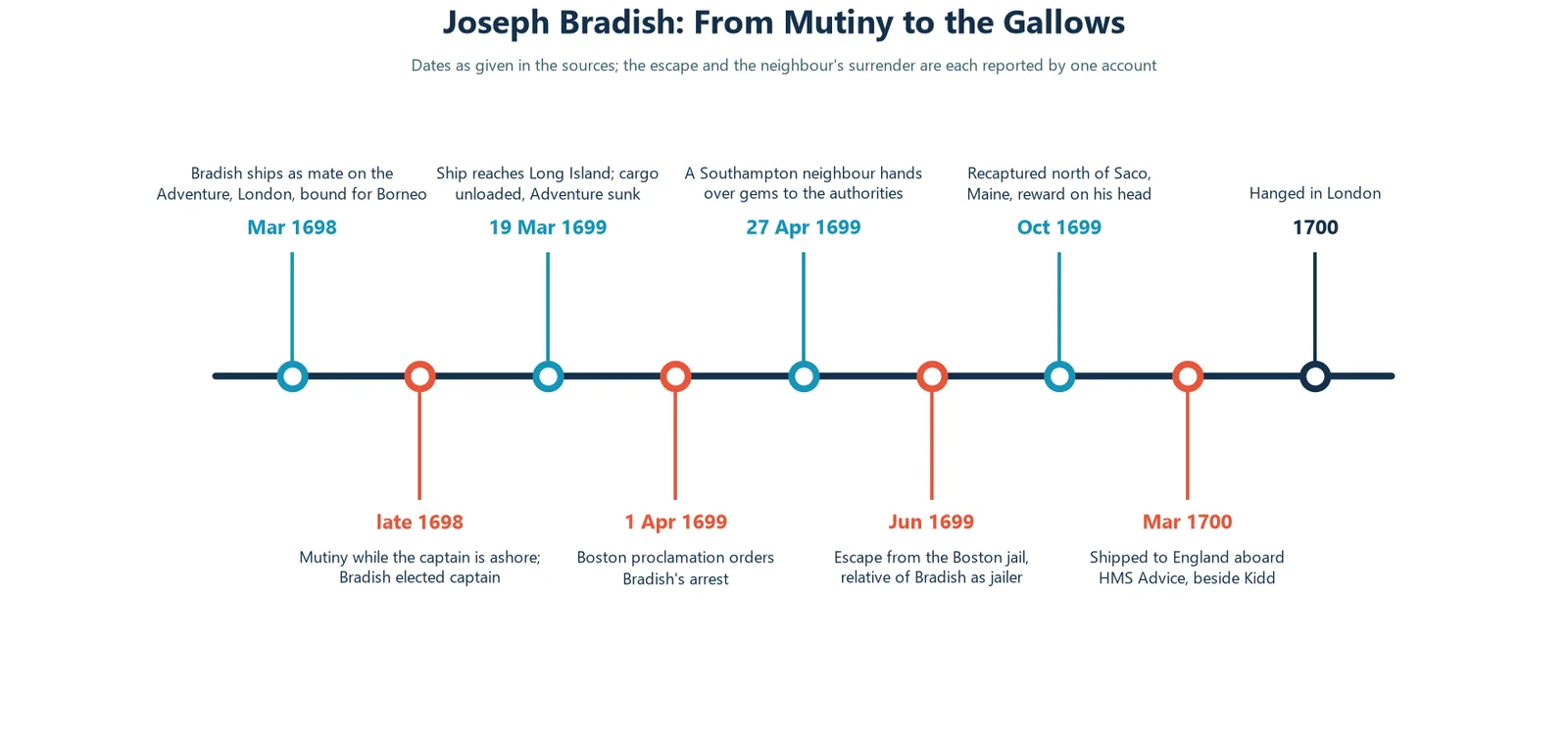
Bradish was born on 28 November 1672 and came from a family of Massachusetts settlers. Sources disagree on whether the birthplace was Sudbury or Cambridge, which is the sort of quarrel you get with a man who spent his career being hard to pin down. In March 1698 he signed on in London as a mate aboard the Adventure, a pink (a narrow-sterned trading ship) of some 300 tons, bound for Borneo on an interloping trade run. Interloper is a polite word for "not licensed by the East India Company, and the Company is cross about it".
The captain, Thomas Gullock (spelled Gulleck in some records), was widely disliked. When he and several officers went ashore in the East Indies, Bradish and the rest of the crew cut the anchor cables and sailed off with the ship. Those who would not join in were set adrift in a small boat. Bradish was elected captain and the treasure in the storeroom was divided up. One account says the crew shared out money and jewellery that filled nine chests. That is a detail worth a raised eyebrow, since it comes from a single source, but the mutiny itself is documented.
Note the name. Bradish is often tangled up with William Kidd, whose own ship was called the Adventure Galley. They were different men with different ships and no joint scheme; the only real overlap is that they ended up in the same Boston jail and on the same ship home to England.
The Adventure Arrives: Long Island, March 1699
After stops at Mauritius and Ascension, the Adventure reached the coast of "Nassau Island", the colonial name for Long Island, in March 1699. One account dates the arrival to 19 March. The crew hired local sloops to carry off the cargo, then sank the ship. Most of the men bought horses from nearby farms and simply vanished into the countryside. Rather efficient, for a gang of mutineers.
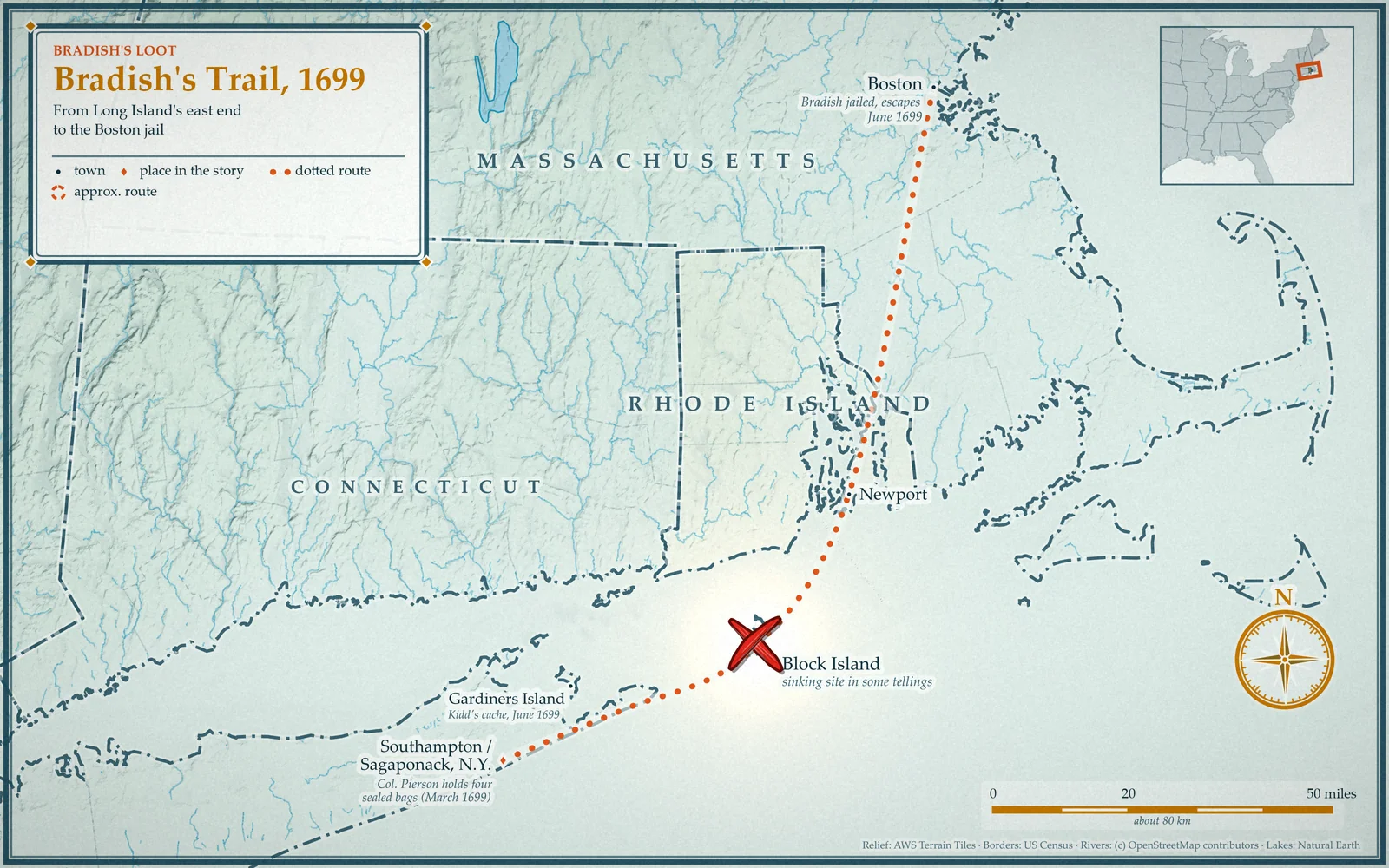
Bradish and a handful of others had a plan. Bradish left four sealed bags with Colonel Henry Pierson, a Southampton leader who had spotted the ship from his window at Sagaponack: three of money and one of jewels. According to one Long Island history, Pierson got two small guns, a cask of powder, a jewel and a little bag of pieces of eight for his trouble. Bradish then headed for Boston, hoping to cash in on the 1698 Act of Grace, a royal pardon for pirates who surrendered voluntarily.
Where Does Block Island Come In?
Here the story forks, and this is where it pays to be careful. One Long Island genealogy page says the Adventure was meant to reach Gardiner's Island, but contrary winds blew her to Block Island, where sloops from Southold and Guilford unloaded her cargo before the crew fired guns into the hull and sank her. The popular treasure-hunting write-ups take that and run with it: Bradish burned the ship at Block Island, split the loot with Pierson, and the coins and gems went into secret pits that nobody ever found again.
The more standard accounts place the unloading and scuttling off Long Island itself. That is also where the sealed bags were left. So the Block Island link rests on one account of the sinking and on later retellings, not on a documented burial. As for the "pits" and the missing map, the sources offer nothing beyond the legend. One site adds that a farmer found gold coins near Sachem Pond in the 1800s; that is a rumour with no source attached. The same write-up has Bradish hanged in Boston, which is wrong: the sources agree he went to London.
Arrest, Escape and the Long Way Home
Massachusetts was ready for them. A proclamation dated 1 April 1699 ordered the arrest of Bradish and others for piracy against the Adventure of London. Bradish was held in the Boston jail that had recently held William Kidd, and his relative the jailer, Caleb Ray in one account, helped him slip out in June 1699. Governor Bellomont's letter of 8 July 1699 describes Bradish as a notorious pirate who had got out about a fortnight earlier, probably with the jailer's consent. A reward followed, and in October he was recaptured north of Saco, Maine.
On 27 April 1699, according to the Long Island account, a Southampton neighbour who had learned of the treasure handed over diamonds, rubies, pearls, sapphires and turquoise to the authorities and had to prove he had merely been indiscreet. Colonel Pierson came very near the gallows himself for harbouring Bradish. Bellomont arranged to recover the treasure Bradish and his men had left across New England with Pierson and others. What came back is described only as several bags of jewels and coins; there is no reliable inventory.
The Hanging
In March 1700 Bradish was shipped to England aboard HMS Advice with Kidd, James Gilliam and many of Kidd's former crew, because Bellomont said he had no authority to execute pirates. Bradish was tried, convicted and hanged in London in 1700, and his body was gibbeted alongside Kidd's as a warning. Two decades later, sailors captured by Bartholomew Roberts reported that Roberts' men refused to trust amnesty offers, pointing to what became of the Kidd and Bradish companies.
Is There Treasure Left on Block Island?
Let's weigh it. In favour: the Adventure brought in a rich cargo, much of which was shared out among men who scattered in every direction, and the authorities only ever described the recovery in general terms. Plenty of loot could have been lost, spent or buried, and a few men with horses and a head start are exactly how that happens.
Against: the documented bags were left in Southampton, not Rhode Island. The governor's own recovery effort covered the bags that were found. The best evidence that anything sits on Block Island is a retelling of a retelling. Block Island does have a genuine pirate past (raids between 1690 and 1704 and a large pirate battle off the island in 1723, after which 26 pirates were hanged at Newport), and Kidd himself is said to have spent a month there in 1699, but none of that puts Bradish's loot in the ground.
So the honest verdict is this: Bradish is real, the mutiny is real, the Long Island bags and the recovery are real, and the Block Island hoard is a legend with a pleasant view.
Block Island Today
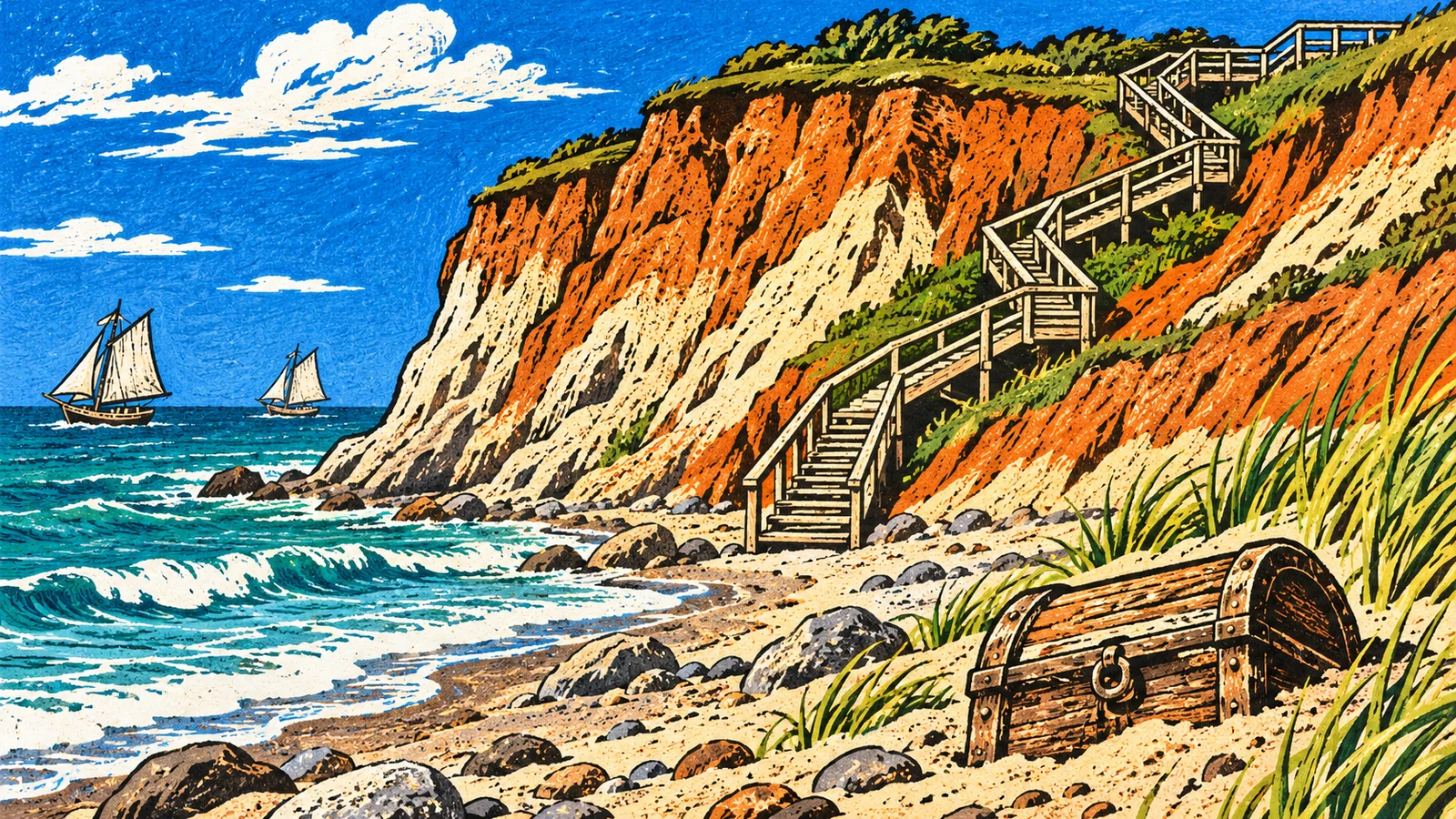
Block Island is a town of Rhode Island, reached by ferry, with clay bluffs, beaches and public conservation land alongside private property. Digging on any of it, public or private, is not on the menu, and there is no documented treasure site to dig anyway. A walk along Mohegan Bluffs, a ferry ride and a seafood supper make for a far better use of an afternoon.
...and if you find it, remember who encouraged your questionable life choices.
The short version of this story is on YouTube at @TenToeExpress.
Deep dive yourself
- Joseph Bradish · Wikipedia
- Pirates on Long Island: Bellomont, Kidd and Bradish · Long Island Genealogy
- Joseph Bradish · Brethren of the Coast
- Earl of Bellomont letter to the Lords of Trade and Plantations, 1699 July 8 · Colonial Williamsburg Foundation, Blathwayt Papers
- Proclamation of 1 April 1699 against Joseph Bradish and others · Berkeley Law Library catalog
- Pirates in Boston, Massachusetts · History of Massachusetts
- A History Lesson: Block Island · The Bay Magazine
- 15 Real Treasures Hidden in Rhode Island Worth Discovering · Rockchasing