 Ten Toe Express
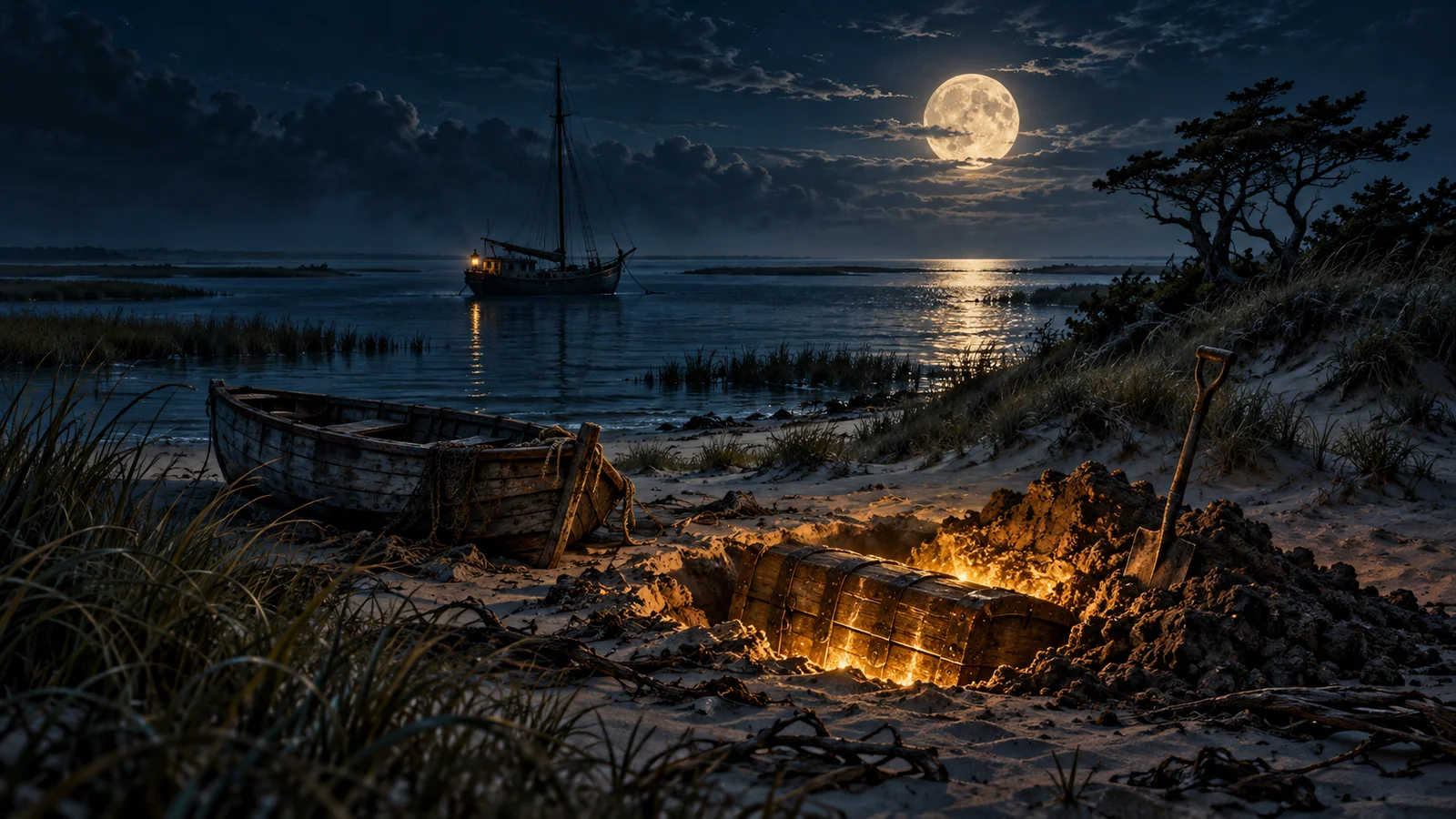
Picture the Eastern Shore on an autumn night in 1717. Marsh grass hissing in the wind, a low barrier island black against the Atlantic, and somewhere offshore a pirate sloop riding at anchor with her lanterns shuttered. A boat crunches onto the sand. Men climb out with a heavy chest between them. Nobody speaks. Somebody starts digging.
That, more or less, is the legend of the pirate treasure of Blackbeard's crew on Maryland's Eastern Shore: that after raiding ships off the mouth of the Chesapeake Bay, members of Blackbeard's company slipped ashore on the long, lonely peninsula between the bay and the ocean and buried their loot, then never came back for it. Over three centuries the story has been told about Maryland's islands, Virginia's barrier beaches and just about every sandy hump with a cedar tree on it.
Here is the fun part, and the rather inconvenient part. Blackbeard really was here. His ships really did prowl the Virginia capes, and he really did use the quiet creeks of the Eastern Shore. Whether anybody left a chest of gold in the sand is another matter entirely. Right then: lanterns on, boots off, time to wade in.
Who was Blackbeard, and what was he doing near Maryland?
For the most famous pirate in the English-speaking world, Blackbeard left a surprisingly patchy paper trail. His real name is usually given as Edward Teach, though the records spell it Thatch, Thach, Thack, Theach and more besides. He is often said to have come from Bristol, England, and to have sailed as a privateer during Queen Anne's War. Nobody can prove much of his early life, and historians are still arguing over who he really was.
He served his apprenticeship under the pirate captain Benjamin Hornigold, who worked out of New Providence in the Bahamas. The earliest primary record that names Teach dates from the summer of 1717. By that autumn he was operating off the Delaware Bay and the Chesapeake Bay alongside Hornigold and a third captain, Stede Bonnet, a gentleman planter from Barbados who had taken up piracy with more enthusiasm than skill.
Why the Chesapeake? Money, basically. The bay was a highway for tobacco ships, wine ships and colonial trade bound to and from Virginia and Maryland. Ships heading in or out had to squeeze past two headlands, Cape Charles on the northern side and Cape Henry on the southern side. For a pirate, that's not a coastline. That's a toll booth.
The raids off the Virginia capes
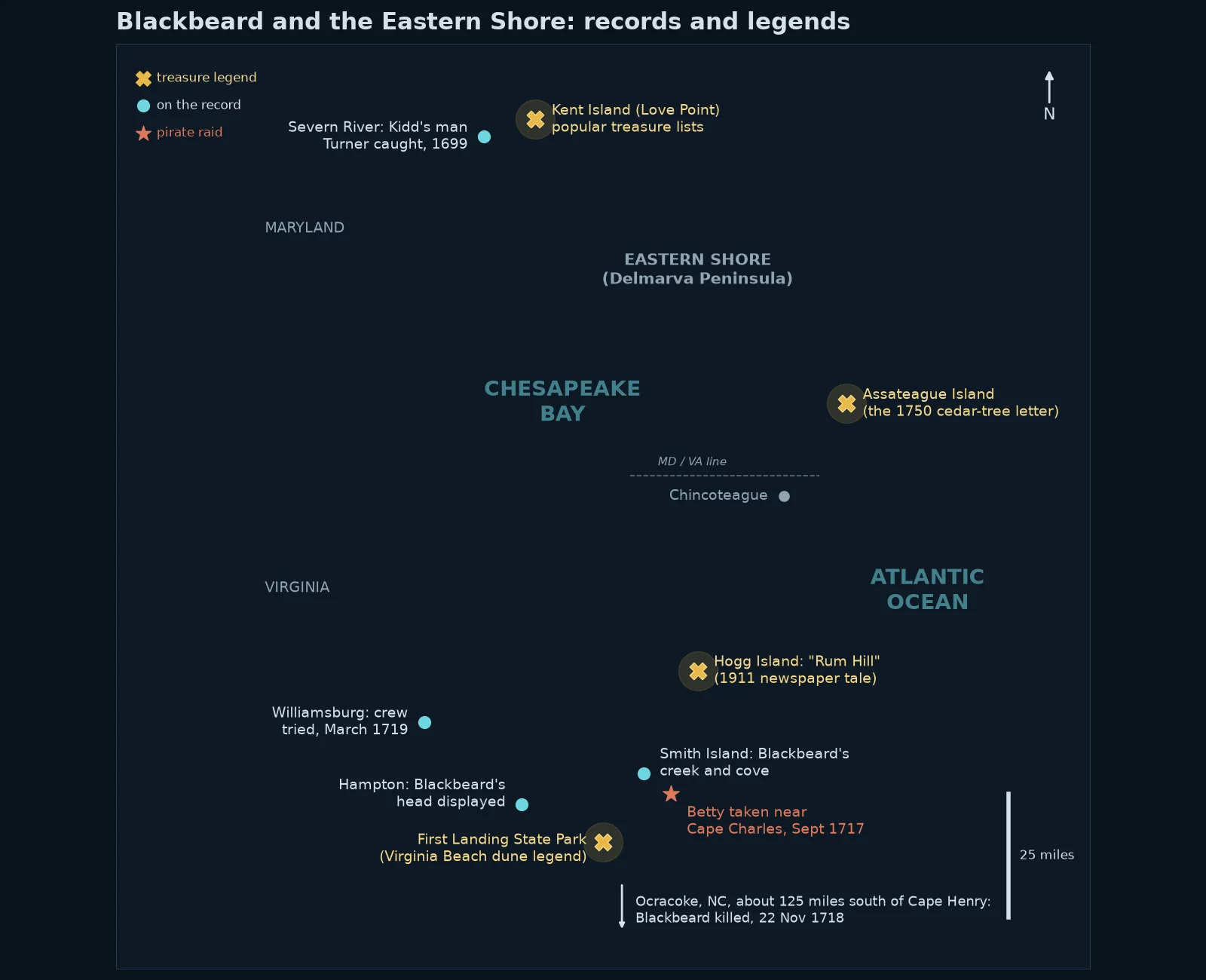
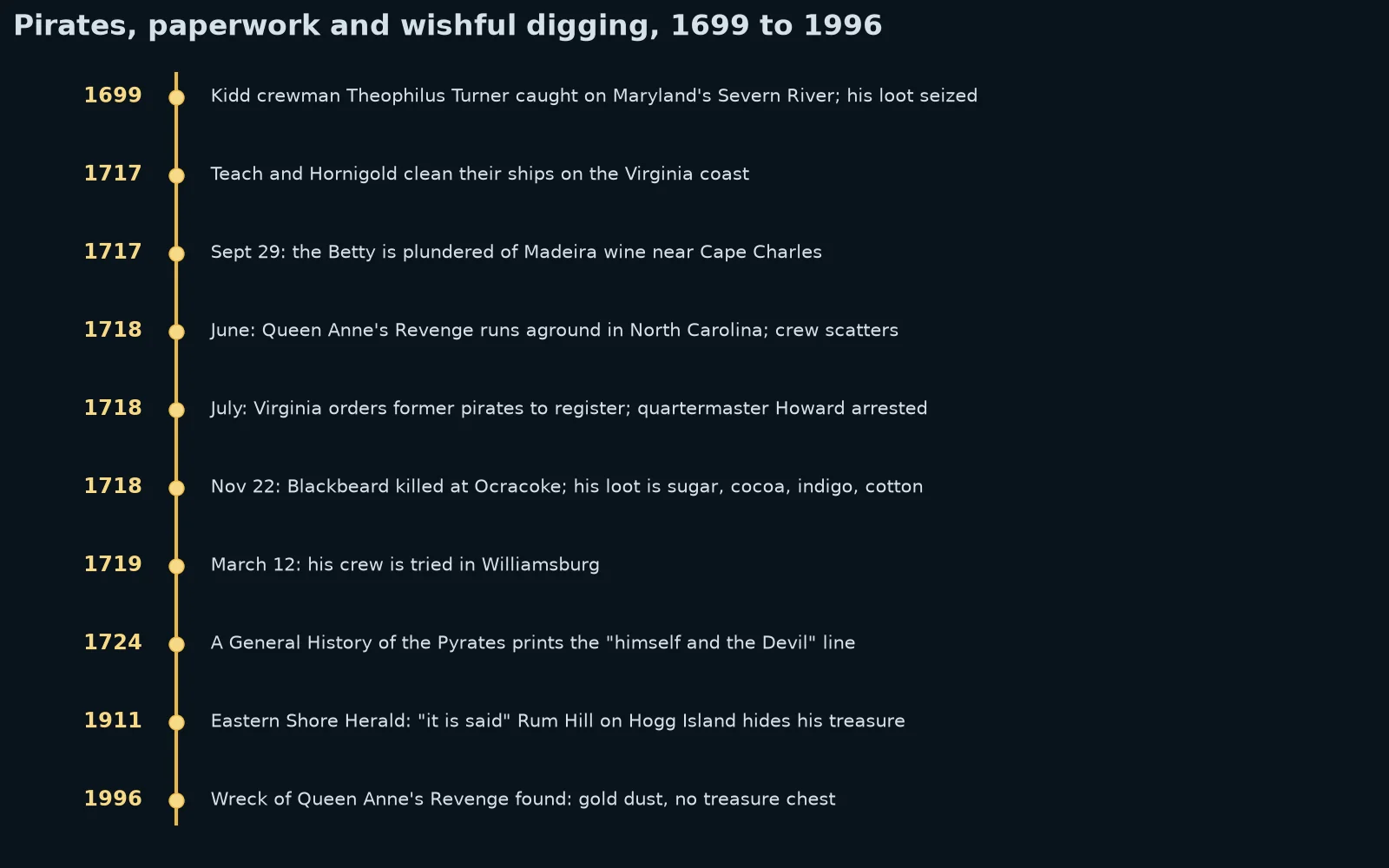
The best-documented hit came on 29 September 1717, near Cape Charles, at the southern tip of the Eastern Shore. The pirates stopped the Betty of Virginia, helped themselves to her cargo of Madeira wine and then scuttled her with the rest of her goods still aboard. A few weeks later, on 22 October, two more sloops, the Robert of Philadelphia and the Good Intent of Dublin, were stopped and had their holds emptied.
Note what was taken: wine, provisions, trade goods. Pirates of this era mostly stole whatever was in the hold, and what was in the hold was mostly cargo. Very useful if you're a pirate, rather disappointing if you're hoping for a chest of doubloons.
The pirates also needed somewhere to clean their ships. Wooden hulls in warm water grew weed and worms at a terrifying rate, so every so often a crew had to haul the vessel onto a quiet beach, tip it on its side and scrape the bottom. This was called careening, and it left a pirate ship helpless for days. You did it somewhere remote. The 1724 book A General History of the Pyrates, published under the name Captain Charles Johnson, says that in 1717 Teach and Hornigold went "cleaning on the Coast of Virginia" before heading back to the West Indies. The Chesapeake Bay Program notes that Teach, like other pirates, used the seclusion of the Eastern Shore to make his ship ready for sea.
And that, right there, is where the treasure legend gets its foothold. A pirate crew pulled up on a lonely Eastern Shore beach for days, with nobody watching? To a storyteller, it practically begs for a shovel.
Off to the Caribbean, and a very bad year
The Chesapeake chapter didn't last. Late in 1717, off Martinique, Teach captured the French slave ship La Concorde, renamed her Queen Anne's Revenge and armed her with about forty guns. With a crew in the hundreds, he became the most feared pirate in the Atlantic. In May 1718 he blockaded Charleston, South Carolina, for nearly a week and held hostages until the town handed over a chest of medicine.
Then, in June 1718, the Queen Anne's Revenge ran aground at Topsail Inlet, now Beaufort Inlet, North Carolina. A second sloop, the Adventure, grounded too. Teach left with a hand-picked crew and, by most accounts, the best of the plunder. He marooned about 25 men on a sandbar (Bonnet rescued them a couple of days later) and stripped Bonnet's own ship of its valuables on the way out. Charming fellow.
This matters for the legend. When a pirate company breaks up like that, men scatter. Some take pardons, some sign on with other captains, some drift up the coast. The Eastern Shore tale is about members of Blackbeard's crew, not the man himself, and a scattering crew is exactly the sort of loose end that legends love to tie off with a buried chest.
Virginia's governor comes hunting
In June 1718 Teach and about twenty of his men took a royal pardon from North Carolina's governor, Charles Eden, at the little town of Bath. He settled in, married, and very soon went back to piracy, anchoring his sloop at Ocracoke Inlet on the Outer Banks.
Up in Williamsburg, Virginia's lieutenant governor Alexander Spotswood was having none of it. Former pirates were turning up in Virginia, and on 10 July 1718 Spotswood issued a proclamation ordering them to come forward and register. He had Blackbeard's former quartermaster, William Howard, arrested in Virginia, believing he could reveal where Teach was. Howard was tried for piracy and sentenced to hang, then pardoned by a commission from London at the last moment. He is, as far as the records go, the closest thing this story has to a Blackbeard crewman loose in the Chesapeake.
Spotswood then did something legally dubious and brutally effective. Royal Navy warships were too big for the shallows around Ocracoke, so he hired two small sloops, the Jane and the Ranger, and put them under Lieutenant Robert Maynard, with roughly sixty men. Never mind that Ocracoke was in North Carolina, not Virginia.
"Nobody but himself and the Devil": the night before
The night before the fight, according to Johnson's General History, Blackbeard sat up drinking until morning. One of his men asked whether, if anything happened to him, his wife knew where he had buried his money. The book gives his answer like this:
That no Body but himself and the Devil, knew where it was, and the longest Liver should take all.
It is the single most important line in every Blackbeard treasure legend ever told, and it deserves a raised eyebrow. Johnson's book came out in 1724, six years later. It mixes sworn trial records with gossip, nobody knows for certain who wrote it, and the man quoted was dead before he could object. Still, it is a cracking line, and you can see why three centuries of treasure hunters have taken it as an invitation.
Ocracoke, 22 November 1718
At dawn on 22 November 1718, Maynard's sloops came at Blackbeard from the sound side. They grounded on sandbars. Blackbeard's guns raked them and crippled the Ranger. When the pirates boarded the Jane, Maynard's men, who had been hiding below decks, rushed up and the fight turned hand to hand. Blackbeard was killed. The sailors who counted said he had taken five pistol wounds and around twenty cuts. Several of his crew died with him.
Maynard had Blackbeard's head cut off and hung from his sloop's bowsprit, the body went over the side, and the head was later displayed at Hampton, Virginia, at the mouth of the James River, as a warning to anyone else with ideas.
So where was the treasure?
This is where the records are, frankly, a bit of a buzzkill. What Maynard found was not chests of gold. Blackbeard's loot, found in the pirate sloops and in a tent ashore, was sugar, cocoa, indigo and cotton. Sold at auction together with sugar and cotton seized from the barn of North Carolina's colonial secretary, Tobias Knight, the lot fetched £2,238. A decent haul for 1718. Not exactly a dragon's hoard.
The crew got no happier ending. Sixteen men were brought to Williamsburg and tried before a Vice-Admiralty court on 12 March 1719, without a jury, as maritime law of the day allowed. Fourteen were found guilty. One, a man from Bath, proved he had only been aboard as a guest the night before the fight and was released. Blackbeard's former sailing master, Israel Hands, who hadn't been at Ocracoke, was pardoned. Accounts disagree on how many of the condemned were actually hanged, and the numbers given range from six to more than a dozen. The hangings took place along the road between Williamsburg and the James River.
So by the spring of 1719, Blackbeard was dead, his crew was dead, jailed, pardoned or scattered, and not one of them, so far as any record shows, was ever made to cough up a secret Eastern Shore treasure map. Rather a lot of people had every reason to ask, too.
The Eastern Shore treasure legends, one by one
Here is the honest truth about the Maryland version of this story: no historical record has turned up that places Blackbeard or his men burying anything in Maryland. What does exist is a whole family of Eastern Shore and Chesapeake treasure tales that have grown up around his name, and they are worth meeting.
Rum Hill on Hogg Island
On the Virginia end of the Eastern Shore, a 1911 article in the Eastern Shore Herald of Eastville described Hogg Island, a ten-mile barrier island, as a place that had been "the resort of Capt. Kidd and of Blackbeard." It added that "it is said" a point called Rum Hill held some of Blackbeard's stolen treasure. The paper explained the name: traders running to and from the West Indies used to stop there and bury rum in the sand until it could be smuggled to the mainland. So the one thing anyone was definitely burying on Rum Hill was rum. Which is, admittedly, a sort of treasure.
Smith Island and Blackbeard's creek
Further south, near Cape Charles, the barrier island called Smith Island (not to be confused with Maryland's famous Smith Island out in the bay) carries Blackbeard's name on the map. Researchers with the Virginia Coast Reserve note that Teach used the south end of the island as a layover, and a creek and cove there still bear his name. A name on a map is real history of a sort. It just isn't a chest.
Three cedar trees near Assateague
Up toward the Maryland line, a story tells of a 1750 letter, said to have been intercepted by a British warship, describing chests of gold, silver and jewels buried by a North Carolina pirate near three cedar trees, north of an inlet above Chincoteague Island. Two problems, for this story. Blackbeard had been dead for more than thirty years by 1750, and Assateague's sands shift so much that three cedar trees from the 1700s would be a very optimistic landmark. Nothing has turned up.
Kent Island and the Maryland bay islands
On the Maryland side, popular treasure lists put a pirate's chest on Kent Island, near Love Point, where the bay narrows toward Annapolis, and toss Blackbeard's name in as a possible owner. None of them gives a source older than the list itself. Kent Island does have a real pirate history (one of its early settlers, Thomas Smith, was executed for piracy in the 1630s, in a colonial feud with Lord Baltimore's government), but nothing ties Blackbeard to it.
The Virginia Beach dunes
The best-known Chesapeake version sits just across the bay from the Eastern Shore. Virginia Beach tourism stories say Blackbeard looted a ship near the Lynnhaven River and buried the treasure in the dunes of what is now First Landing State Park, meaning to come back. People have dug holes on an island in Lake Joyce, once the Lynnhaven's outlet, looking for it. A local writer pointed out the obvious snag: a spot that easy for the whole crew to reach is a dreadful place to hide anything from the whole crew.
Maryland's real pirate treasure, and where it went
If you want a pirate, a Maryland river and actual treasure in the same story, you need a different crew. In 1699, England ordered the arrest of Captain William Kidd. One of Kidd's men, Theophilus Turner, fled to the Chesapeake with his share of the loot. An agent of Maryland's governor caught him on the Severn River, near Annapolis. Turner was shipped back to England for trial, and his treasure was confiscated. Kidd himself was hanged in London in 1701.
Across the bay in Virginia, three pirates named Davis, Wafer and Hinson were caught with plunder from the South Seas in the 1680s. After a long legal tangle, the Crown let them have most of it back, but kept £300 that went toward founding the College of William and Mary.
Notice the pattern? When real pirate treasure reached the Chesapeake, the authorities usually got their hands on it, and they wrote it down. That paper trail is exactly what the Blackbeard legend is missing.
What turned up when Blackbeard's ship was found
On 21 November 1996, the research firm Intersal located a wreck just over a mile off Bogue Banks near Beaufort Inlet, North Carolina. It has since been identified as the Queen Anne's Revenge, and archaeologists have raised hundreds of thousands of artifacts from it: cannons, an anchor, a bell, weapons, tools and medical gear.
The gold? Mostly gold dust, plus a few snipped fragments of jewelry, some of it in West African Akan styles. Conservators with the Queen Anne's Revenge Project think much of it slipped from pockets and purses into cracks between the deck planks, and they have cheerfully called it "Blackbeard's couch change." Stories that the ship carried something like twenty pounds of gold before she grounded remain unconfirmed. Whatever Teach carried off from the wreck, it wasn't left lying around for the archaeologists.
The theories, weighed
- Blackbeard's men really did bury loot on the Eastern Shore. The romantic favourite. In its favour: they were here, they careened here, and the shore was remote. Against it: no record of anyone recovering such a cache, and the crewmen captured in 1718 were held in Virginia, where some turned informer, yet none is recorded pointing to buried loot.
- The "treasure" was cargo, and it was spent. The records lean this way. Blackbeard's known loot was wine, sugar, cocoa, indigo and cotton, the sort of plunder you drink, sell or trade, not bury.
- The legend borrowed from other pirates. The Chesapeake has real pirate treasure stories, from Kidd's man Turner on the Severn to Davis, Wafer and Hinson in Virginia, and Kidd really did bury treasure, on Gardiners Island in New York. Over time, the most famous pirate's name sticks to every chest.
- It grew out of a single line and a lot of sand. "Nobody but himself and the Devil" was printed in 1724 and has been sending people out with shovels ever since. Add a coastline full of smugglers' hiding spots like Rum Hill, and the legend more or less writes itself.
Historians of piracy tend to be blunt about buried pirate treasure in general: it is mostly a later invention, popularized by novels like Treasure Island, and Kidd is about the only pirate known for certain to have buried any. The honest answer for the Eastern Shore? Nobody knows, nobody has found anything, and the evidence points to wine and sugar rather than gold. Which, of course, has never stopped anyone from wondering.
Visiting Blackbeard's Eastern Shore today
Fancy a look? Brilliant. The places in this story are lovely, wild and mostly protected, so leave the shovel at home.
- Assateague Island straddles the Maryland and Virginia line. Most of it is Assateague Island National Seashore, run by the National Park Service, with Chincoteague National Wildlife Refuge on the Virginia end. Digging for treasure is not allowed on these federal lands, and metal detectors are banned on National Park Service land. Assateague State Park on the Maryland side has its own seasonal rules for metal detectors, so check with the park before bringing any gear. The seashore also has old military debris wash up from time to time, and officials ask visitors not to pick up unknown metal objects.
- Smith Island and Hog Island, Virginia are barrier islands in the Virginia Coast Reserve, much of it owned by The Nature Conservancy. Some islands are open for low-impact day use, reached only by boat, with visitors asked to stay below the high-tide line and off the dunes, and seasonal closures for nesting birds. Check current rules before you go.
- Kent Island is now largely homes, marinas and farms. The Love Point area is private property, so enjoy the view from public land.
- First Landing State Park in Virginia Beach has trails through the very dunes of the legend, but digging for treasure in a state park is not allowed.
- Williamsburg still has its Public Gaol, where Blackbeard's men waited for trial, and Colonial Williamsburg sometimes stages the trial as an evening program.
- Ocracoke Island, North Carolina, most of it part of Cape Hatteras National Seashore, has Teach's Hole Channel, where it all ended. The North Carolina Maritime Museum in Beaufort displays artifacts from the Queen Anne's Revenge, including some of that famous couch change.
The real treasure of the Eastern Shore is the shore itself: wild ponies, marsh at sunset and islands that look exactly the way a pirate would want them to. Whatever Blackbeard's men left behind, if they left anything at all, the sand is keeping the secret. Probably along with a few bottles of very old rum.
...and if you find it, remember who encouraged your questionable life choices.
The short version of this story is on YouTube at @TenToeExpress.
Deep dive yourself
- Three pirate tales that took place on the Chesapeake Bay · Chesapeake Bay Program
- Blackbeard: History of the Dreaded Pirate · Queen Anne's Revenge Project, North Carolina Department of Natural and Cultural Resources
- Did you know? Blackbeard's crew was tried in Virginia · Queen Anne's Revenge Project
- Artifact of the Month: Blackbeard's Couch Change · Queen Anne's Revenge Project
- Blackbeard the Pirate · NCpedia (Dictionary of North Carolina Biography)
- Blackbeard (Edward Teach) · National Park Service, Cape Hatteras National Seashore
- A General History of the Pyrates (1724), by Captain Charles Johnson · Project Gutenberg
- Hogg Island (Eastern Shore Herald, 1911) · The Countryside Transformed, University of Virginia
- The barrier islands and Blackbeard's layover, by Barry Truitt · Virginia Coast Reserve Long-Term Ecological Research
- Mythical Hidden Treasures of Virginia · Virginia Places