 Ten Toe Express
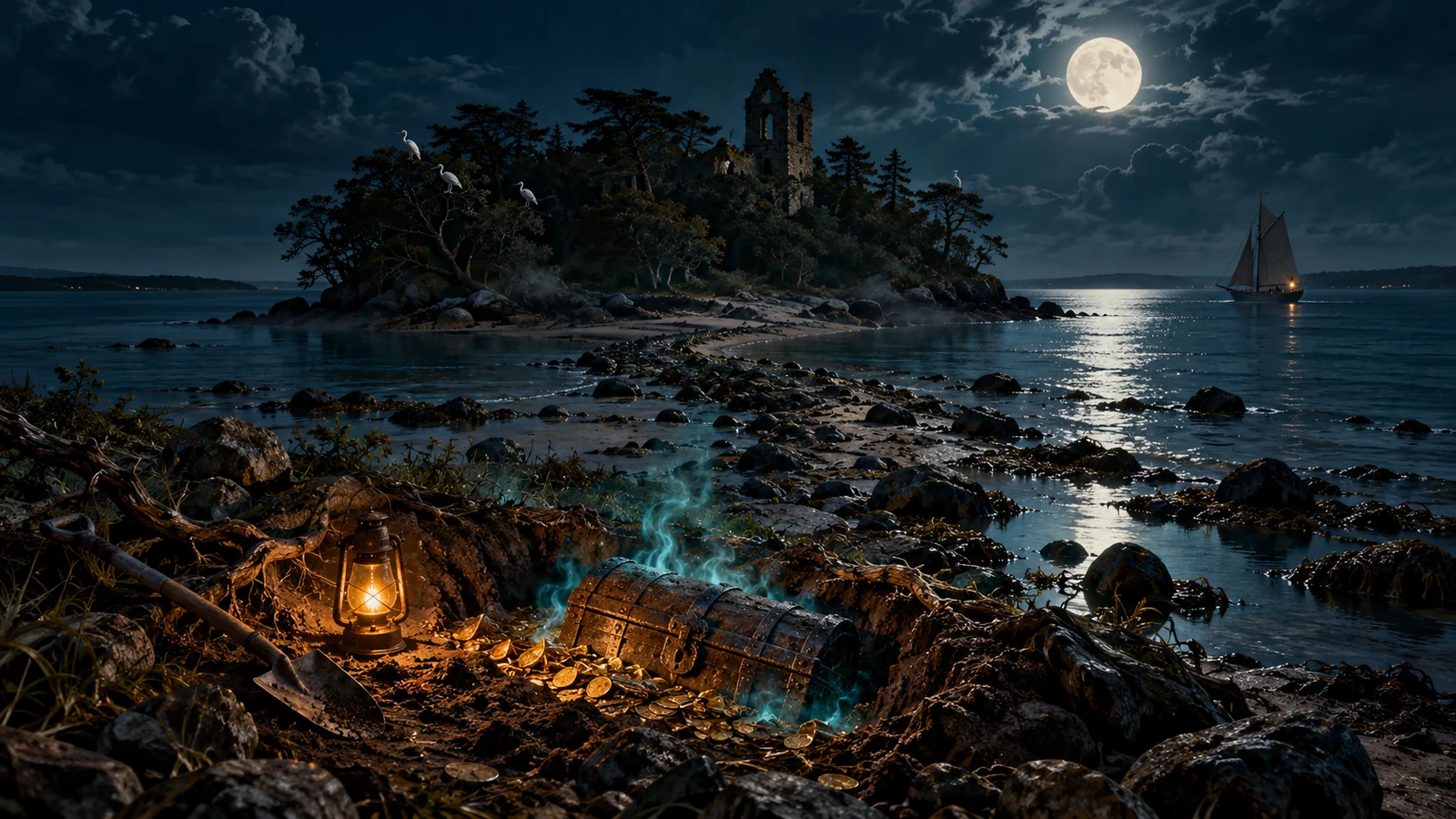
Low tide, Milford, Connecticut. The water drains off a long, stony bar, and for a couple of hours you can walk straight out across Long Island Sound to a small wooded island. Nobody lives there. Nobody has managed to stay there for long. And if you believe the stories told on this stretch of shore for three centuries, somewhere under its trees lies an iron chest of gold, buried by the most famous pirate in American history: Captain William Kidd.
The place is Charles Island, about 14 acres of rock, sand and scrub off Silver Sands State Park. Legend calls it "thrice cursed": once by a Paugussett sachem, once by Kidd himself, and once by a sailor running from a stolen Aztec fortune. Treasure hunters have dug, a headless phantom has reportedly objected, and a parade of hotels, factories and retreats has come and gone. The chest, of course, has not turned up.
Right then. Check the tide table, and keep one eye on the water.
Captain Kidd in a hurry: the pirate's short, strange career
To understand why Milford thinks it has his gold, you need the man himself, quickly.
William Kidd was a Scot, most likely from Dundee, born around the 1640s or 1650s (sources disagree, and some old American books cheerfully claimed he was a New Yorker). By 1690 he was a respected privateer and sea captain in New York City, and in 1691 he married Sarah Bradley Cox Oort, a wealthy young widow. He had a fine house, good friends and, by the standards of the day, a perfectly respectable career.
Then came the job that ruined him. In 1695 and 1696, a group of powerful backers, led by Richard Coote, Earl of Bellomont, and including several English lords, bankrolled Kidd to hunt pirates and French ships in the Indian Ocean. The King himself signed off. Kidd sailed in 1696 aboard the Adventure Galley, a 34-gun ship with oars and about 150 men.
It went badly. Disease killed a third of his crew. The pirates proved hard to find. Tempers frayed, and on 30 October 1697 Kidd hit his gunner, William Moore, with an iron-bound bucket; Moore died the next day. On 30 January 1698 Kidd took a rich merchant ship, the Quedagh Merchant, which had been hired by Armenian traders. Kidd claimed it sailed under French passes and was fair game. London disagreed, and he was declared a pirate.
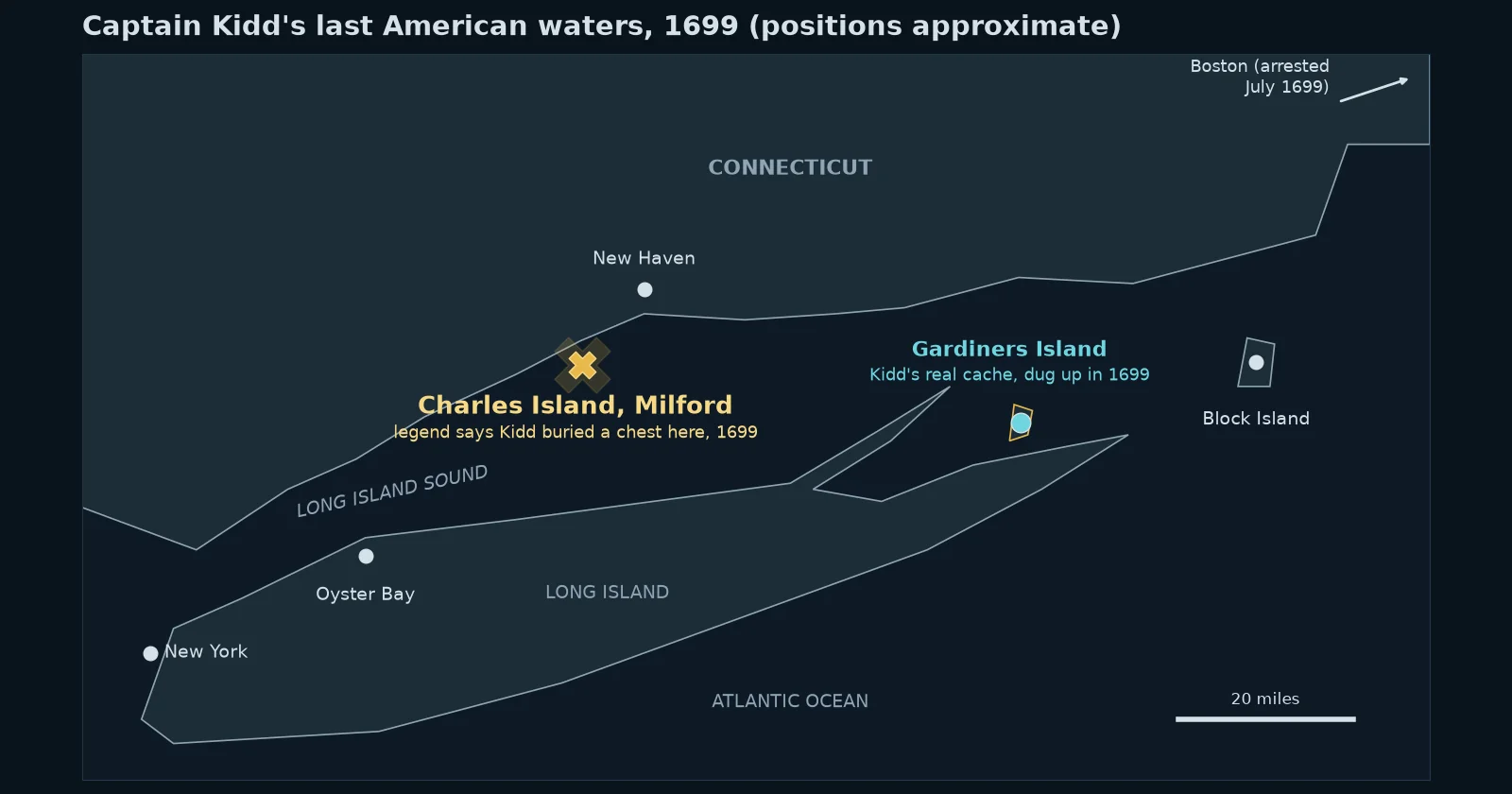
Kidd made his way back across the Atlantic in 1699 and found every friendly harbor closed to him. He left the Quedagh Merchant off Hispaniola (archaeologists from Indiana University later identified its wreck there, in shallow water off Catalina Island, after a snorkeler spotted cannons in 2007) and headed north in a smaller sloop, usually named as the Antonio. He crept into the waters around Long Island, called at Oyster Bay, and quietly buried a cache of treasure on Gardiners Island, off the eastern tip of Long Island, as a bargaining chip.
It didn't work. Bellomont, by then governor in Boston, lured him in with talk of a pardon and had him arrested on 6 July 1699. The Gardiners Island cache was dug up and shipped off: an old inventory counts 783 ounces of gold and 633 ounces of silver, along with jewels, silks and cloth of gold. Kidd was sent to England, held for close to two years, convicted of piracy and of Moore's murder, and hanged at Execution Dock in Wapping on 23 May 1701. The first rope broke; the second did not. His body was left hanging in chains by the Thames for years as a warning to others.
And here's the line that launched a thousand shovels. Kidd claimed, while bargaining for his life, that he had hidden far more than the Gardiners Island haul, more than £100,000 by one account, in other places. He never said where. The authorities never found it. Every inlet from Maine to the Carolinas has been arguing about it ever since. (Delaware Bay has its own Kidd story, which is a tale for another day.)
Did Captain Kidd ever stop at Charles Island?
Here is the honest answer: nobody can show that he did.
The legend says Kidd, on that last nervous run through Long Island Sound in 1699, slipped into Milford, rowed out to Charles Island and buried a chest on its south side, next to a rock. Some versions have him visiting Milford several times. Since Milford sits on the Sound between Oyster Bay and the eastern islands where he really did go ashore, the idea isn't absurd. It just isn't on paper.
The nearest thing to evidence is curious in its own right. In 1889, a writer named William Howe Downes published an article describing a "faded and torn letter," dated 1699 and written by a young woman, that had supposedly been found in a bundle of papers in the attic of one of Milford's oldest houses. It was said to describe a Kidd visit to the town. A researcher writing for the Friends of the Office of State Archaeology in 2016 went looking for that letter, and for any earlier mention of it, and couldn't find either. So the best clue is a lost letter about a lost treasure. Rather fitting, really.
The headless guardian of the iron chest
Every good treasure island needs a ghost story, and Charles Island's is a corker. It appears in Charles M. Skinner's 1896 collection Myths and Legends of Our Own Land, which gathered American folk tales.
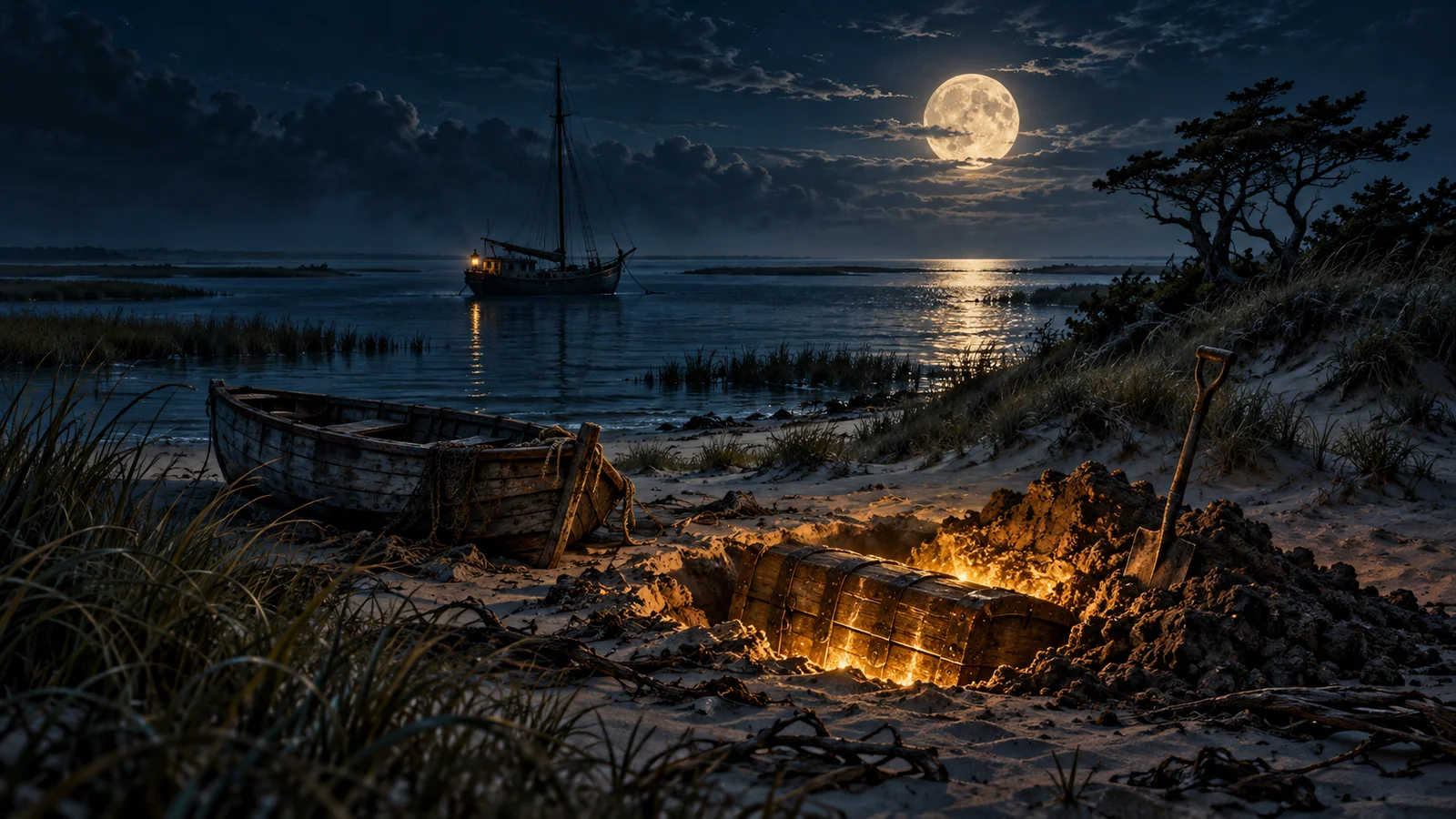
The story goes that a group of Milford men heard about Kidd's visit and reasoned, quite sensibly, that a pirate doesn't row ashore on a lonely island for the scenery. So one night they went out with lanterns, picks and spades, and they dug. And dug. Until a blade struck iron, and they cleared the lid of a chest.
At which point, according to the tale, a headless man came bounding down out of the air and leaped into the pit, and blue flames poured up out of the hole. The treasure hunters, showing excellent judgment, left. When they came back, their tools were gone and the ground was smooth again, as if nobody had ever touched it. Later tellings add smoke curling around the pit for good measure.

No names, no date and no newspaper report back it up, and similar "guardian spirit" tales are attached to Kidd sites all along the coast. Skinner's book places another one at Lion's Rock near Lyme, where a demon supposedly guards Kidd's gold and can only be kept off by reciting Scripture while you dig. Kidd, it seems, was terribly well staffed.
The three curses of Charles Island
Charles Island's real claim to fame isn't one curse. It's three, stacked like a layer cake of bad luck. Locals have long used them to explain a genuine oddity: for an island so close to a busy shore, nothing built on it ever seems to last.
Curse one: Ansantawae
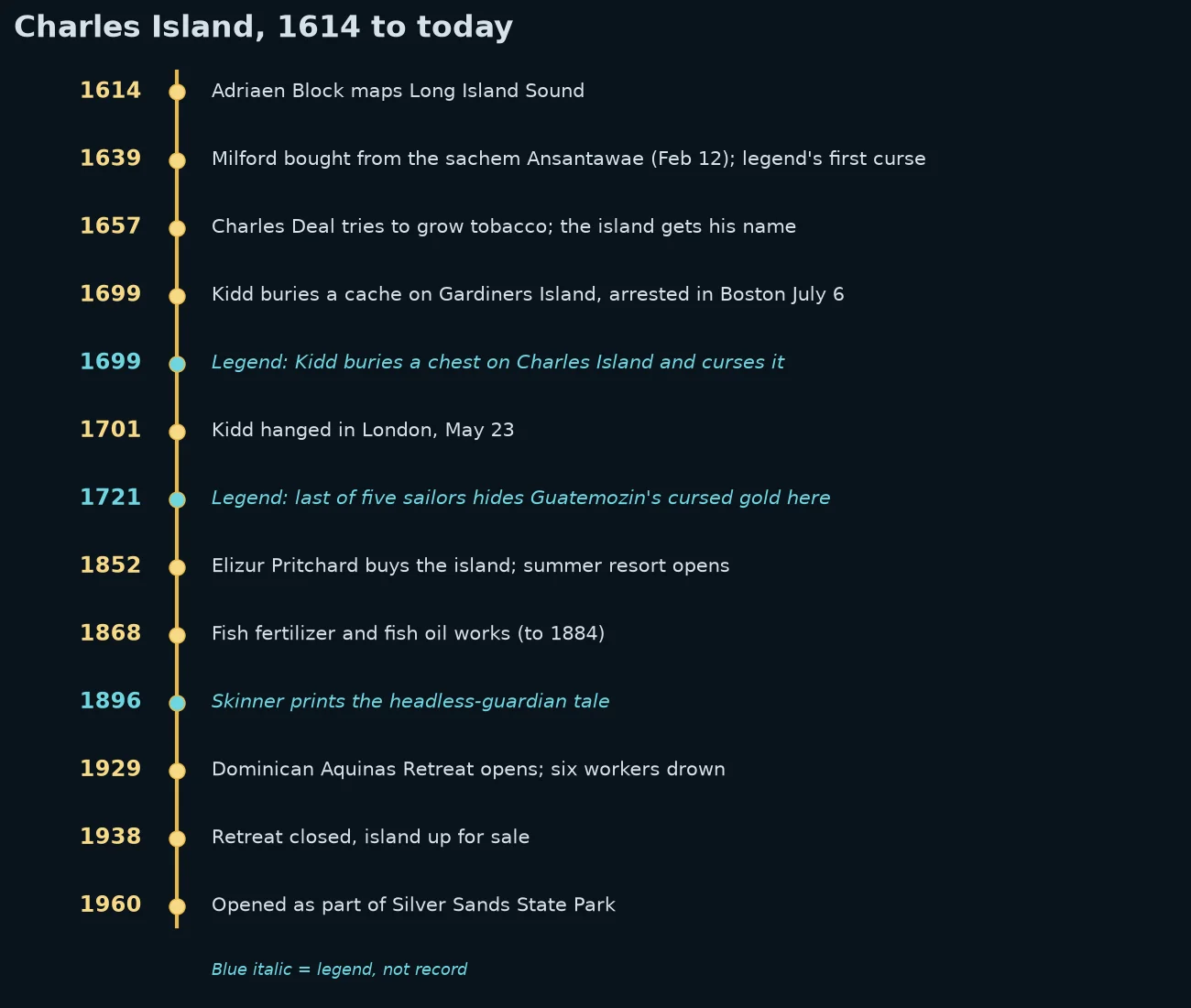
Before the English arrived, the island was known as Poquahaug (spellings vary), a name thought to mean "cleared land." Early local histories say Ansantawae, the sachem of the Paugussett people along the Milford shore, spent his summers there. On 12 February 1639, English settlers bought the land that became Milford from Ansantawae, and the island was included in the deed.
The legend says he cursed the island over the loss: in one version because he regretted the sale, in another because his daughter had been kidnapped. These are settler-era stories, not Paugussett tradition, and historians point out that nothing in the record supports either one. The Paugussett are a living people, so it's worth taking that particular "curse" with a large grain of salt.
Curse two: Captain Kidd
In this one, Kidd buries his chest in 1699 and lays a curse on anyone who disturbs it. Note the convenient bit: the curse explains perfectly why nobody has found the treasure. A curse that guards a treasure that may not exist is about as efficient as folklore gets.
Curse three: the gold of Guatemozin
And now the wild one. Cuauhtémoc (spelled Guatemozin or Guatmozin in older English books) was the last Aztec emperor. He was captured by Hernán Cortés's forces in 1521, tortured to make him reveal where the Aztec treasure was hidden, and executed in 1525 without giving it up. That part is real history.
The Connecticut sequel is not. According to the legend, in 1721 a band of Connecticut sailors found Cuauhtémoc's treasure hidden in a cave in Mexico and sailed home with it, bringing his curse along as a free extra. Disaster followed them. Four of the five men met grim and mysterious ends. The last survivor, by now thoroughly rattled, rowed the loot out to Charles Island and buried it, hoping to leave the curse behind with the gold. It worked for him, so the story goes, and the island has been paying for it ever since.
Tellers can't agree on the details. Some say four sailors, some five. One version even has the survivor hiding the treasure in the cellar of an old Milford inn instead, where a drunken customer stumbled onto it. Which is either a cautionary tale about drinking or an advertisement for it.
A real island that just won't settle down
Whatever you make of the curses, the island's actual history is a lovely run of plans that went sideways.
- The tobacco man (1657). Charles Deal bought the island and tried to grow tobacco, one of the earliest such attempts in Connecticut. It failed, but the name stuck: Charles Island.
- The summer resort (1835 to the 1880s). Major John Harris built a house in 1835. In 1852, Elizur Pritchard of Waterbury bought the island and turned it into a summer hotel, at one point called the Ansantawae House. Steamboats called from New Haven, and guests could cross by carriage at low tide. In November 1860, on Thanksgiving Day by one account, Pritchard died suddenly, probably of a heart attack, while hurrying back to the mainland ahead of the tide. His daughter Sarah kept the resort going and expanded it, with a big aquarium and, reportedly, a trained seal named Ned from P. T. Barnum.
- The fertilizer works (1868 to 1884). Part of the island was leased for a fish fertilizer and fish oil plant. The smell drifted ashore and the neighbors were not amused. The hotel burned in the 1880s, around the time the plant closed, and the island went into foreclosure in 1888.
- The prizefights (1870). In April 1870, Governor Marshall Jewell sent the state militia to break up two prizefights on the island, attended by what a report called a "large party of roughs" from New York.
- The retreat (1929 to the late 1930s). The Dominican friars of St. Mary's parish in New Haven built the Aquinas Retreat: a chapel, cabins, a dining hall, a grotto and Stations of the Cross along the paths. The first retreat was held over the Fourth of July weekend in 1929. That same year, six workers drowned when their boat went down on the way back to the mainland, and a statue of St. Christopher was put up in their memory. A stone chapel and a bell tower of local stone followed, but the retreat closed, and the island was for sale again by 1938.
- The ideas that never happened. An amusement park, a yacht club, a World War I wireless station and, at one point, a nuclear power plant were all floated. None got built.
Curse believers count all of that as proof. Skeptics point out that a tiny, exposed island cut off from the mainland twice a day is simply a hard place to run a business. Both sides agree the fish plant was a mistake.
Today the island is state land, opened in 1960 as part of Silver Sands State Park. The ruins of the retreat, including part of the bell tower and the chapel foundation, are slowly sliding into the Sound.

Where's the treasure? The theories, weighed
- Kidd really buried some of his loot there. He did hide treasure in Long Island Sound, he did claim there was more elsewhere, and Milford is on the way. The problem: no record puts him at Charles Island, and the letter that supposedly did can't be found.
- Someone's treasure, just not Kidd's. Coastal islands were handy hiding places in colonial times, and Kidd's name tends to get attached to any buried money on the East Coast. The island may have produced a find or two that grew into a legend.
- The Aztec hoard. The history of Cuauhtémoc is real; the 1721 sailors aren't documented anywhere, and the tale has the shape of a story built to explain a run of bad luck.
- Just a cracking story. A real pirate, a real treasure on a nearby island, a spooky little island that drowns its causeway twice a day and a town that loves a yarn. That's plenty to keep a legend going for three hundred years without a single coin.
The plain truth: no treasure has ever been found on Charles Island, by anyone, in any century. If the chest is there, the headless gentleman is doing a superb job.
Visiting Charles Island today: tides, birds and the rules
Fancy a look? Good news: you can walk to it, some of the year. Here's what to know before you go.
- The island is a bird sanctuary. Charles Island is a Natural Area Preserve and one of the largest wading bird rookeries in Connecticut, home to nesting herons and egrets. The state says the interior of the island is off limits to visitors at all times. In plain English: treasure hunting and digging are out of the question.
- Seasonal closure. Crossing to the island is not allowed during nesting season. Connecticut's state parks site currently says no crossing from May 1 through September 9; older signs and some guides give May 1 to August 31, so check the park's notice before you go and respect the posted signs.
- The tides are not joking. The sandbar, a natural feature called a tombolo, is underwater twice a day. The state warns that the tide can rise as much as ten feet in under two hours, and strong currents can strand you on the island until the next low tide, or worse. Go on a falling tide, start back early, and never wade across a flooded bar.
- The walk. The Charles Island trail is about a 1.5-mile round trip from the beach across the bar.
- Silver Sands State Park is open daily from 8 a.m. to sunset. Parking is free for Connecticut-registered cars; out-of-state cars pay a fee (at last check $15 on weekdays and $22 on weekends and holidays). The boardwalk gives a fine view of the island if the tide or the season says no.
So the treasure stays where the legend left it, under the egrets, guarded by three curses, a fast tide and one very persistent headless man. Brilliant, really. Some mysteries are better kept than solved.
...and if you find it, remember who encouraged your questionable life choices.
The short version of this story is on YouTube at @TenToeExpress.
Deep dive yourself
- A Good Spot and a Healthy Place: A Short History of Charles Island, by Nancy Finlay · Connecticut History, a CTHumanities project
- An Island Buried in History, by Michael C. Dooling · Friends of the Office of State Archaeology
- Silver Sands State Park · Connecticut State Parks (CT DEEP)
- Charles Island: The "Cursed" CT Landmark, by Andrew Fowler · Yankee Institute
- Charles Island · Atlas Obscura
- Myths and Legends of Our Own Land: As to Buried Treasure, by Charles M. Skinner (1896) · Project Gutenberg
- Captain Kidd's Quedagh Merchant · Indiana University Center for Underwater Science
- William Kidd and Charles Island (Connecticut) · Wikipedia (good starting points with further references)