 Ten Toe Express

Picture a small brook in East Granby, Connecticut, splitting into two forks under the oaks, with a few scratched marks on a rock that nobody can quite explain. Somewhere near it, the story goes, a Dutch pirate named David Marteen buried chests of Spanish gold more than 350 years ago. Nobody has ever dug them up. Plenty of people have tried.
Right then, here's the thing to know up front: David Marteen was a real man, a genuine privateer with a paper trail in the Caribbean. The Connecticut treasure is a different matter. It lives in local legend, treasure-hunting lists and one very determined searcher from the 1950s and 60s. Fancy sorting the fact from the folklore? Let's.
Who was David Marteen?
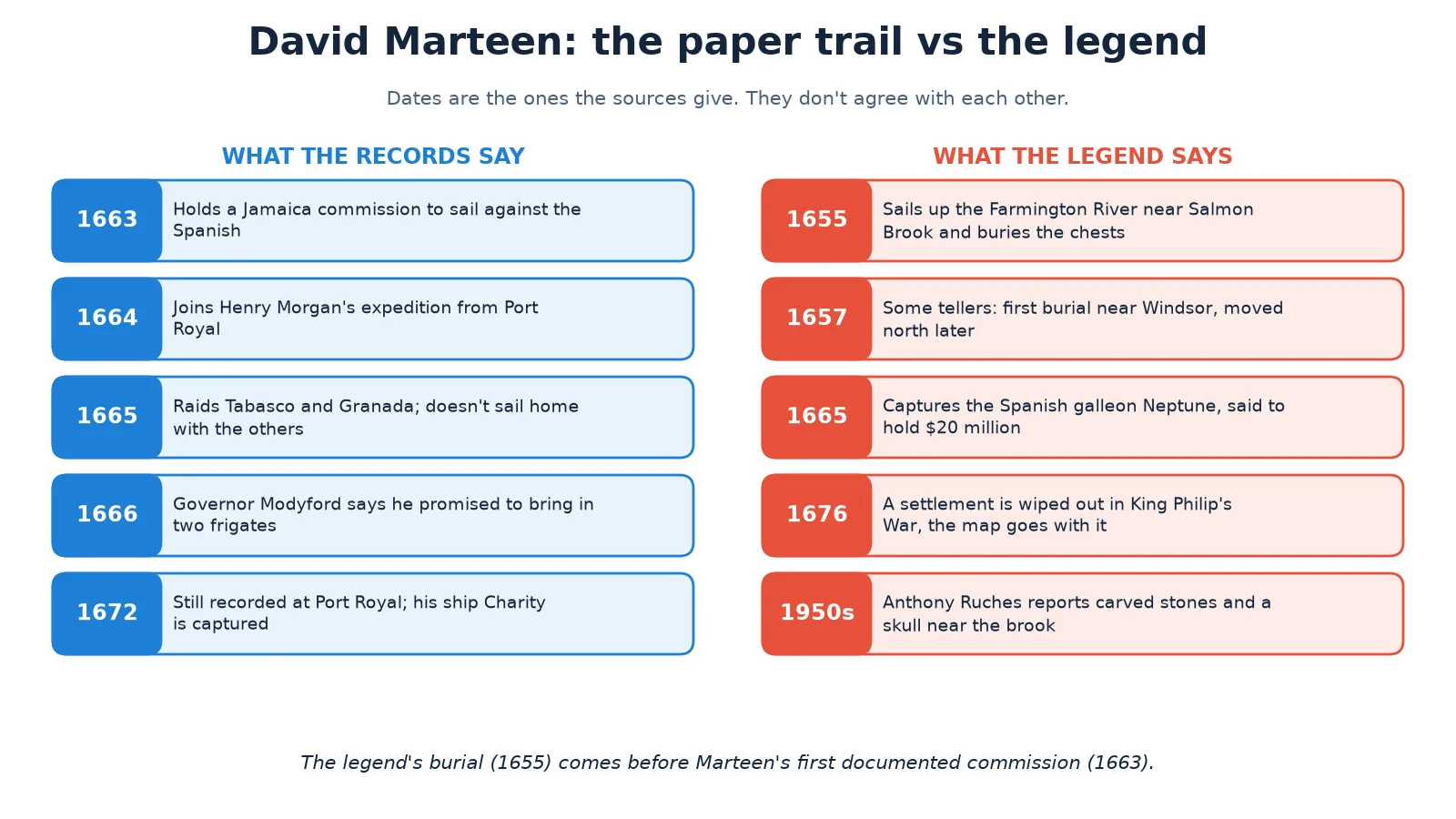
The real Marteen turns up in the records under many spellings: Martien, Martin, Marten, Martyn. He was a Dutch privateer, documented as active from 1651 to 1672. By 1663 he held a commission from the governor of Jamaica to sail against the Spanish, working from a small vessel called the Charity.
In 1664 he joined Henry Morgan's expedition out of Port Royal under letters of marque. The raiders looted Tabasco and Villahermosa, then pushed through the Yucatan, Honduras and Nicaragua, sacking Granada. Marteen did not sail home to Jamaica with the others in late 1665. He was the only Dutch captain in the party, and with England and the Netherlands at war, going back to an English port was an invitation to be locked up. He turned up on Tortuga instead.
The paper trail then thins out. In 1666 the Jamaican governor wrote that Marteen had promised to bring in two frigates. By 1672 the Charity had been captured by other privateers, and Marteen was recorded as still living at Port Royal. A pirate with an interesting career, then. What none of those records mention is Connecticut.
The legend: chests up the Farmington River
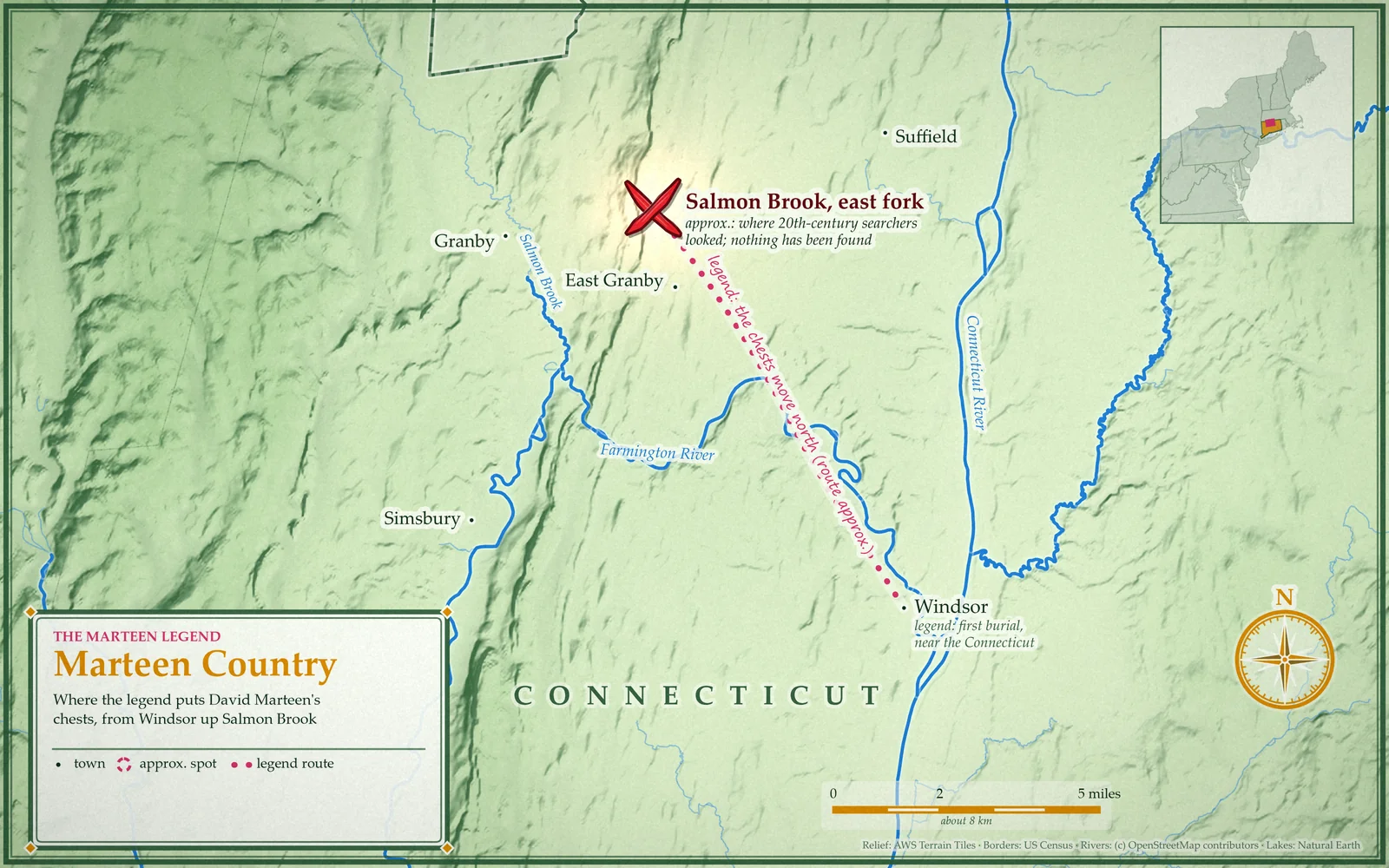
The Connecticut story comes in several flavours. The most common one runs like this. Marteen captures a Spanish galleon, the Neptune, loaded with gold. Sailing north, he takes his ship up the Connecticut River to a little settlement near Windsor, and buries the chests there. When the townsfolk grow suspicious (armed, outnumbering the pirates and thoroughly unimpressed), he agrees to clear off within two weeks. Rather than leave the loot where it might be found, he moves it about eight miles northwest to a fork in Salmon Brook, in what is now East Granby, and buries it again. He marks the spot with inscribed stones that work as a map.
The Wikipedia entry on Marteen has him sailing up the Farmington River near Salmon Brook in 1655, setting up a camp and burying treasure from the Neptune after being discovered. Another version says his men founded a settlement that was destroyed in King Philip's War in 1676, taking the secret of the burial with it. A third says the whole crew died at sea a year after the burial, which is rather convenient for anyone who wants a treasure nobody can check.
Why the story doesn't quite add up
Here's where the raised eyebrow comes in. Several details clash with the record:
- The dates. The 1655 burial comes before Marteen's first documented commission in 1663. Other tellings put the Neptune capture in October 1665, the same year he was, according to records, busy in Central America and then keeping clear of Jamaica.
- The ship. No source in the record names a galleon called the Neptune in connection with Marteen. One forum poster pointed out that Spanish ships of the period would usually carry Spanish names, "Neptuno" rather than Neptune.
- The landscape. The Salmon Brook Historical Society's timeline records the area being settled by English colonists from about 1680, after local Algonkian peoples gave up their land. A pirate camp there in the 1650s is a very long way ahead of the record.
- The money. The $20 million figure, and the "over $250 million" and "over $300 million" modern versions, are repeated across treasure sites with no source behind them.

None of this proves there is nothing buried near Salmon Brook. It does mean the Marteen connection rests on lore rather than documents.
Anthony Ruches and the carved stones
The searching is the best-documented part of the whole saga, and even that is mostly retold. According to a New England Legends podcast page, which cites a 1966 Hartford Courant article, a local treasure hunter named Anthony Ruches began metal-detecting in 1951, convinced the treasure was linked to the so-called Santa Barbara treasure. In 1956, the retelling says, he found strange markings on stones near the fork in Salmon Brook, along with crossed bones and a skull. He believed the chests might lie as deep as 20 feet. He kept at it for roughly 15 years and came up with no confirmed treasure.
Other versions rearrange the cast. One has a searcher named Richard Nelson combing the east fork in the 1920s and finding an inscribed stone before bringing in Ruches. It says that Ruches later sent the stones to an archaeologist, who declared them a treasure map carved by a crew member named Robert Caldwell. The podcast page says the Treasure Trove Club of New York reached the same Caldwell conclusion. A forum poster places the stone finds in the 1980s. The catch, in every telling, is that the map only works if the stones are laid back in their original positions, and nobody remembers where those were. The key stone is now said to be missing, possibly pocketed by other hunters.
The Hartford Courant article itself is the one concrete thing to look for, and it isn't easy to find online. The stones can't be inspected. The tidy "treasure map that can't be read" ending is the sort of detail legends grow naturally, so treat it as a story, not a finding.
The theories, weighed
- It's all real, and the chests are still down there. The appeal is obvious, but there is no record, no recovered coin and no verified stone.
- A real pirate, a borrowed story. Marteen was a genuine buccaneer, and 17th-century pirates certainly sailed the Atlantic coast. New England is full of buried pirate tales, and a real name makes a legend easier to believe. This fits the records best.
- The stones are real, the meaning isn't. Carved rocks do turn up in woods all over New England, and carvings can be decades old without being pirate maps. Without the stones, nobody can say.
- The settlement theory. If a settlement was destroyed in King Philip's War, as one version claims, the burial site could have been lost. That is a convenient explanation for why nothing was ever found, which is exactly why it deserves a raised eyebrow.
Where it stands today
The Marteen treasure remains unfound and unproven. The area around East Granby and the Farmington River is a mix of private property and public land, so digging holes along the brook without permission is trespassing, and the history here is better enjoyed from the footpaths and the library. The Salmon Brook Historical Society in Granby keeps the real local story, which has a good deal more documented history than the pirates do.
...and if you find it, remember who encouraged your questionable life choices.
The short version of this story is on YouTube at @TenToeExpress.
Deep dive yourself
- David Marteen · Wikipedia
- New England Legends: David Marteen's treasure · New England Legends podcast
- 10 Lost Treasures of Connecticut · TreasureSeekr
- 15 Real Treasures Hidden in Connecticut Worth Searching For · Rock Chasing
- The lost treasure of David Marteen · TreasureNet forum
- Sack of Campeche (1663) · Wikipedia
- Christopher Myngs · Golden Age of Piracy
- Archaeology in Granby · Salmon Brook Historical Society