 Ten Toe Express
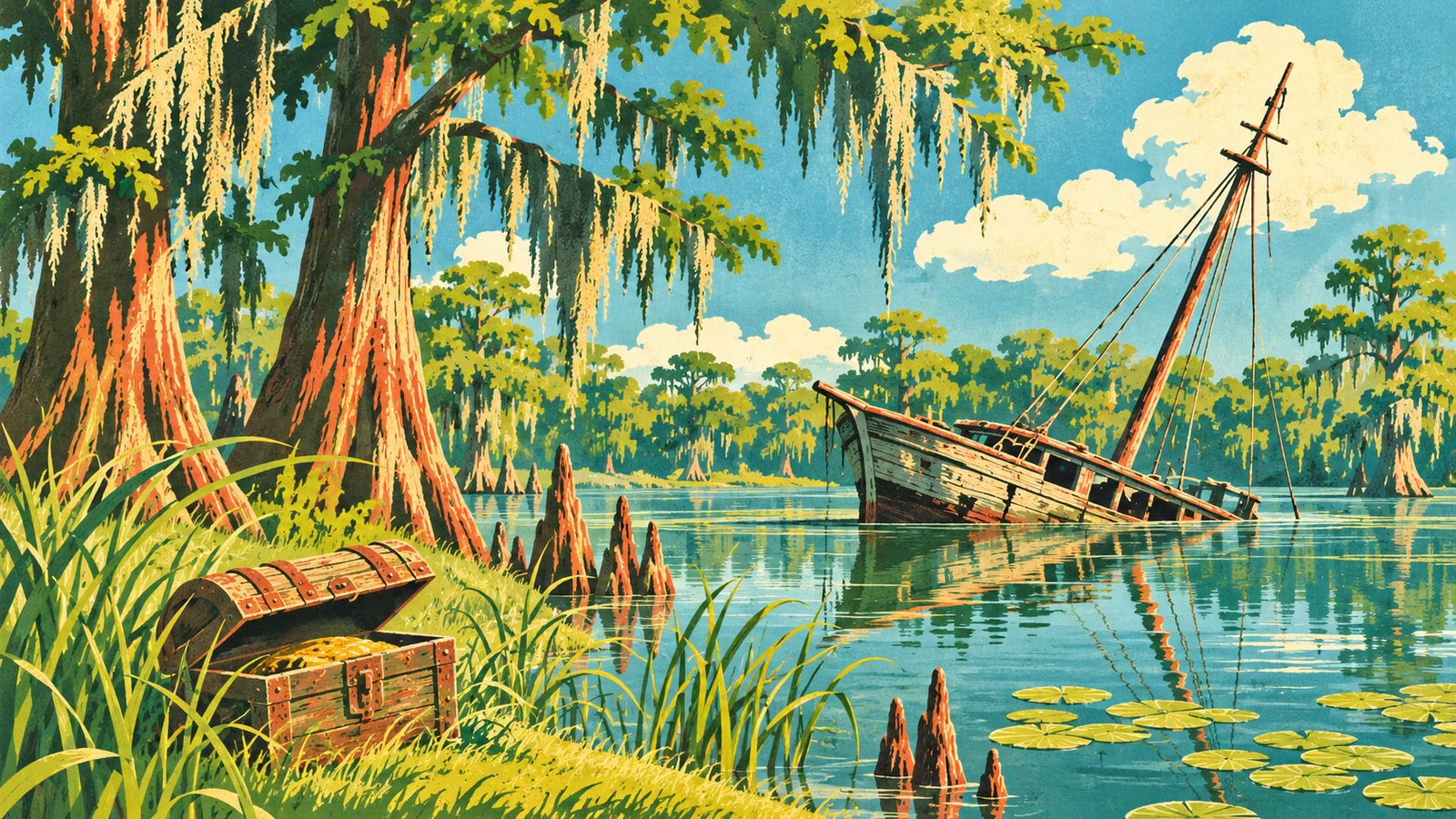
Right then, picture a quiet green bayou running through a modern Louisiana city. There is a university campus on one bank, port docks and a casino resort near the mouth, and a golf course named after the thing you came for. This is Contraband Bayou in Lake Charles, Louisiana, and according to local legend the pirate Jean Lafitte buried silver and gold somewhere along its shores. Nobody has ever produced a single coin to prove it.
That has not stopped anyone. Folks have been digging around Lake Charles for more than a century, a whole festival has been built on the rumour, and more than 5,000 pairs of crossed pirate pistols decorate the rails of the Interstate 10 bridge over the Calcasieu River. The bayou's name, at least, is real. What lies under it is another matter, and that is what this story sorts out.
Who was Jean Lafitte?
Start with the man, because he is the reason anyone cares. Jean Lafitte (many scholars spell it Laffite) was probably born in the early 1780s, in France or the French colony of Saint-Domingue, now Haiti. By 1810 he and his older brother Pierre were living in Louisiana. The National Park Service sums up the problem with his biography neatly: even the date and place of his birth and death are unknown.
What is known is that he was a smuggler. His base was the Barataria wetlands south of New Orleans, where American trade bans and the 1808 law ending the legal import of enslaved people created a thriving black market. Lafitte always insisted he was a privateer with a legal commission, not a pirate. American officials disagreed. His men were called Baratarians, and by 1812 he led them.
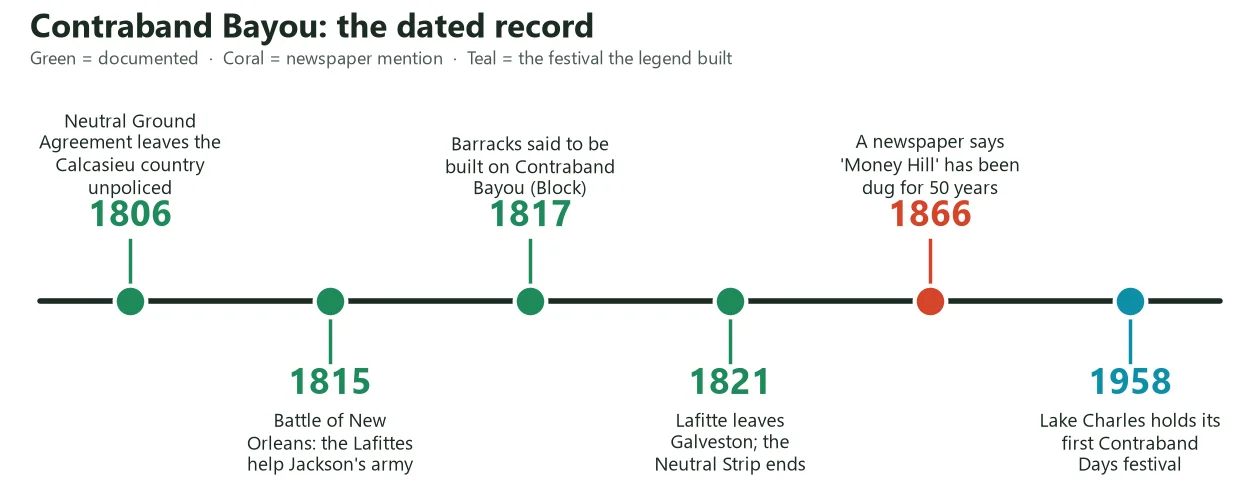
Then came the War of 1812. When the British threatened New Orleans in late 1814, the Lafittes offered help to General Andrew Jackson's army, and Jackson thanked them publicly afterwards. They were pardoned for past crimes, yet they did not come out of it rich. After the war they went back to raiding, set up on Galveston Island, and by 1820 and 1821 the United States had pushed them out of the Gulf of Mexico altogether. Jean's trail goes cold in the early 1820s.
Keep that last bit in mind. A man who spends his career being indicted, fined and chased by navy ships does not sound like someone with a spare fortune to bury.
The Neutral Strip: where Lafitte's name met the Calcasieu
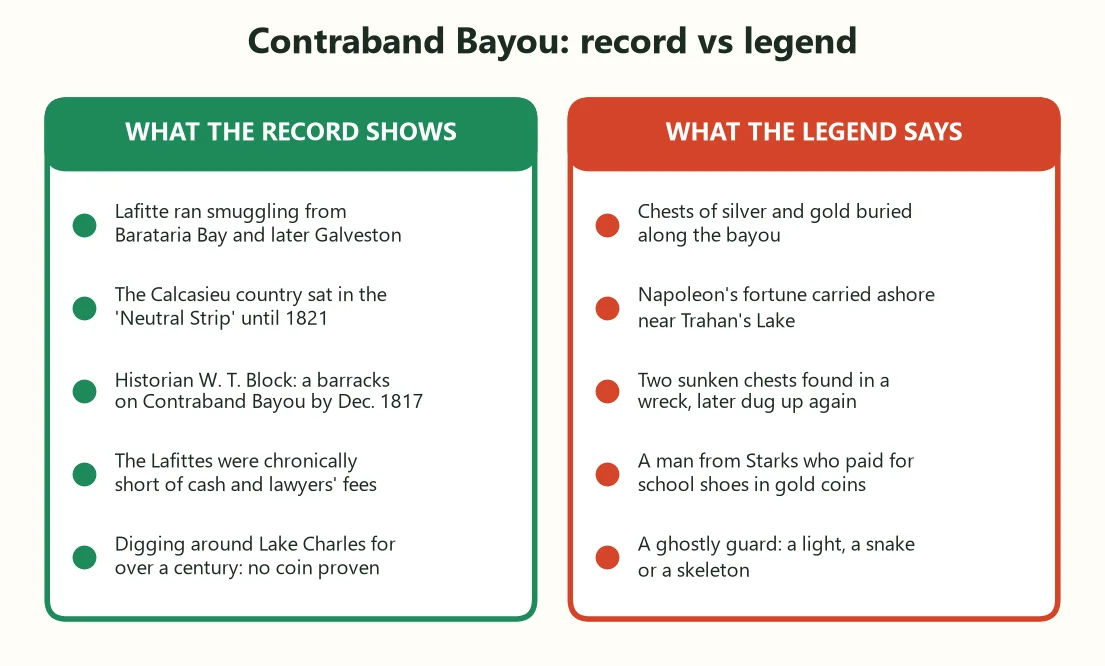
So why Lake Charles? Because of an odd scrap of border. In 1806 Spanish General Simon Herrera and American General James Wilkinson agreed to leave a stretch of land between Spanish Texas and the United States unpoliced while the boundary was disputed. This "Neutral Ground", sometimes called the Neutral Strip, ran roughly 40 miles wide across what is now Calcasieu and Cameron parishes in Louisiana, and the arrangement lasted until 1821. Historian W. T. Block, who wrote at length about the area, notes that it soon became a hideout for the lawless of two countries.
Block also writes that by December 1817 Lafitte had built two barracks for holding enslaved Africans in the Neutral Strip, one on Contraband Bayou, a tributary of the Calcasieu, and the other at Ballew's Ferry on the Sabine River. These were slave pens, and the bayou's name fits that trade: "contraband" was the official word for goods and people smuggled in against the law. It is a grim fact, and it belongs in the record before any talk of chests and doubloons. Block also records that John Bowie, one of the brothers who bought from Lafitte, put his profit from selling 1,500 Africans in Louisiana at $65,000 over two years.
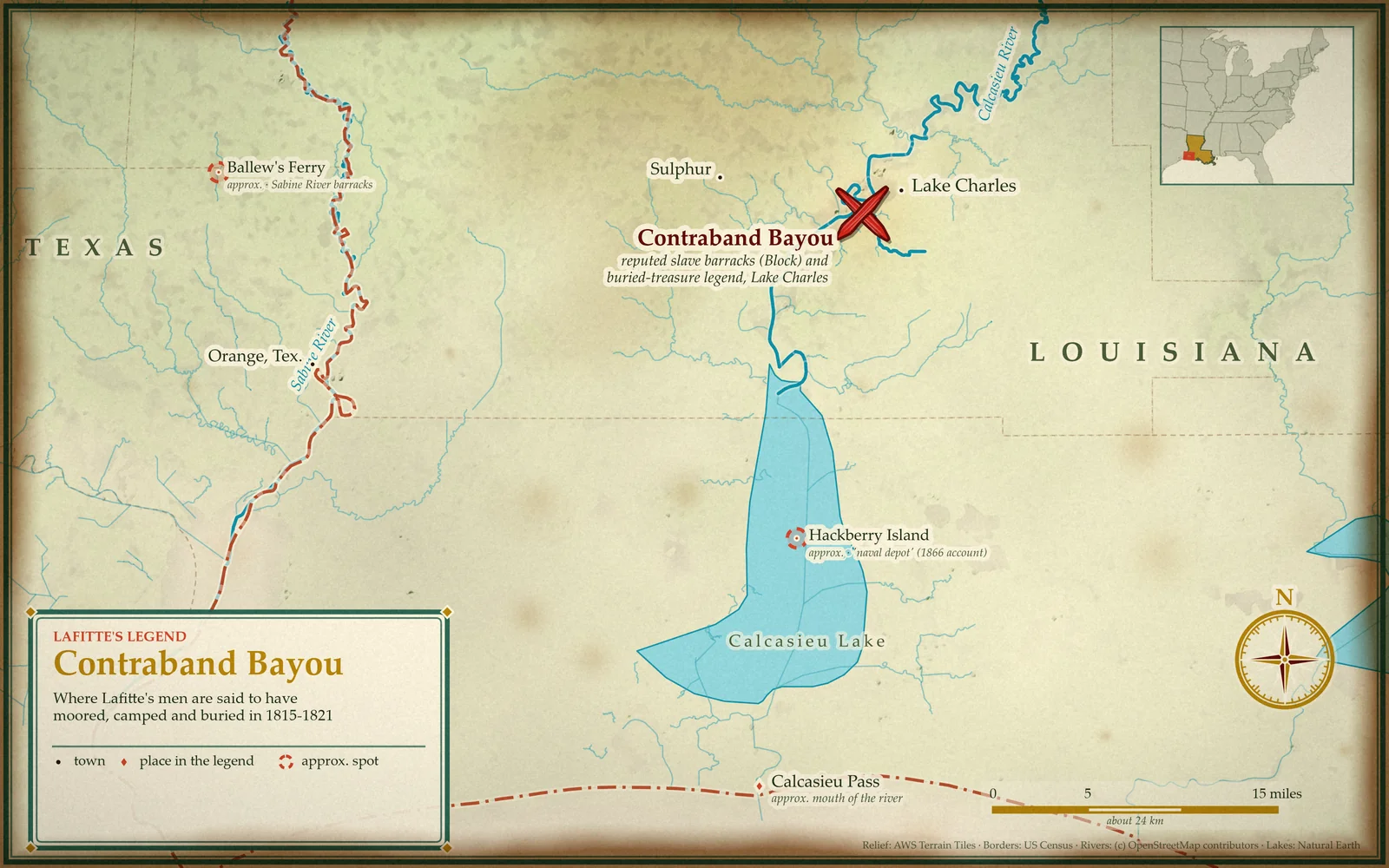
Local settlers also knew Lafitte's crews. Block names people such as Charles Sallier and Michel Pithon who reportedly supplied the ships with beef and vegetables when they anchored in the river, and it was their descendants, he says, who kept the Lafitte stories alive in the parish for the better part of a century.
What the legend says about Contraband Bayou
The treasure tales arrive in layers. Here is the short version of the layers, told as legend, not fact.
- The 1866 newspaper note. A traveller's account in the Galveston Weekly News said the Calcasieu was once the nest of Lafitte and his band. It pointed to Hackberry Island in Calcasieu Lake as their naval depot, and to a rise on the river called Money Hill as the place where Lafitte buried his money, which people had occasionally dug at for fifty years until the owner stopped them. Contraband Bayou, it added, was pointed out as a depot for smuggled goods and enslaved Africans. This is the oldest written version of the tale found for this article, so it is the best starting point. It is also hearsay: "is pointed out" is not the same as "was found".
- Money Hill. Block says this high ground was also called Barb's Shellbank, where the old Sallier house stood until it was moved on rollers to the edge of Lake Charles in 1841.
- The shipwreck chests. One tale has Lafitte's crew bury treasure near the shellbank, build a clamshell fort, and sink a leaky ship in the river. Years later two Acadian men scavenging the hulk supposedly found two chests of silver plate and bars, buried them on a marsh ridge, and came back for them. A fresh hole was said to have been found beneath a marked cypress, with rust marks where the chests had lain.
- Napoleon's fortune. The Sallier family story claims Lafitte sailed to France in 1815 to collect the defeated emperor's treasure chests, and later buried some of them on a marsh ridge near Trahan's Lake. This one has no support in the records, and it is the most obviously romantic of the lot.
- The man from Starks. A modern tale, told to a magazine writer in 2012, says a man would stroll into a swamp near Starks whenever his children needed school shoes and return with pockets full of gold coins, then lead followers in circles until he lost them. He reportedly died without saying where the coins came from. A separate claim says farmers near DeQuincy found Lafitte-era gold coins about 25 years before 2012. Neither has been backed by a photograph or an object.
Block's retelling of a folk story from a man called Wash adds a darker note. Wash, a formerly enslaved man who reportedly died in Lake Charles in 1880, supposedly saw three men ride to a green knoll on Contraband Bayou with a metal rod that pointed to buried gold. Only two came back out of the woods. It is a typical treasure-hunting tale: a dowsing rod, a chest, a murder and a witness too frightened to talk. Block himself says only that the legends are "true" in the sense that their tellers claimed to know Lafitte or his men, and that he cannot say whether any of them knew where gold was really buried.
He also spots the pattern in them. Most of the region's Lafitte treasure tales, he writes, involve a buried chest on a remote marsh ridge and a guardian, such as a strange light, a rattlesnake or a cutlass-wielding skeleton, set to lead gold hunters astray.
What the historians say
The scholars who know Lafitte best are blunt. Writing in New Orleans Magazine, journalist Deborah Burst reports that historians remain united in believing the pirate never buried treasure anywhere. William C. Davis, author of The Pirates Laffite, says pirates lived largely hand to mouth, and that anyone who buried a hoard had no guarantee of returning for it. Robert Vogel, who has spent more than 40 years studying the brothers' letters, said "Jean Laffite never buried any money," and described their correspondence as far more about lawyers' bills than treasure. He points out that the Lafitte brothers banked in New Orleans.
They also had a long run of legal trouble. The brothers hired the expensive attorney Edward Livingston, who took his fees up front, and when Jackson's thanks and a pardon did not bring a payout, they went back to piracy broke. Vogel calls the whole buried-pirate-gold idea a nineteenth-century romantic fad with long legs.
There is also a good bit of bad news for the souvenir hunters. Burst notes that in more than a century of digging around Lake Charles, no tangible or photographic evidence of any doubloon has turned up anywhere in southwest Louisiana. And a UCF historian, David Head, has said of the Lafittes that you sometimes get family lore passed down from a grandmother's uncle's neighbour. That is a fair description of how most of these stories travel.
How a legend became a festival
What no historian can deny is that a story can be worth more than a chest. In 1957 a group of Lake Charles businessmen from the Chamber of Commerce's downtown division formed the group that became the Louisiana Pirate Festival, and they chose a pirate theme built on the legend of Lafitte's buried treasure along Contraband Bayou. The first Contraband Days was held on June 29, 1958, a one-day event of boat races and a water-ski show, according to the American Press. It has since grown to a festival of around twelve days in early May, with attendance reported above 200,000.
The theatre is part of the fun. Each year a man chosen as "Jean Lafitte" sails to the waterfront with a band of costumed Buccaneers to capture the mayor and take over the city, while militia with cannons put up a mock defence. Mayors from around the parish are made to walk the plank into Lake Charles. Nobody is expected to believe it, and that is rather the charm.
Contraband Bayou today
The bayou is a working piece of city. It flows through Lake Charles, past the McNeese State University campus, and empties into Prien Lake. It has been dredged and channelized along parts of its length, and the salt water that came in with the dredging killed off some of the old cypress trees, leaving stumps standing in the water. Port of Lake Charles city docks and the L'Auberge resort, whose golf course carries the bayou's name, sit near the mouth.
That is the practical answer to "fancy a dig?". Those banks are a mix of private property, university grounds and port land, so no, you may not go digging along them. The legal way to chase the legend is the festival, the history books and the stories themselves.
Where it stands
So is there pirate gold at Contraband Bayou? The honest score is this. The bayou's connection to Lafitte's smuggling and slave trade rests on a historian's account of a barracks there in 1817. The treasure legends first appear in print decades later, they are second-hand, and the people best placed to know say Lafitte never buried a hoard. A man whose letters ask his brother for more money for the lawyers seems an unlikely candidate for a pirate with a pension fund.
Yet "never" is a large word for a man whose own birth and death are unrecorded, and whose region gave birth to a hundred hiding-spot stories. The bayou keeps its secrets, or it keeps nothing at all. Either way, it has paid for a very good party.
...and if you find it, remember who encouraged your questionable life choices.
The short version of this story is on YouTube at @TenToeExpress.
Deep dive yourself
- The Legacy of Jean Lafitte in Southwest Louisiana · W. T. Block, LAGenWeb Calcasieu Parish
- Jean Laffite · New Orleans Magazine
- Jean Lafitte: A Pirate's Life · National Park Service
- Contraband Bayou · Wikipedia
- The Story Behind the Louisiana Pirate Festival · Louisiana Pirate Festival
- 150th anniversary: Lake Charles "Festival Capital of the State" · American Press
- Pirates don't leave a paper trail · University of Central Florida College of Arts and Humanities