 Ten Toe Express

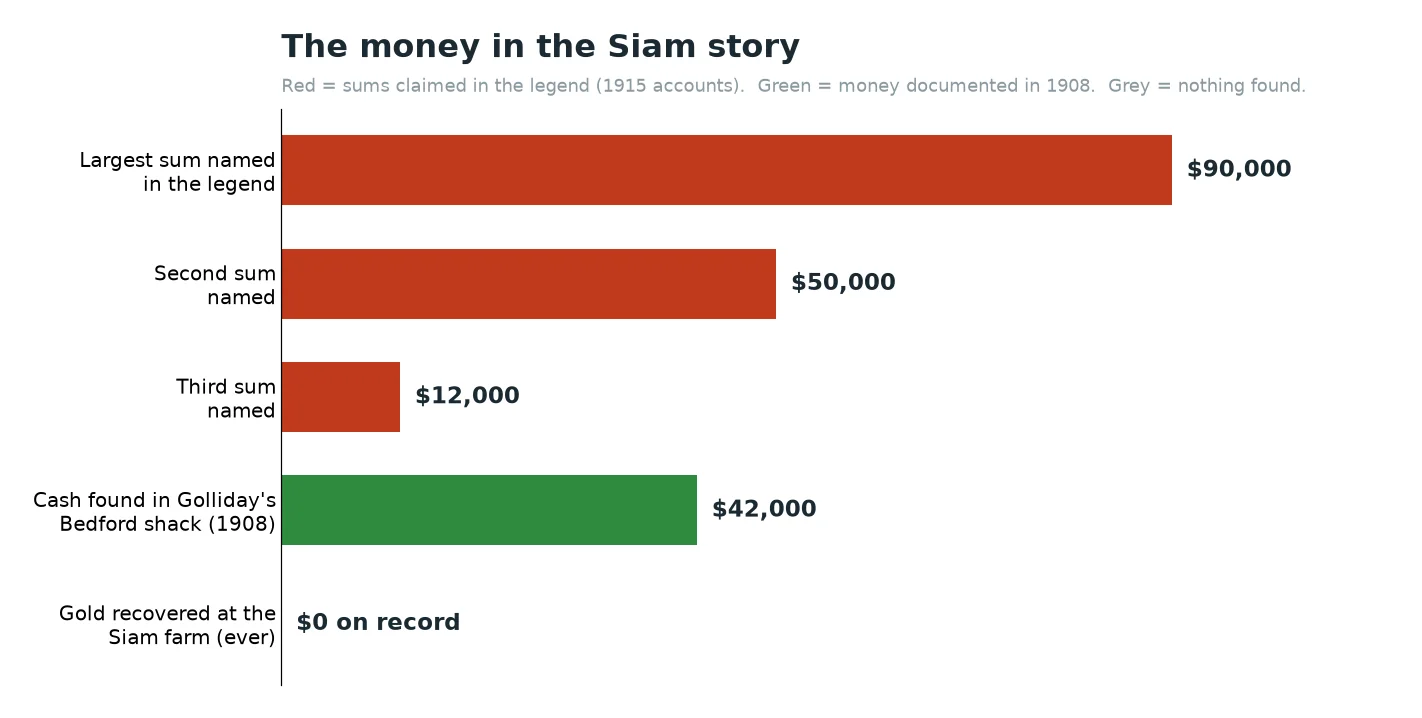
Right then, picture southwest Iowa in the summer of 1915. Hot July nights, a packed courtroom in Bedford, and four elderly men sitting in a row, charged with a murder that nobody could prove had ever happened. The prize at the end of the story: Siam's buried gold, somewhere on a farm in Taylor County, Iowa, and said to be worth as much as $90,000.
The gold was never found. Neither, as it turned out, was the body. What survived was one of the strangest treasure stories in the Midwest, complete with a haunted farm, a shadowy figure in the field, a box that vanished and a courtroom that burst into cheers.
Where Siam, Iowa actually is
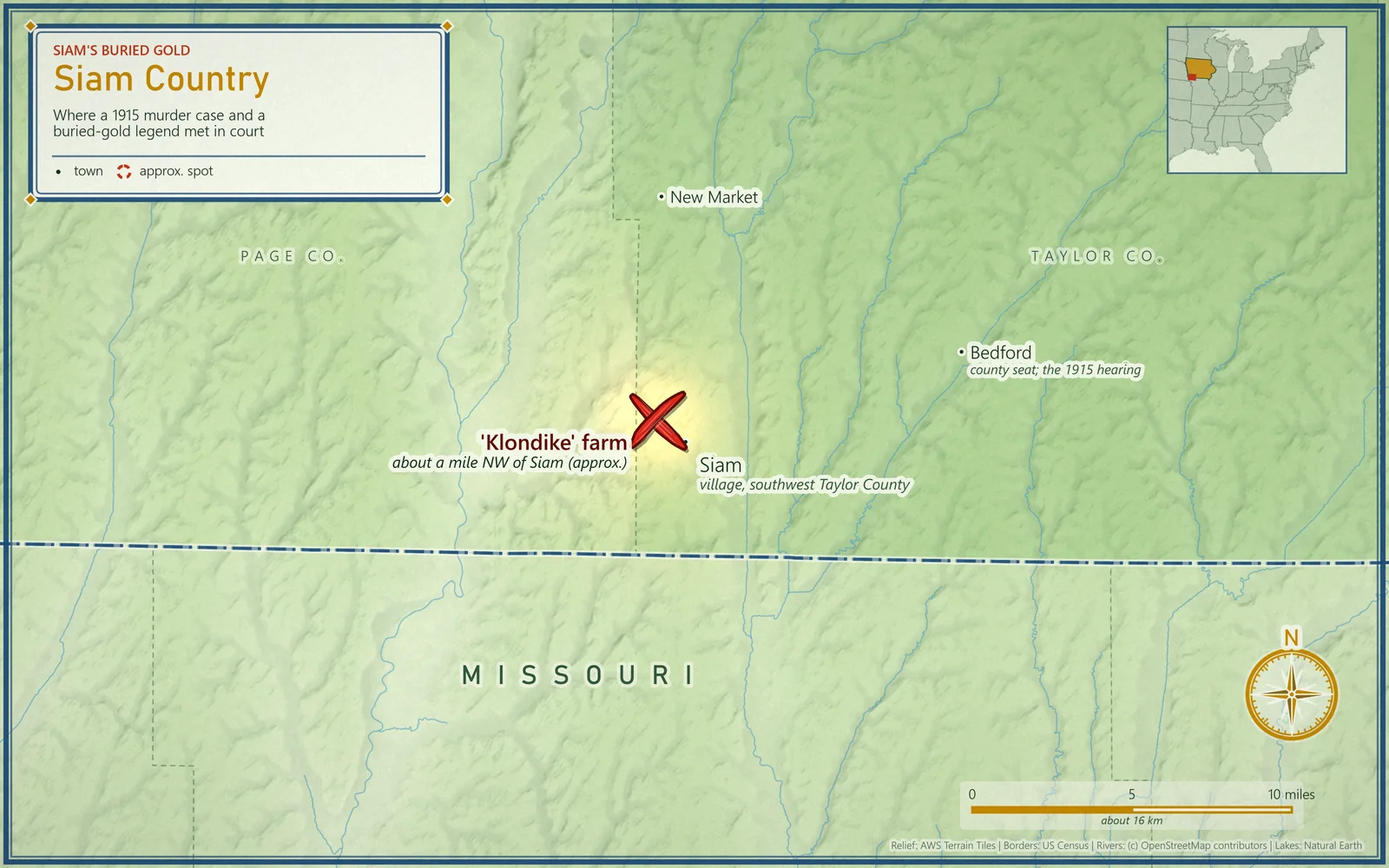
Siam is a tiny unincorporated community in Polk Township, Taylor County, about 3.5 miles north of the Missouri line and about 7 miles south of New Market. Its post office opened in 1860 under the name Buchanan and closed around the turn of the century. These days, very little is left apart from a church and a cemetery with more than 900 graves.
Back in the years after the Civil War, southwest Iowa was thinly settled, and the 1927 state historical journal The Palimpsest describes it as a rough, lawless sort of place. That matters, because the legend leans heavily on that reputation.
The legend: a cattle buyer, a boy and a trunk of cash
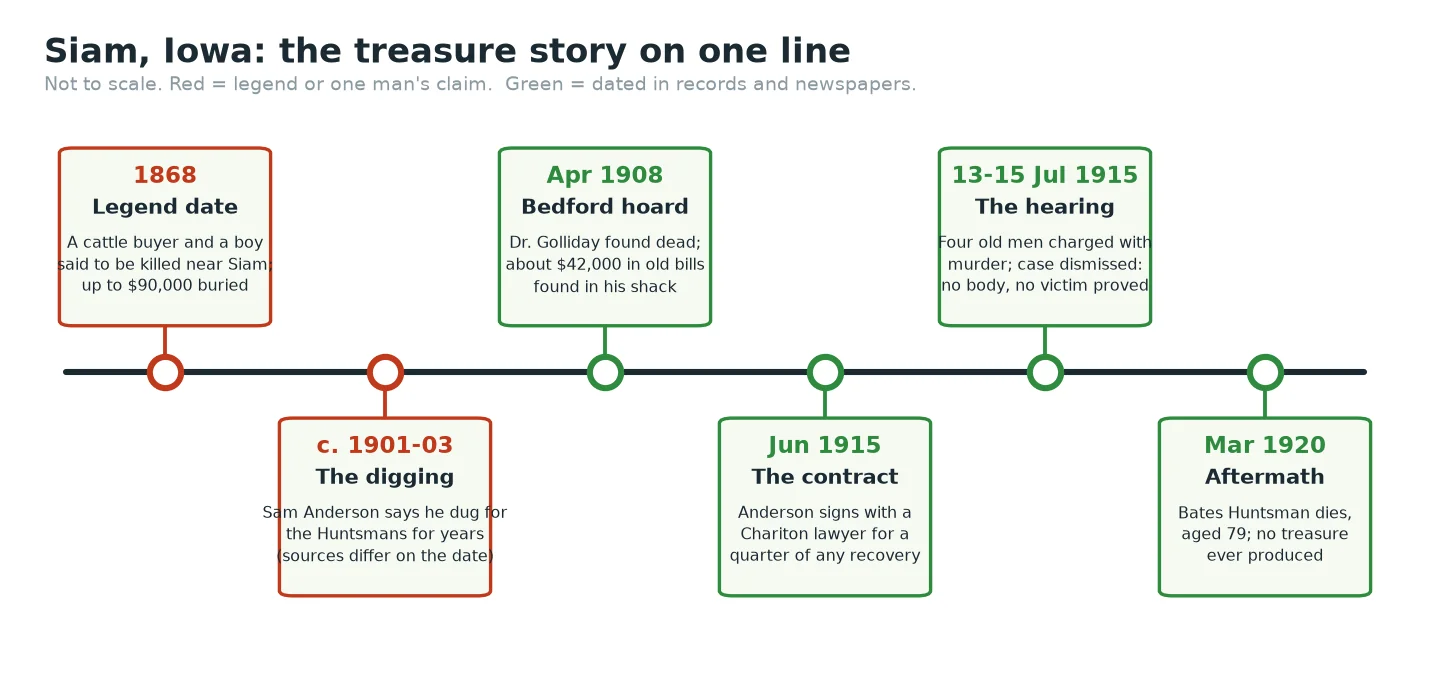
Here is the story as it was told in 1915. In 1868, a rich cattle buyer came to the Siam country, reportedly from the east or from Missouri, with a young companion and a trunk said to hold somewhere between $80,000 and $90,000. A gang of young men waylaid them. The man was killed and thrown into an old well. The boy ran, was caught, and was buried in a locust grove near the well.
The gang then buried the money and, so the story goes, drew a plat of the farm marking the spot. They planned to split the loot once the fuss died down. But a fire destroyed the cabin where the plat was kept, and the location was lost. (Other tellings say the key was a line of three stakes, or that the map simply burned. The accounts do not agree.)
Rumour put the blame on a handful of local men: Dr. C. R. Huntsman, his brother Bates Huntsman, Sam Scrivner, Hank and John Damewood, and two others who were already dead by 1915.
Pause here. Everything above is legend. It was told decades after the supposed crime, by interested parties, and no document from 1868 backs it up.
Sam Anderson goes digging
The documented part begins with Sam Anderson, a farmer in his seventies. According to his account, around the turn of the twentieth century (sources say about 1901 or 1903, one older newspaper says "nearly a quarter century" of digging) he was hired by the Huntsmans to dig for gold on the old farm nearby. The deal was a quarter of whatever he found.
The Huntsmans, he said, told him the money was buried in three places: $90,000 in one, $50,000 in another and $12,000 in a third. Dr. Huntsman's explanation was surprisingly dull. The cash, he said, came from selling a farm in Missouri and had been buried for safekeeping.
Anderson's story only gets stranger from there:
- Neighbours had warned him the farm was poor and haunted. He ignored them.
- One day a shadowy figure appeared in the field about a hundred yards off. Anderson fetched his old muzzle-loading shotgun, fired once, and the figure vanished. Dr. Huntsman was reportedly shaken for days.
- A cutting rig struck a soft spot in the ground. The next day, freshly dug earth turned up a bone about eight inches long, which Anderson took to be a boy's. Handed the bone, Bates Huntsman said he "never had anything to do with it."
- He found three charred stakes in a line, and then white sand that led up a hill to a box about the length of an arm, under a rock, in a hole twelve or thirteen feet deep.
Then, according to Anderson, Dr. Huntsman jumped into the hole and called a halt for the night. When Anderson demanded his share, the doctor's son turned up holding a gun. Anderson climbed out, and never saw the box again. Dr. Huntsman died not long after. Anderson was never paid.
That is Anderson's account, and only Anderson's. No one else has ever confirmed the box existed.
June 1915: a lawsuit turns into a murder case
Years later Anderson had moved to Lucas County, and in June 1915 he took his grievance to a Chariton attorney, Walter Washington Bulman. A contract was signed on June 12 for a quarter of any recovery, and cancelled by Bulman six days later. Bulman started asking questions, and the questions turned into something much bigger than a lawsuit over unpaid digging.
Four men were arrested: Bates Huntsman, 77, of Siam; Sam Scrivner, 74, a farmer from New Market said to be worth a tidy $50,000 from Iowa land; Hank Damewood, 61; and John Damewood, 64, Anderson's own son-in-law. The charge was the murder of a man of unknown identity. Each was released on $5,000 bond.
State agent G. A. Brunson arrested Huntsman at home. Asked about money, Huntsman said there was none on the place and mentioned something about the "Klondike." Asked about a boy, he said he did not know, and asked Brunson to stop questioning him. That is about as dramatic as the arrests got. Scrivner insisted he had never killed anything but livestock.
The Bedford hearing, 13 to 15 July 1915
Bedford treated the hearing like a public holiday. Crowds gathered at the Taylor County courthouse on July 13 and the preliminary hearing before Justice of the Peace M. A. Sawyer opened that hot evening in a packed room. The state brought in its attorney general, George Cosson, and the defence was led by the Flick law firm, with B. J. Flick pressing the case for dismissal.
The star witness was Maria Collins Porter, an elderly woman from Quitman, Missouri. She said that as a girl she had seen men carrying a heavy bundle past her home, recognised "Doc" Huntsman's voice, and glimpsed a body's dangling hand and leg. She said she was made to wash a bloody quilt, and that threats kept her silent for decades.
Under cross-examination, the details began to slip. She was unsure of the date, and she described the late Dr. Golliday, one of the men she named, wrongly. She had placed the events in September 1868, but the defence pointed out that her own father's tombstone gave a death date of 1876, which she could not explain. Anderson, for his part, testified only about the long digging and said he knew nothing of a murder.
The doctor's shack
One more thread tangled itself into the story. Dr. A. M. Golliday of Bedford, a former Rush Medical College graduate and once a popular doctor, had become a recluse behind a high board fence on Main Street. When he was found dead in his shack in 1908, searchers turned up about $42,000, much of it in old Treasury "Spinner" bills stuffed into pigeonholes, books and an old safe, and carried it to the bank in buckets. Banks in St. Joseph and Chicago refused the old notes, but the Treasury in Washington accepted them at face value. Some people wondered whether the Siam gold had been quietly dug up and tucked away in that shack. Friends of the doctor denied any link, and the evidence about him was ruled out of the hearing.
On July 15 the case ended in a few minutes. The state could not produce a body, and no witness had put the supposed victim anywhere near Siam. B. J. Flick moved to dismiss. Attorney General Cosson agreed, and Justice Sawyer dismissed the case against all four men. The courtroom, one account says, erupted in cheers.
Was the victim anyone at all?
Here is the awkward bit. In 1915 the "victim" was never named for certain. Newspapers floated Nathaniel Smith, a northern Missouri rancher who vanished in the late 1860s. Another candidate was William Hedrick, a horse trader who disappeared during the Civil War, but witnesses said Hedrick died early in the war, so Smith became the presumed victim. A 1919 Bellevue newspaper account put it bluntly: the state could not establish the existence of the man.
That is the central problem. A treasure needs an owner and a crime needs a victim, and the Siam story has neither on record.
What about the James brothers?
Of course the James gang turned up. A press dispatch from Fresno, California, quoted C. P. Huntsman, son of Dr. Huntsman, claiming his father and uncle had buried the bodies and the money on the orders of the James boys. Cole Younger denied it flatly, saying Frank James was in California from 1866 to 1870 and the gang was not yet organised, and that the Jameses never had anything near $90,000.
The Jesse James angle is a press claim from one man, in 1915, about events half a century earlier. It has no documents behind it.
What happened to everyone
- Sam Scrivner died on 7 September 1918 and has a tombstone in Siam Cemetery.
- Bates Huntsman died on 13 March 1920 and lies in an unmarked grave in Siam Cemetery. Local lore says he spent so much on digging that nothing was left for a stone.
- John Damewood died in 1936 and is buried near Braddyville.
- Sam Anderson died in November 1935 in Missouri, aged 92.
- W. W. Bulman lived to 98 and died in 1971.
A 1919 newspaper report says Bates Huntsman's sons were still digging, which is the only mention of any search after the hearing. Wikipedia notes that no evidence of the crime or the treasure has ever been found, though many have searched.
Siam's buried gold today: fact, legend and nothing
Sorting it out, plainly:
- Documented: The 1915 arrests of four men, the July 1915 hearing, the dismissal, and the 1908 discovery of Dr. Golliday's cash in Bedford.
- One man's claim: Anderson's account of the digging, the box and the bone.
- Legend: The 1868 killing, the trunk of $90,000, the burned plat and the James gang link.
- Unknown: Who, if anyone, died, and whether there was ever any gold in the ground.
The land around Siam is private farmland, so anyone curious should be content with the cemetery and the history books. The gold, if it was ever there, has outlasted every man who went looking for it.
...and if you find it, remember who encouraged your questionable life choices.
The short version of this story is on YouTube at @TenToeExpress.
Deep dive yourself
- Siam Gold (The Palimpsest, July 1927) · State Historical Society of Iowa, via IAGenWeb
- Mystery, murder and the Siam treasure (Part 1) · The Lucas Countyan
- Siam treasure, murder & a bucket of blood (Part 2) · The Lucas Countyan
- Siam treasure & secrets taken to the grave (Part 3) · The Lucas Countyan
- Buried Treasure At Bedford (Bellevue Leader, 1919) · Taylor County IAGenWeb
- Siam, Iowa · Wikipedia