 Ten Toe Express

Picture a steel safe, built airtight and waterproof, stuffed with millions of dollars in cash, bonds and gold. Now picture it buried in the Catskill Mountains of New York, somewhere near the little hamlet of Phoenicia, by a gangster who was dead within the year. That is the legend of Dutch Schultz's lost Catskills treasure, and right then, it has been wasting people's weekends for the better part of a century.
The strange part is that the gangster is entirely real, the shooting that killed him is thoroughly documented, and his last hours were taken down by a police stenographer. The treasure itself? That's another matter. Nobody has ever produced the safe, the map, or the shovel.
Who Was Dutch Schultz?
Arthur Simon Flegenheimer was born in the Bronx on August 6, 1901, to German Jewish immigrants. He left school after the eighth grade, drifted into burglary, and did 17 months in jail. By the mid-1920s he had a new name, "Dutch Schultz", and a bootlegging business that thrived through Prohibition. Later he moved into gambling and the numbers racket in New York City.
Gang wars in the late 1920s and early 1930s killed off a long list of rivals and made him one of the most feared gangsters in the city. They also attracted the attention of the law. A young prosecutor named Thomas E. Dewey was about to make Schultz's life very inconvenient indeed.
The Tax Trials That Took Him to the Mountains
Here is where the Catskills come into it. Schultz was indicted for tax evasion in New York in January 1933 and promptly vanished. He stayed on the run for months, then surrendered in Albany in November 1934, partly so his trials would be held upstate, far from New York City juries who knew exactly who he was.
It worked. His first trial, in Syracuse, ended in a hung jury. The retrial, in the small northern town of Malone, ended with an acquittal in the summer of 1935 after a jury deliberated for more than 28 hours. Some accounts suggest the jury may have been got at. Mayor Fiorello La Guardia was unimpressed and ordered that Schultz be arrested on sight if he set foot back in New York City.
Cash was tight at this stage. Schultz was spending heavily on lawyers and, by one account, cutting the commissions paid to the people who ran his numbers racket to fund his defence. His men grumbled and his standing slipped. The people he had to deal with in the underworld were running out of patience, which brings us to Newark.
The Newark Chop House, October 1935
On the night of October 23, 1935, Schultz sat down to dinner at the Palace Chop House in Newark, New Jersey, with his accountant Otto Berman, his lieutenant Abe Landau, and his bodyguard Bernard "Lulu" Rosenkrantz. Two gunmen from the crime syndicate's enforcement arm, Murder, Inc., Charles "The Bug" Workman and Emanuel "Mendy" Weiss, burst in and opened fire.
All four men were fatally wounded. Berman died in the early hours, Landau shortly after, and Rosenkrantz about 29 hours after the shooting. Schultz survived long enough to be rushed to hospital, operated on, and questioned. He died on October 24, 1935, at the age of 34.
The Deathbed Words
This is the part that keeps the legend alive. Police sent a stenographer to the hospital and took down everything Schultz said, and what he said was bizarre: rambling, broken, sometimes poetic, often nonsense. He asked not to be left alone, mentioned somebody called Bugs, and drifted through scraps of conversation. His last recorded words are usually given as "French-Canadian bean soup."
Buried in the babble, the story goes, were references to a cash box and to driving back to Phoenicia, and some people also read the line about Satan as a pointer to local landmarks. The statements were recorded; what they mean is entirely a matter of taste. Schultz was dying of peritonitis, had received last rites, and was by every account delirious. Treating a fever dream as a treasure map is a bold move. It has not stopped anyone.
The Legend of the Phoenicia Safe
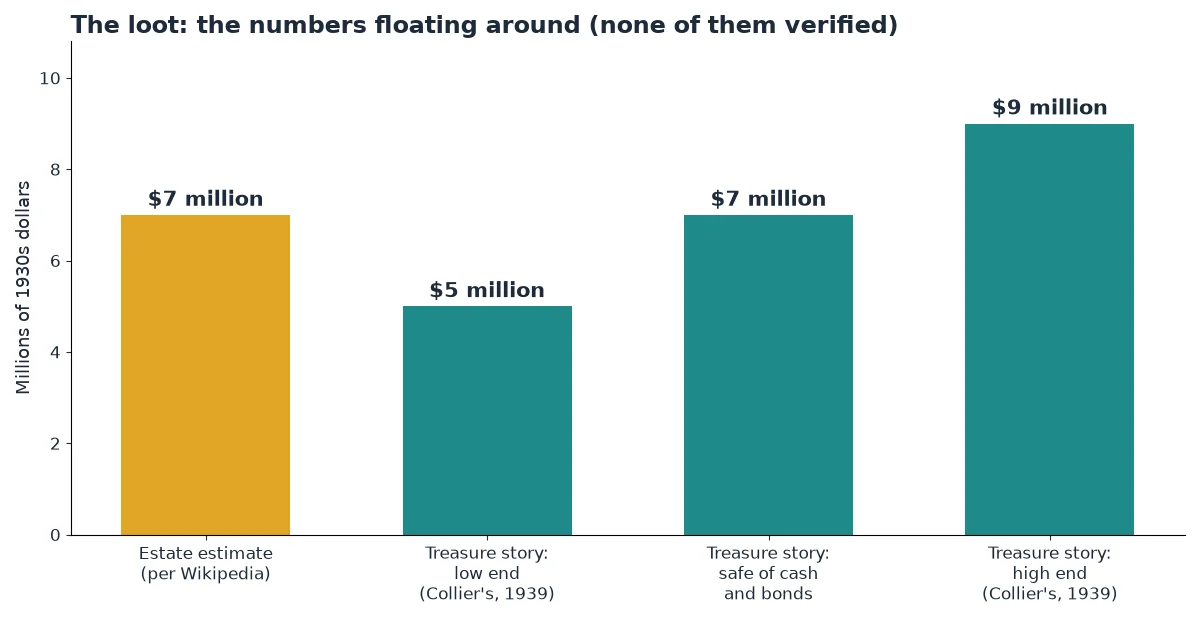
The tale as it is usually told runs like this. Fearing his tax troubles, Schultz had a waterproof, airtight steel safe built and loaded it with cash, bonds and gold, worth somewhere around $7 million. He and Rosenkrantz drove up to the Phoenicia area, a part of the Catskills where Schultz's bootlegging operation was known to have been active, and buried it. Rosenkrantz then died alongside him in Newark, taking whatever he knew to the grave.
Where, exactly? Take your pick. Different tellings put it in the woods near Esopus Creek, in a pine grove, under the railroad tracks, at a campground, or beneath a skull-shaped rock called the Devil's Face along Stony Clove Creek, where the pair supposedly stopped for lunch at a Phoenicia hotel before heading off with shovels. Locals reportedly spotted two men with shovels near the creek at the time, though that is the sort of detail that tends to appear only after the story is famous.
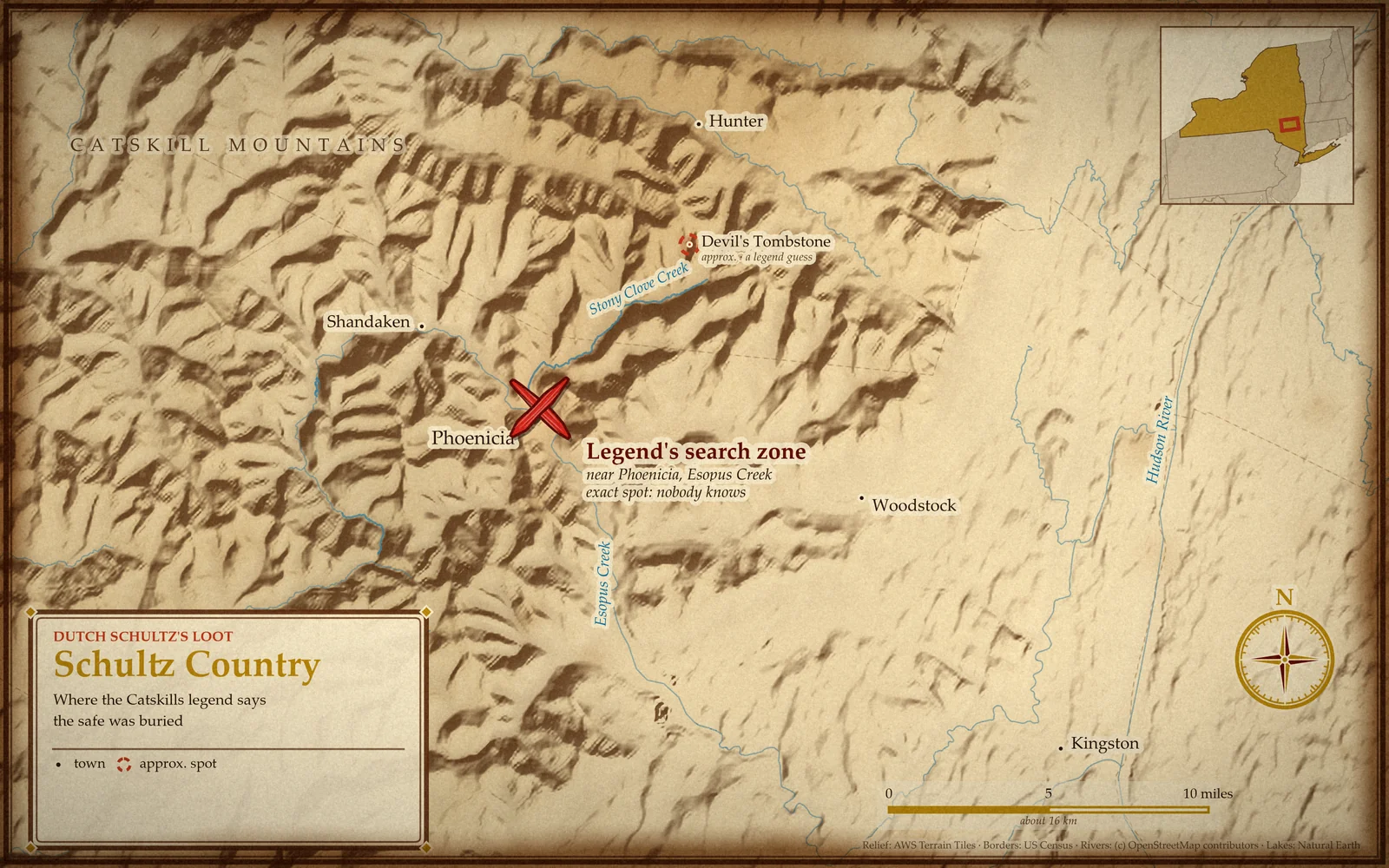
Dixie Davis, Schultz's lawyer, is the key witness. In 1939 he told Collier's magazine that Schultz had stuffed a steel strongbox with cash, bonds and diamonds worth perhaps $5 to $9 million. That is where the number in most retellings comes from. A rumoured map is said to have turned up later, though in one telling it points to a spot now underneath a state highway, which is rather inconvenient for a shovel.
Searches Since: Trenches, Truck Doors and a Bachelor Party
People have been looking for a very long time. A self-described treasure hunter named Tony Houston searched in the 1970s and came away with a truck door and the remains of a moonshine still. By 1997 a Phoenicia librarian said visitors routinely asked her for maps of the area. One determined digger kept at it until he had to be warned off, because his trenches were making the nearby railroad tracks unstable. Trees across the area have been marked with an X, and some of those marks, the story goes, were made by people hoping to send rivals up the wrong hill.
In 2005 a newspaper followed a bachelor-party crew into the Phoenicia pines, armed with a sketchy map that had come by email. They found woods. The same article noted that the search area is more than four times the size of Central Park.
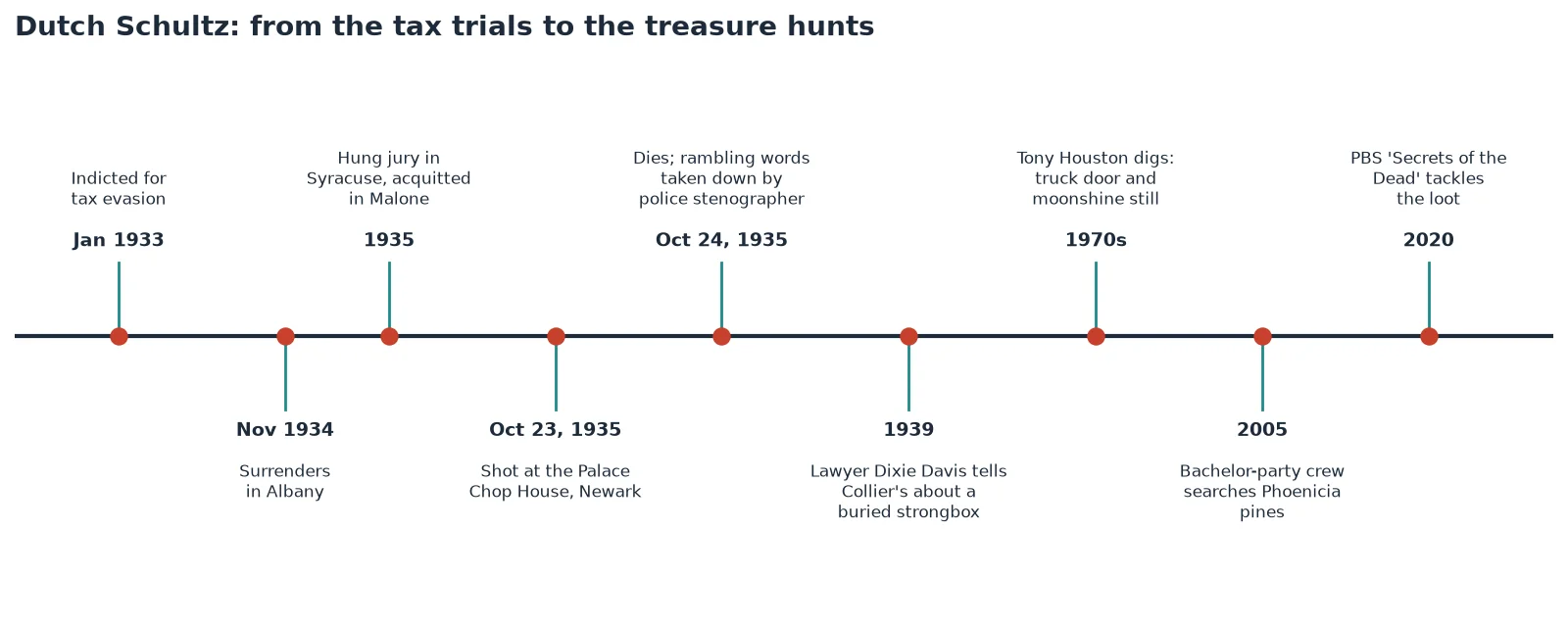
The legend has also kept the entertainment industry busy. A documentary called Digging for Dutch appeared in 2001, PBS aired a Secrets of the Dead episode called "Gangster's Gold" in November 2020, and Expedition Unknown looked at it in 2022. Local historian John Conway, the Sullivan County historian, wrote a book on the subject, Dutch Schultz and His Lost Catskills' Treasure.
Fact, Legend and the Missing Money
What the records show: Schultz was real, dangerous, and a regular visitor to the Phoenicia area. He was indicted, tried twice and acquitted. He was shot on October 23, 1935 and died the next day. His hospital ramblings were written down. His estate was estimated at around $7 million, yet no trace of it was found.
What is legend: everything else. That a safe was built, that it was buried, that Phoenicia is the place, that there was a map, that the words on the hospital bed point to it. Even the contents change from telling to telling: cash, gold, jewels, or Liberty bonds.
Was It Ever Buried?
Weigh it up. In favour: Schultz was famously careful with money and did not flaunt his wealth, and a man with a large estate that nobody could find has to have put it somewhere. Mob money had a habit of vanishing after a death. Against: no source shows that Schultz or Rosenkrantz ever told anyone where anything was. The locations contradict each other, and the key witness is a lawyer talking to a magazine four years after the fact.
Mafia historian Allan May has pointed out that burying a fortune more than 100 miles from Schultz's usual territory makes little sense. A man who ran the numbers racket in New York City could have used a hundred closer hiding places, and he had every reason to keep the money where he could reach it quickly. The simplest explanation may be that the money was spent, seized, hidden somewhere ordinary, or never as large as the legend says. Spoiling a good story is rarely popular, but there it is.
Where It Stands Today
The Catskills are a real place to visit, and Phoenicia is a pleasant little hamlet on Esopus Creek, well worth a stop for the scenery alone. The legend, though, has no confirmed site to see. The countryside around is a mix of private property and protected state land, so a hunt is not something to improvise with a spade. The safe has never been found, and neither has proof that it exists. Most days, the best treasure on offer is the autumn colour.
...and if you find it, remember who encouraged your questionable life choices.
The short version of this story is on YouTube at @TenToeExpress.
Deep dive yourself
- Mobster Dutch Schultz & His Hidden Treasure · Legends of America
- The Dutch Schultz Treasure Mystery · Mental Floss
- The Lost Treasure of Phoenicia · American Catskills
- Buried booty still attracts curious treasure hunters · The Vindicator archives
- Dutch Schultz and His Lost Catskills' Treasure, by John Conway · Sullivan County Historical Society
- Dutch Schultz · Wikipedia