 Ten Toe Express

Picture a Union Pacific express rolling west to east across the Nebraska prairie on a Tuesday night in September 1877. Inside the express car sit three plain wooden boxes. Nobody has bothered to lock them in the safe. Inside the boxes: roughly $60,000 in brand-new $20 gold pieces, fresh from the San Francisco Mint. Six masked men are about to climb aboard at Big Springs, Nebraska, and one of them will spend the rest of his short life becoming a legend.
Right then. The Big Springs train robbery is a proper piece of Old West history, with names, dates and a body count that sources broadly agree on. The "lost treasure" part is murkier: some of that gold was recovered within days, and some of it simply vanished into the prairie, the Texas Hill Country and the pockets of men who weren't telling. Here's what's documented, what's legend, and what nobody knows.
Who Was Sam Bass Before Big Springs?
Sam Bass was born near Mitchell, Indiana, on July 21, 1851, and was orphaned before he turned 13. He ran away in 1869, worked in a Mississippi sawmill and turned up in Denton, Texas, in 1870, where he worked with horses and drove freight wagons. In 1874 he began racing a quick horse known as the Denton Mare.
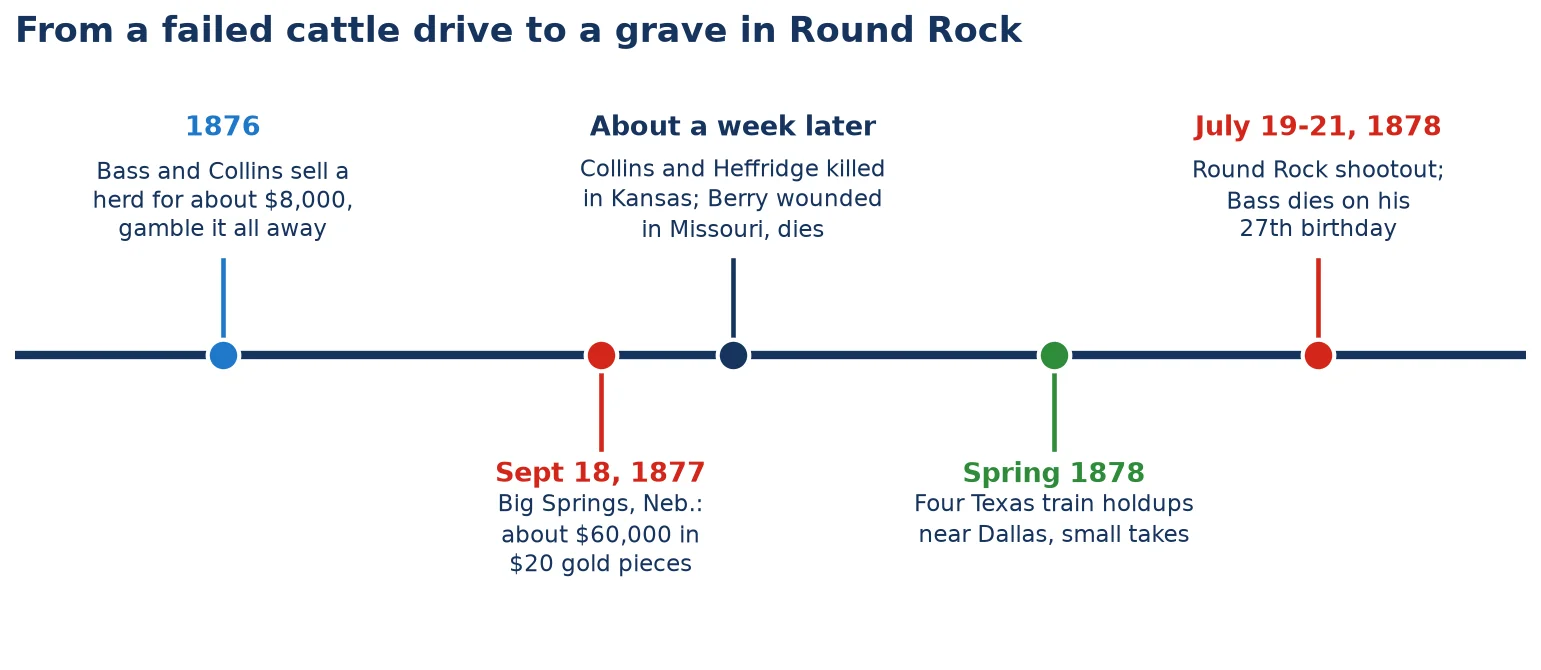
In 1876 he and Joel Collins drove a small herd of longhorns north and sold the cattle for about $8,000. Then they gambled the lot away, in Ogallala, Nebraska, and in Deadwood, in what was then Dakota Territory. A year later their freighting business had failed too. Broke, with a talent for losing money rather than keeping it, they turned to robbing stagecoaches. They held up seven. The takings were small. A bigger target was needed.
The Big Springs Robbery, September 18, 1877
The target was the eastbound Union Pacific express. Six men were in on it: Bass, Collins, Jack Davis, Tom Nixon, Bill Heffridge and Jim Berry. According to the accounts, they captured the station master, John Barnhart, at the isolated Big Springs water stop, wrecked the telegraph so nobody could raise the alarm, and boarded the train after dark.
The express messenger insisted the main safe had a time lock and he couldn't open it. One of the robbers pistol-whipped him. Bass, to his credit, decided the man was telling the truth and pleaded for the beating to stop. The way safe held only about $450.
Then one of the gang spotted three wooden boxes stacked near the safe and broke one open. Gold. Why the coins weren't in the safe is, as one account puts it, unknown. Each box is said to have held about $20,000 in $20 gold pieces, so about $60,000 in total. The robbers then worked through the passengers and collected around $1,300 and four gold watches. It is still described as the largest single robbery in Union Pacific history.
The Split Under the Lone Tree
The story goes that the gang divided the gold six ways under a lone cottonwood on the prairie near Big Springs. The local historical marker repeats the tradition, adding that the old tree died long ago. The share size, $10,000 a man, comes from Texas Ranger James B. Gillett's 1921 account, which is a recollection rather than a bank statement, so treat the tidy arithmetic with a raised eyebrow.
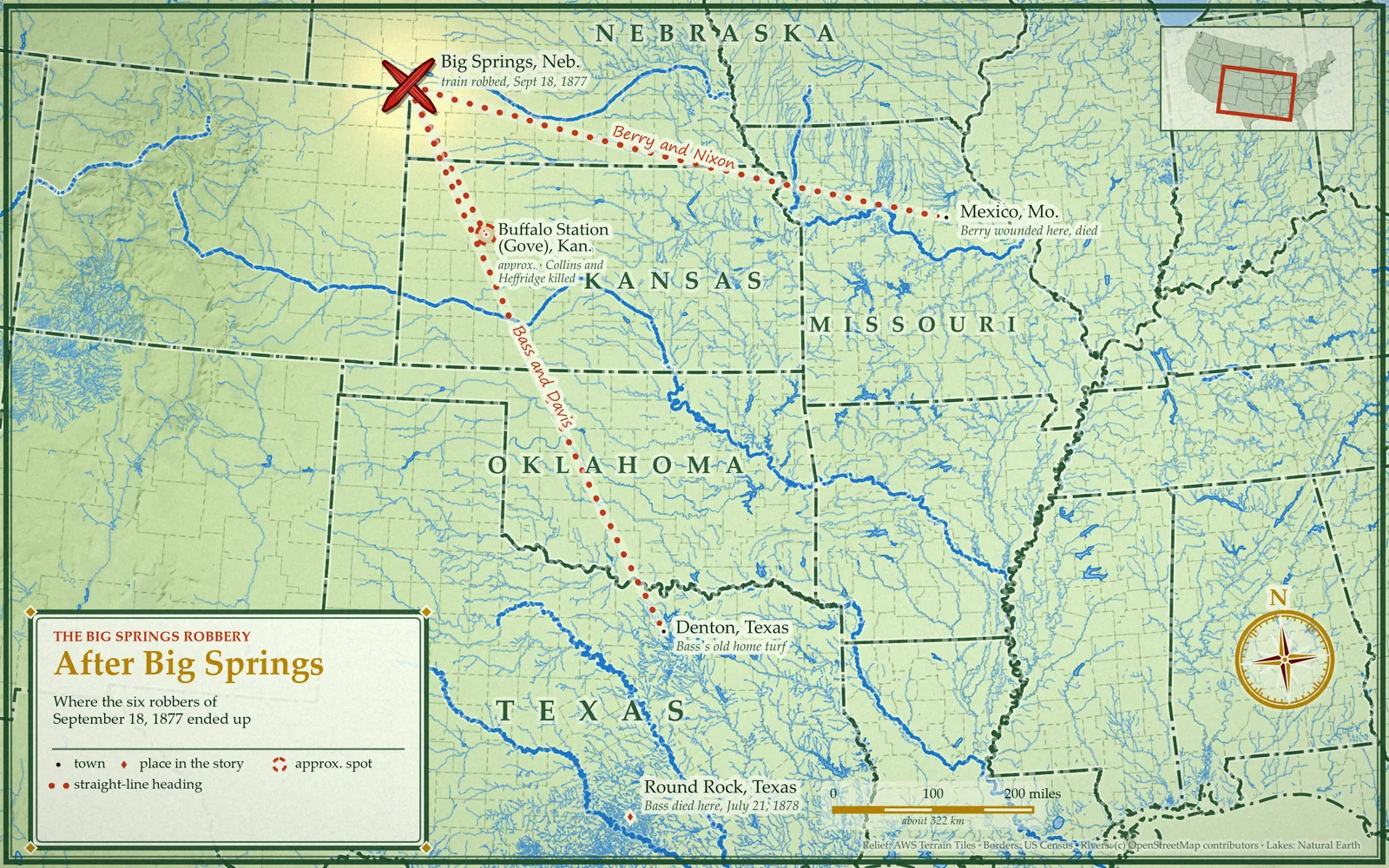
After the split the gang paired off and scattered in three directions:
- Collins and Heffridge: toward Texas by way of Kansas
- Bass and Davis: south toward Denton County, Texas, by buggy, with the gold hidden under their bedding
- Berry and Nixon: toward Mexico, Missouri
What Happened to the Gold and the Gang?
The getaway did not go well, which is rather inconvenient when you are carrying $60,000 in coins.
- Joel Collins and Bill Heffridge were killed about a week later near Buffalo Station, Kansas (today's Gove), when a sheriff's posse and a troop of soldiers caught up with them after a railroad agent identified the pair. Around $20,000 in gold was recovered.
- Jim Berry was wounded in a clash with law officers near his home in Mexico, Missouri, and died a couple of days later. About $2,840 in cash was recovered from him, though Gillett's account says most of Berry's share was recovered, so sources differ.
- Tom Nixon split from Berry and disappeared with his share. He was never caught, and the long-told guess is that he made for Canada.
- Jack Davis escaped with Bass. He reportedly urged Bass to flee to South America and was never seen again. Gillett says Bass once received a letter from Davis in New Orleans.
- Sam Bass posed as a farmer, claimed his sudden riches came from a Black Hills gold strike, and went home to Texas.
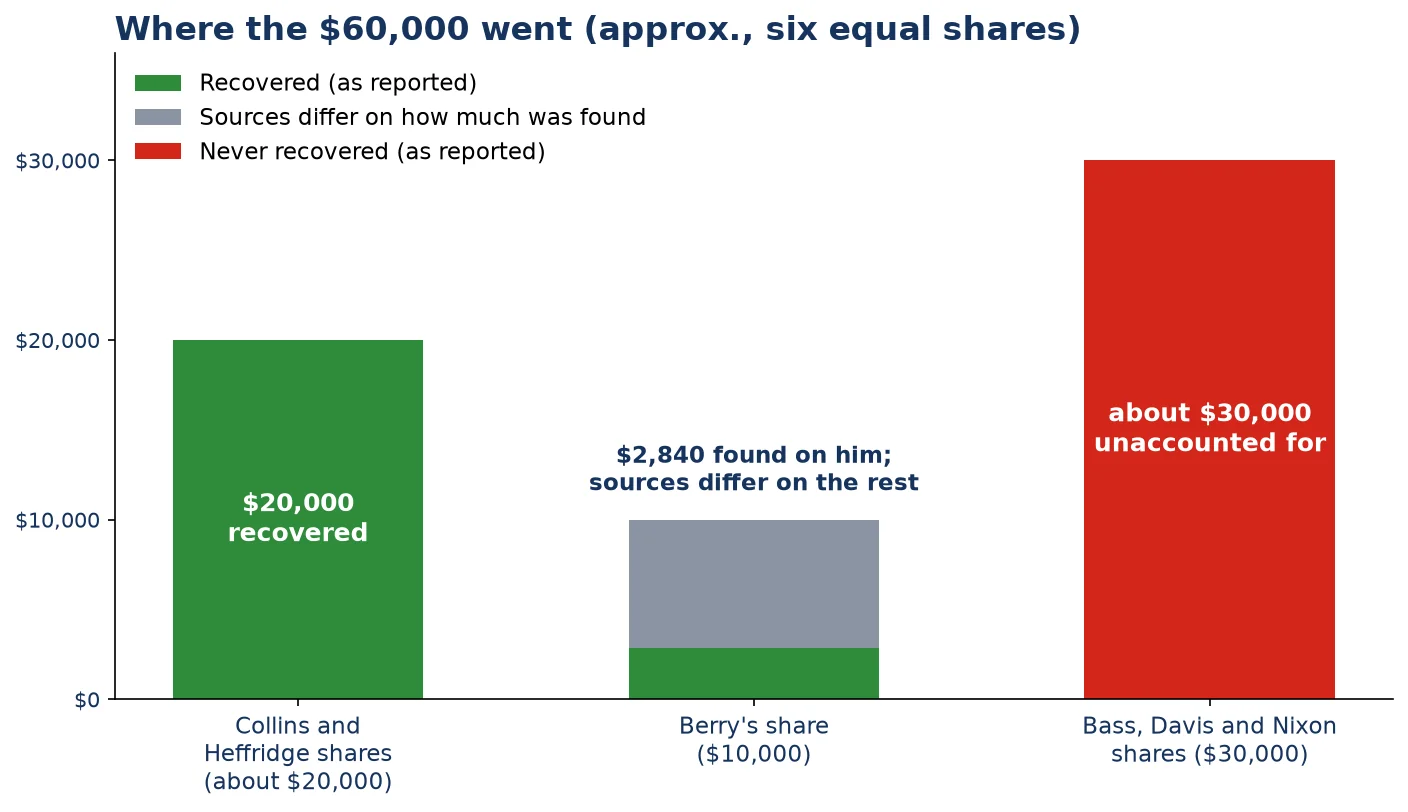
Do the sums and a good chunk of that gold never came back to the Union Pacific: the shares of Bass, Davis and Nixon, and possibly some of Berry's. Some of it was surely spent. Some of it may not have been.
Robin Hood With a Gold Habit
Bass was in no hurry to be sensible. Reports say he spent money freely and earned a Robin Hood reputation, with tales of him paying around $20 for a dozen eggs or a pan of warm biscuits. The City of Round Rock's account notes that he seemed to spend about $10,000 in under four months. By early 1878 he had a new gang and was back to robbing. Four trains went within about 25 miles of Dallas that spring. The take was small, but the Texas Rangers took notice.
An informant in the gang, Jim Murphy, tipped off Major John B. Jones of the Frontier Battalion about a plan to rob the bank in Round Rock. On July 19, 1878, Bass and his men rode in, a gunfight broke out and Bass was wounded. He was found helpless the next morning in a pasture north of town, brought back to Round Rock and died on July 21, 1878, his 27th birthday. Who fired the fatal shot is still disputed in the sources. He was buried in Round Rock Cemetery. A tombstone paid for by his sister was later chipped away by souvenir hunters and replaced with a granite marker.
The Sam Bass Treasure Legend
When a man spends $10,000 in four months but walked off with a share of $60,000 in gold, people start doing sums and drawing maps. The legend says Bass cached loot from his robberies somewhere in Texas before he died. Be clear about the status of this one: it is legend. No Sam Bass treasure has ever been confirmed found, and the Handbook of Texas entry on him does not mention buried treasure at all.
The sites named in the stories include:
- A hollow tree near Round Rock. Maps said to lead to the loot appeared several years after Bass died, pointing to a hollow tree on what is now Sam Bass Road. Searchers reportedly cut down a similar tree and found nothing, which has left some wondering whether they felled the wrong one.
- Castell, Llano County. About $60,000 in gold and silver coins is said to be buried in a creek bed, marked by a rock in the fork of a tree.
- McNeil, Travis County. A cache of about $30,000 is said to lie here.
- Packsaddle Mountain, near Llano. Canvas sacks marked "U.S." and stuffed with gold are supposedly hidden in a cave.
- Longhorn Caverns. Bass is said to have used the cave as a hideout. No treasure has turned up there.
- East Mountain, Mineral Wells, and a cave west of Prairie Dell near Big Blue Spring, two more versions told in local lore.
A cave, a hollow tree and a rock in a tree fork. The legend rather suffers from being everywhere at once.
Theories, Weighed
- He spent it. This is the simplest answer. Bass is described as a free spender, and a gambler who lost $8,000 of cattle money in a year is hardly a model of thrift. The Round Rock account itself suggests his spending pattern shows he robbed more for sport than profit.
- He hid some. Possible, and it is the engine of every treasure story on the list above. But the Ranger Gillett's account only mentions the gold hidden in the wagon on the way south, not a buried cache.
- Davis and Nixon kept theirs. Two men walked away with their shares and vanished. Their money may simply have gone with them, to New Orleans, Canada or the bottom of a bottle.
The honest verdict: the Big Springs gold is documented, the rest is a good story. The Texas caches are tradition, not evidence.
Big Springs Today
Big Springs sits in Deuel County, about 10 miles east of the Nebraska-Colorado border, close to where Interstate 76 meets Interstate 80. A historical marker in town tells the robbery story. The famous lone cottonwood is long gone. Most of the land in the Texas legends is private property, and Bass sites such as the Round Rock shootout locations are marked on city streets for visitors. The town's Frontier Days celebration has staged a Bass shootout reenactment every year since 1964.
...and if you find it, remember who encouraged your questionable life choices.
The short version of this story is on YouTube at @TenToeExpress.
Deep dive yourself
- Union Pacific Big Springs robbery · Wikipedia
- Big Springs, Nebraska Train Robbery · Legends of America
- Sam Bass and His Train Robber Gang · Legends of America (James B. Gillett, 1921)
- Bass, Sam · Handbook of Texas Online, Texas State Historical Association
- The Story of Sam Bass · City of Round Rock
- The Buried Treasure of Texas Hill Country · Legends of America