 Ten Toe Express

Seymour, Indiana, the evening of October 6, 1866. An Ohio and Mississippi train pulls out of the depot, heading east, with an Adams Express car full of other people's money. Somewhere down the carriages, two brothers in masks are making their way forward. A few minutes later, an iron safe goes tumbling off the moving train into the dark, the bell rope is pulled, and America has invented something new: the peacetime train robbery.
The men were John and Simeon Reno, and the outfit behind them was the Reno Gang of Jackson County, Indiana. Over the next two years they hit trains, banks and county treasuries across the Midwest, and in May 1868 they pulled off a heist worth around $96,000. Within months, almost all of them were dead, hanged by vigilantes before a single trial. And the money? Nobody has ever found it. Ever since, the story has gone that the lost treasure of the Reno Gang is sitting in the woods of southern Indiana, waiting.
Right then. Let's see what the records say, what the legend says, and whether you should be bringing a shovel (spoiler: you shouldn't).
Who were the Reno brothers?
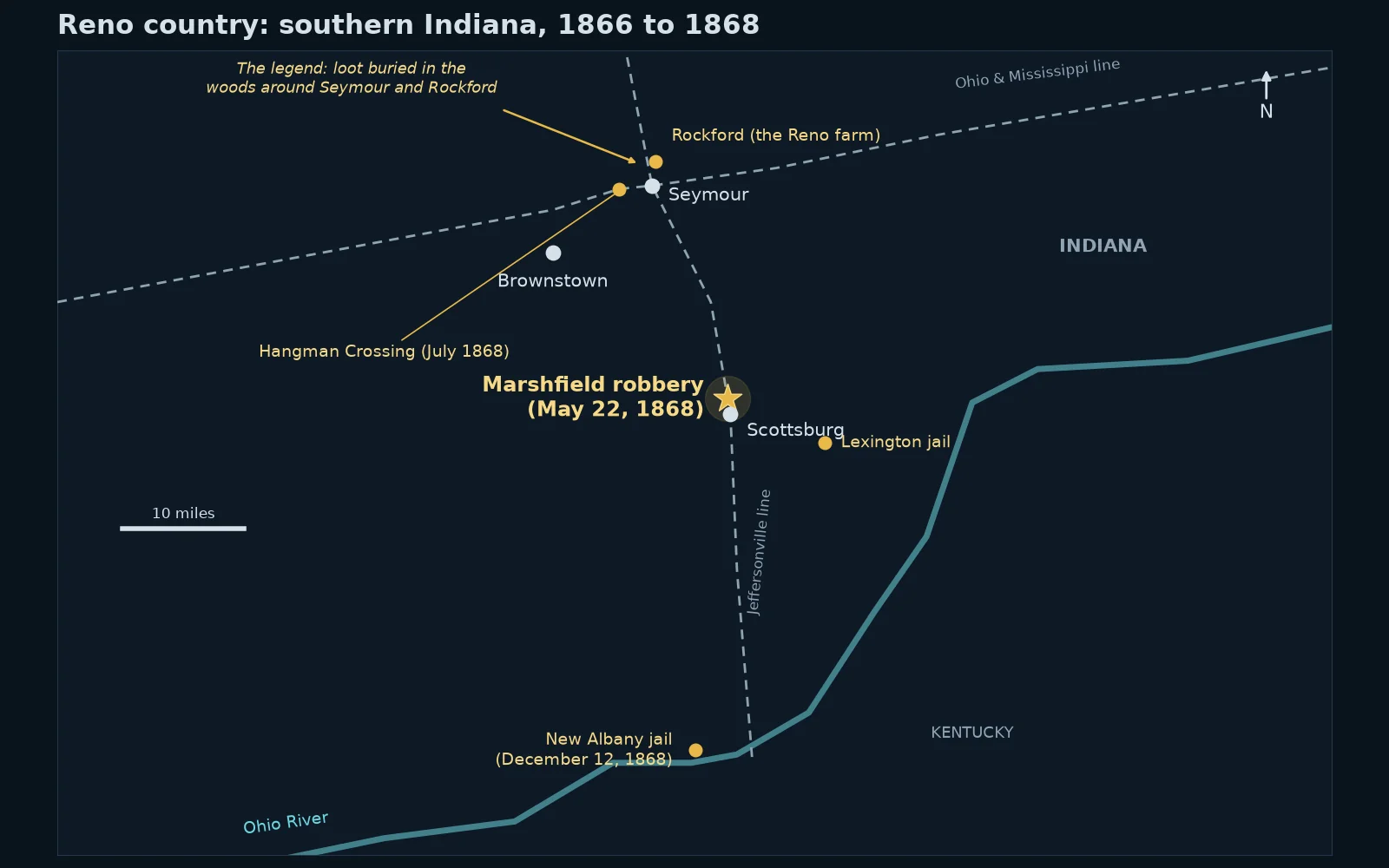
The family farm sat at Rockford, a small village about two miles north of Seymour. Wilkinson Reno, from Kentucky, worked around 1,200 acres there with his wife Julia Ann, and they raised five sons, Frank, John, Simeon, Clinton and William, and a daughter, Laura.
The boys earned a reputation early. Accounts say they ran crooked card games, and when Seymour suffered a run of fires in the 1850s, some townsfolk muttered that the Renos were behind it. Nobody ever proved it. During the Civil War, Frank and John, at least, worked as bounty jumpers: they signed up for the cash bonus paid to recruits, deserted, then signed up again somewhere else. A tidy little business, if you don't mind the firing squad that technically came with it.
Clinton stayed out of the family trade and got stuck with the nickname "Honest Clint," which tells you everything about the rest of them. Laura wasn't an outlaw either, but she stood up for her brothers' reputation for the rest of her life.
By 1864 Frank and John were back home, and they brought friends: deserters, counterfeiters, safecrackers and assorted ne'er-do-wells. They robbed post offices, stores and county treasuries, and witnesses who might testify against them had a nasty habit of turning up dead. Jackson County, for a while, belonged to them.
October 1866: the first peacetime train robbery
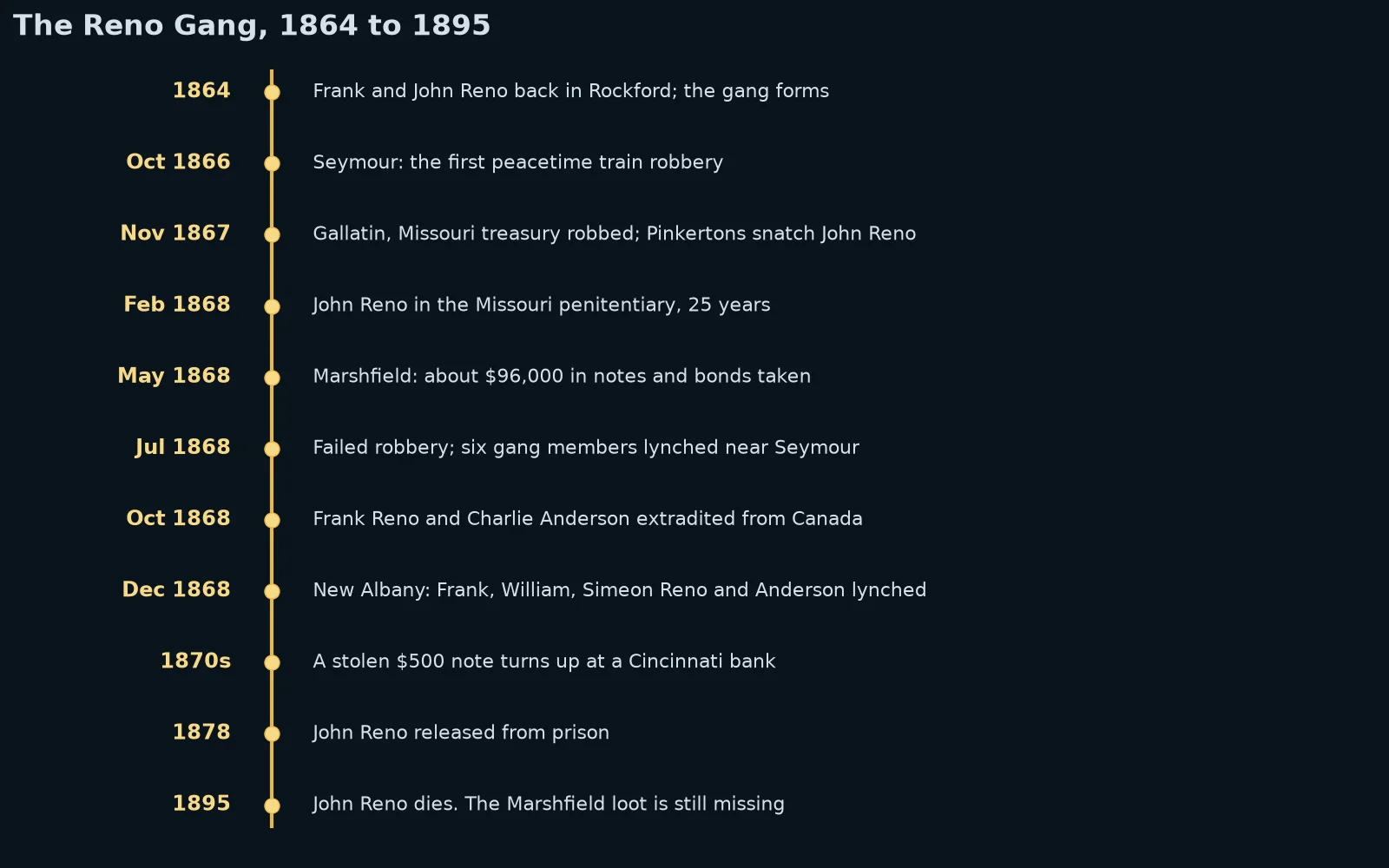
The job that made them famous was simple, bold and slightly chaotic. On October 6, 1866, John Reno, Simeon Reno and Frank Sparks boarded the eastbound Ohio and Mississippi train at Seymour. Masked and armed, they forced their way into the Adams Express car and ordered the messenger, Elem Miller, to open the safes.
Miller could only open the local one. So the robbers cleaned that out and, in the grand tradition of men who haven't quite thought things through, shoved the second, bigger safe off the moving train for their friends waiting beside the track. They pulled the bell rope, hopped off as the train slowed and vanished into the night.
How much did they get? Depends who's counting. One telling, based on the Library of Congress account, says about $10,000 in gold coins and $33 in bank notes. Other sources say $12,000, or around $16,000. Everyone agrees on one detail, which is rather delicious: the gang never managed to open the big safe they'd thrown off the train, and fled when a posse turned up.

It's usually called the first peacetime train robbery in the United States. There had been wartime raids on trains, but this was the first time a gang simply climbed aboard, robbed the express car and rode off into history. Others would copy them, from the James-Younger crowd to Butch Cassidy's Wild Bunch.
The suspects were arrested within days and let out on bail. Then a passenger who could identify them was shot dead, the other witnesses suddenly couldn't remember a thing, and the case collapsed. The Adams Express Company, which had insured the money, decided it had had quite enough and called in Allan Pinkerton's detective agency.
The Pinkertons come to Seymour
This is where the story turns into a proper cat-and-mouse game. The Renos kept busy: a bank in Muncie, county treasuries across Indiana, and in November 1867 the treasurer's office in Gallatin, Missouri, which lost around $22,000. When a pair of copycats robbed an Adams Express train near Seymour in September 1867, the Renos reportedly took the loot off them and left the two men for the law. Professional courtesy, Reno style.
The Pinkertons fought back with cunning. According to the Daviess County Historical Society in Missouri, they planted undercover agents in Seymour, including a saloon keeper, a gambler and a freight hauler. One of them bet John Reno $20 about which train would arrive next and strolled him down to the station to settle it. When the train pulled in, out stepped Allan Pinkerton himself with Missouri lawmen, and John Reno was bundled aboard, kicking and bellowing. By February 1868 he was in the Missouri State Penitentiary, sentenced to 25 years.
Which, as it turned out, probably saved his life.
With John gone, Frank Reno took charge. Frank was caught in Iowa in early 1868 after a string of treasury robberies there, and promptly broke out of jail on April 1, which is the kind of thing that makes a man feel invincible. Rather a mistake.
Marshfield, May 1868: the big one
On the night of May 22, 1868, the gang, led by Frank Reno and up to a dozen strong, stopped a Jeffersonville, Madison and Indianapolis train at Marshfield, a refuelling and watering stop in Scott County, about 17 miles south of Seymour. They knew what was aboard.
The robbers uncoupled the engine and express car from the passenger cars, left the passengers sitting in the dark, and ran the engine north. They broke into the express car, beat the messenger badly and threw him off the train. Sources disagree about his fate: some say his injuries were fatal, others only that he was badly hurt, and even the spelling of his name varies. The gang cracked three safes and took U.S. treasury notes and government bonds worth an estimated $96,000 to $97,000. The engine and car were found abandoned near Seymour.
For a gang from a farming village, that was an enormous haul. Ordinary working people of the day often earned less than $300 a year. This was a fortune, and it was about to go missing for good.
Vigilantes and the end of the Reno Gang
This is the dark part of the story, so here it is plainly.
By the spring of 1868, people in and around Seymour had formed a vigilance committee, fed up with the gang and with courts that never seemed to convict anyone. In early July, the gang tried to rob another train near Seymour. This time Pinkerton guards were on board and fired back, and several gang members were wounded and caught.
On July 20, 1868, as three of them, Volney Elliott, Charlie Roseberry and Theodore Clifton, were being moved by train, masked men calling themselves the Jackson County Vigilance Committee stopped it a couple of miles west of Seymour and hanged the three prisoners from a tree. Five days later, on July 25, Frank Sparks, John Moore and Henry Jerrell, recently captured in Illinois, were taken from their guards and hanged at the same spot. The place has been called Hangman Crossing ever since.
Frank Reno had fled to Windsor, Ontario, with Charlie Anderson. William and Simeon Reno were arrested in Indianapolis. After a court fight in Canada, Frank and Anderson were extradited to the United States in October 1868, on assurances they would get a fair trial. All four were held in the Floyd County Jail at New Albany, on the Ohio River.
In the early hours of December 12, 1868, around 65 masked men came down by train, forced their way into the jail and the sheriff's quarters, beat and shot the sheriff, and took the keys. They hanged Frank, William and Simeon Reno and Charlie Anderson inside the jail, then left before dawn. Because Frank and Anderson had been handed over under an international treaty, the killings caused a diplomatic row with Britain, which then handled Canada's foreign affairs. No one was ever convicted.
In six months, ten members of the gang had been lynched. Not one of them was found with any serious money.
The lost treasure of the Reno Gang: what the legend says
Here's the puzzle in a nutshell. The Marshfield haul was enormous. The robbers were dead or in prison within months. And the money never surfaced. So where did it go?
The legend has a tidy answer: they buried it. The story goes that the gang hid their gold and cash in the forests of southern Indiana, somewhere near Seymour and the family's old ground at Rockford, before the vigilantes got to them, and took the secret to their graves. Some versions add caves, which southern Indiana has in generous supply, and one cable treasure show went looking for a cave hideout that "could hold millions."

A few things worth knowing before you start squinting at tree roots:
- It probably wasn't gold. The Marshfield loot was mostly government bonds and treasury notes, according to the state's own historical marker. Paper, in other words. Paper does not age well in a damp Indiana hole.
- The amount gets bigger with every telling. The real figure is around $96,000 to $97,000. Modern treasure lists happily inflate that into "millions," usually by converting it to today's money and then rounding up with enthusiasm.
- The searching has been serious. According to True West magazine, after 1868 the gang's old haunts around Seymour were searched, relatives were questioned for years, psychics were consulted, and dozens of spots in Indiana and Illinois were dug up. Nothing.
Follow the money: where it might really have gone
Mark Boardman, who has studied the Renos for about 30 years and writes for True West, has a theory that's less fun for metal detectors but rather convincing.
Some of it went to Canada. Frank Reno and others escaped to Windsor after Marshfield, and while fighting extradition Frank offered bribes worth thousands of dollars to stay put. Boardman believes they took at least part of the loot north and may have left some with friends there.
The Renos didn't bury money. They spent it. Over years of robberies, there's no record of the gang ever stashing cash in the ground or in caves. They spent it on high living and on keeping local officials and businessmen sweet. Why change a winning system?
And some of it was laundered. Here's the cracking bit of evidence. The serial numbers of the Marshfield notes were sent round to banks across the Midwest in 1868. In the early 1870s, one of Seymour's most successful merchants, John Pfaffenberger, tried to cash one of the stolen $500 notes at a bank in Cincinnati. He was arrested and tried for passing stolen notes, and found not guilty, because the prosecution couldn't prove he knew where it came from. Boardman thinks local businesses quietly swapped the hot paper for clean cash and kept a cut for their trouble.
Which would make the real winners of the Marshfield robbery not the outlaws at all, but a few respectable people in nice suits. That's the trouble with a proper mystery: sometimes the answer is just very boring paperwork.
The theories, weighed
- Buried in the woods near Seymour or Rockford. The romantic favourite and the one in the Short. The problem: no evidence the gang ever buried money, and more than 150 years of searching has turned up nothing.
- Hidden in a cave. Southern Indiana is riddled with them, which makes it a lovely story and an impossible one to check. No record ties a specific cave to the loot.
- Taken to Canada. Backed by the timeline: the leader fled there with the money still fresh and offered bribes from there.
- Spent and laundered. Backed by the gang's habits and by a real stolen $500 note turning up in a Cincinnati bank years later.
- A bit of everything. The likeliest answer: split between a dozen robbers, some spent, some carried off, some cleaned up through local hands, and perhaps a stray bundle never recovered. Not a single chest, but crumbs scattered across two countries.
The honest verdict? A real robbery, a real fortune, and a real disappearance. A buried hoard is the least likely of the lot. But nobody can prove it isn't out there, and that's exactly why people still ask.
Visiting Reno Gang country today
You can follow the story on a day out in southern Indiana, as long as the only thing you dig into is the history.
- The Reno brothers' graves are in the Old City Cemetery in Seymour. Frank, William and Simeon lie together, and the plot is fenced to keep visitors at a respectful distance. Charlie Anderson is buried in New Albany.
- The Marshfield Train Robbery marker, an official state historical marker put up in 2002, stands at US 31 and Terrell Road on the north edge of Scottsburg.
- Hangman Crossing is a railroad crossing a short way west of Seymour along US 50. It's a working railway line, so look from the road and stay off the tracks.
- New Albany, on the Ohio River, is where the last act played out. Local lore links the city's Reno Avenue to the gang, though that has never been confirmed.
- John Reno, the one brother who survived, was released in 1878, went back to prison in 1885 for passing counterfeit money, and died in 1895.
The woods and fields around Seymour and Rockford are mostly private farmland and homes today. Digging there without the owner's permission is trespassing, plain and simple, and cemeteries and historical sites are off limits to metal detectors and shovels alike. Bring a camera and a good pair of boots instead.
The Renos invented the train robbery, lost everything in a single brutal year, and left behind a fortune nobody could find. Whether it's under an Indiana beech tree, spent in a Windsor tavern or tucked into a merchant's ledger, the trail went cold in 1868, and it's stayed that way ever since.
...and if you find it, remember who encouraged your questionable life choices.
The short version of this story is on YouTube at @TenToeExpress.
Deep dive yourself
- Outlaws, Pinkertons, and Vigilantes: The Reno Gang and its Enemies · Indiana Historical Bureau, Indiana History Blog
- Marshfield Train Robbery (state historical marker) · Indiana Historical Bureau
- Crime and Law Photograph Collection (Reno Gang notes) · Indiana State Library
- Where Did the Loot Go? by Mark Boardman · True West Magazine
- How the Reno Gang Launched the Era of American Train Robberies · Smithsonian Magazine
- 1867: Reno Gang steals $23,000 from Daviess County, MO · Daviess County Historical Society
- Reno Gang Graves · Discover Indiana
- Reno Gang and the 1st Big Train Robbery · Legends of America
- Reno Gang · Wikipedia (a starting point)