 Ten Toe Express

Picture the Natchez Trace in the spring of 1802. It is a muddy, root-tangled footpath through the Mississippi Territory, and it is the only sensible way home for a boatman who has just sold a cargo in Natchez and is carrying the cash. He has floated down the river, he cannot float back up it, so he walks, with his pockets full and one eye on every bend in the trail. Somewhere in those trees sits a man who very much wants to meet him.
That man was Samuel Mason, a former militia captain turned river pirate turned highwayman, and the legend of Mason's Natchez Trace outlaw treasure says that a great deal of what he stole is still buried in Mississippi. Right then: how much of that is paper-trail fact, and how much is the sort of story that grows a little taller every time a porch gets a fresh pot of coffee?
Who Was Samuel Mason?
Mason was not born a bandit, which makes him more interesting. He came into the world in Norfolk, Virginia, in 1739 and, by 1777, was a captain in the Ohio County militia, commanding men at Fort Henry in what is now West Virginia. That September he was wounded in an ambush near the fort, an engagement where most of his company was killed. Proper frontier hero material.
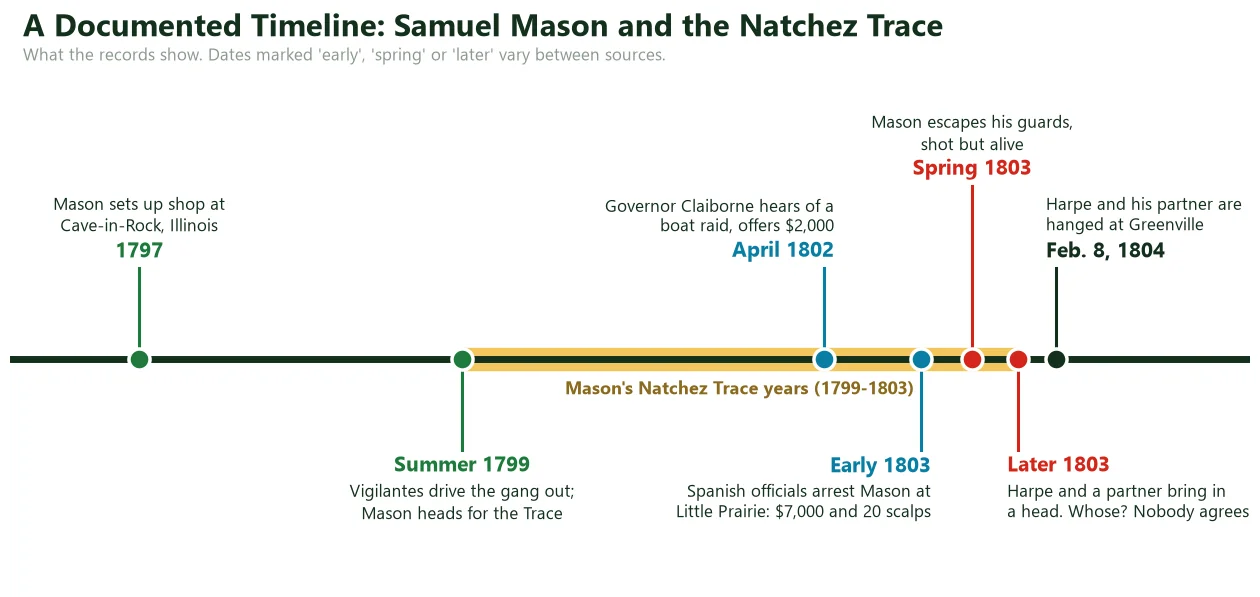
Then the money ran out. After the war he drifted through Pennsylvania and Kentucky, fell into debt and lost his farm at a sheriff's sale in 1785. By the early 1790s he was in the crime business on the Ohio River, and by 1797 he had made Cave-in-Rock, Illinois, his headquarters. The cave sits in a limestone bluff above the river, and Mason turned it into an inn with a sign advertising a "Liquor Vault and House for Entertainment." The hospitality had a catch. Flatboat crews who stopped for a drink were sized up, and the valuable ones were robbed once they floated on downriver.
In the summer of 1799 a group of vigilantes led by a Captain Young, the "Exterminators," drove Mason's band out of the cave. Mason did what any sensible villain with a bruised reputation would do: he moved to somewhere with fewer neighbours. He settled his family in Spanish Louisiana and took up highway robbery on the Natchez Trace.
The Natchez Trace Years
The Trace was the overland route running from Natchez up toward Nashville, and in the early 1800s it was arguably one of the most dangerous roads on the continent. Boatmen who had sold goods downriver walked it home, cash in hand. That is the sort of traffic a robber dreams about. Mason and his gang, including Wiley "Little" Harpe, one half of the infamous Harpe brothers, worked the road and the river alongside it from about 1799 to 1803.
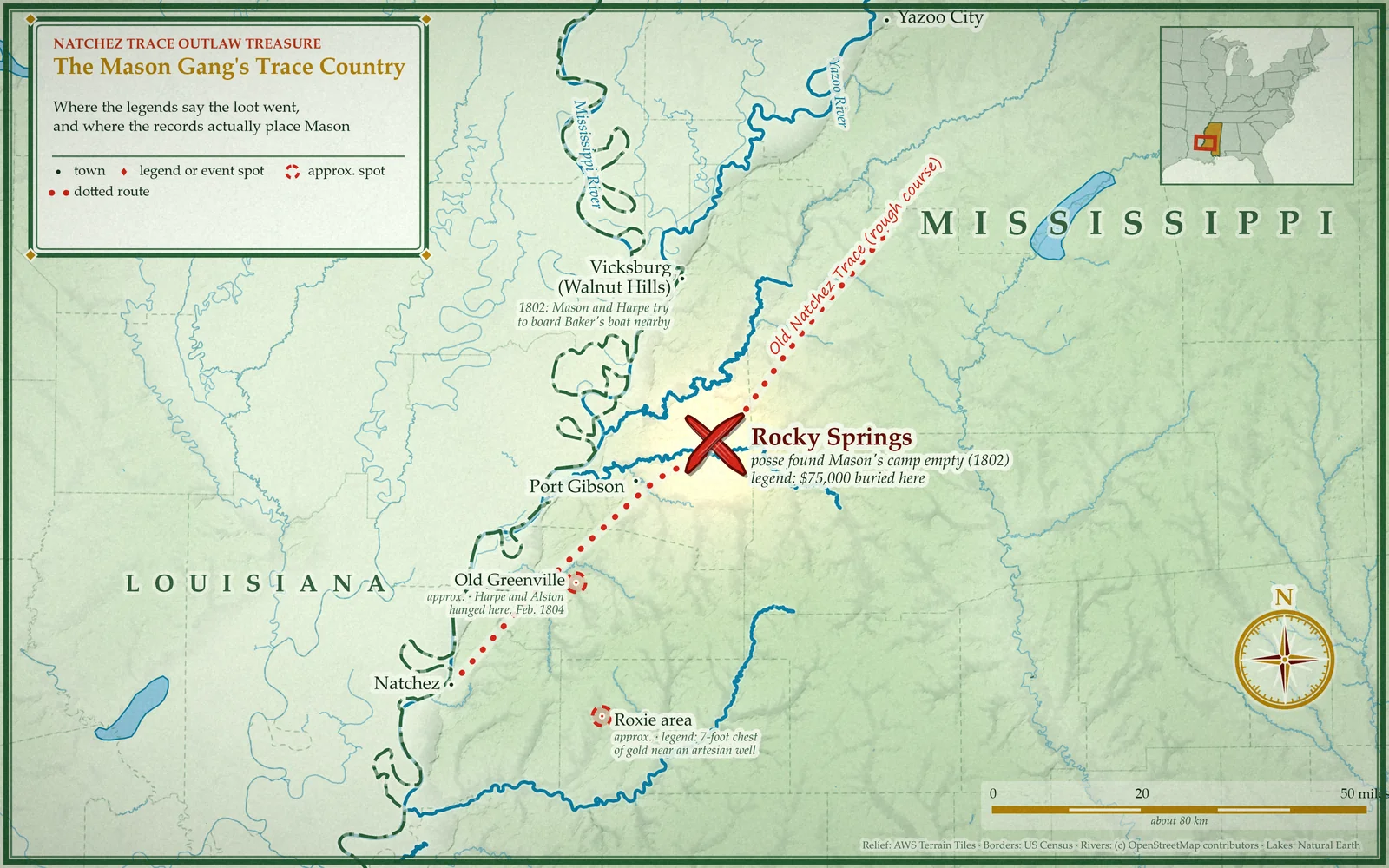
The records for this period are thin, and it pays to say so. Few newspapers or public documents survive from the territory, so many details come from later retellings. What is solid comes from official correspondence. In April 1802 Governor Claiborne was told that Mason and Harpe had tried to board Colonel Joshua Baker's boat on the Mississippi between Yazoo and Walnut Hills, near modern Vicksburg. Claiborne sent Colonel Daniel Burnet with fifteen or twenty volunteers, and a $2,000 reward went up. A posse found Mason's camp near Rocky Springs, Mississippi, empty. The gang had moved on, taking its secrets with it.
Arrest, Escape and a Very Disputed Head
Mason's luck ran out in early 1803, and not in Mississippi. Spanish officials arrested him and some of his sons at Little Prairie, in what is now Caruthersville, Missouri. At a hearing in New Madrid he claimed to be an honest farmer. His baggage disagreed: officers found $7,000 in currency and twenty human scalps. He was sent downriver toward New Orleans, with the Spanish governor ordering that he be handed over to American authorities in the Mississippi Territory.
He never made it to court. During the trip Mason and Harpe, who was travelling under the name John Sutton, overpowered their guards. Mason was shot, but he got away, and Claiborne raised the reward to $2,500.
What happens next depends on whom you ask. Later in 1803, Harpe and a companion (Peter Alston, who used the name James May) turned up with a severed head they said was Mason's, hoping to collect the reward. Accounts differ on whether they killed him or whether he died of his wounds, and on the date. Some people, Mason's wife among them according to one account, disputed that the head was his at all, and the claim was rejected. The pair were recognised as wanted men, tried for piracy and hanged at Old Greenville, in the Mississippi Territory, in early 1804. One local history gives the date as February 8. Mason's death was never legally confirmed, which is why sightings and rumours, including reports from as far away as Canada, kept the story going.
Where the Loot Is Supposed to Be
Here is the delicious part, and the part to read with a raised eyebrow. The Mason gang was known to carry loot on mules and to hide things near its camps. When Mason vanished from history, the stories began to say that he had stashed his gains and never came back for them. Several places claim a piece of the action, and not one of the amounts has been verified.
- Rocky Springs: About $75,000 in gold and silver coins is said to lie between the old church and the cemetery at Little Sand Creek. The records only tell us the posse found a camp nearby, empty.
- Near Roxie: A seven-foot chest of gold coins and jewelry is supposed to be buried near an artesian well on a farm roughly four miles northwest of town.
- Colbert Tavern, near Bissell: As much as $250,000 is said to be hidden near one of the gang's favourite drinking spots on the Trace. That is a large number even by tall-tale standards.
- Stack Island and the ghost town of Tillman: Loot is said to be hidden in both places, with considerably fewer details.
- Cave-in-Rock, Illinois: The gang supposedly hid gold in the cave around 1800 and never retrieved it, with more caches along the cliff face.
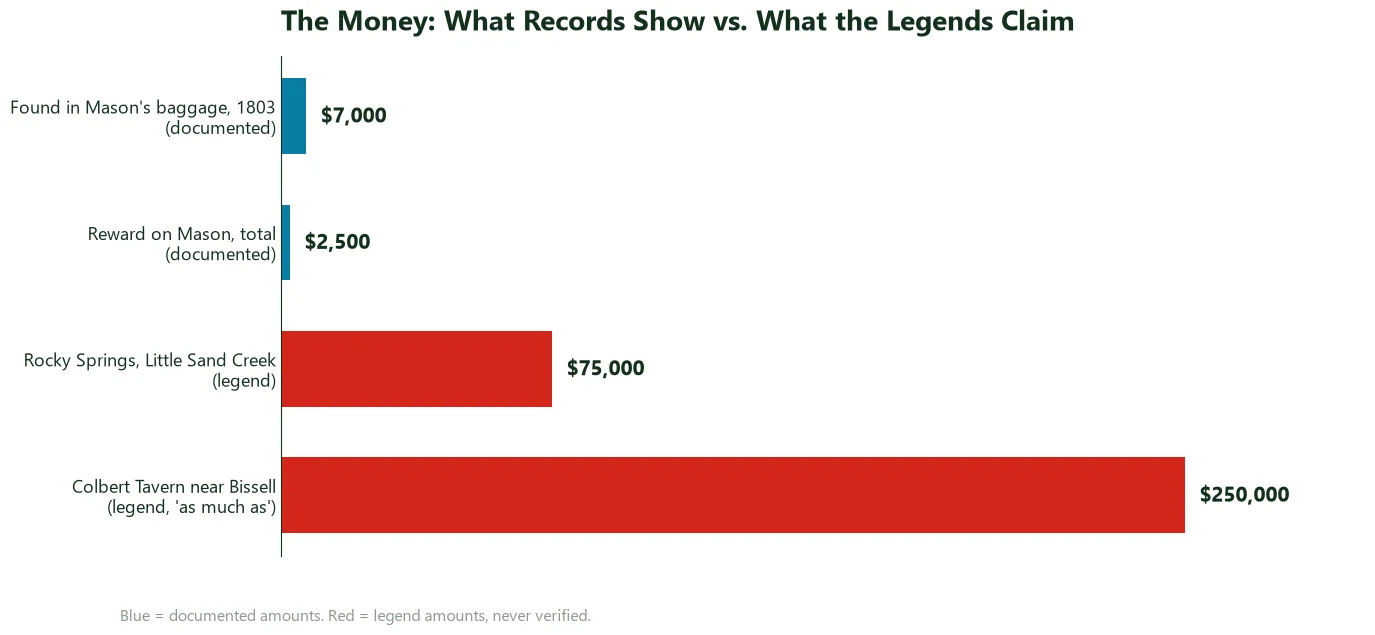
Notice the pattern. Real, documented money shows up in only one place: the $7,000 found in Mason's luggage at Little Prairie, and the $2,500 reward on his head. The buried hoards are all legend, and the further they sit from the paper trail, the bigger they get. Put them side by side and the legends outgrow the facts by a distance that would embarrass a fisherman.
Theories, Weighed
Could a gang that robbed travellers for four years have buried something? Quite possibly. They carried cash, they moved quickly, and a posse on your heels is a fine reason to put a bag in the ground. But that is as far as the evidence goes. No recovered cache has been documented, no map has surfaced, and the sources for the specific locations are retellings rather than records. A few cautions apply:
- The amounts are unverifiable. Nobody can say where $75,000 or $250,000 came from, and the Mason gang's cash haul has no ledger.
- The Rocky Springs link is shaky. The only documented fact there is an abandoned camp in 1802. The coins between the church and cemetery are a later addition.
- Mason's fate muddies everything. If he died in 1803, he had no chance to return. If he survived, he might have collected his own treasure and left no trace. Both versions fit the legend, which is exactly why the legend is so durable.
- The Harpes' reputation rubs off. The Harpe brothers were among the most brutal outlaws of the day, and some of their notoriety has leaked into Mason's story.
Where It Stands Today
The old Trace is now the Natchez Trace Parkway, run by the National Park Service. Rocky Springs, at milepost 54.8, is a pleasant stop: a town site that peaked at about 2,600 people before about 1860 and faded after the Civil War, yellow fever and the boll weevil. The last store closed in the early 1930s. What remains is a church, a cemetery, a couple of rusting safes and some cisterns, and the spring no longer flows. There are exhibits, parking, a restroom and a trailhead for the Natchez Trace National Scenic Trail.
Visit it for the history, because the ground is not for digging. The Rocky Springs land is either privately owned or part of the National Park Service's parkway, and the other legend sites are mostly on private farmland. Cave-in-Rock is now a state park in Hardin County, Illinois, where you can admire the cave without anybody expecting you to bring a shovel.
The ordinary truth is rather good on its own: a decorated militia captain became one of the most feared men in the lower Mississippi valley, escaped the Spanish, disappeared into the swamps, and left behind a mystery nobody has ever managed to settle. The treasure, if it ever existed, is still out there under the oaks. Or it was spent on boots and whiskey in 1801. Bit of both, probably.
...and if you find it, remember who encouraged your questionable life choices.
The short version of this story is on YouTube at @TenToeExpress.
Deep dive yourself
- Samuel "Wolfman" Mason Takes on the Natchez Trace · Legends of America
- Samuel Mason · Wikipedia
- Jefferson County, Mississippi: Bandits · Mississippi GenWeb
- King of the River Pirates · Missouri Life
- Rocky Springs Town Site · National Park Service
- The Outlaws of Cave-in-Rock · Otto A. Rothert, Project Gutenberg