 Ten Toe Express
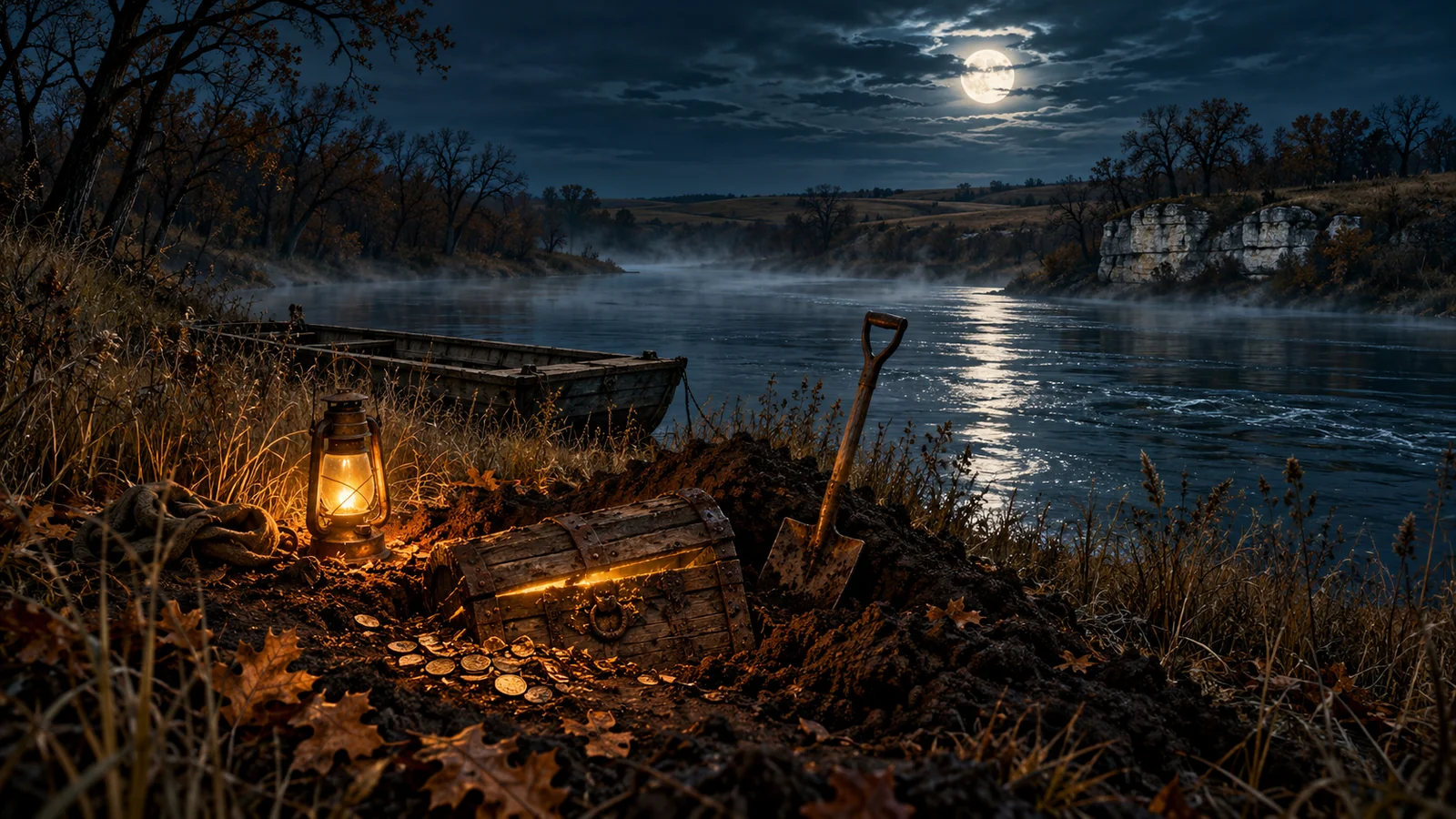
Picture a slow, dark river winding through the oak groves of northern Illinois. A lantern bobs on the bank. Men with stolen gold and very bad reputations are digging a hole in a hurry, because someone, somewhere, is coming for them. They fill it in, smooth it over and slip away. Not long after, the whole gang is wiped out, and the gold stays exactly where they left it.
That, in a nutshell, is the legend of the lost gold of the Fox River Raiders: river pirates of the early 1800s who are said to have buried their loot along the Fox River in Illinois before meeting a sticky end. It's a cracking story. It also has one rather inconvenient problem, which is that the Fox River Raiders are remarkably hard to find in any history book.
But keep your boots on, because when you go digging in the records (the only kind of digging this story recommends), something real turns up. Prairie pirates. A gang boss named Fox. A bottle of stolen money sealed in beeswax and buried in the night. And a hiding place that was found, years before anyone could sell a map to it, already empty.

The legend of the Fox River Raiders
As it's usually told, the story is short and sharp. River pirates worked the Fox River in the early 1800s, robbing whoever came their way. They buried their stolen gold along the banks, meaning to come back for it. They never did, because the gang was wiped out first. The gold, the story goes, is still down there.
And that's about all the legend gives you. No names for the pirates. No year for the burial. No amount, no landmark, no handy rock shaped like a skull. For a treasure tale, it's travelling remarkably light. Most legends at least have the decency to include a dying man's last words or a map drawn on a scrap of hide.
So the honest place to start is the river itself.
Meet the Fox River, Illinois
The Fox River of Illinois rises in a swamp near Colgate, Wisconsin, wanders south through the Chain O'Lakes, and then runs past a string of towns that today are mostly Chicago suburbs: McHenry, Algonquin, Elgin, St. Charles, Geneva, Batavia, Aurora, Oswego and Yorkville. Then it heads southwest through Millington and Sheridan and joins the Illinois River at Ottawa. It's 202 miles long, and these days it's better known for smallmouth bass, catfish and wintering bald eagles than for anything with an eyepatch.
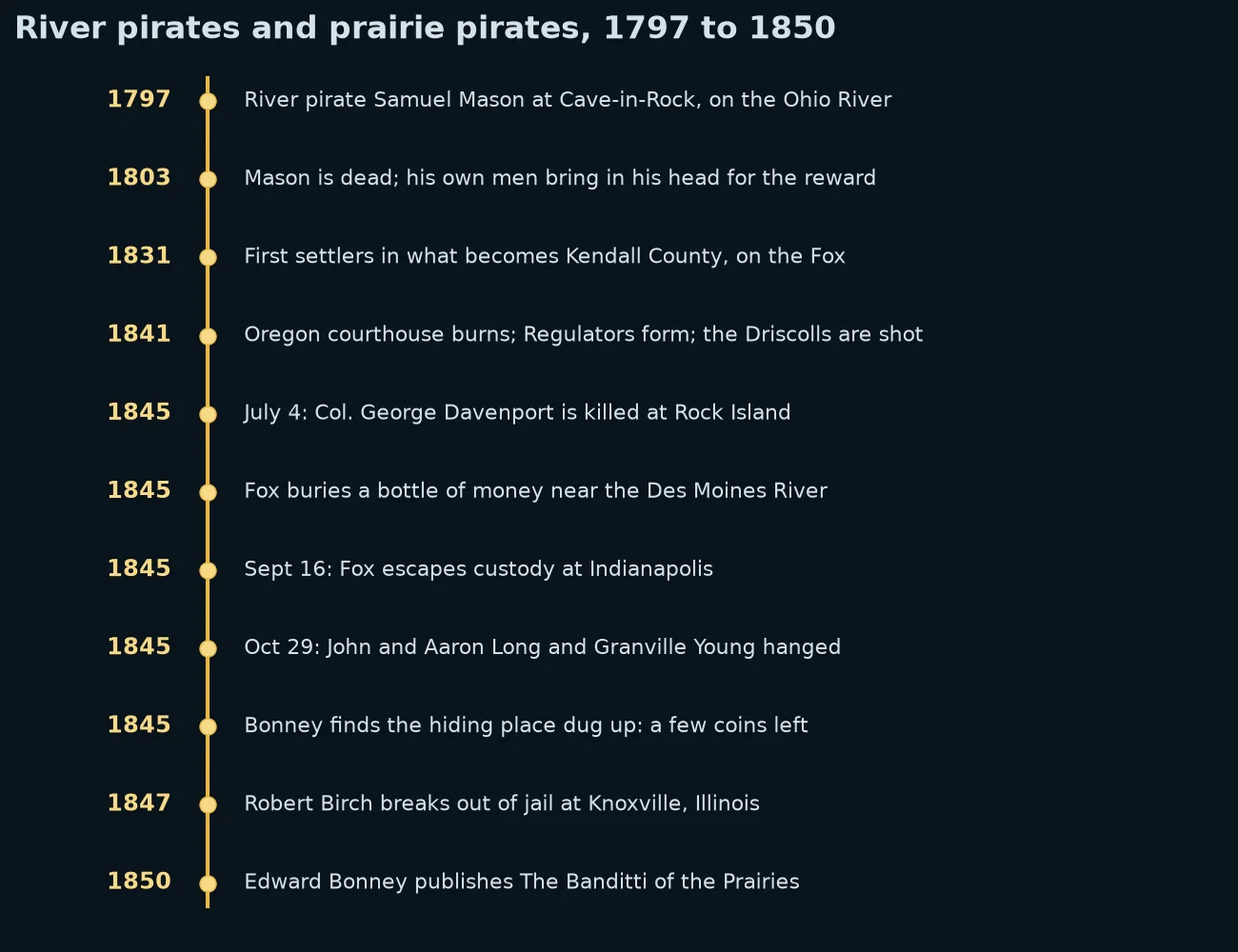
Here's the first snag for the legend. In the early 1800s, this wasn't a busy river full of pirate targets. The Potawatomi, Sauk and Meskwaki lived along it, and American settlers only started arriving in numbers after the Black Hawk War of 1832. Kendall County, right in the middle of the Fox valley, got its first settlers in 1831 and wasn't even organized as a county until 1841. Not much point in being a river pirate where there aren't any boats worth robbing yet.
Illinois certainly had river pirates in the early 1800s. They just weren't on the Fox. They were down on the Ohio River at the state's southern tip, around Cave-in-Rock, where the outlaw Samuel Mason, a Revolutionary War officer gone very wrong, was at Cave-in-Rock in 1797, preying on flatboats. When he was finally arrested in Spanish territory, he was carrying about $7,000 in bank notes. He died in 1803, and his own men handed in his head for the reward. Charming fellow. But Cave-in-Rock is roughly 270 miles south of the Fox.

Hunting for the Raiders in the records
Look for the "Fox River Raiders" in the old county histories, the state historical markers, the treasure-hunting books or the local historical societies, and you come up empty. Even the popular lists of Illinois lost treasures, which are not known for being fussy, tend to skip it: they've got Starved Rock, Cave-in-Rock and the Mackinaw River, but no Fox River pirates.
That doesn't prove nobody ever told the story around a stove in Kane County. Plenty of real folklore never made it into print. But it does mean there's no named gang, no robbery and no burial to check. What there is, a short ride west of the Fox, is a very real band of outlaws whose story fits the legend's outline almost suspiciously well.
The prairie pirates of northern Illinois
In the 1830s and 1840s, northern Illinois had a genuine outlaw problem. A loose network of horse thieves, counterfeiters, burglars and occasional murderers worked the new settlements, and people called them the Banditti of the Prairie. They had other nicknames too, and two of them are worth underlining: the Prairie Pirates and the Pirates of the Prairie.
Their heartland was Ogle, Lee, DeKalb and Winnebago counties, the country around the Rock River, which lies just west of the Fox valley. They worked out of inns and groves along the stagecoach roads, at places like Paw Paw, Inlet Grove and Genoa, and near Sycamore, Oregon and Dixon. Genoa sits only about 20 miles from the Fox at Elgin. They were bold, too: one night in June 1844, during a thunderstorm, masked men crept into the Haskell house at Inlet Grove and carried off a trunk of money from underneath the sleeping couple's bed. The Haskells didn't notice until morning.
The network stretched well beyond Illinois, into Iowa, Indiana and Ohio. And among the men said to run it were Robert Birch and a slippery character named William Fox. One museum account simply calls the outfit the Birch-Fox gang.
Pirates, then. A gang with a Fox in charge. Working the prairie next door to the Fox River. You can see how a story might wander a few miles east over the years and pick up a river on the way.
Wiped out: the Regulators and the gallows
The legend says the Raiders were wiped out. The Banditti weren't wiped out all at once, but they did get hammered from two directions.
The first came in 1841 in Ogle County. Six gang members were arrested for counterfeiting and held for trial at Oregon, Illinois, and the brand-new courthouse burned down, a fire people blamed on the gang. Fed up, settlers formed a vigilante company called the Regulators, which ordered suspected outlaws to leave or be whipped. Its first leader stepped aside after his mill was destroyed and his horse was killed. The next, John Campbell, was shot dead at his farm on June 27, 1841. His widow named the gunmen: David and Taylor Driscoll, sons of a family of horse thieves.
What followed was a dark chapter, and it deserves to be told plainly. The Regulators seized John Driscoll and his son William. At Washington Grove on June 29, a "jury" of 111 men found them guilty, and the two were shot to death on the spot. A third son, Pierce, was released. The Regulators were later put on trial for the killings and acquitted. It badly dented the gang in Ogle County, but it didn't finish them off.
The second blow came four years later, and it is where the story finally gets its buried treasure.
The Davenport murder, July 4, 1845
Colonel George Davenport was a prominent trader and landowner with a fine house on the island in the Mississippi now called Arsenal Island, at Rock Island, Illinois. Rumor said he kept at least $20,000 in his safe. On July 4, 1845, while his family was across the river for the holiday and he was at home feeling unwell, a gang broke in. He was shot in the leg, tied up and beaten, and he died that night, though he lived long enough to describe the men who did it.
The fortune turned out to be fiction. The safe held less than $400. The robbers also took a watch and chain, a gun and a gold coin. One gold coin, for the record, is the only gold anybody can actually document in this whole affair.
Enter Edward Bonney, an amateur detective who went undercover in the gang, posing as a counterfeiter. Bit by bit he tracked down the men behind the killing: John and Aaron Long, Granville Young, Robert Birch and William Fox. On October 29, 1845, the Longs and Young were hanged at Rock Island. Aaron Long's rope broke, and he had to be hanged a second time. John Baxter, also sentenced to death, had his sentence commuted to life in prison.
Which leaves two names, and a bottle.
William Fox buries the money
After his arrest, Robert Birch talked. According to his confession, as printed in Bonney's 1850 book The Banditti of the Prairies, after the Davenport job Fox, John Long and Birch headed for Missouri. A mile or two short of the Des Moines River in Iowa, they stopped at a farmhouse for breakfast, where Long bought some beeswax from the woman of the house, telling her he was a tailor about to set up shop in Farmington.
Then they slipped down a ravine behind the house and got to work. Birch said they put some eight or nine hundred dollars in paper money into a glass bottle and sealed it with the beeswax. That money came from other robberies, including the June 1845 robbery of an elderly farmer named Jeremiah Strawn in Putnam County, Illinois. With it went about $200 in silver tied up in a cloth, and Colonel Davenport's watch, also wrapped in beeswax to keep out the wet. Then Fox carried the lot a little way up the bluff, alone, and buried it.
Think about that for a second. The gang's most careful member takes the loot out of sight of his own partners. Not exactly a vote of confidence in your colleagues, is it?
Bonney and the sheriffs took Birch, under guard, back to the spot. Everything was exactly as he'd described it: the farmhouse, the woman who sold the beeswax, the ravine, the old mill where they crossed the river. Everything except the money.
The walnut tree clue
Meanwhile, Fox had done a runner. He had been arrested in Indiana, but on September 16, 1845, Fox escaped from the officer guarding him at Indianapolis, who had kept him in a hotel room in a pair of light handcuffs instead of a jail cell. Bonney was convinced the man had been bribed.
Then, a few hours before he was hanged, John Long passed along the directions Fox had left so that he, or his friends, could find the money again. Bonney printed them word for word:
"At the point where Fox left Birch, to go and bury the money, he made the figures 72, on a large black walnut tree. Seventy-two yards from this tree in a northeast direction is a small black walnut tree with a cross cut in the bark with a bowie knife; fourteen yards from this small tree, due north, is a large stone; midway between the tree and stone is the spot where the money was buried."
Now that is a proper treasure clue. Numbers carved in a tree, paces counted out, a knife mark, a big stone. Bonney set off at once, and the marks were all there, just as Long had said. Autumn leaves had covered the ground. But after a close search, Bonney found the spot, and the hole had already been dug out. Lying in the dirt were three American half dollars and two Spanish quarters. Somebody had come in the night and taken the rest. Bonney had no doubt who: William Fox, fresh from his escape.

Bonney went after Fox again and tracked him south, across the Ohio River, before he had to give it up and go home. A threatening letter later arrived postmarked Columbia, Kentucky, apparently meant to look like it came from Fox. By most accounts he was never seen again.
As for Birch, he broke out of jail at Knoxville, Illinois, on March 22, 1847, and his story splits in two from there. One account says he was shot dead a few months later. Another has him resurfacing out West in the gold camps of New Mexico Territory, serving the Confederacy, and dying around 1866. Even the outlaws in this story can't stay in one place long enough to be pinned down.
A word about the storyteller
Almost everything about Fox's buried bottle comes from one source: Edward Bonney's own book. It was a hit, reprinted again and again through the 1800s and once more in 1963, and historians treat it with caution. Bonney was writing about himself, he had every reason to look heroic, and he was not shy about drama. The broad facts of the Davenport case, the hangings and the escapes are backed up elsewhere. The beeswax, the walnut tree and the three half dollars rest on his word, and on confessions from men facing the rope.
Still, it's a rather good word. It has dates, places, names and a hole in the ground, which is a great deal more than the Fox River Raiders can offer.
So where's the gold? The theories, weighed
- A real local legend that never got written down. Possible. Oral stories don't always make it into county histories. The trouble is there's nothing to test: no gang, no names, no place.
- The Banditti, remembered wrong. The likeliest root, if there is one. "Prairie pirates", a boss named Fox, buried loot, vigilantes and hangings. Swap the prairie for a river and the 1840s for "the early 1800s", and you've got the Fox River Raiders.
- Borrowed pirates. Illinois' real river pirates worked the Ohio River at Cave-in-Rock, and tales from there may have drifted north and picked up a new address.
- A modern list-filler. Treasure lists copy one another endlessly, and a vague entry can gain a name and some swagger with each copy.
And the one documented cache? It was in Iowa, not on the Fox, it was mostly paper money and silver, and by every account in the record it was dug up within months. If there's gold still waiting on the Fox River, nobody has yet shown where it came from.
Visiting Fox River country today
Fancy seeing the territory for yourself? Brilliant, just leave the shovel in the shed.
- The Fox River is lovely to paddle, fish or walk beside, from the Chain O'Lakes down to Ottawa. Its banks are a patchwork of private property, towns, parks and forest preserves. Private land needs the owner's permission, and public parks set their own rules, which don't include excavating the riverbank for pirate gold.
- Colonel Davenport House on Arsenal Island in Rock Island, built in 1833, is where the 1845 murder happened. It's described as the oldest original home left in the Quad Cities and opens for tours in season. The island is an active Army installation, so check visiting rules before you go.
- Oregon, Illinois, on the Rock River, is the county seat whose courthouse burned in 1841 and where the Regulator story began.
- Garfield Farm Museum in Kane County, a few miles west of the Fox, has hosted talks on the Banditti by a researcher who spent years tracing the gang's people and places.
- Starved Rock, just down the Illinois River from where the Fox ends at Ottawa, has treasure legends of its own about buried French gold. It's a state park, so admire the bluffs and keep your hands in your pockets.
The Raiders may never have existed, but the prairie pirates did, and somewhere near the Des Moines River a black walnut tree once had a cross cut in its bark and an empty hole at its feet. Sometimes the real story is better than the legend. This is one of those times.
...and if you find it, remember who encouraged your questionable life choices.
The short version of this story is on YouTube at @TenToeExpress.
Deep dive yourself
- The Banditti of the Prairies, by Edward Bonney (full text) · Internet Archive
- Banditti of the Prairie · Wikipedia (a good starting point, with references to the Lee County Historical Society and Illinois Heritage)
- The Regulators and the Banditti (historical marker) · Illinois State Historical Society
- The Death of Colonel George Davenport · Davenport Public Library, Special Collections
- Banditti of the Prairies lecture · Garfield Farm Museum
- Colonel Davenport House · Clio
- Robert H. Birch · Wikipedia
- Profile of Kendall County in 1847 · KendallKin
- Fox River (Illinois River tributary) · Wikipedia
- Samuel Mason: The Cave-In-Rock Pirate Who Prowled the Region's Waterways · WKMS