 Ten Toe Express
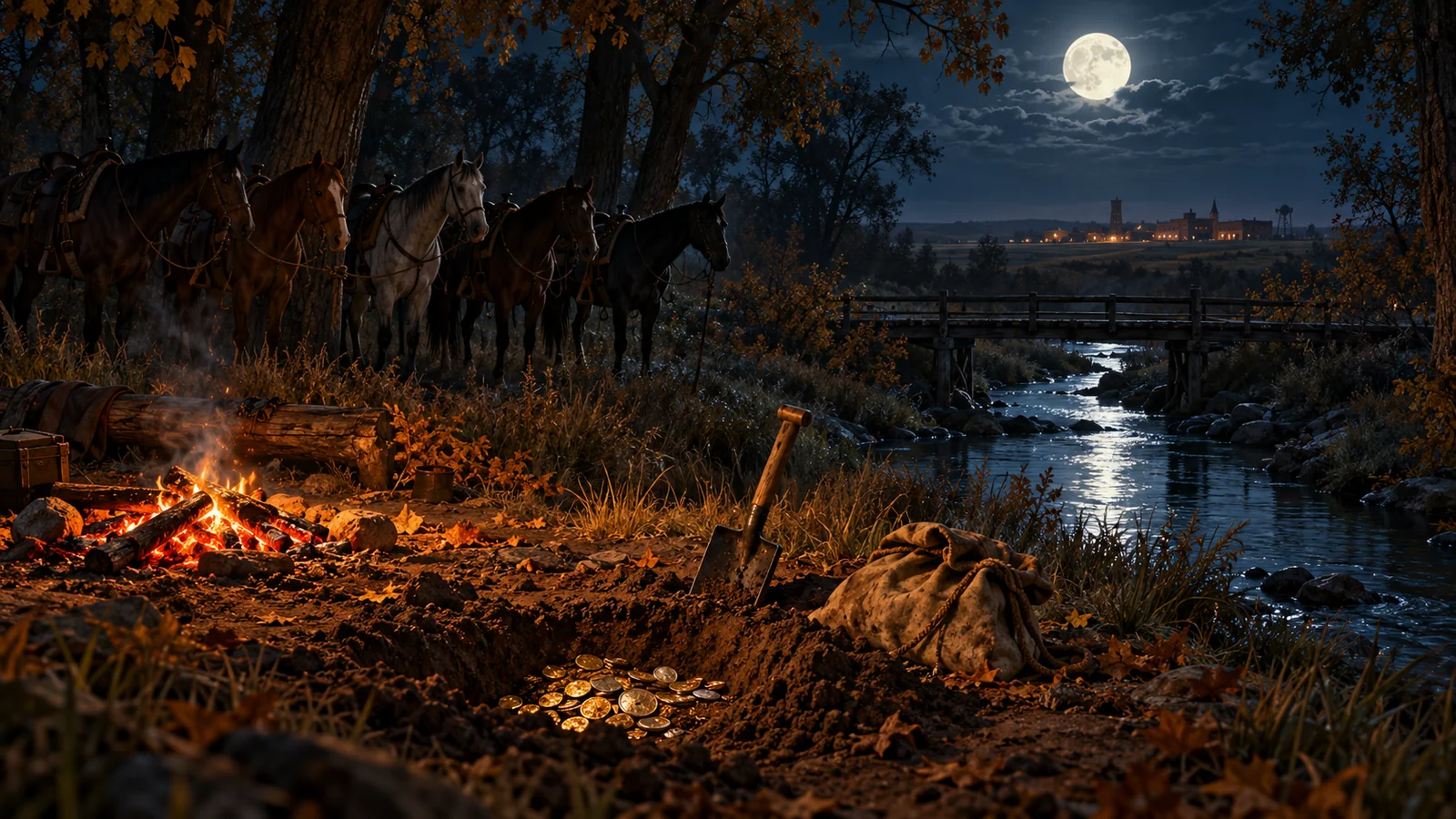
October 4, 1892. A creek in the timber a few miles west of Coffeyville, Kansas. Five men sit around a campfire, horses picketed in the dark, and tomorrow they plan to do something no outlaw gang in America has ever pulled off: rob two banks in the same town, at the same time, in broad daylight. By lunchtime the next day, four of them will be dead.
That much is history. Here's the bit that keeps metal detectors beeping along the Kansas-Oklahoma line: the story goes that before they turned in, the Dalton Gang dug a shallow hole beside that campfire and buried a fortune in gold and silver coins, loot from their earlier train robberies, to collect on the way out. Nobody came back for it. The one survivor spent the rest of his life refusing to go near the place.
So is the lost treasure of the Dalton Gang still sitting in the mud of Onion Creek? Or is it one of those stories that grew a pot of gold because a gunfight this famous simply deserved one? Right then. Saddle up, and mind the alley.
From badges to bandits: who were the Daltons?
The awkward truth about the Dalton Gang is that they started out on the right side of the law. Lewis and Adeline Dalton raised a very large family (fifteen children, by the Oklahoma Historical Society's count) in Kansas, close to Indian Territory. Adeline, as it happens, was an aunt of the Younger brothers who rode with Jesse James. Outlawry ran in the family tree, though nobody seems to have planned it that way.
The eldest of the brothers who matter here, Frank Dalton, served as a deputy US marshal for the federal court at Fort Smith, Arkansas, from 1884. Horse thieves and whiskey peddlers killed him on November 27, 1887, and by every account he was a good officer. His brothers Grat and Bob pinned on badges after him, serving as deputy marshals out of Wichita and Fort Smith, with young Emmett often riding along as a guard or posseman.
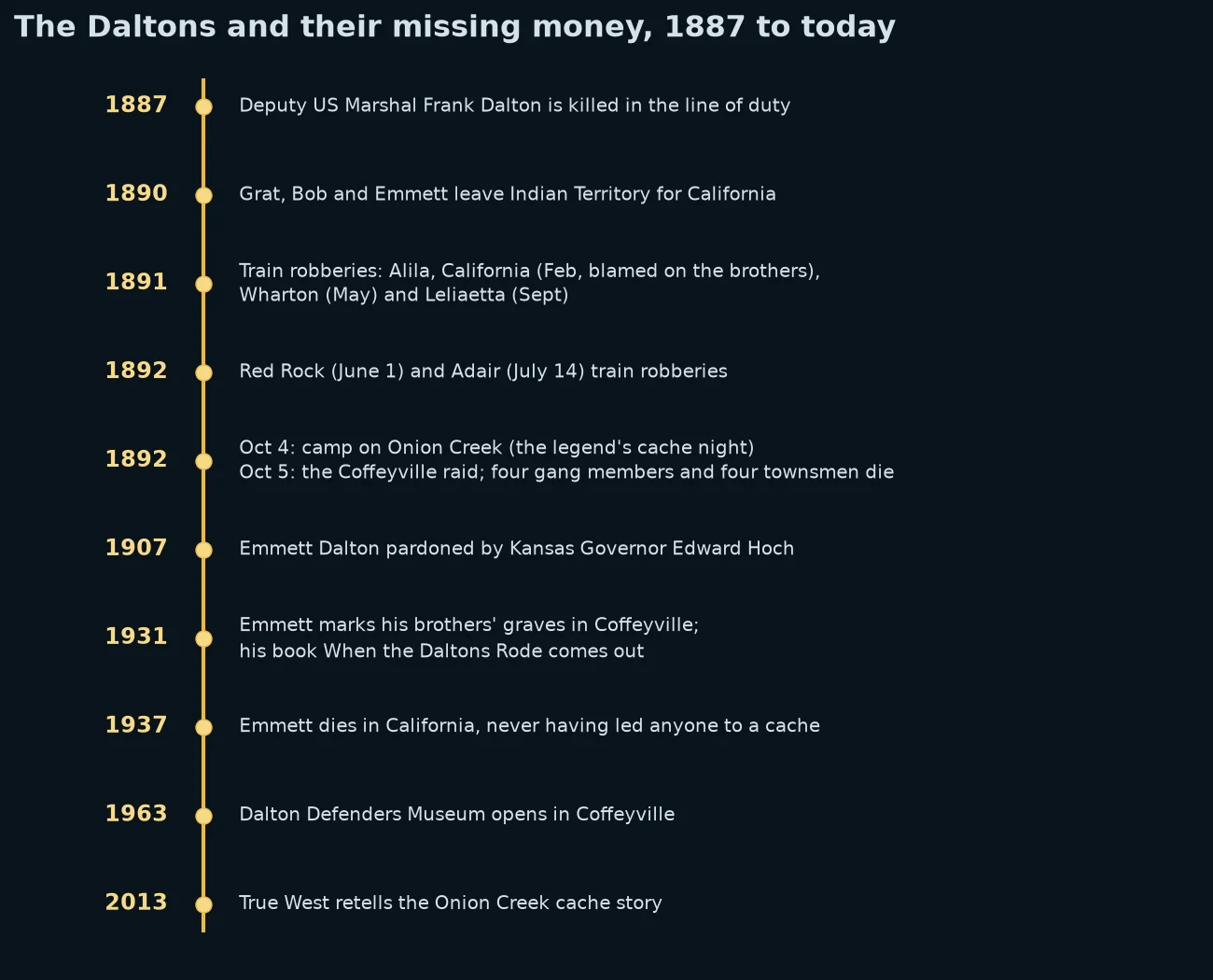
It didn't last. Around 1890 the brothers were tangled up in charges of horse theft and of bringing whiskey into Indian Territory, and Grat, Bob and Emmett headed for California, where another brother, Bill, lived. In February 1891 a Southern Pacific train was robbed at Alila, California, and the Daltons got the blame. Grat was convicted, despite more than a dozen witnesses who swore he was in a Fresno hotel at the time, and then broke out of jail that September. Bill was tried and acquitted. Bob and Emmett slipped back to Indian Territory, and the Dalton Gang was born.
Four trains and a lot of arguing about the money
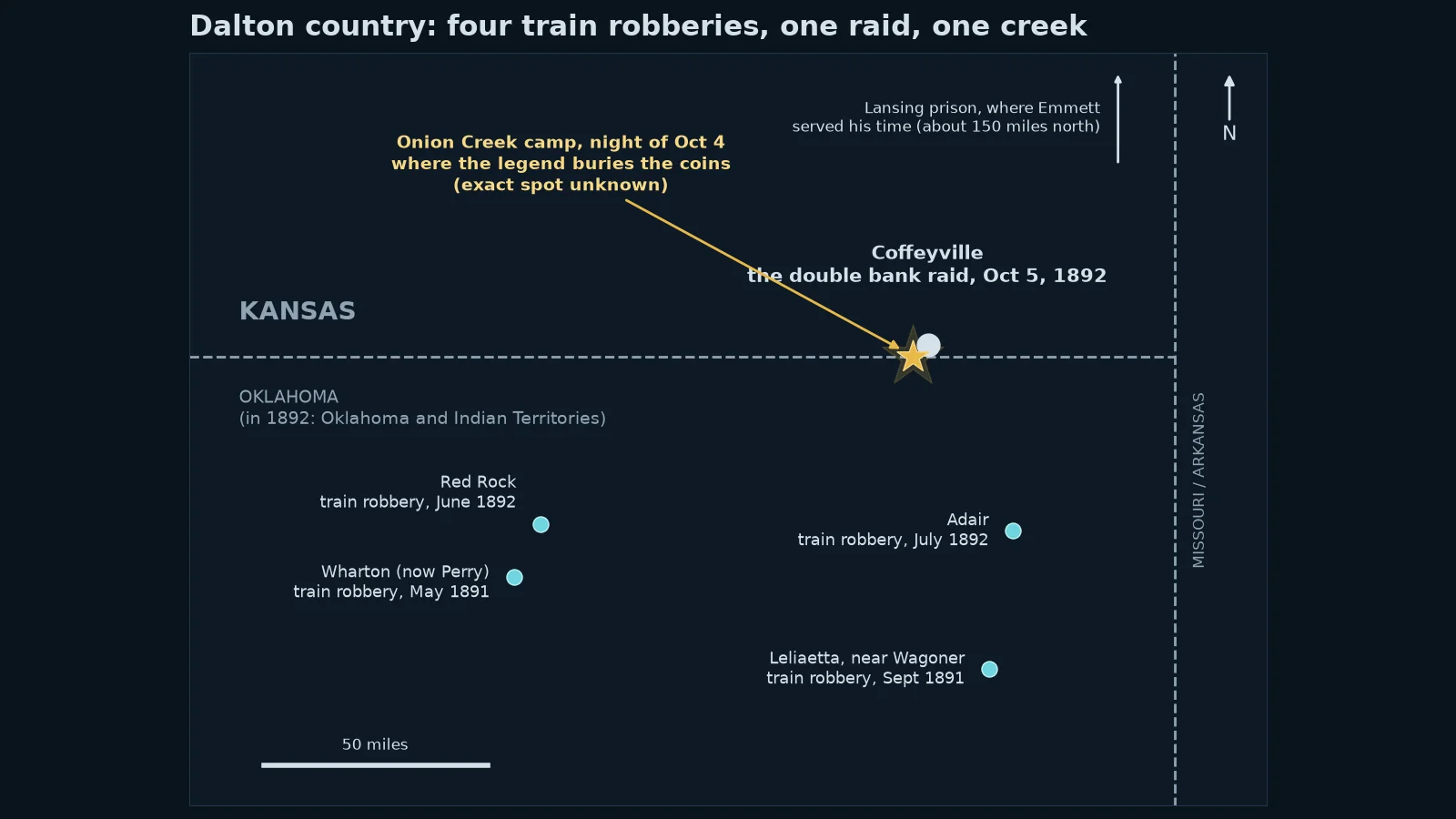
Back home, the gang went in for train robbery, and the Oklahoma Historical Society lists four jobs:
- Wharton (now Perry, Oklahoma), Santa Fe train, May 9, 1891.
- Leliaetta, near Wagoner, Missouri, Kansas and Texas ("Katy") train, September 15, 1891.
- Red Rock, Santa Fe train, June 1, 1892.
- Adair, Katy train, July 14, 1892. Guards fired back, and a local doctor, W. L. Goff, was fatally wounded by stray shots.
Now, how much did they actually take? This matters rather a lot for a treasure story, and the answer is a glorious mess. For Wharton, one National Park Service summary says $1,500 and Legends of America says about $1,745. For Leliaetta, the Park Service says $25,000 while Legends of America says $2,500. For Red Rock, the Park Service says over $70,000, Legends of America says the safe held about $50 (the big money supposedly rode on a train the gang let pass), and Wikipedia's account says most of the haul was drafts and paper that the robbers threw away, leaving roughly $1,800 in cash. Adair comes in around $17,000 to $18,000 in some tellings and "an unknown sum" in others.
In other words, nobody can say how rich the Daltons were in the autumn of 1892. That's important, because the whole legend depends on them having a sizeable pile of coins to bury. It's also worth knowing that, even at the time, people assumed the loot had gone into the ground: the Kansas Historical Society notes a California newspaper report claiming the Daltons had buried their treasure in Indian Territory. Rumours of buried Dalton money, it turns out, are nearly as old as the Daltons.
The plan: beat Jesse James
By late summer 1892 the territory was getting hot for the gang. Rewards were piling up, and lawmen were on their trail. The story goes that Bob Dalton wanted one last, enormous score that would let them clear out for good, and he wanted it to be legendary. Jesse James had never robbed two banks at once. The Daltons would.
The target was Coffeyville, Kansas, a town the brothers knew well because the family had once lived nearby. That turned out to be the first of several problems. The second was that the two banks, C. M. Condon & Co. and the First National, sat practically across the street from each other in the busiest part of town.
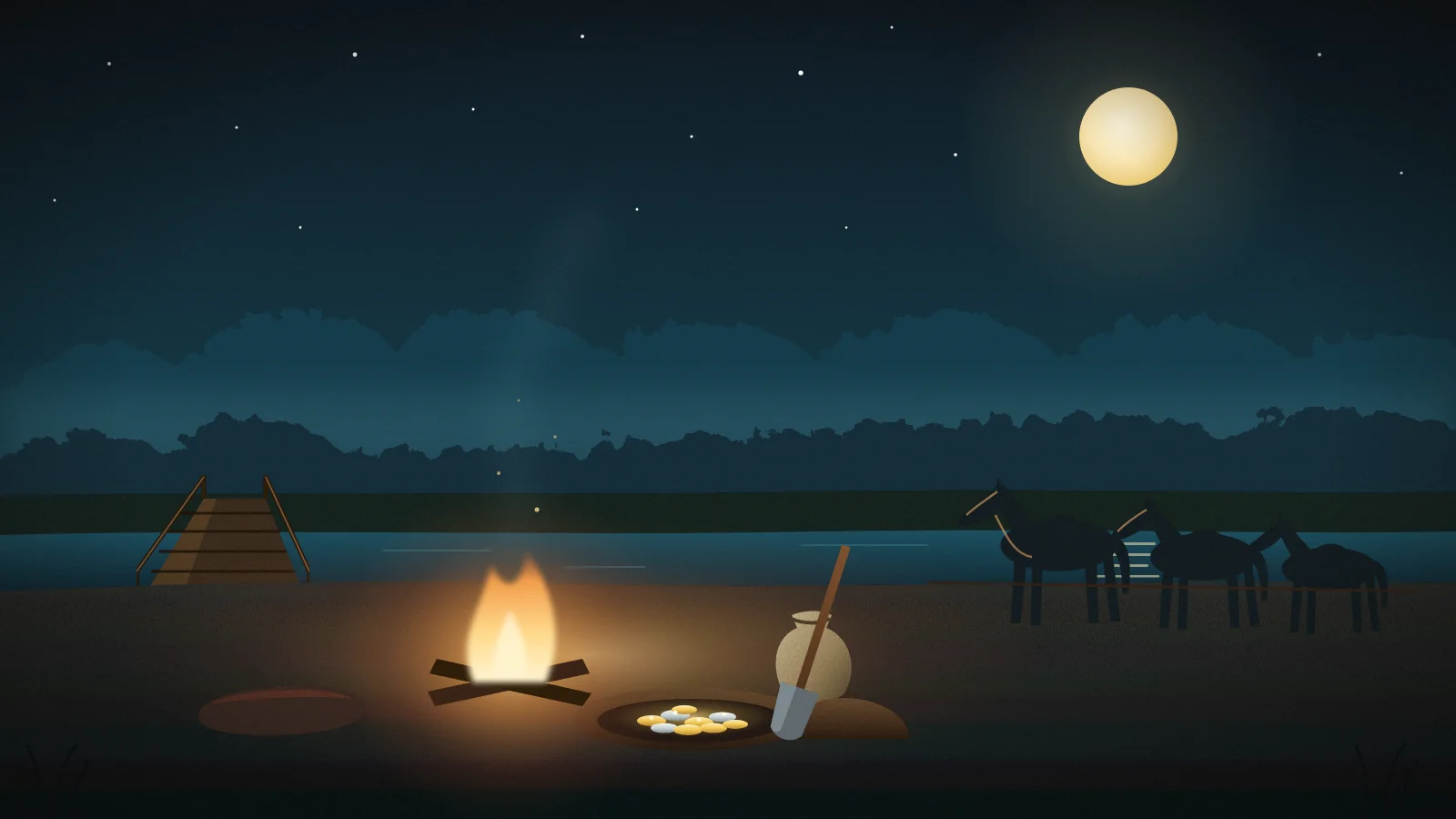
The five riders were Bob, Grat and Emmett Dalton, Dick Broadwell and Bill Powers. On the night of October 4 they camped on Onion Creek, west of Coffeyville. The Coffeyville Historical Society puts it there plainly; a Dalton family history describes the spot as timber along the creek about three miles southwest of town. Hold on to that campfire. It's where the treasure lives.
The Coffeyville raid: twelve minutes on October 5, 1892
A little after nine on the morning of October 5, the five men rode east into town along Eighth Street. The brothers, being recognisable former locals, wore disguises. Their plan was to tie the horses between the two banks, but the street was torn up for paving work, so they tied them in an alley near the city jail instead, a fair walk from the getaway. Rather inconvenient, as things turned out.
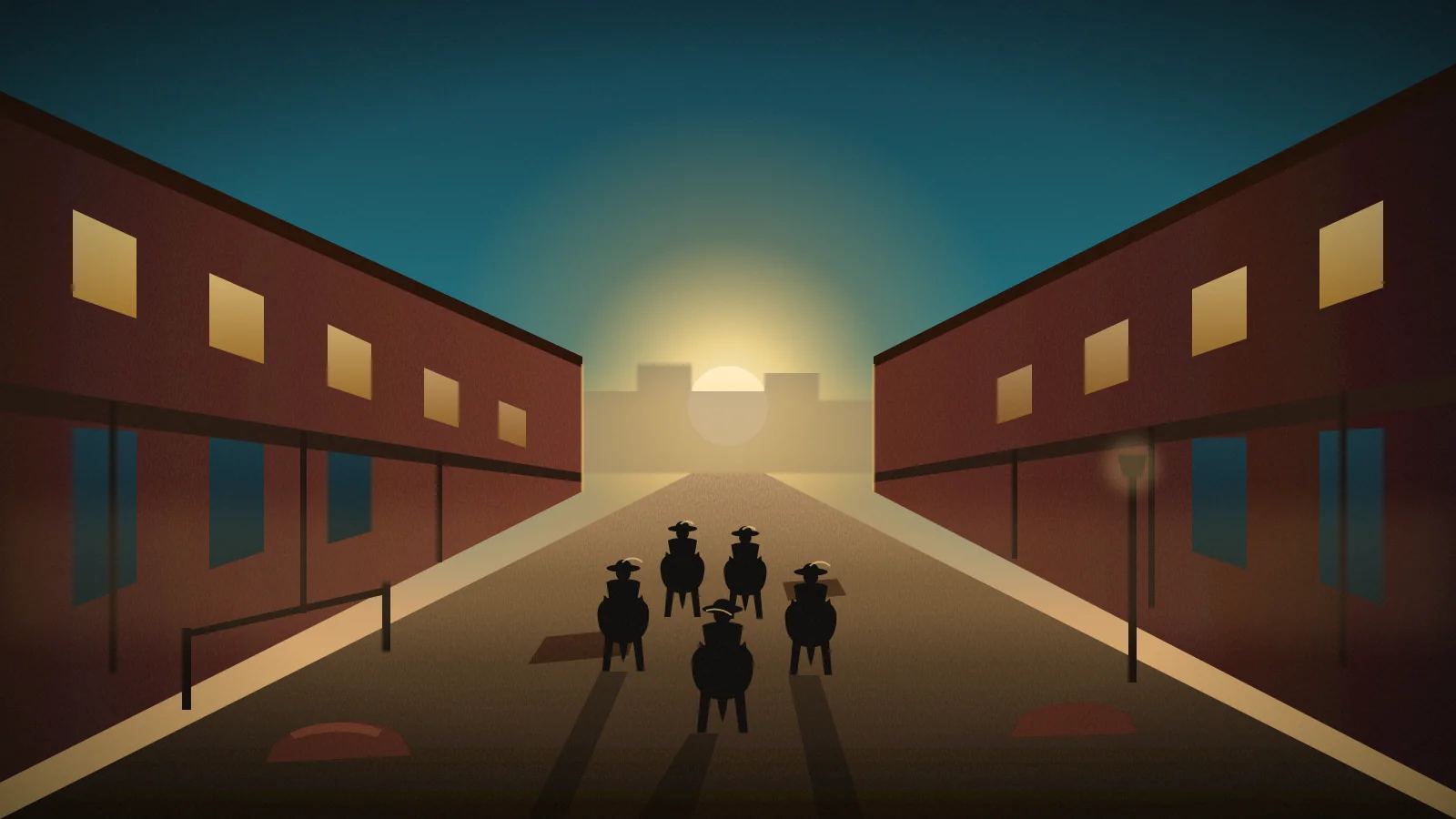
Grat, Powers and Broadwell went into the Condon bank. Bob and Emmett took the First National. The disguises fooled nobody for long; townspeople recognised the Daltons and word spread fast.
Then came the bluff that made the town's name. At the Condon, cashier Charles Ball told Grat the vault was on a time lock and couldn't open until 9:30. It was about twenty past nine. Grat said he'd wait. According to the Coffeyville Historical Society, there was no time lock at all. Those ten minutes were all the town needed: men ran to Isham Hardware, grabbed rifles and ammunition, and took up positions facing the banks. Cheeky, brave and very effective.
The gunfight lasted about twelve minutes. When it was over, four Coffeyville men were dead:
- Charles T. Connelly, 46, a schoolteacher who also served as the town marshal, killed in the alley.
- Lucius M. Baldwin, 23, a store clerk.
- George B. Cubine, 36, a shoemaker.
- Charles Brown, 59, also a shoemaker.
Cashier Thomas Ayres of the First National was shot and survived. Four of the gang died too: Bob Dalton, Grat Dalton and Bill Powers in the alley where they'd left their horses, now known as Death Alley, and Dick Broadwell, who got away on horseback only to die about half a mile from downtown.
Emmett Dalton made it to his horse with the First National's money. The Kansas Historical Society tells it this way: he could have escaped, but turned back when he saw Bob down, and was shot trying to help him. He was hit over and over (the usual figure is 23 wounds) and survived, which nobody expected.
The money that didn't get away
Here is the first great spoiler for anyone hoping the Coffeyville cash is out there. The gang grabbed roughly $25,000 from the two banks, and almost all of it came straight back. The Coffeyville Historical Society says that when the books were balanced that evening, the Condon bank was $20 short and the First National was $1.98 over. You couldn't make it up.
So the treasure, if it exists, isn't Coffeyville money. It would have to be what the gang brought with them from the train robberies. And here comes the second spoiler, from the Kansas Historical Society: when the bandits rode into town, they were carrying about $920 between them, plus watches, jewellery and guns, most of which vanished after the bodies were put on display and souvenir hunters went to work. That was hardly a fortune, but it's also exactly what you might expect if the real money had been left somewhere safe. Funny how one fact can be read both ways.
The legend of the Onion Creek cache
Right, the treasure. The best-known version comes from the treasure writer W. C. Jameson, who has told it in his book Buried Treasures of the Great Plains and in a 2013 piece for True West magazine. Here's how the story goes, and it is a story, not a record:
- On the evening before the raid, the gang reached Onion Creek near where it meets the Verdigris River, close to the Kansas-Oklahoma border.
- They had with them a hoard of gold and silver coins from earlier robberies, estimated at $9,000 to $20,000 in 1892 values.
- Rather than haul heavy coin into a bank job, they dug a shallow hole beside the campfire and buried it.
- The plan, according to the legend, was that anyone who got separated would meet back at the camp, dig up the coins and ride south into Oklahoma.
Nobody made the rendezvous. Four of the five never left Coffeyville.
The legend adds a witness. A young rancher's daughter named Mary Brown, the story goes, was out near the creek that morning, heard men eating and saddling horses, and watched five riders come out from under a small wooden bridge. Years later, having heard about the buried coins, she went looking. By then the old bridge had been torn down, parts of the creek had changed course and the road had been moved. She found nothing. It's a lovely detail, and so far it can't be checked against any record from the time, so treat it as campfire material.
Emmett's long silence
If anyone knew where the coins were, it was Emmett Dalton. He pleaded guilty and was sent to the Kansas State Penitentiary at Lansing (most sources say for life; a 1903 county history says 99 years), and by all accounts was a model prisoner. In November 1907, after about fourteen and a half years, Kansas Governor Edward Hoch pardoned him.
And this is where the legend gets its best twist. According to Jameson's telling, lawmen expected Emmett to head straight for Onion Creek, and they tailed him for weeks. He never went near it. He supposedly told an interviewer that he considered the coins tainted and wanted no more to do with them. That line rests on the treasure literature rather than on a document anyone has produced, so give it a raised eyebrow, but it fits the man he became.
Because Emmett went straight, properly straight. He married Julia Johnson in Bartlesville, Oklahoma, in 1908, moved to Southern California, and worked in real estate and construction. He wrote Beyond the Law, which became a 1918 silent film with Emmett playing himself, and later When the Daltons Rode (1931), turned into a Hollywood film in 1940. In May 1931 he went back to Coffeyville and had a marker placed on his brothers' graves. He died in Los Angeles on July 13, 1937, and is buried in Kingfisher, Oklahoma. If he ever dug anything up, he took the secret with him.
The searches since
Onion Creek has had plenty of company over the years. Treasure-hunting forums have traded stories for decades about where exactly the 1892 camp stood, which of the creek's several bridges the Mary Brown tale means, and detector sweeps along the banks that turned up the usual haul of fence wire, tin and disappointment. Nobody has produced a coin that can be tied to the Daltons.
The problem is the creek itself. A camp in the timber 130-odd years ago left no monument. Creeks wander, banks erode, bridges and roads get rebuilt, and a shallow hole dug in a hurry is about the easiest thing in the world for a flood to rearrange. Jameson has written that new information has narrowed the search area. Nobody has announced a find.
The legend has also had its moment on television: Expedition Unknown devoted a Season 10 episode, "Outlaw Fortune of the Dalton Gang," to the gang's missing loot, with Josh Gates retracing their last ride. A bit of telly glamour for a creek that mostly just wants to be left alone.
Did the Daltons really bury treasure on Onion Creek? The theories, weighed
- The cache is real and still there. The romantic favourite. The gang had robbed four trains, it makes practical sense not to carry heavy silver into a bank, and the $920 in their pockets on the day looks like travelling money, not life savings. The problem: there's no contemporary record of a cache, and the dollar figure rests on later retellings.
- The cache was real, but someone got there first. Some accounts say Bill Dalton and Bill Doolin were waiting near Coffeyville with fresh horses that morning and rode off before the shooting was over. If anyone else knew about a stash at the camp, they had decades to collect it quietly. Pure speculation, mind you; no source says they did.
- There wasn't much to bury. If the Red Rock haul really was mostly worthless paper and the other jobs brought in modest sums split five or more ways, the gang may simply have been broke. Wanting a huge payday is, after all, why you'd try to rob two banks at once.
- A story that grew in the telling. Rumours of buried Dalton loot were in the papers while the brothers were alive, and a gunfight this famous practically begs for a lost treasure to go with it. The Onion Creek details (the rendezvous plan, the bridge, the witness, Emmett's "tainted" line) arrive in treasure books, not in 1892 reports.
The honest verdict? The camp on Onion Creek is history. The coins in the hole beside the fire are legend. And the space between those two sentences is exactly where treasure stories like to live.
Visiting Dalton country in Kansas today
Fancy walking in the gang's footsteps? Brilliant. Coffeyville makes it easy, and nobody will shoot at you.
- Dalton Defenders Museum, 814 S. Walnut St., Coffeyville. Run by the non-profit Coffeyville Historical Society and opened on October 5, 1963, it's dedicated to the townspeople who died defending their town, with a large Dalton Gang collection. It now sits directly across the street from the bank the gang tried to rob. At last check it was open Tuesday to Saturday, 11 a.m. to 3 p.m., with adult admission $8; check before you go.
- Death Alley, beside the old city jail downtown, where Marshal Connelly and three of the gang died.
- Elmwood Cemetery in Coffeyville, where Bob and Grat Dalton and Bill Powers are buried. Dick Broadwell was buried in Hutchinson.
- The Dalton Gang Hideout and Museum in Meade, in southwest Kansas, is the home of the brothers' sister Eva Dalton Whipple, complete with a 95-foot tunnel from the barn to the house. Whether her outlaw brothers ever actually hid there is a 20th-century local legend that historians can't confirm, which makes it a fine fit for this story.
As for Onion Creek itself: the land along it is overwhelmingly private farm and ranch country, and the exact campsite has never been pinned down. Digging on someone's land without permission is trespassing, plain and simple, so admire the creek from the road and save your shovel for the garden.
The Daltons rode into Coffeyville to make history, and they did, just not the way they planned. Whether they left a fortune behind on Onion Creek or only a good story, the creek isn't telling.
...and if you find it, remember who encouraged your questionable life choices.
The short version of this story is on YouTube at @TenToeExpress.
Deep dive yourself
- The Dalton Raid, October 5, 1892 · Coffeyville Historical Society
- Dalton Defenders Museum · Coffeyville Historical Society
- Emmett Dalton · Kansas Historical Society, Kansapedia
- Dalton Gang Souvenirs · Kansas Historical Society, Kansapedia
- Dalton Gang, by Nancy B. Samuelson · Oklahoma Historical Society, Encyclopedia of Oklahoma History and Culture
- The Daltons' Life of Crime · National Park Service, Fort Smith National Historic Site
- The 1892 Dalton Raid at Coffeyville (from the 1903 History of Montgomery County) · Kansas Genealogy
- Outlaw Treasure: The Dalton Gang Loot, by W. C. Jameson (2013) · True West Magazine
- The Deadly Dalton Gang · Legends of America
- Dalton Gang and Dalton Gang Hideout and Museum · Wikipedia (good starting points, with further references)