 Ten Toe Express
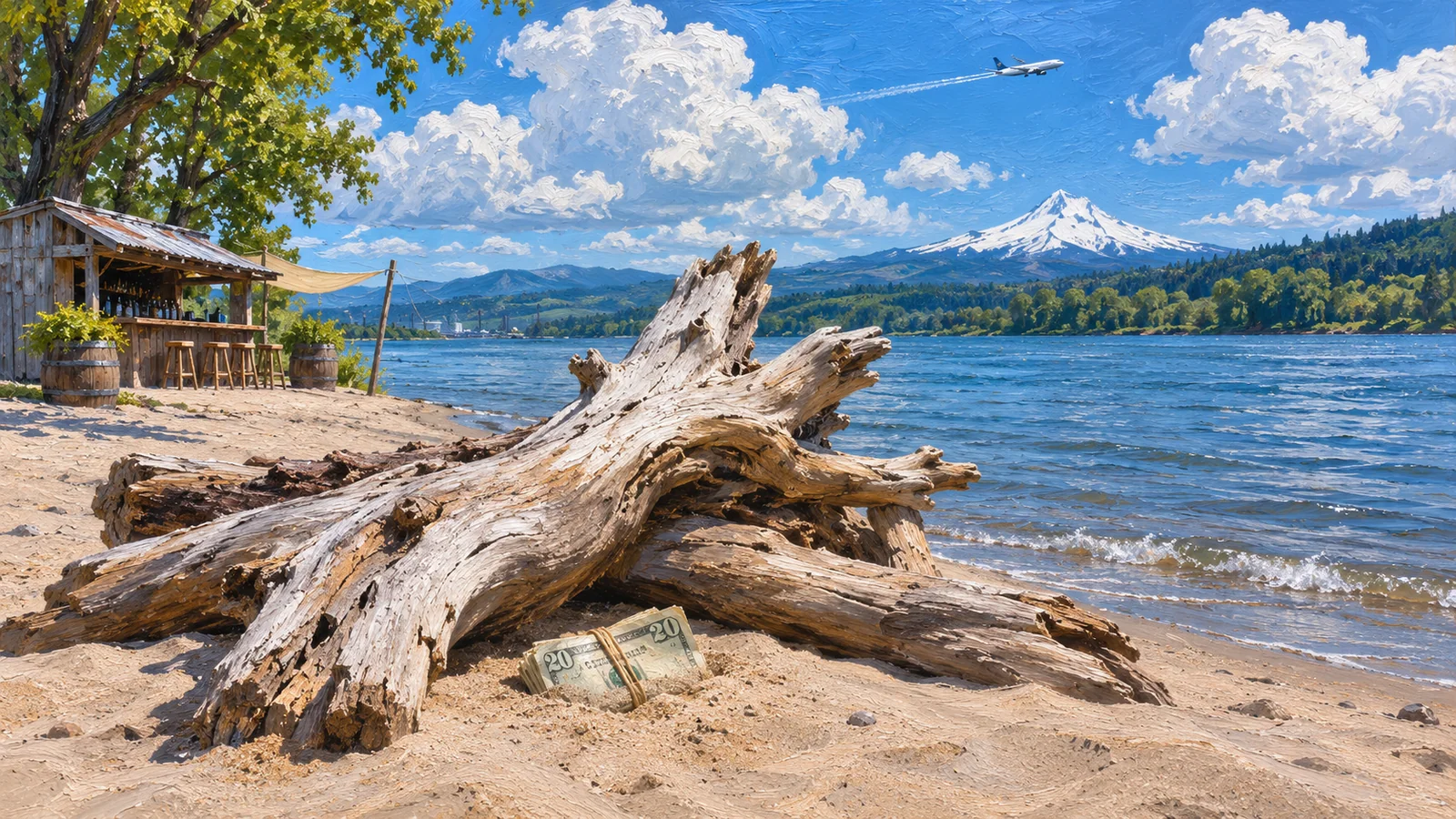
Right then, picture a quiet sandbar on the Columbia River in Washington, a Sunday in February 1980, and a family out for a picnic. An eight-year-old boy is raking the sand smooth to make a spot for a campfire when something "fluffed up" under the rake. It looks like a soggy lump of greenish paper. It is, as it turns out, the only piece of D.B. Cooper's hijacking ransom money anyone has ever found.
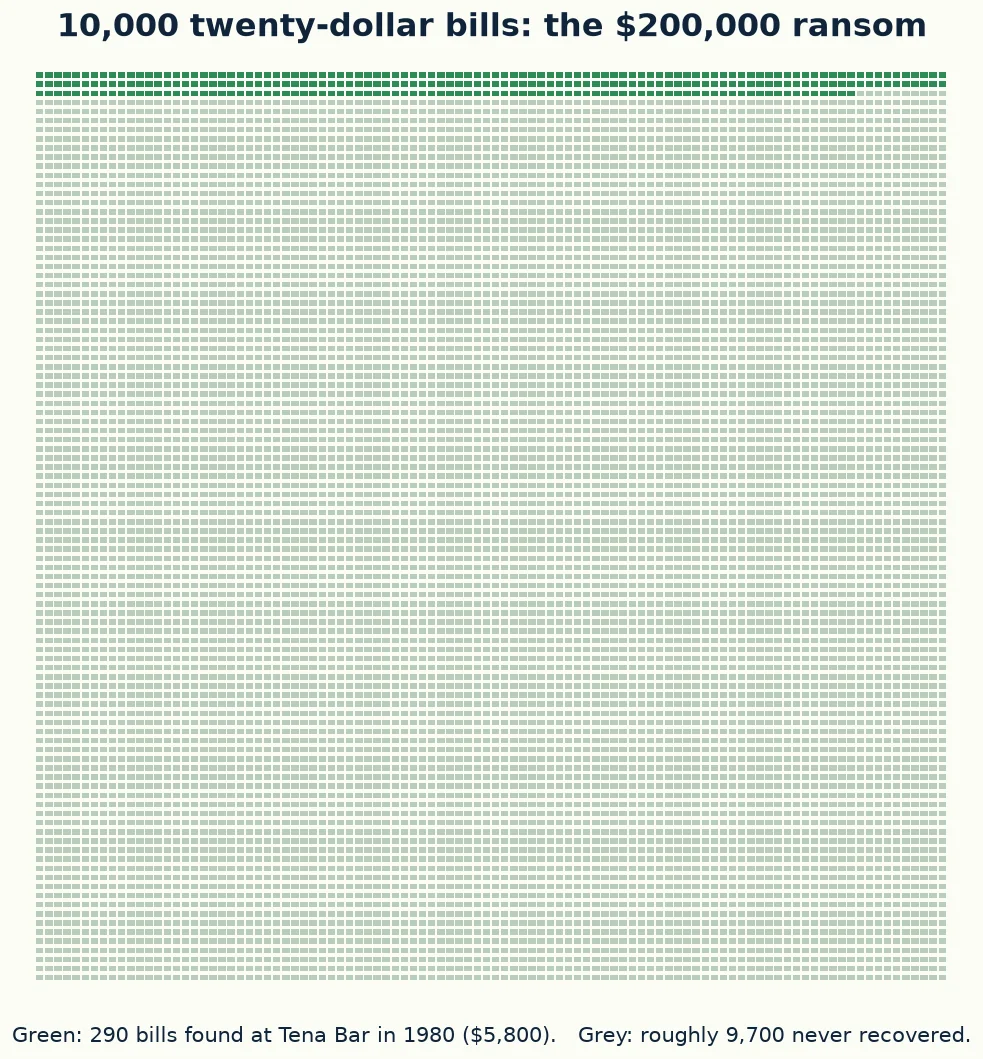
The rest, some 9,700 twenty-dollar bills, has never turned up. That is the treasure here: not gold in a cave, but a pile of very ordinary money from the most famous unsolved hijacking in American history, still missing after more than half a century.
The hijacking that started it
On November 24, 1971, a man bought a one-way ticket from Portland, Oregon, to Seattle-Tacoma International Airport for $20 on Northwest Orient Airlines, using the name Dan Cooper. A wire-service mix-up later turned him into "D. B. Cooper", and the name stuck for good. Once the Boeing 727 was in the air, he made his demands: $200,000 and four parachutes.
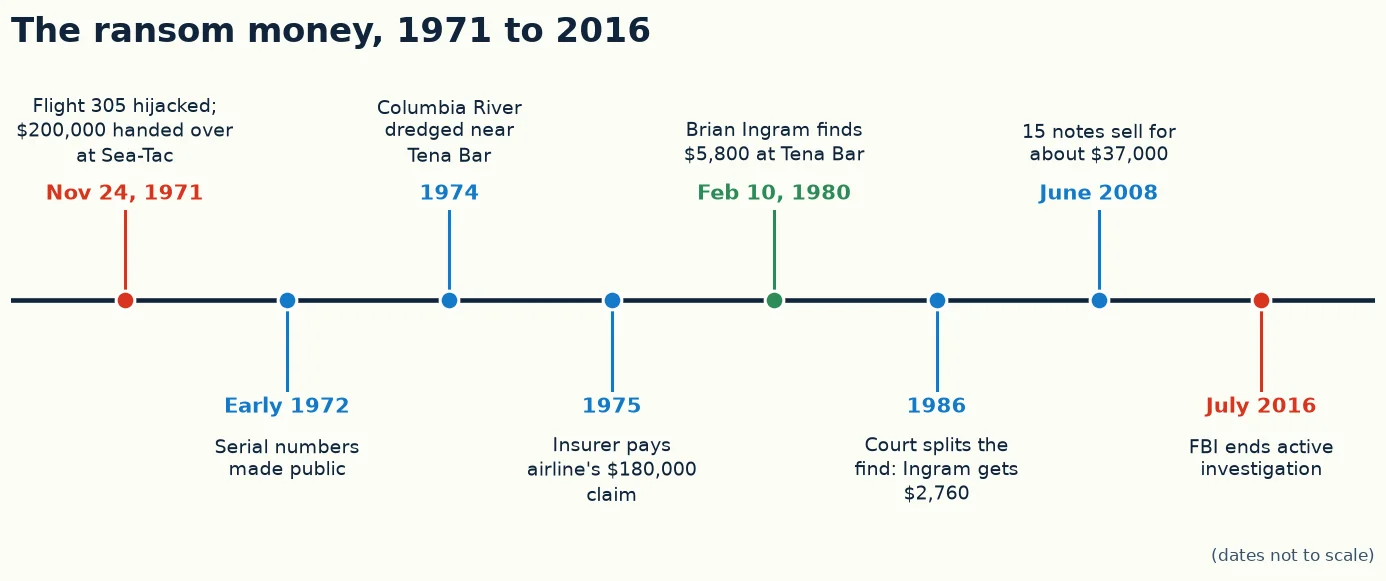
Northwest Orient's president, Donald Nyrop, agreed to pay. The plane landed at Sea-Tac in the early evening, the money and parachutes came aboard, and the passengers were let go. The cash was packed into a bag that weighed about 19 pounds. It was 10,000 twenty-dollar bills, and a few things about them would matter very much later: most of the serial numbers began with the letter "L", marking them as issued by the Federal Reserve Bank of San Francisco, and the numbers had been recorded on microfilm before the bag changed hands.
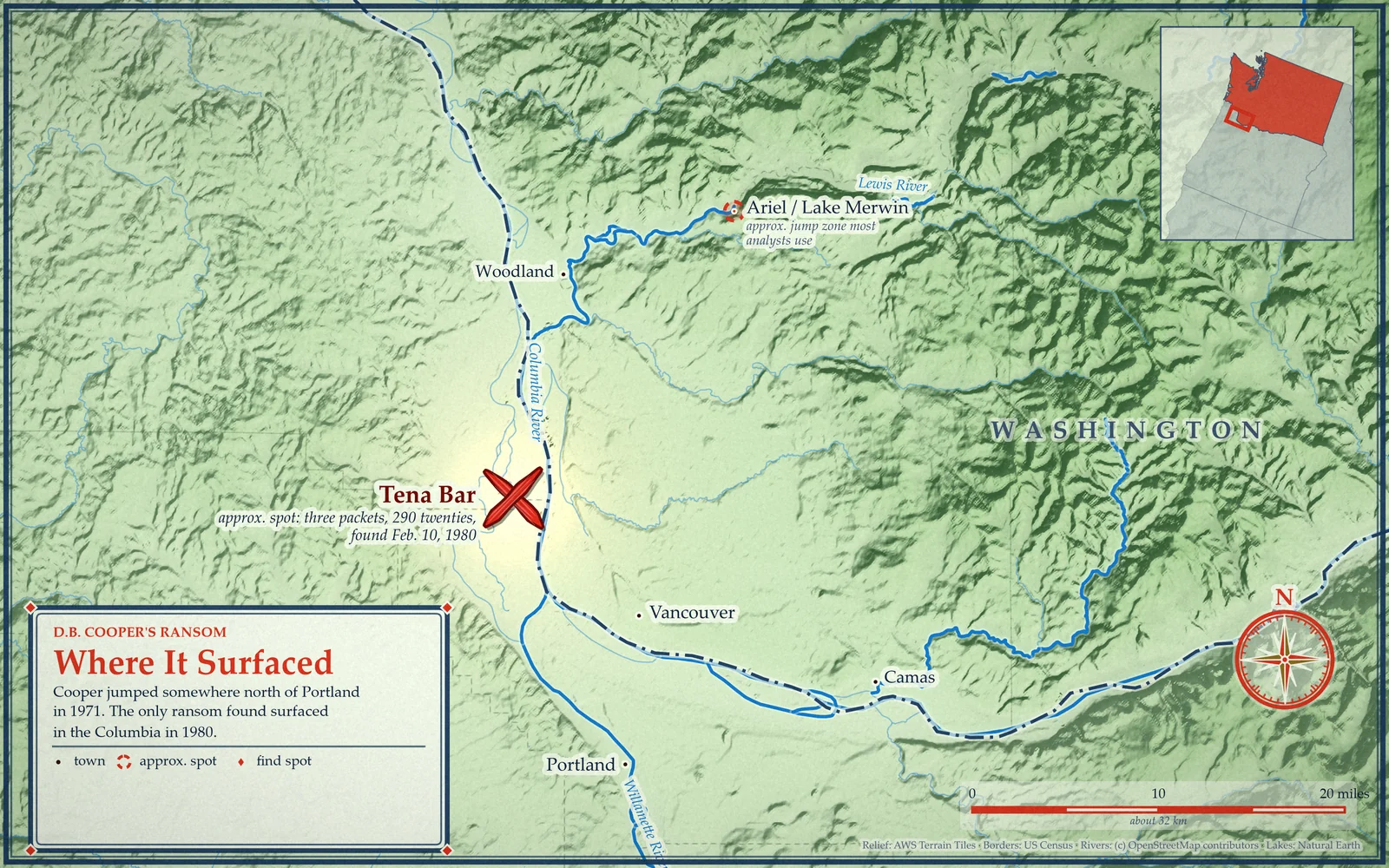
After refuelling in Seattle, the 727 took off again, heading toward Mexico. Shortly after 8 p.m., Cooper jumped from the rear stairs, roughly 20 miles north of Portland. The plane was flying at about 196 mph at some 10,000 feet, in the dark and over rough, forested country. Where exactly he went out is unknown. Most analysts work from a zone near Ariel, Washington, on the Lewis River and Lake Merwin, and that is as precise as anyone gets.
A very long wait for a single banknote
The FBI sent out the serial number lists about a month after the hijacking, and U.S. Attorney General John N. Mitchell released them to the public in early 1972. Then the money came with a bounty. Northwest offered 15 percent of anything recovered, up to $25,000. In early 1973 the Oregon Journal put up $1,000 for a ransom bill, and the Seattle Post-Intelligencer put up $5,000. The offers stayed open until Thanksgiving 1974.
Nobody collected a penny. Not one genuine bill surfaced. In 1975 Northwest's insurer paid the airline's $180,000 claim, after a Minnesota Supreme Court order. For eight years it looked as if the money had simply gone into the woods with the man who took it.
The Tena Bar find, February 10, 1980
Tena Bar (sometimes spelled Tina Bar) is a beach on the Washington side of the Columbia River in Clark County, about 9 or 10 miles downstream from Vancouver. On Sunday, February 10, 1980, eight-year-old Brian Ingram was there with his parents when he went to clear a spot for a fire. His rake turned up three packets of badly decayed twenty-dollar bills, still held together by rubber bands. His five-year-old cousin Denise was helping dig, although accounts differ on who found what.
The bills were buried anywhere from a few inches to about three feet down. Many had rotted to black mush or shrunk to the size of business cards, and the family reckoned only about 30 were in decent shape. They took the stuff for counterfeit or play money, and put it in a plastic bread bag. The next day they took it to the FBI.
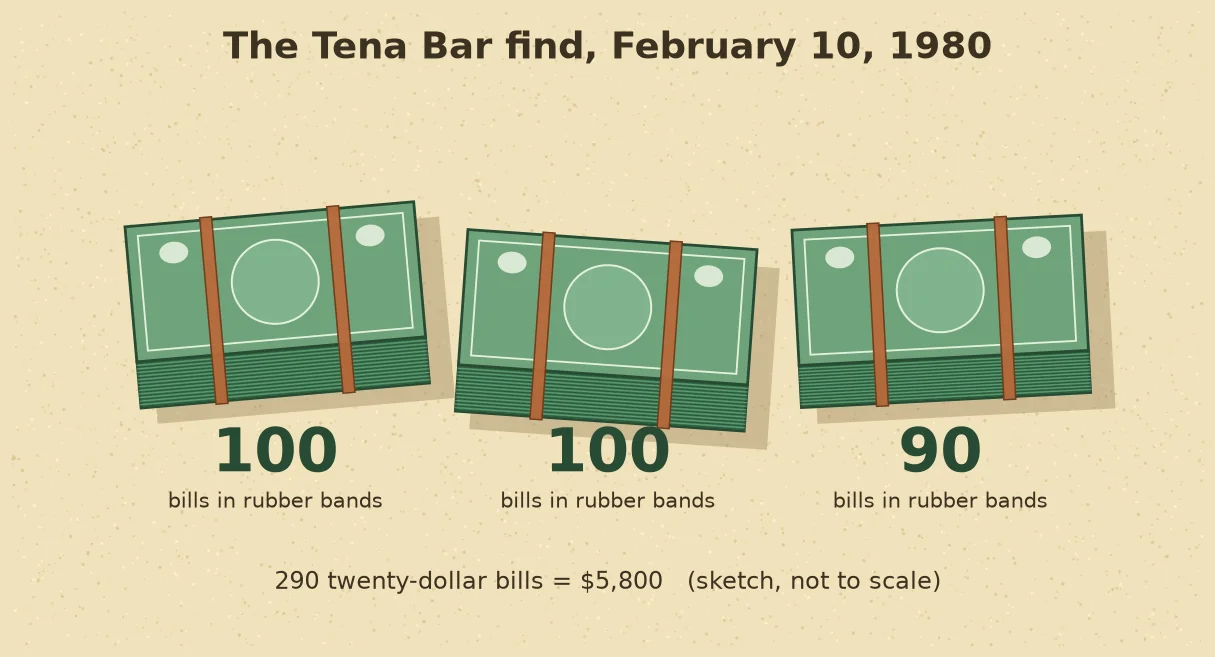
That is where the microfilm paid off. Agents checked the serial numbers against the list recorded by Seattle First National Bank before the hijacking, and they matched Cooper's ransom. There were three packets, two of 100 bills and one of 90, so 290 twenties, or $5,800.
On February 13 the FBI came back with a backhoe and experts in soil, archaeology and river currents. Agents recovered more bill fragments about five feet from the Ingram spot, some three feet down, but no more intact money.
Why the find raised more questions than it answered
The money was real. How it got there was another matter, and the answers have never lined up neatly.
- Buried or washed in? A U.S. Army Corps of Engineers hydrologist noted that the bills were matted together, which pointed to a river depositing them rather than someone digging a hole.
- The dredging problem. Sand dredged from the Columbia was dumped on Tena Bar in 1974. Geologist Leonard Palmer's findings suggested the bills arrived after that dredging, which means they were not simply lying there since 1971.
- The diatom study. A 2020 analysis of diatoms (tiny algae) found that the bills entered the water at least several months after the hijacking.
So the money did not drop out of the sky onto Tena Bar. Something moved it there, and some time had passed. Among citizen sleuths the favourite explanations are that the bills washed down the river from farther upstream (the "Washougal washdown"), that the flight path was not what anyone assumed, or that someone buried or dumped the cash on purpose. The FBI never reached a firm conclusion. Agents suggested the money may have drifted downstream, possibly via a tributary.
One more thing is worth a raised eyebrow. The widow of Duane Weber, a man once suspected of being Cooper, later recalled him tossing a trash bag into the Columbia just upstream of Tina Bar on a 1979 trip. The FBI eliminated Weber as an active suspect in July 1998 after his fingerprints did not match. Treat it as a good yarn, not a clue.
What happened to the money Ingram found
The legal tangle took years. In 1986 a court judgment gave the FBI a small slice as evidence and divided the rest between Ingram and the insurance company that had paid out on the hijacking. Ingram received $2,760 that June.
He held on to the rest. In 2008 he had 83 partial notes and fragments certified by PCGS Currency, and the examination turned up nearly three dozen serial numbers the FBI had apparently not recorded, including 35 more full numbers revealed in conservation work. In June 2008 he sold 15 of the notes at Heritage Auctions for about $37,000. Collectors, it turns out, pay rather more for a mouldy twenty than a shop does.
Where the trail stands now
The FBI code-named the case NORJACK and chased it for decades. In July 2016 it announced it was no longer actively investigating, calling it one of the longest and most exhaustive investigations in its history and saying its resources were needed elsewhere. The 66-volume case file is preserved and public. Cooper was never identified, and the roughly 9,700 missing bills have never been recovered. Case agent Larry Carr believed the money never went back into circulation.
The 1980 find remains the only confirmed physical evidence from the hijacking found outside the aircraft. Tena Bar is still a stretch of Columbia River shoreline in Clark County, and no later discovery of more ransom money has been confirmed. The river is a moving thing, and what it took in the 1970s could be anywhere between there and the Pacific.
...and if you find it, remember who encouraged your questionable life choices.
The short version of this story is on YouTube at @TenToeExpress.
Deep dive yourself
- D.B. Cooper hijacks a Northwest Orient airliner in 1971 · HistoryLink
- D. B. Cooper · Wikipedia
- Boy finds $5,800 of D.B. Cooper's ransom money near the Columbia River · KIRO 7
- D.B. Cooper skyjacking: Boy, 8, unearths ransom notes · Coin World
- PCGS Currency certifies legendary D.B. Cooper skyjacking ransom notes · PCGS
- D.B. Cooper notes make $37K at Heritage's Americana auction · CoinNews