 Ten Toe Express
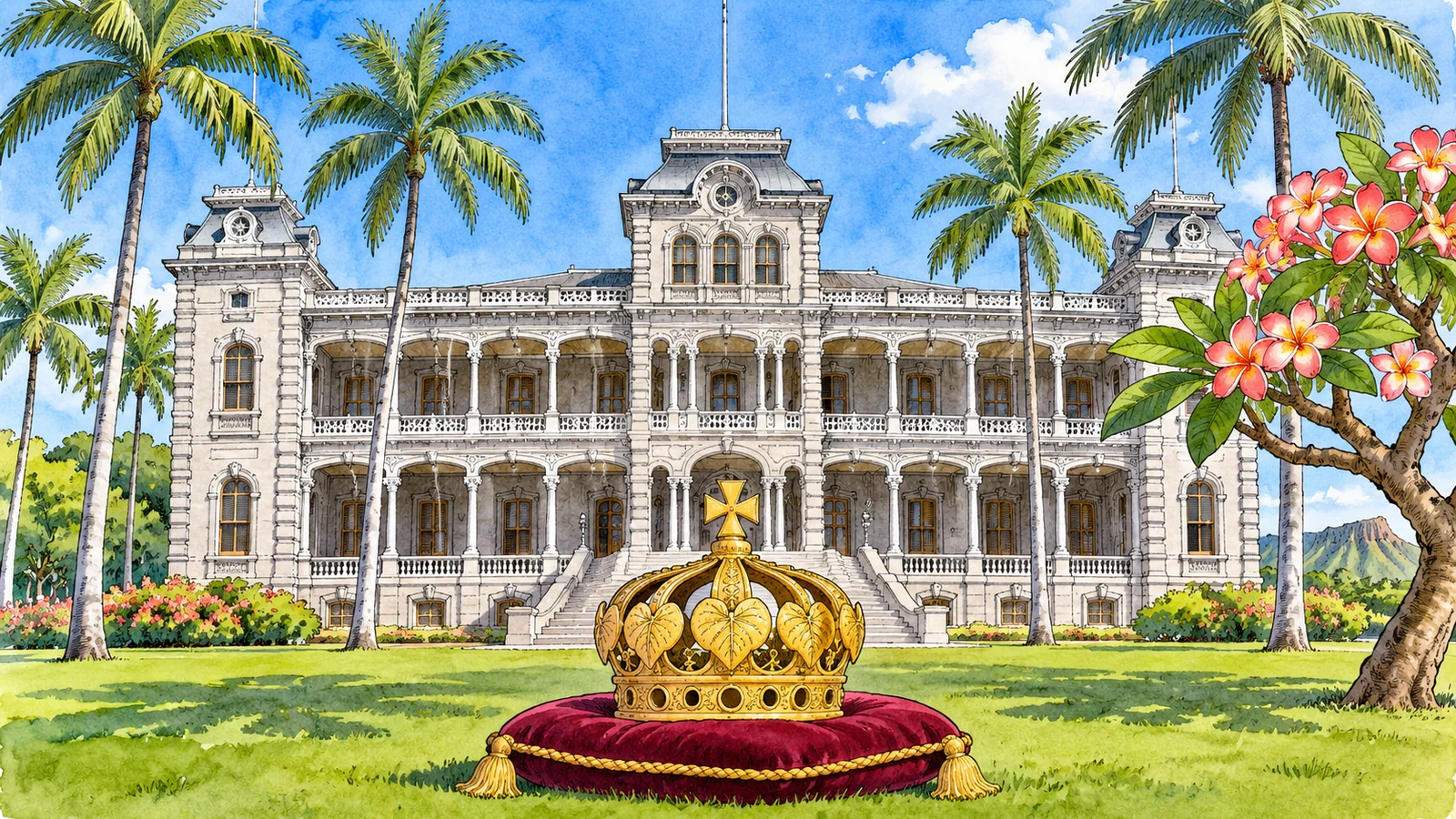
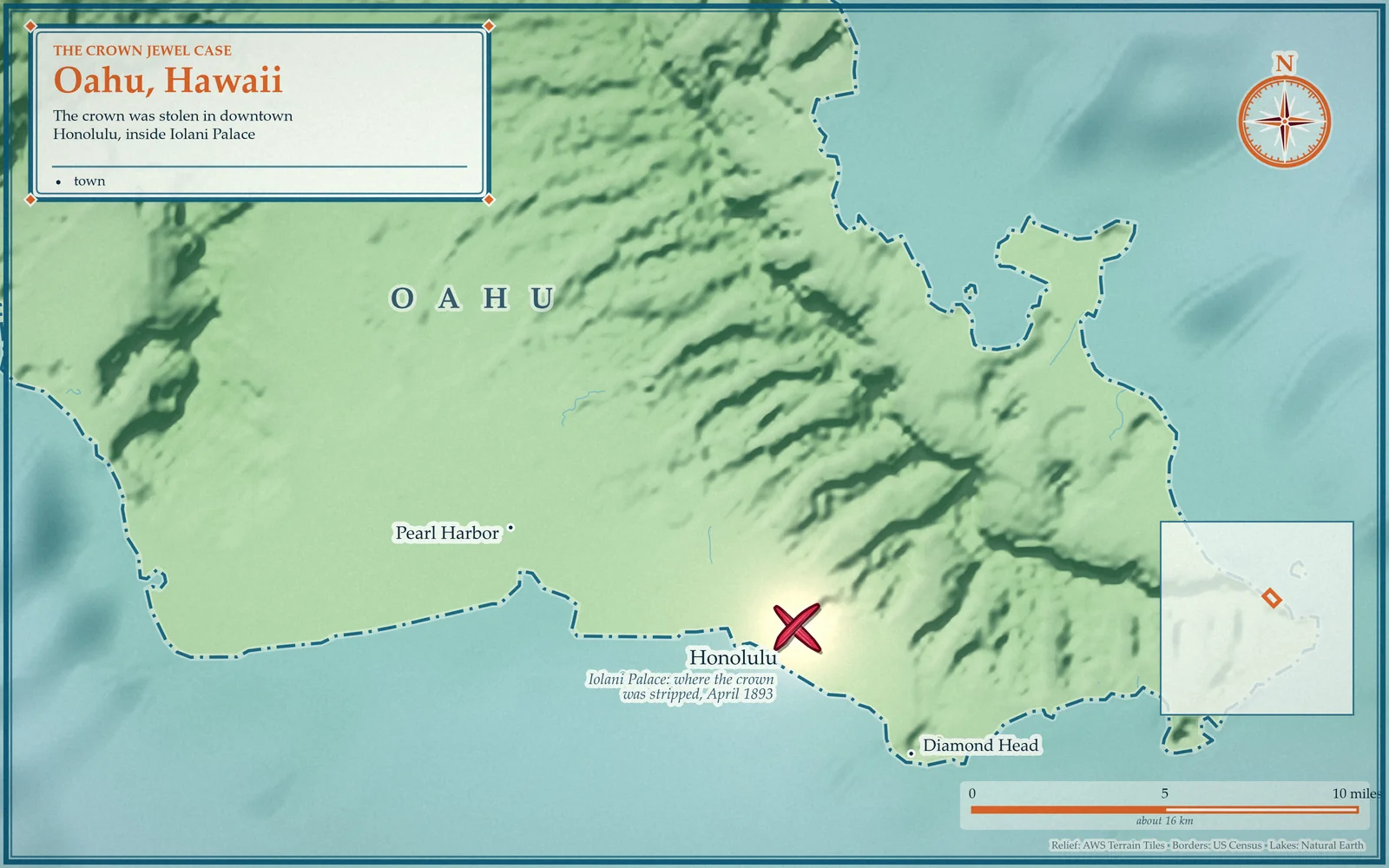
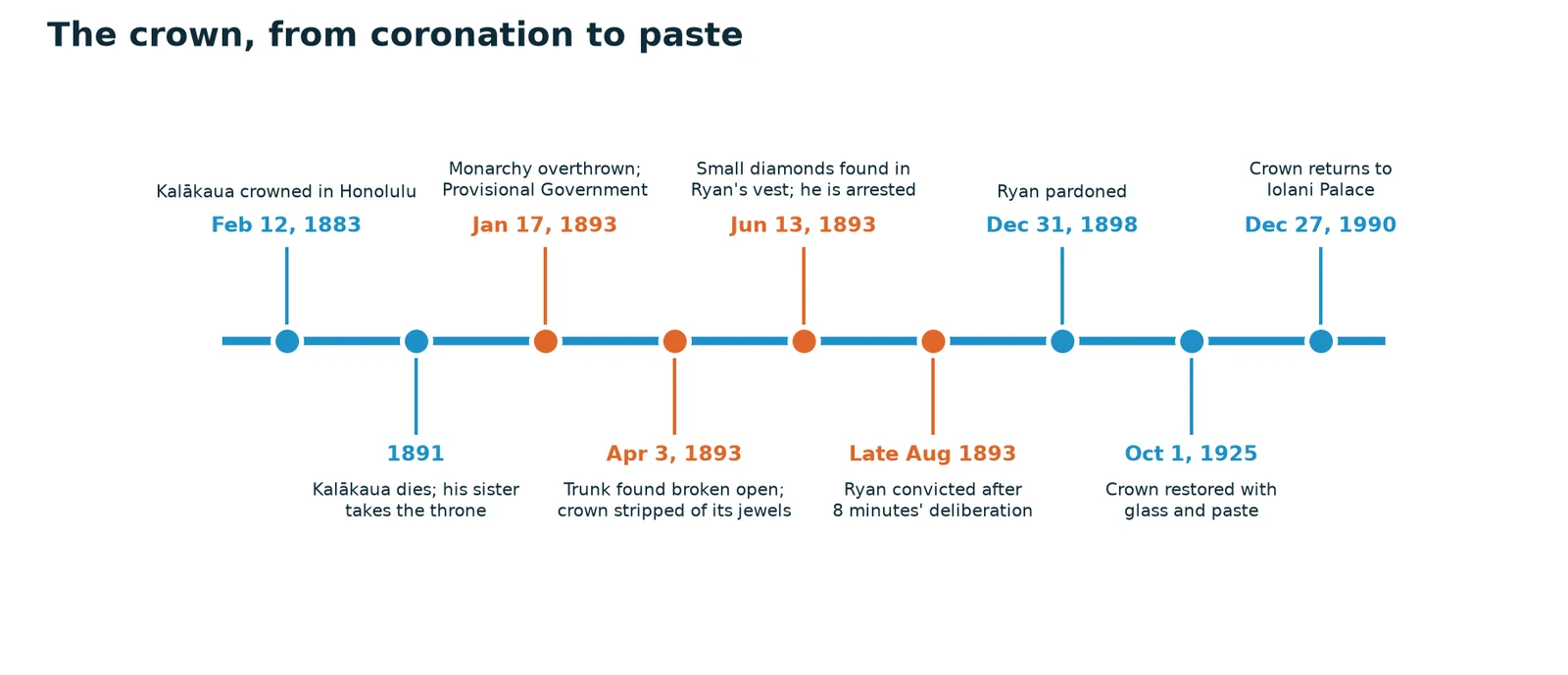
Monday, April 3, 1893, Honolulu. A new government has been running Hawaii for about eleven weeks, and its custodian of the royal palace is doing the dullest job in politics: taking the keys and counting the furniture. Down in the basement of Iolani Palace, in the chamberlain's office, he reaches a trunk. The trunk has been broken open. Inside lies what is left of King Kalākaua's crown: a bent gold frame, some gold leaves and a bit of velvet. Every jewel has been pried out.
That is the case of King Kalākaua's missing crown jewels, Hawaii's strangest burglary. It is a proper whodunit with a named thief, a courtroom, a prison break and a handful of tiny diamonds in a vest pocket. The big prizes, though, never came home. Plenty of stones left Honolulu in the luggage of tourists, and nobody knows where they went.
A crown made in London for a king who wanted a proper coronation
David Kalākaua became king of the Hawaiian Kingdom in 1874. After a world tour he decided his kingdom deserved a coronation in the European style, complete with crowns. Two solid gold crowns, one for the king and one for Queen Kapiʻolani, were made in London by the firm Hoffnung and Co. One account puts the price at £1,000; another gives $5,000 per crown. The sources do not agree, which is the first hint that this story likes to wriggle.
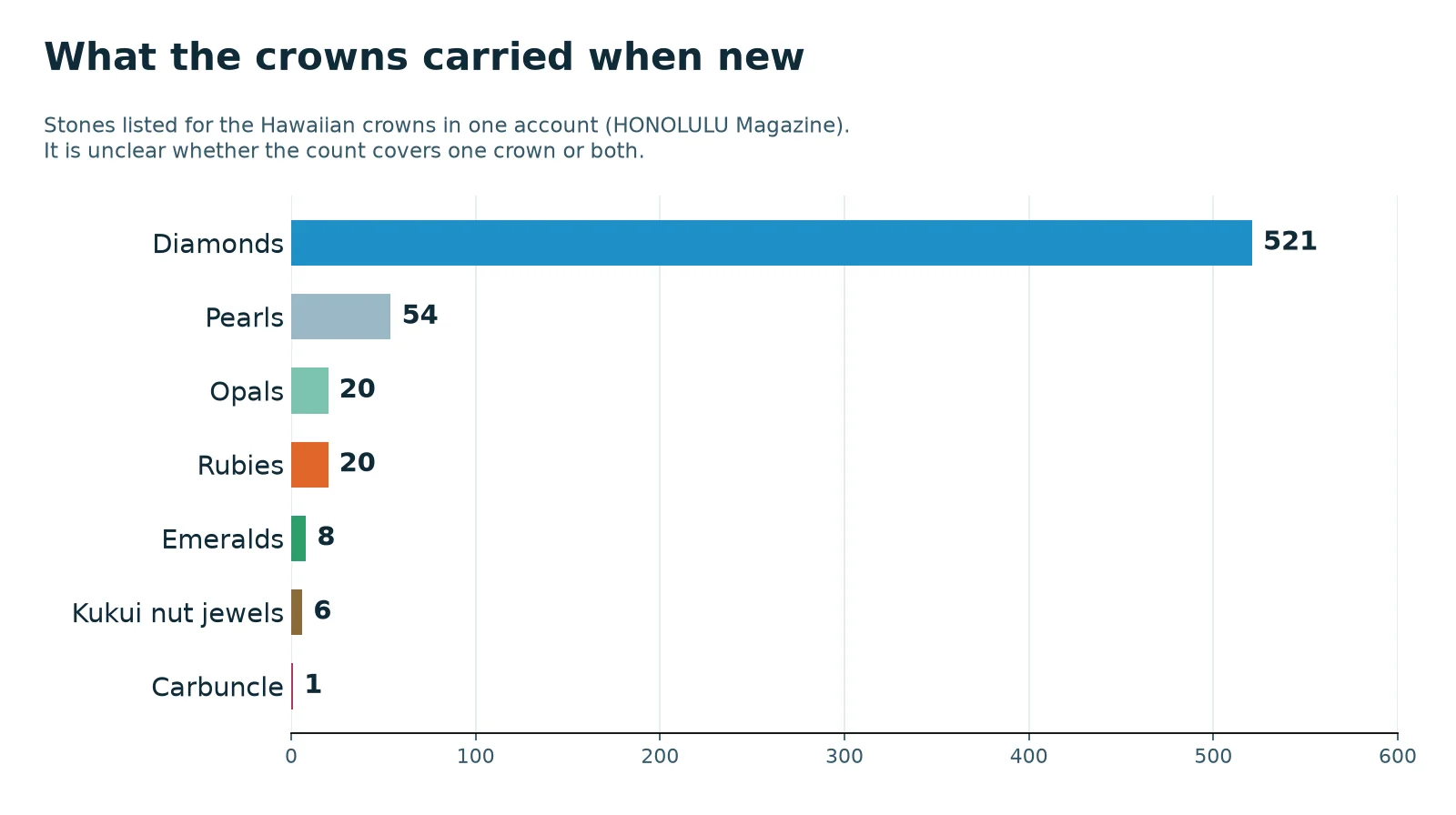
Kalākaua's crown was nearly oval, decorated with golden kalo (taro) leaves and crowned with a Maltese cross set with a large diamond. One account lists the stones on the crowns when new as 521 diamonds, 54 pearls, 20 opals, 20 rubies, eight emeralds, one carbuncle and six kukui nut jewels. It is unclear whether that count covers one crown or both, so treat it as the order of magnitude: a great many shiny things.
The coronation took place on February 12, 1883, on the grounds of Iolani Palace. By Mental Floss's count, it was the only occasion the crown was ever worn. Kalākaua died in 1891 and his sister Liliʻuokalani took the throne. Queen Kapiʻolani took her own crown home, which turned out to be an excellent decision.
January 1893: the kingdom changes hands
On January 17, 1893, a group of foreign residents and their Hawaiian allies, backed by US Marines and sailors landed from a warship, proclaimed a Provisional Government headed by Sanford B. Dole. Queen Liliʻuokalani yielded her authority to avoid bloodshed. Iolani Palace passed to the new regime, and so did everything in it, including a trunk in the chamberlain's basement office.
The new government reorganized the palace guard as the Hawaii Guard. Among the guardsmen was a corporal named George Ryan, who is where the story gets interesting.
The broken trunk
The handover came on Monday, April 3, 1893, when the keys passed from the old chamberlain, James Robertson, to the Provisional Government's custodian, R. Jay Green. The trunk had been forced. Queen Kapiʻolani's crown was not in it, and Kalākaua's was stripped of every stone. The Pacific Commercial Advertiser reported it on April 5, 1893 under a headline that said the king's crown had been left without ornaments. Honolulu Magazine places the theft over the weekend of April 1 to 2. Pinning down any tighter date is beyond the surviving accounts.
The suspects were the men who had guarded the basement. Some of them, by every account, had been spending money in a way that raised eyebrows.
Who was George Ryan?
Ryan was in his mid-twenties, with a past that did not improve on closer inspection. In January 1893 he had been arrested for carrying a concealed weapon and ordered to leave the islands, then turned up in the Hawaii Guard anyway. Police later connected him to earlier convictions under other names, including an Oregon penitentiary term and a term in Oʻahu Prison in 1887. He also used the name "Preston Horner" and claimed it was his real one. Nobody has proved that.
For weeks nothing happened. Workers found a few worthless stones and some gold filigree in the palace basement in late April. In May Ryan was court-martialed for dereliction of duty and discharged. Then, on June 13, Detective William Larsen searched his room at the White House Hotel on Nuuanu Avenue. In a vest pocket he found about a dozen small diamonds. A Fort Street jeweler, Henry Wichman, valued them at $2,500. Ryan was arrested that evening near a saloon.
The fences, the hack drivers and the tourists
Here is where the tale gets properly Honolulu. According to Honolulu Magazine's account, the thieves did not exactly have a vault of connections. Some of the diamonds went through hack drivers (the taxi drivers of the day), who sold them to visitors, so jewels walked off the island in travelers' pockets. Others were offered to merchants in Chinatown, where at least one man turned them down and another pointed the sellers toward a pawnbroker. The Guard also had a second suspect, Richard Stone, whose name came up in witness statements. A guardsman called William Wagner avoided prosecution by turning state's evidence. Stone was never charged with the crown theft, though he was convicted of other crimes.
A jeweler, J. E. Gomes, testified that he set diamonds for the thieves. A large diamond, the six-carat stone from the crown's cross according to one telling, was reportedly mailed to Ryan's sister in Missouri. Prison officials intercepted a letter thanking him for it. One account says the Attorney General got the stone sent back and it vanished again; another mentions only that some stones went to his sister, with no return. Take your pick, because the sources do.
Trial, escape and a short ride
Ryan escaped while awaiting trial in the summer of 1893. Accounts disagree on whether this was late July or August, but all agree he did not stay out long: he was caught again the same day. In late August he stood trial before Judge William Austin Whiting in the First Circuit Court, defended himself, and was found guilty after about eight minutes of deliberation. The sentence was three years and a fine (one newspaper report adds six months for the jailbreak). Ryan was pardoned by the Executive Council of the Republic of Hawaii on December 31, 1898.
His end is murky. One account says he stowed away on a transport to the Philippines in March 1899, and another that he enlisted in the army. Honolulu Magazine says he was found dead on a raft on the Pampanga River in April 1899. It is a grim ending and the sources are thin, so the details are better left alone.
What happened to the loot?
Only a handful of stones were recovered, mostly the very smallest. According to Honolulu Magazine, those tiny diamonds from Ryan's vest were turned over to the government and are kept in the State Archives. The larger stones, the pearls, the opals, rubies and emeralds, were scattered. What did not walk away in a tourist's pocket probably went into rings and brooches long ago. No one has publicly traced a stone to the crown since.
One popular version says American troops looted the palace and took the crown, and History.com repeats that a valuable crown was stolen in the aftermath of the coup. The detailed record points elsewhere: a Hawaii Guard corporal, a trial, a conviction.
The crown today
In 1925 the empty crown was sent to the Honolulu jewelers Wall and Dougherty. Work finished on October 1, 1925, and the replacements were glass and paste, at a cost reported as $350. In December 1990 it came back to Iolani Palace and went on show in the basement where it was stolen, next to Queen Kapiʻolani's crown.
The palace has also been hunting its own scattered treasures for decades, since much of its contents were auctioned in the years after the overthrow and dispersed across 38 states and several countries, according to the Honolulu Star-Bulletin. Its public "Most Wanted" list includes Kalākaua's bedroom furniture and a statue from the Grand Hall. A group called the Crown Restoration Committee was formed to restore the crown with real gems, according to Honolulu Magazine in 2011. Where the crown is displayed today is worth checking with the palace before a visit.
Iolani Palace is a museum, and you can tour it. The stones that went missing in 1893 are not hidden under a floorboard waiting for a lucky visitor: they are simply gone into the world, which is a rather more honest kind of mystery.
...and if you find it, remember who encouraged your questionable life choices.
The short version of this story is on YouTube at @TenToeExpress.
Deep dive yourself
- Malice in the Palace: The Hawaii Crown Jewel Robbery · HONOLULU Magazine
- Plundered · Images of Old Hawaiʻi
- 7 Spectacular Lost Crown Jewels · Mental Floss
- The Hunt for the Missing Hawaiian Crown Jewels · The Daily Beast
- Crown of Hawaii · Wikipedia
- When Hawaii's Monarchy Was Overthrown, With Rogue US Support · History
- Iolani Palace honors Kalakaua by displaying priceless artifacts · Honolulu Star-Bulletin
- Most Wanted Items · Iolani Palace