 Ten Toe Express

Picture a spring day in 1887 on the west face of Lookout Mountain, just outside Spearfish, South Dakota. Two Norwegian brothers are hauling out sandstone for building. One of them turns over a flat slab, rubs off the grime, and squints at scratchy handwriting that ends with four unsettling words: "Indians hunting me."
That slab became the Thoen Stone, and it has been starting arguments ever since. Read it at face value and it is the last message of a lone prospector, dated 1834, who says his party got gold in the Black Hills forty years before Custer's expedition set off the great gold rush. Read it with a raised eyebrow and it is the best hoax a bored stonemason ever carved. Right then: fancy a proper mystery?
The day the Thoen Stone turned up
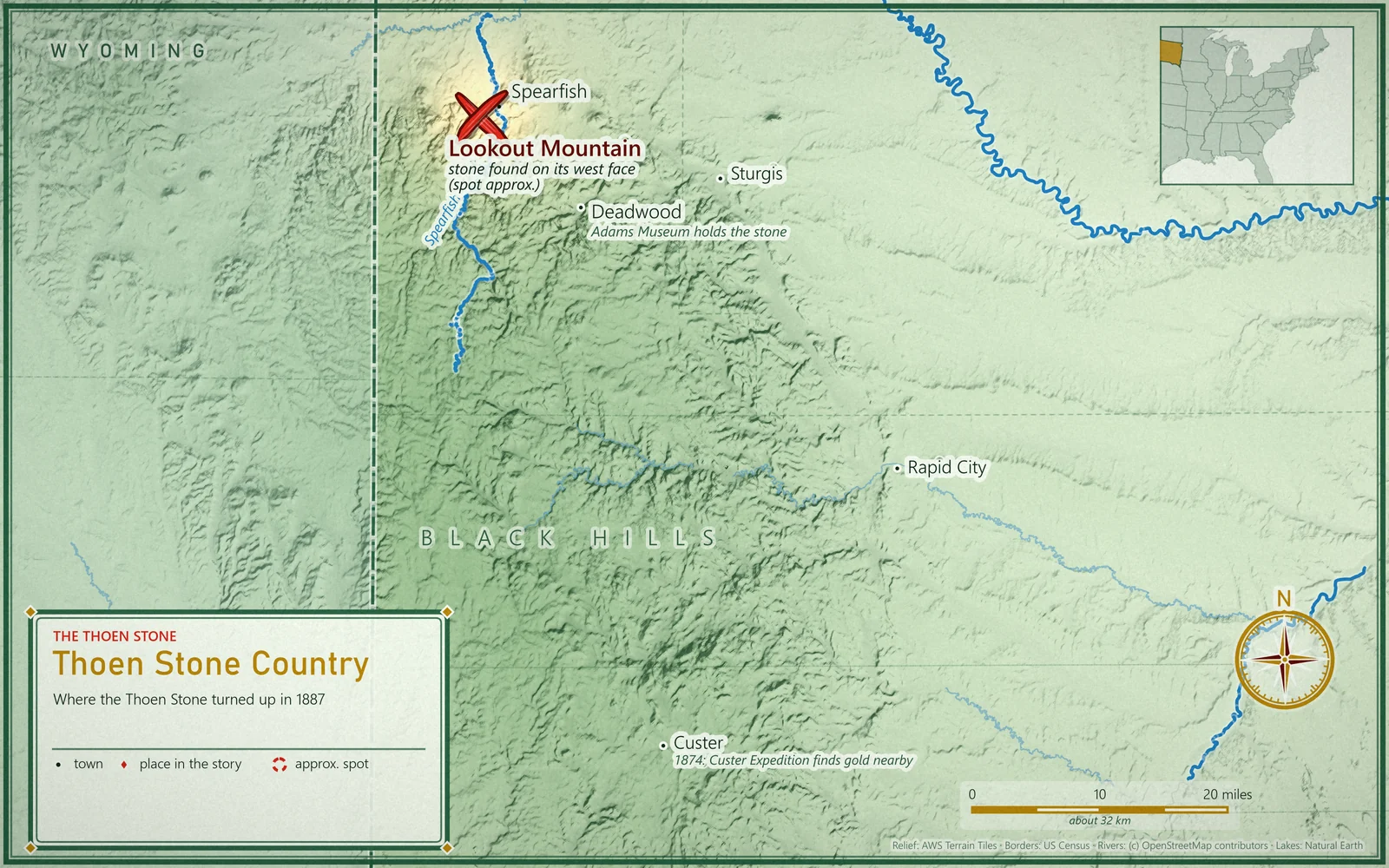
The date most sources agree on is March 14, 1887. Louis Thoen and his brother Ivan, Norwegian immigrants living at Spearfish, were gathering stone on the west face of Lookout Mountain when Louis found a flat sandstone slab. One account has it half-buried in dirt; Wikipedia says several feet down; a local-history write-up says it lay near an old Indian trail to Deadwood with native grasses growing over it. Accounts differ on the details, which is rather typical of this story.
The slab measures roughly 10 by 8 inches and about 3 inches thick, with handwriting-style lettering cut into it. Louis could make out enough of the text to take it home and clean it up. He showed it to Henry Keats, who later became mayor of Spearfish, and it landed at the Spearfish Register. A day later it was on display in John Cashner's store in town, and pictures of it were sold as postcards. In 1888, Cashner sold the story to the Detroit Free Press, so the whole country got to wonder about it.
What the stone says
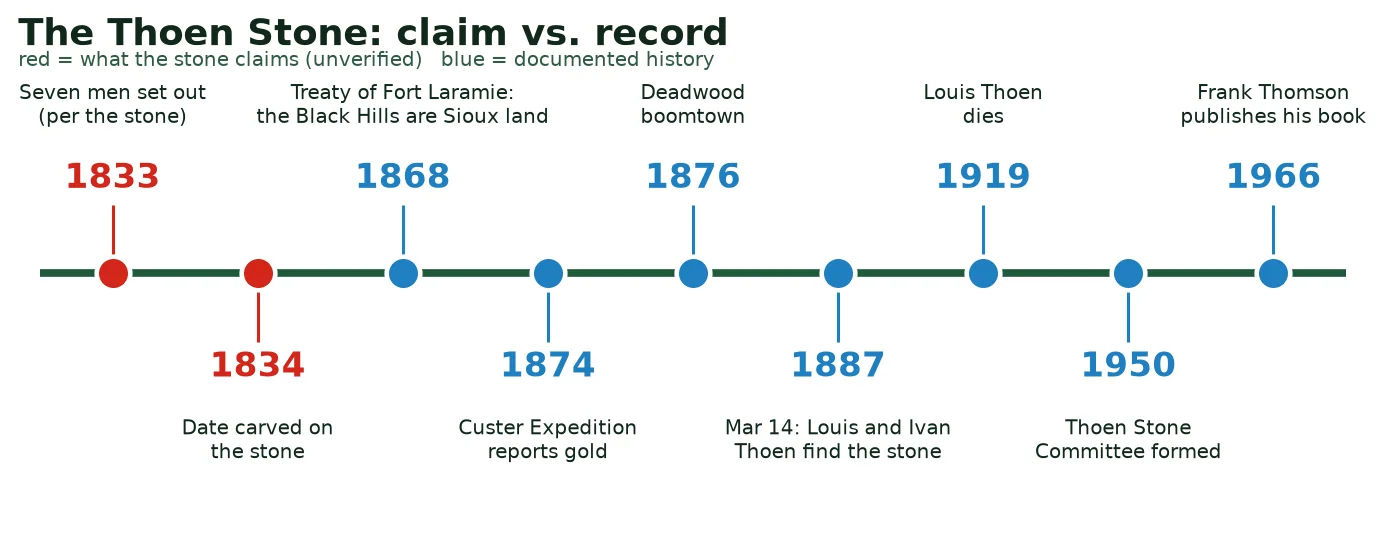
The writing is plain English, spelling and all, so nobody needs a translator. The front opens with the year and a roll call, which sources give as: "Came to these hills in 1833 seven of us," followed by seven names: De Lacompt, Ezra Kind, G.W. Wood, T. Brown, R. Kent, Wm. King and Indian Crow.
Then the bad news, as the sources quote it: "All ded but me Ezra Kind. Killed by Ind[ians] beyond the high hill," and the gold is dated June 1834. The other side adds that the party took as much gold as the men could carry, that their ponies were taken, and that the writer had lost his gun, had nothing to eat and had Indians hunting him.
That is the entire treasure map. No coordinates, no landmark beyond "the high hill", no weight of gold. Whatever was supposedly gathered, the stone only says it existed and that its owners did not last.
The case for a real 1834 message
Why would anyone believe it? Mostly thanks to Frank Thomson, a Spearfish historian who formed the Thoen Stone Committee in 1950 and spent years chasing the names. His 1966 book, The Thoen Stone: A Saga of the Black Hills, argues the story holds up.
Thomson reported that a party left Independence, Missouri, in the spring of 1833, apparently aiming to open a route to Santa Fe. According to his account, they met a Crow man who told them about gold in the Black Hills, and they changed plans. He traced descendants of several of the men who said their ancestors vanished somewhere in the West around that time. Kent's family told stories of letters in which he claimed to have all the gold he could want and said he would soon be home. Thomson also found that Brown had gold-field experience in North Carolina, and that King and "Indian Crow" came from Lumpkin County, Georgia, scene of an earlier gold rush. Kind, he concluded, was a German immigrant to Pennsylvania who disappeared in the 1830s; one local-history account traces his roots to Saxony.
He even had a theory for who did the killing: he suggested the American Fur Company might have encouraged attacks to keep outsiders away from the region. That part is Thomson's theory, not a documented fact.
The case for a very clever hoax
Skeptics started on day one. The finder was a stonemason, and he turned up a piece of sandstone with unusually readable writing. Critics also asked why seven men fleeing for their lives would sit down and carve a message, and whether a party described as mostly inexperienced miners could have gathered much gold in the first place.
The Thoen family stood by the stone for the rest of their lives. Louis died in 1919 during the influenza epidemic; the stone carries his name. In the 2000s, handwriting experts, including Marion Briggs and a colleague in California, compared the lettering with writing by the Thoen brothers, Cashner and John S. McClintock, an early champion of the stone. According to the summary on Wikipedia, they concluded it was not written by any of them. That does not authenticate the stone, since it only rules out those particular people. No source in this research describes a scientific test dating when the letters were cut.
Local writers still frame it as an open question. A museum-style article says the matter is unresolved, and another summary calls it a mystery that cannot yet be settled. Fair enough.
Why 1834 would be a big deal
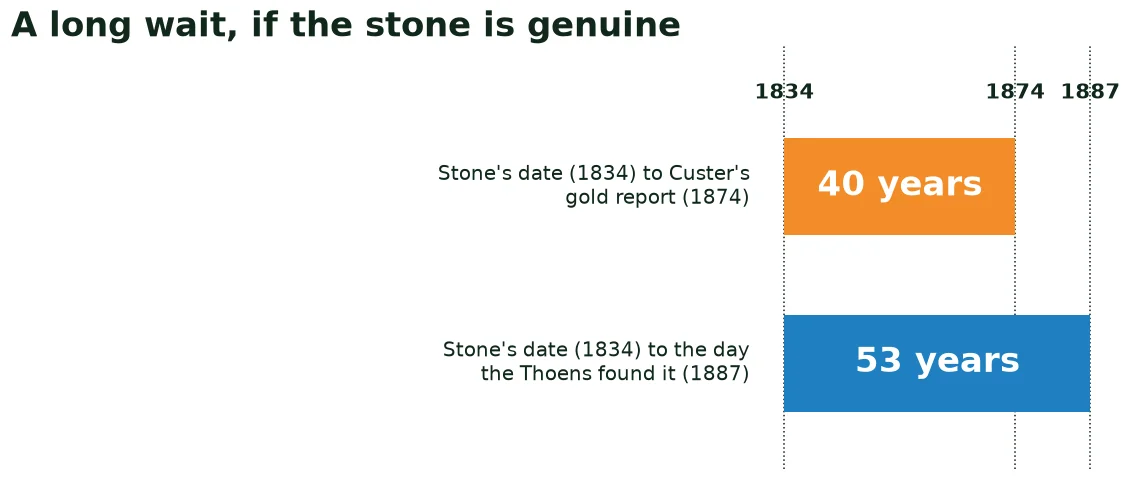
Gold in the Black Hills is usually dated to 1874, when General George Custer's expedition reported it. Within a couple of years the rush was on and Deadwood was a boomtown. If the Thoen Stone is real, someone found gold there four decades earlier and kept quiet because nobody lived to tell it.
There are other hints that gold was known in the Hills before 1874. A local article notes that the Jesuit priest Father De Smet, who visited the Hills off and on between 1848 and 1870, repeatedly saw gold dust held by Sioux. It also says an 1875 military exploration found a cave with rusted mining tools and two decaying log cabins. None of that proves the Thoen Stone, but it shows the idea of earlier gold seekers is not absurd.
Where the gold might be
Here the legend gets thin. The stone mentions only "the high hill". Some believe Kind hid whatever the party gathered close to where the slab was found before he died, so the gold may still be sitting out there. That is a legend, not a record: no source here documents any gold actually attached to this story, and the stone does not say the party hid anything.
No one has reported a find, and the story has no famous digs or lost expeditions of its own. Its power lies elsewhere: the stone is real, the handwriting question is real, and the names on it are real enough that a historian spent years chasing their families.
Seeing it today
The original slab is on display at the Adams Museum & House in Deadwood, South Dakota. In Spearfish, a monument with a replica stands on a hill above the city park, at the end of St. Joe Street. A local seven-mile run past the marker is named for the stone.
Lookout Mountain is a real hike, but much of the Black Hills is national forest or private land, so check who owns the ground before leaving the trail. The stone, the museum and the monument are the parts you can enjoy without a permit.
...and if you find it, remember who encouraged your questionable life choices.
The short version of this story is on YouTube at @TenToeExpress.
Deep dive yourself
- Thoen Stone · Wikipedia
- The Mystery of the Thoen Stone · Mental Floss
- The Thoen Stone: A Spearfish Legend · Visit Spearfish
- Thoen Stone · Visit Spearfish
- The Thoen Stone · Black Hills Visitor
- Gold in the Hills · Sioux Replications