 Ten Toe Express
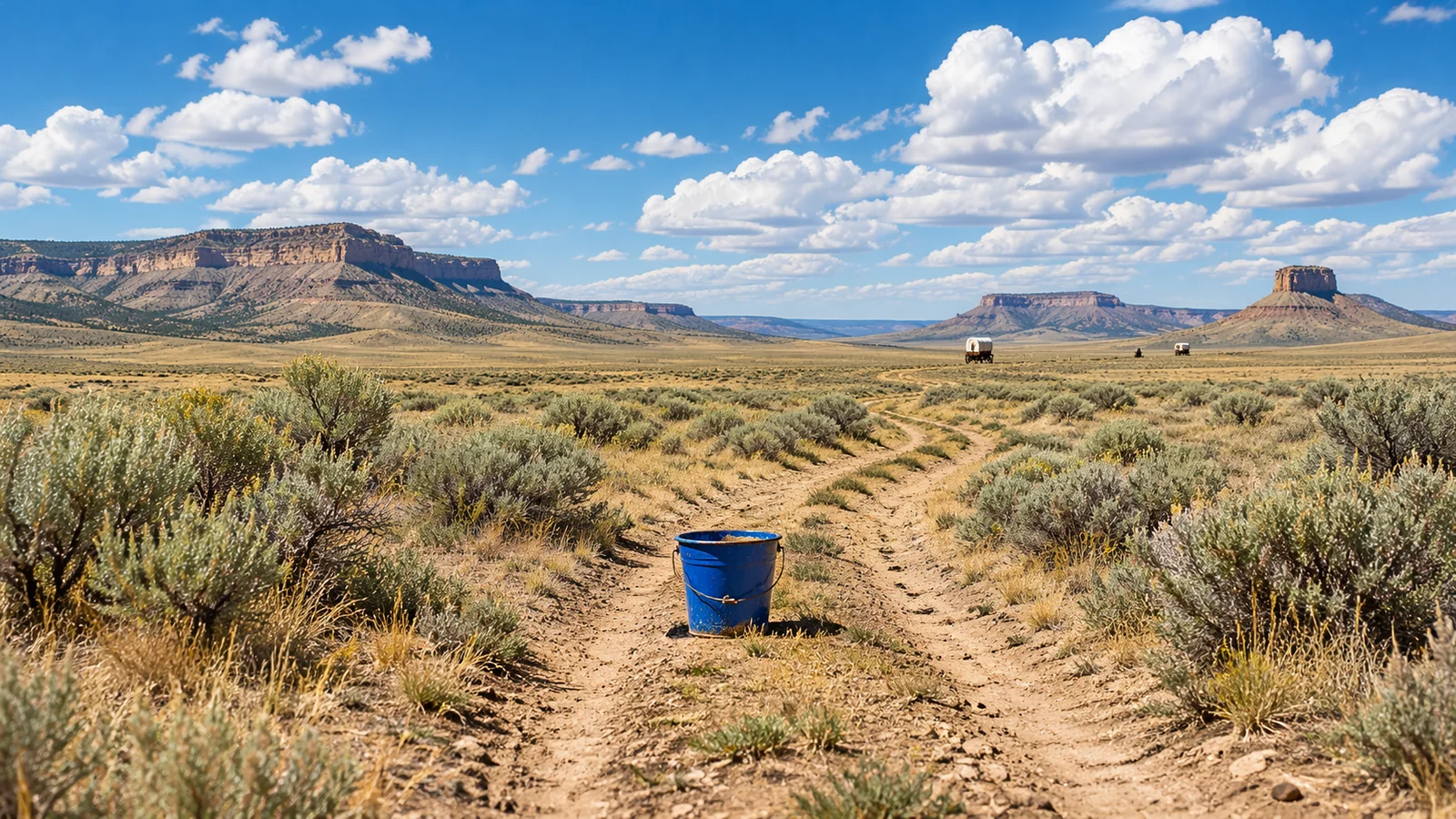
Right then, picture the scene. It's 1845, the sun is trying to cook the top off Oregon's high desert, the oxen are dying, the water has run out, and the man who promised you a shortcut has no idea where he is. Some children wander off to find a creek, come back with a bucket full of heavy yellow pebbles, and nobody thinks a thing of it. The pebbles get left behind. A few years later, someone works out what they were.
That's the legend of the Lost Blue Bucket Mine, Oregon's most famous lost gold, and it's a cracker. A blue bucket, a wagon train in trouble and a fortune nobody could find again. The spot has never been pinned down, and people have been arguing about it for well over a century.
The Meek Cutoff: a shortcut that wasn't
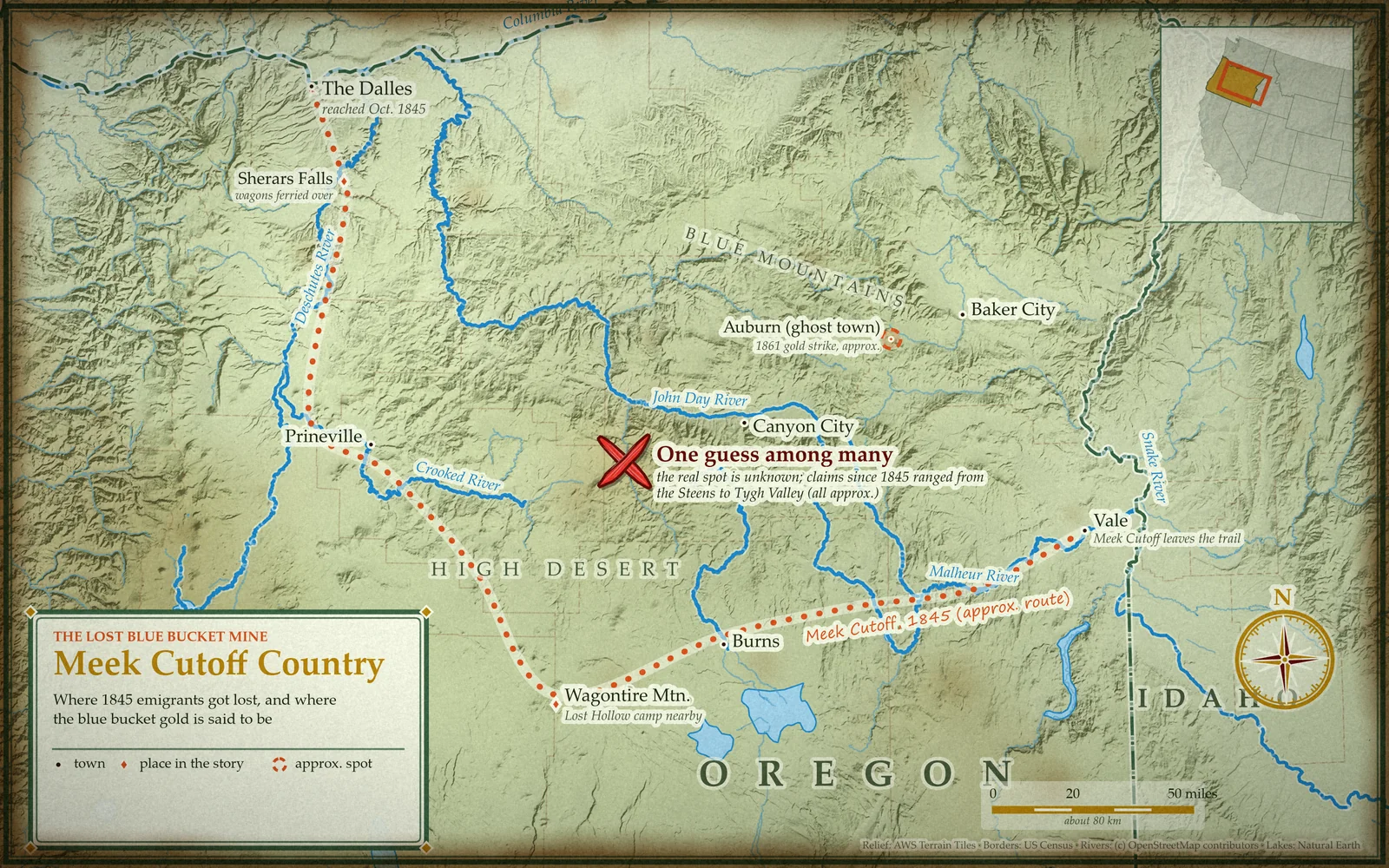
The documented part of this story is the bit with the wagons. In 1845 the Oregon Trail was a long, tiring road, and the final stretch down the Columbia River was the worst of it. Stephen Meek, a mountain man and the older brother of the more famous Joe Meek, said he knew a quicker way across the desert to the Willamette Valley.
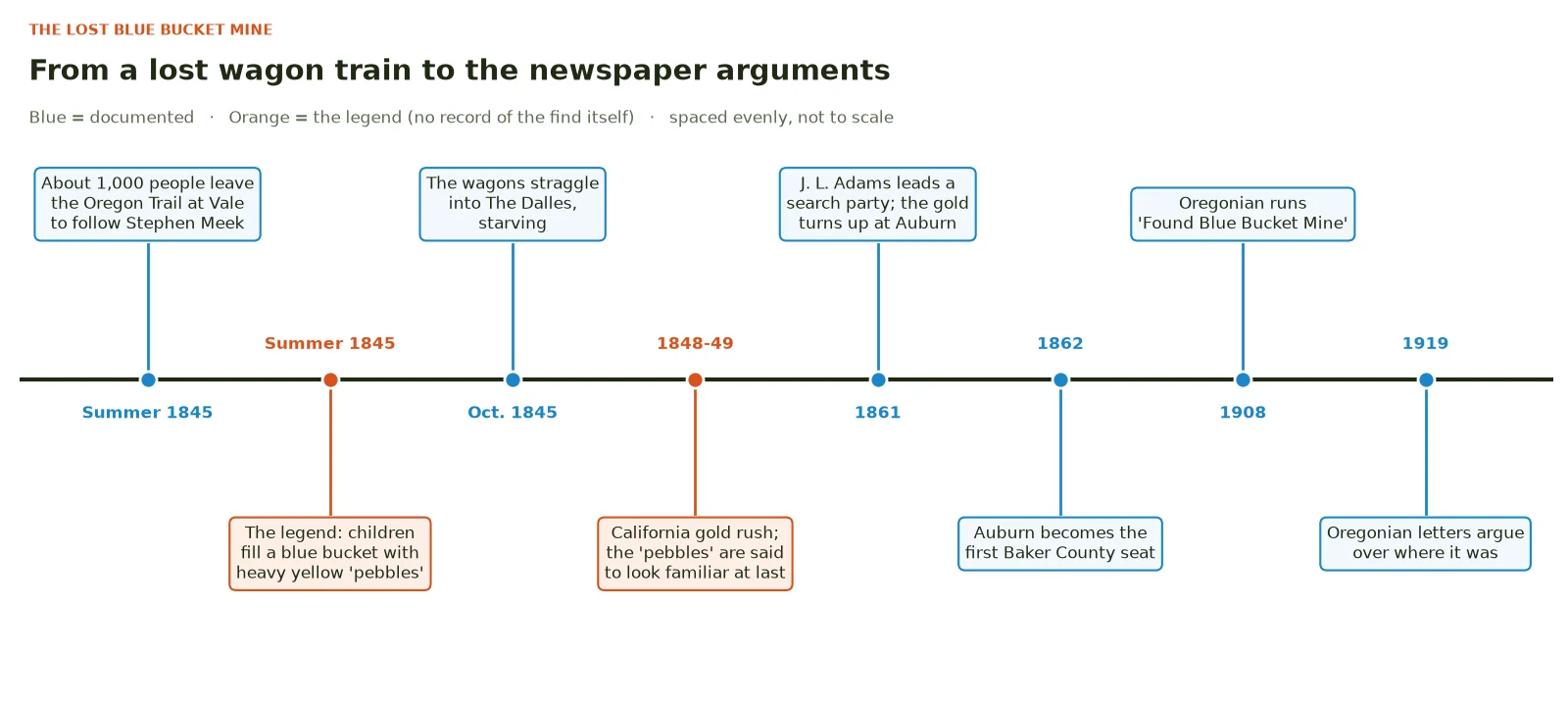
According to Wikipedia's account of the Meek Cutoff, some 200 wagons and about 1,000 people left the main trail at what is now Vale, Oregon, and followed him. For the first couple of days they tracked the Malheur River. Then the country turned stony, the road got worse, and oxen began dying every day.
It got properly grim. Sarah "Sally" King Chambers died on September 3, 1845, near the North Fork of the Malheur River; her husband carved her gravestone, and it is one of the few Oregon Trail gravestones that survives. The article counts 23 known deaths during the journey and an estimated 25 more after the emigrants reached The Dalles. At a camp near Wagontire Mountain the water ran short and tempers ran shorter. The company split, Meek's guiding was blamed for the whole mess, and he ended up warned that one father who had lost two sons meant to kill him.
The emigrants began reaching The Dalles around the second week of October, after a rescue effort and a long, rope-and-wagon-box crossing of the Deschutes River at Sherars Falls. Everything in this paragraph and the one above is the record. The next section is where it turns into a story.
The blue bucket legend
The legend says that somewhere out in the desert, young people from the wagon train found gold without knowing it. The details change depending on who is telling it, which is the first clue that you're dealing with folklore:
- One version has three young men out looking for stray oxen, who find a small stream and pick up a handful of coloured pebbles. Legends of America names a Mrs. Fisher as the person who kept a single nugget; the rest were left behind.
- Another version, repeated in the Wikipedia articles, credits the family of John Herren. The family said later that had they stayed at their campsite, they could have filled a blue bucket with gold.
- A third has children playing in a creek and filling a bucket. The adults didn't recognise the stuff, a blacksmith flattened a piece on a wagon tyre, and some of it ended up as fishing sinkers. The oxen were too weak to haul anything extra, so the pebbles stayed where they lay.
In every version the punchline arrives in 1848 and 1849, when California's gold rush showed everyone exactly what gold looks like. By then the emigrants were farming in the Willamette Valley, and nobody could say which dry creek bed had been the one.
Where the wagon train was when it happened is the part that won't stay put. The sources describe a dry stream bed or canyon, lava with potholes in it, the headwaters of this creek or that one. One writer puts the search area at some 40,000 square miles. You could lose a county, a few mountain ranges and your sense of humour in that.
The skeptics have a point
Finn J.D. John of Offbeat Oregon, who has written a good, sceptical take on the legend, lists the holes. If the nuggets made such handy sinkers and the travellers were starving, why didn't anyone carry a few along? The usual retellings name no participants, despite how often the journey must have come up around the fire. A blacksmith of that era, he argues, would likely have known gold when he saw it. And it seems unlikely that not one child pocketed a rock or two. He calls it pretty sketchy as history, but good folklore.
There's an old trick behind a lot of lost mine stories: the most useful clue is always the one nobody wrote down. Here, nobody seems to have written down the place, the date, or who actually did the finding, at least not at the time. The usual retellings name no participants and cite no documents from 1845, and the first real fuss in print comes decades later.
The search that found something else
The legend did something real, though. It sent people into eastern Oregon looking for gold. In 1861 a Portland man named J. L. Adams claimed he knew where the Blue Bucket was and recruited a party of 58 men, per Offbeat Oregon. When the men realised he had no actual destination, Adams admitted the story had been a way to gather a big, well-defended group. They took his supplies and sent him packing.
On the way home, the story goes, the party struck a large gold find, and everyone staked a claim, Adams included. That camp became the town of Auburn. Wikipedia says gold was found in the area in 1861; by September 1862 Auburn had over 20 stores and was described as the largest community in Eastern Oregon. It became the first county seat of Baker County that same month. The boom didn't last: by the 1870s it was largely deserted, and its post office closed in 1903. Today it is a ghost town.
So the legend of the Blue Bucket Mine never produced the Blue Bucket Mine. It produced a gold rush, a county seat and a ghost town, which is a decent consolation prize if you aren't the one who wanted the bucket.
1919: five readers, five guesses
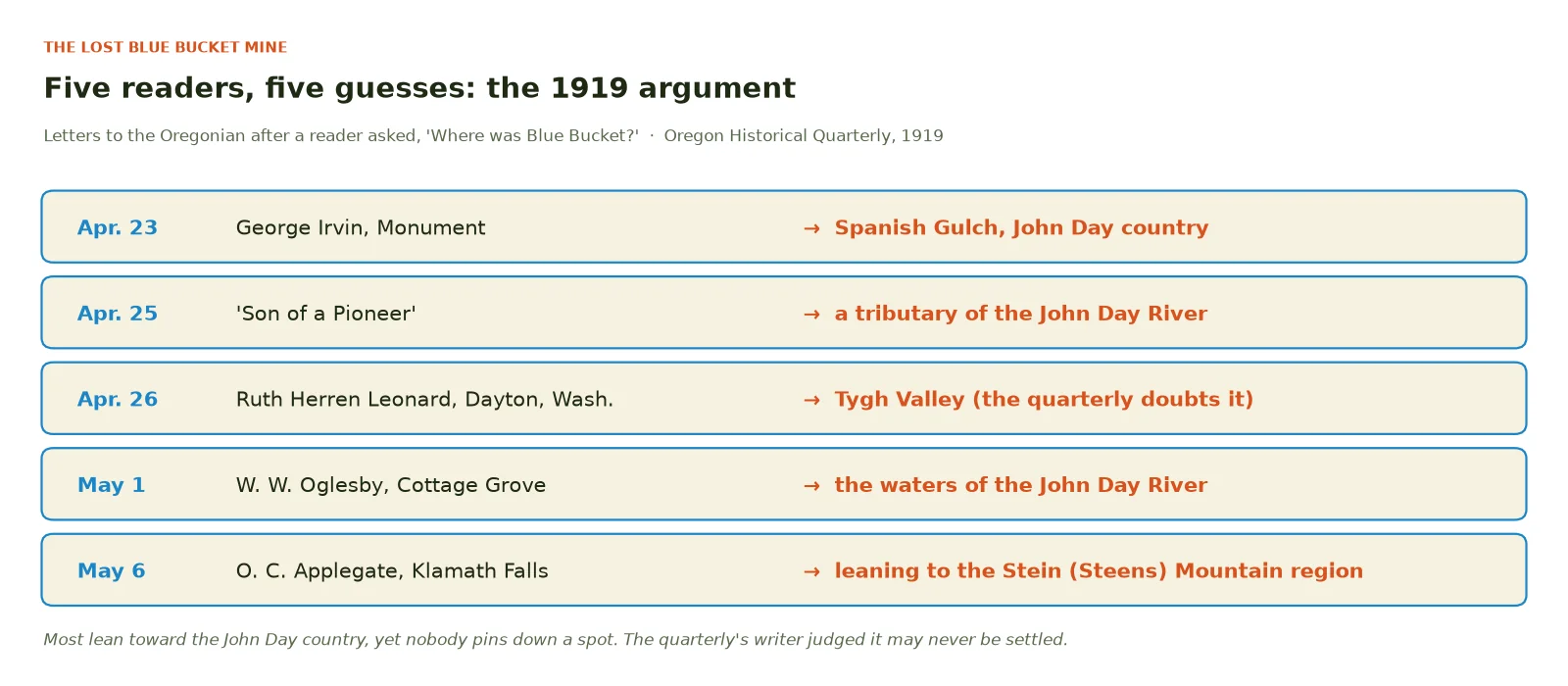
The argument got properly loud in 1919. According to the Oregon Historical Quarterly, a reader named Tyra Allen of Pendleton wrote to the Canyon City Eagle in March asking "Where was Blue Bucket?" The Oregonian soon filled with answers:
- George Irvin of Monument put it in Spanish Gulch in the John Day country.
- A writer calling himself "Son of a Pioneer," whose father was in the party, thought a tributary of the John Day River, and said the nuggets had been tested by hammering them on wagon tyres.
- Mrs. Ruth Herren Leonard of Dayton, Washington, quoted her father, a party member, as saying Tygh Valley. The quarterly's writer isn't convinced, since the party doesn't appear to have gone through Tygh Valley at all.
- W. W. Oglesby of Cottage Grove said the waters of the John Day River.
- O. C. Applegate of Klamath Falls leaned toward the Stein (Steens) Mountain region.
The quarterly's own conclusion is that the location is still uncertain and may never be settled. It also makes a fair point in the legend's favour: placer gold really was found later in eastern Oregon, particularly around the John Day country, and nuggets do sit in stream beds. So the idea is believable. It is the particular creek that's missing.
The theories, weighed
- A John Day River tributary. The most popular answer, repeated in several 1919 letters and in Legends of America. It fits a party wandering north and west, but the John Day has a lot of tributaries.
- A Bear Creek tributary of the Crooked River. Another candidate on the list, and close to the stretch where the wagons split.
- Somewhere near Wagontire Mountain. Some say the site lies between there and the south fork of the Crooked River. That's where the water ran short and the Herrens are said to have been.
- Steens Mountain country. Applegate's 1919 lean. It sits well south of where most of the wagons seem to have gone.
- It never happened as told. The skeptics' view: a real, miserable wagon train, a real later gold rush, and a story that grew in the retelling until it needed a bucket.
Where it stands today
Nobody has found the Blue Bucket Mine, and nobody can prove there was one. Real mines elsewhere in the country carry the name, and at least one is in Grant County, Oregon, but none is connected to the legend. The Meek Cutoff itself is real and is one of the historic trails recognised by the State of Oregon, and ruts from the wagons can still be seen near Westfall.
The country the legend covers is large, and much of it is national forest, Bureau of Land Management land, wilderness or private ranch land, each with its own rules about mining and digging. If you fancy tracing the story, the safe and legal way is on foot or by car, with a good map, the rangers' rules and a lot of water. The desert is still very good at trying to kill everyone.
...and if you find it, remember who encouraged your questionable life choices.
The short version of this story is on YouTube at @TenToeExpress.
Deep dive yourself
- Lost Blue Bucket Mine · Wikipedia
- Meek Cutoff · Wikipedia
- The Lost Blue Bucket Mine · Offbeat Oregon History
- Where was Blue Bucket? (Oregon Historical Quarterly, vol. 20) · Oregon Historical Society, via Wikisource
- The Lost Blue Bucket Mine in Oregon · Legends of America
- Auburn, Oregon · Wikipedia