 Ten Toe Express
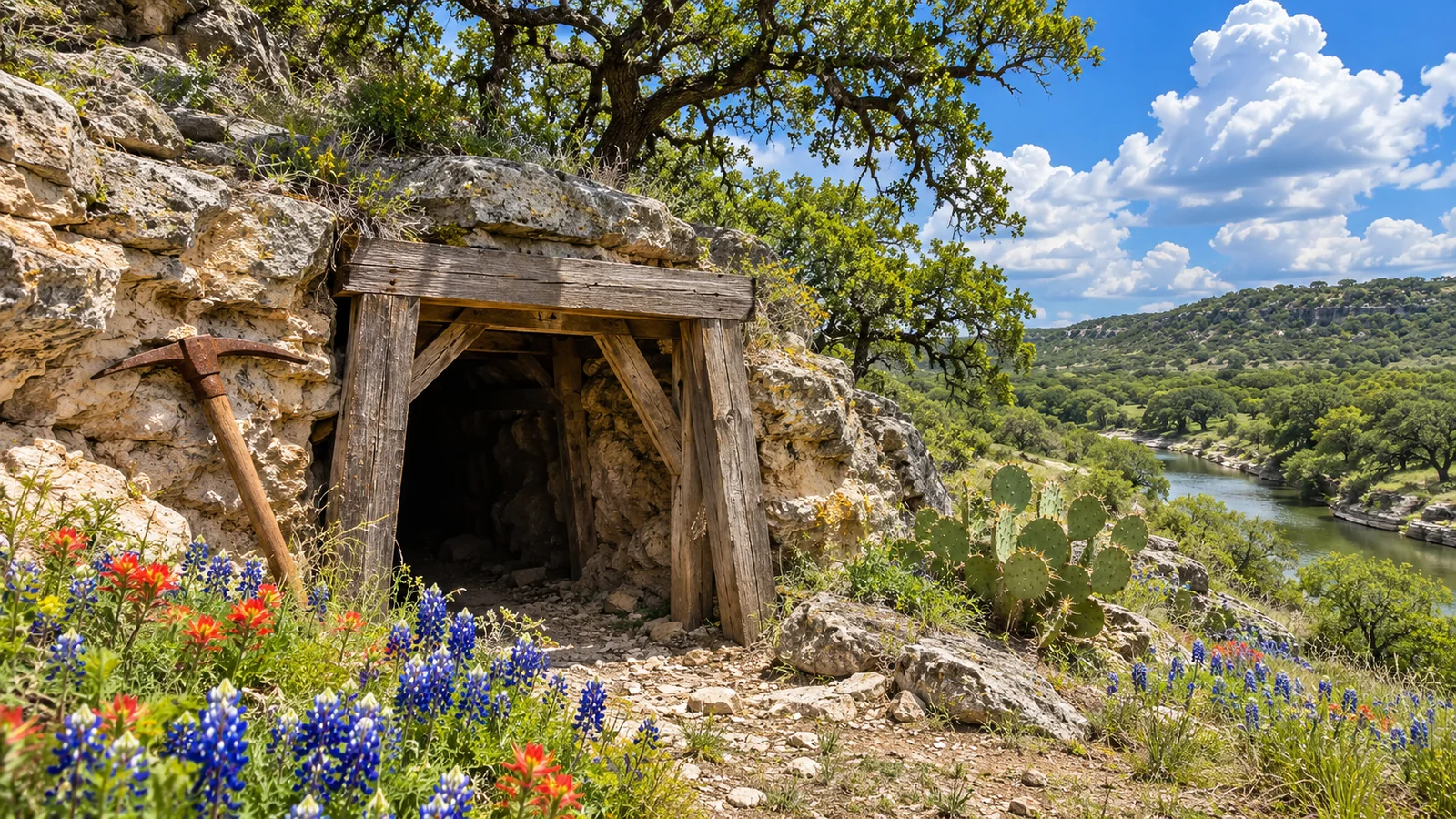
Right then, picture a man with a famous knife, a brother, nine more companions and a plan to get rich. The man is Jim Bowie. The plan is to find the Lost Bowie Mine in Texas, the silver that Spain chased across the hills northwest of San Antonio in the 1750s and never quite managed to dig. On November 21, 1831, a few miles from the old San Sabá mission ruins, that plan collided with a very large number of very determined people. The silver is still missing. So, by most accounts, is the mine's address.
Here's the twist that makes this a proper mystery: the "Lost Bowie Mine" was never Bowie's, and it may not have been lost where everyone looked for it. Fancy untangling that?
The Spanish silver rush that wasn't
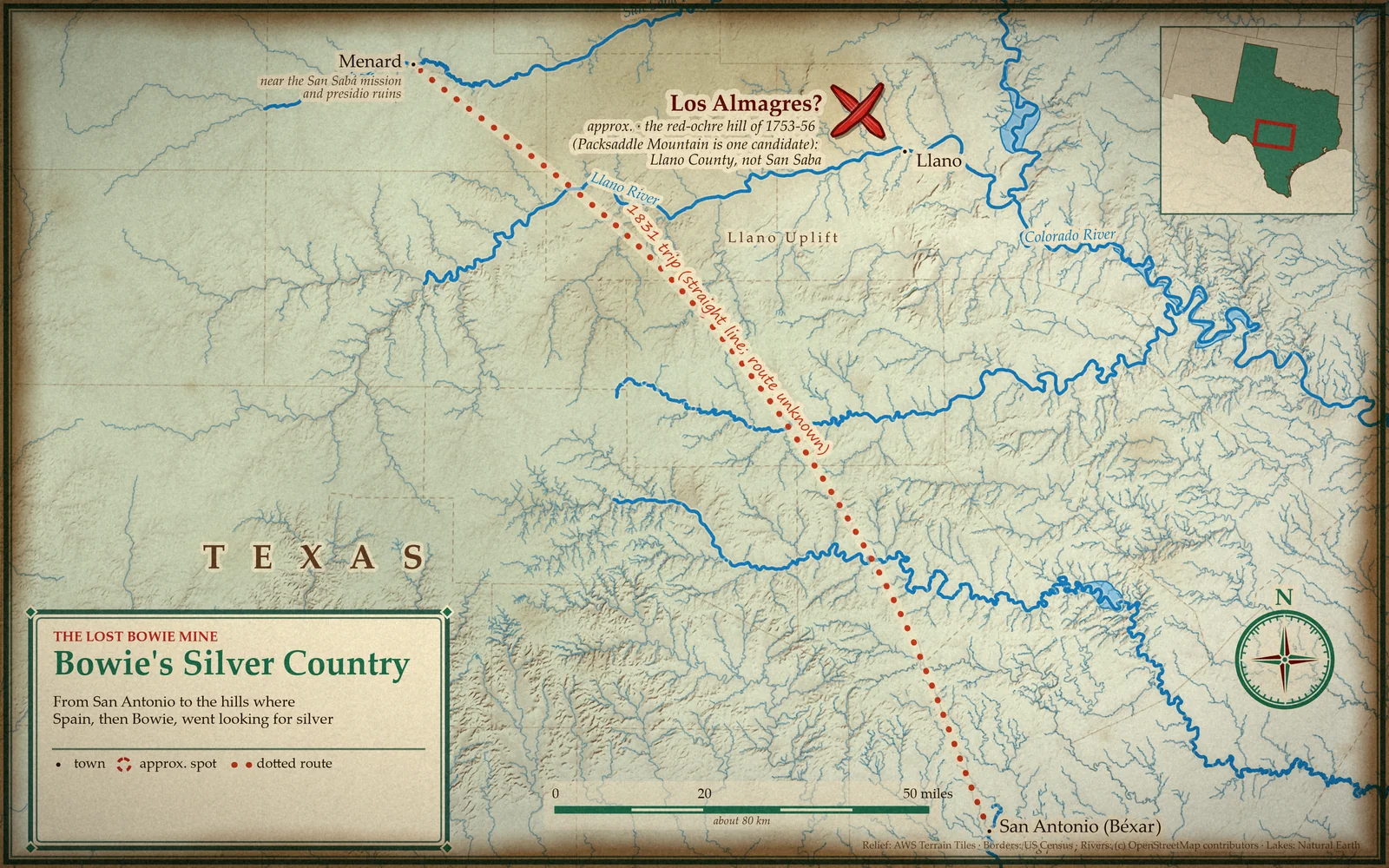
The documented part of this story starts in 1753. A party searching for a mission site for the Apache heard of a hill of red ochre, a cerro de almagre, in what is now Llano County. Guided by Apache, men from San Antonio reached it that August and found nothing valuable.
Three years later the Texas governor, Jacinto de Barrios y Jáuregui, sent an official expedition under Bernardo de Miranda y Flores. It left San Antonio on February 17, 1756, with 23 soldiers and citizens, and was back on March 10. Miranda was thrilled. He reported what he called a tremendous stratum of ore and, so the story goes, promised a mine to every inhabitant of Texas. He carried home a sample of about three pounds.
Mexico City was less excited. The royal assayers said three pounds was too small to judge properly and asked for something like thirty mule loads of ore, which Texas could not produce. Even the optimistic reading of the tests was modest: roughly five ounces of silver per hundred pounds of ore, far below what the governor had hoped. The diggings were also reddish earth near the surface rather than a gleaming vein in solid rock.
Still, the hope was enough to matter. Interest in the deposits was one reason for founding the Presidio San Luis de las Amarillas (1756) and Mission Santa Cruz de San Sabá (1757). Captain Diego Ortiz Parrilla sent miners to work the site, and his own estimate was about an ounce and a half of silver per 75 pounds of ore. Then, on March 16, 1758, roughly two thousand Comanches burned the mission, and the mining dream went up with it. Parrilla was reassigned. The workings, such as they were, faded from use.
How Los Almagres became "Bowie's" mine
Here's where the confusion starts. The mission was on the San Saba River. The ochre hill was in Llano County, a good way south-east. A few decades of retelling blurred the two together, and Stephen F. Austin made it official, in a way: his 1829 map of Texas marked a lost silver mine, and put it in the wrong place. People began calling it the San Saba mine.
Mary Austin Holley repeated the tradition in her 1836 book Texas, describing a mine that had been worked until Indians drove the workers off. That's secondhand tradition, not a mining record, but it sounded splendid in print.
Enter Jim Bowie. He had settled in Mexican Texas, married, and caught the silver bug. He and his brother Rezin got permission from the Mexican authorities to go into Indian country and reopen the mines. One thing the Bowie name does not have is any evidence of the mine ever being found by him. The label "Lost Bowie Mine" was stuck on later.
November 1831: eleven men and a very bad day
The party left San Antonio on November 2, 1831. By the usual account it was 11 men: James and Rezin Bowie, David Buchanan, Robert Armstrong, Jesse Wallace, Matthew Doyle, Thomas McCaslin, C. K. Ham, James Coryell (the man Coryell County is named after) and two servant boys, Charles and Gonzales.
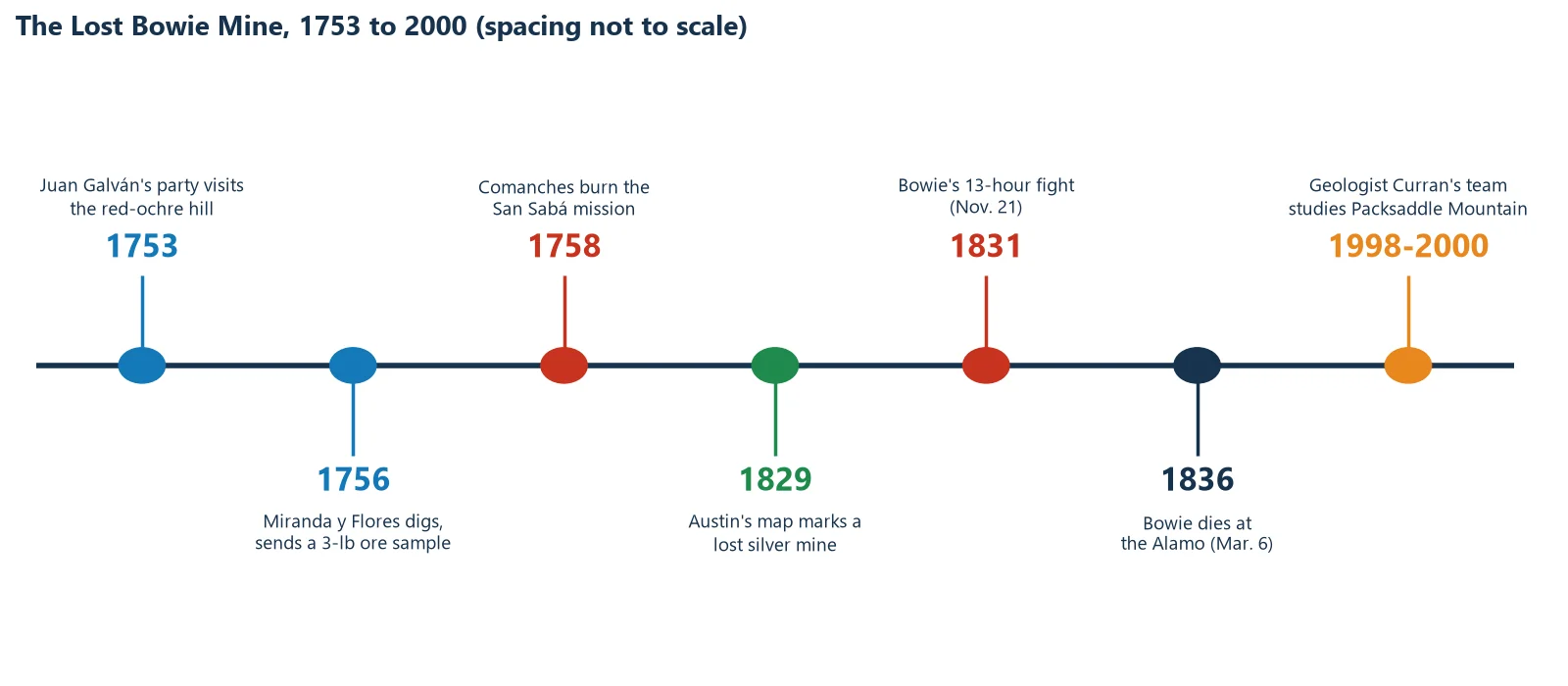
Friendly Comanches warned them that a large party was trailing them. Bowie pressed on anyway. On November 21 they were attacked while camped in a live oak grove not far from the San Sabá River. Accounts differ on the exact spot and on who the attackers were: one popular version puts it at Calf Creek and names a Lipan Apache chief, while the account summarised by Wikipedia describes a raiding party of more than 120 Tawakoni and Waco with about 40 Caddo. All agree on the rest of the picture. It was a long day.
The fight lasted about 13 hours. The attackers surrounded the grove and, in some tellings, tried twice to burn the defenders out with grass fires. One of the eleven, Thomas McCaslin, was killed. Buchanan, Doyle and Coryell were wounded. The Bowies later claimed that about 21 attackers died and that they found 48 bloody spots on the ground; popular retellings go much higher, with 40 or more dead. Nobody independent counted. Treat the numbers as the Bowies' own.
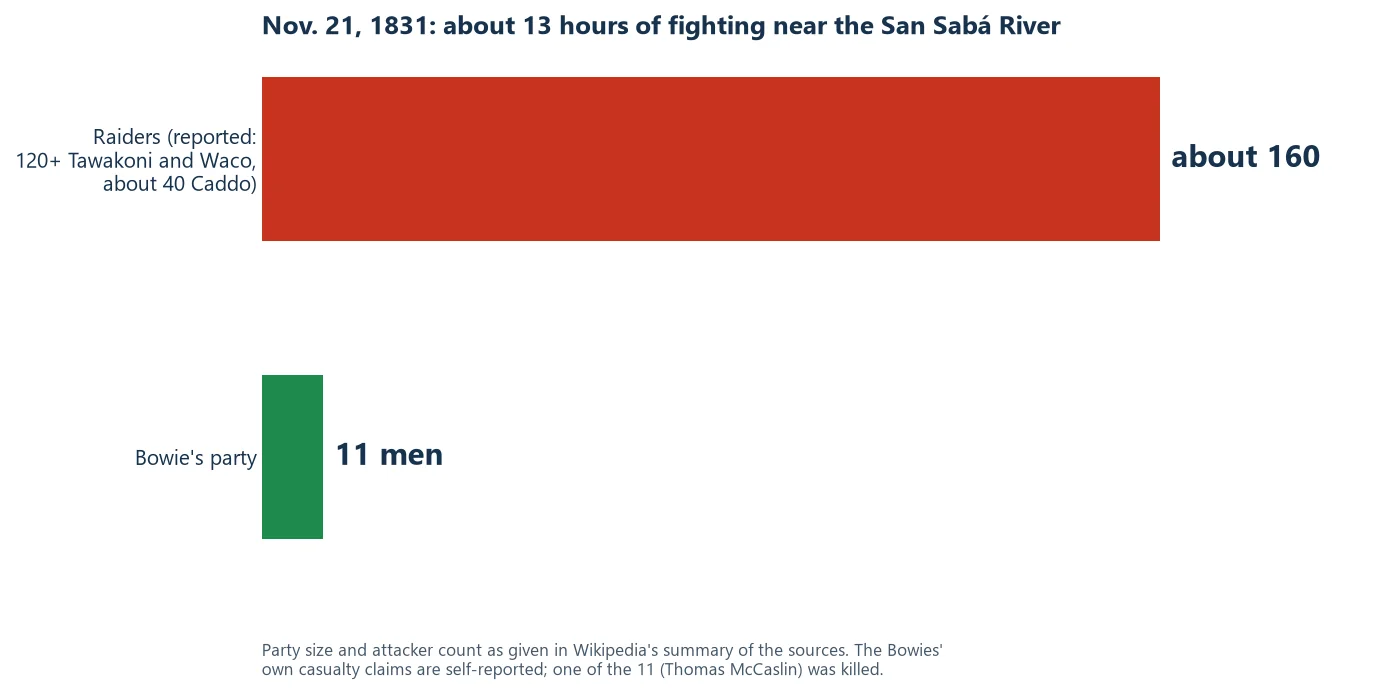
Back in San Antonio, a friendly Comanche party had already reported the odds as about fourteen to one. Citizens assumed the expedition was dead, and Ursula Bowie began wearing mourning. The survivors rode in on December 6. Bowie's report, written in Spanish, was printed in several newspapers, and his fame grew. The following month he led a larger force back out and, after about two and a half months of searching, came home empty-handed.
One more detail does the legend no favours: there's no evidence Bowie ever returned to look for the mine before he died at the Alamo on March 6, 1836.
Where was Los Almagres, really?
This is the sharpest part of the mystery, and it's a surprisingly modern argument. In the early 1900s the historian Herbert E. Bolton worked from copies of Miranda's journal and placed the mine in the Riley Mountains of Llano County, north of Honey Creek. He and a partner started a mining company that closed about two years later. Decades afterwards a University of Texas student, Roderick Patton, reviewed the records and concluded Bolton was right.
Then a rancher, James Stotts, found old mine workings across Honey Creek on Packsaddle Mountain, on land that became known as the Stotts Ranch. With the amateur historian Joe Wallace he became convinced these were the real Los Almagres mines. In 1998 to 2000 the Texas Historical Foundation brought in the geologist S. Christopher Curran, whose team found evidence of three periods of mining on the ranch, one of them Spanish Colonial. In 2000 Curran wrote that the oldest mines there were the Los Almagres mines, while noting the claim was preliminary. Not everyone is persuaded; some historians who've worked with Miranda's text don't think the evidence fits Packsaddle Mountain.
So: the best-documented answer is that Los Almagres is in Llano County, and the argument is over exactly which hill. That's a long way from a lost mine on the San Saba, which is where Bowie's party was heading.
Fact, legend and the well at the Alamo
- Documented: Miranda's 1756 expedition and its weak assay; the San Sabá presidio and mission; the mission's destruction in 1758; Austin's 1829 map; Bowie's 1831 expedition and its battle.
- Self-reported: The Bowies' casualty figures for the attackers.
- Legend: That Bowie found a rich mine and grew wealthy from it. Nothing supports it.
- Legend with a shovel: A researcher's theory that Bowie hid silver in a well near the Long Barrack at the Alamo made it onto Unsolved Mysteries in 1995. A dig supervised by St. Mary's University's archaeology department found no treasure.
The dry irony is that the real Los Almagres was probably not a bonanza at all. The Spanish assays were underwhelming, the ore was red earth, and the people who knew the country best weren't keen to see miners arrive. The "lost" part grew in the telling.
Where it stands today
Los Almagres is a research question more than a treasure hunt. The candidate sites sit in Llano County's Central Mineral Region, on land with owners, and Packsaddle Mountain's workings are on ranch property. Nothing here is a welcome mat: anyone curious is better off with Miranda's journal, the geologists' reports and the historical markers than with a shovel. If you'd like to see the country that fooled generations of fortune seekers, the Llano area and the San Saba valley make a very good road trip, minus the 13-hour fight.
...and if you find it, remember who encouraged your questionable life choices.
The short version of this story is on YouTube at @TenToeExpress.
Deep dive yourself
- Bowie's Silver · The Alamo
- San Sabá fight (1831) · Wikipedia
- Mining Los Almagres · Texas Co-op Power
- Los Almagres Mine · Tejano History
- Bowie goes looking for silver and finds Indians · Hays Free Press