 Ten Toe Express

Picture a sandstone rock house deep in the hills of eastern Kentucky, the kind of overhang that has kept the rain off travellers for thousands of years. Somewhere under one just like it, so the story goes, an Englishman named Swift stacked bars of silver and bags of freshly struck coins, walled them up, carved a few marks on the nearest trees and walked away, fully intending to come back. He never did. He went blind first.
That is the heart of the Swift Silver Mine, Kentucky's oldest and most stubborn treasure legend. For well over two centuries people have pored over "Swift's journal," a diary of silver mining and coin making in the wilderness of the 1760s, and gone off into the Kentucky, Virginia and Tennessee mountains with it tucked in a pocket. Thousands have looked. Nobody has found a single bar. And the deeper the historians dig into the paperwork, the stranger the whole thing gets.
Right then. One journal, a few dozen copies that don't agree, a blind man, a dead partner and a frontier full of land speculators. Fancy a look?
The legend of the Swift Silver Mine
The story has been told in so many versions that there is no single "correct" one, but the common thread runs like this.
John Swift was an Englishman: a sea captain or merchant in some tellings, a trader among the Cherokee in others. During the French and Indian War he crossed paths with a Frenchman named George Munday, who had been held captive by the Shawnee and claimed to know where they got their silver: a rich vein in the country south of the Ohio River. Around 1760, Swift and Munday led a small party over the mountains from Alexandria, Virginia, found the silver, built a furnace and went to work.
For the rest of the decade, the journal says, Swift came back nearly every year with a crew of men whose names it lists: Hazlitt, Ireland, Blackburn, McClintock, Staley, a Montgomery said to be a die maker, and others, including two Frenchmen. They smelted the ore and struck it into coins, English crowns in some versions, and hauled the loot back east by packhorse. One version adds a wounded bear that led Swift to a cave of ore, which is either a lovely detail or a very helpful bear.
It was not a happy operation. The journal records a Christmas quarrel, a mutiny in 1766 and an ambush near the Big Sandy River in 1768 in which two of the party were killed. By 1769 Swift had had enough. He closed the mines, walled up the cave and buried what they couldn't carry.

The caches: what the journal says is buried
This is the part treasure hunters have photocopied to death. A 1940 newspaper account of the journal lists the stashes Swift supposedly left behind on September 1, 1769:
- Between $22,000 and $30,000 in dollars and crowns on a large creek.
- About $15,000 near several marked trees.
- A "prize" buried about three feet down near a forked white oak.
- About $6,000 at the forks of the Sandy, near a small rock with a spring.
- $3,000 in a rock house.
Lovely. Precise numbers, vague places. "A large creek" in eastern Kentucky narrows it down to roughly all of them. Other versions give different sums and different landmarks, and the Kentucky Geological Survey reckons the versions of the Swift maps alone probably run into the hundreds. Based on the descriptions, it says, every county in eastern Kentucky could probably claim the mines. Rather inconvenient, if you were hoping for an X.
The blind man and the widow
Then the story turns into a tragedy. In the most common telling, Swift sailed to England and was thrown in prison for speaking up for the American colonies. By the time he was released and made it back across the Atlantic, his eyesight had failed. He went back into the hills to find his silver and couldn't recognise a thing.
A Tennessee thread of the legend, recorded by the early historian Judge John Haywood, has Swift turning up in East Tennessee around 1790 or 1791, nearly blind, carrying his journal. He is said to have left it with Mrs. Renfro, the widow of a man killed by Indians, at Bean's Station, and some say he wanted to marry her. The two Frenchmen who had been with him headed off toward Nashville and were never heard from again. Swift never came back for his caches, or for Mrs. Renfro.
And then there's the spookiest version of all. In one telling Swift fell out with Munday and killed him, and on a later trip the dead man's hand appeared over Swift's compass so he could never find his way back. Folklore has a fine sense of justice.
The paper trail: Filson's 1788 silver mine claim
Here's where the legend bumps into real records, and it's the bit that keeps the story alive.
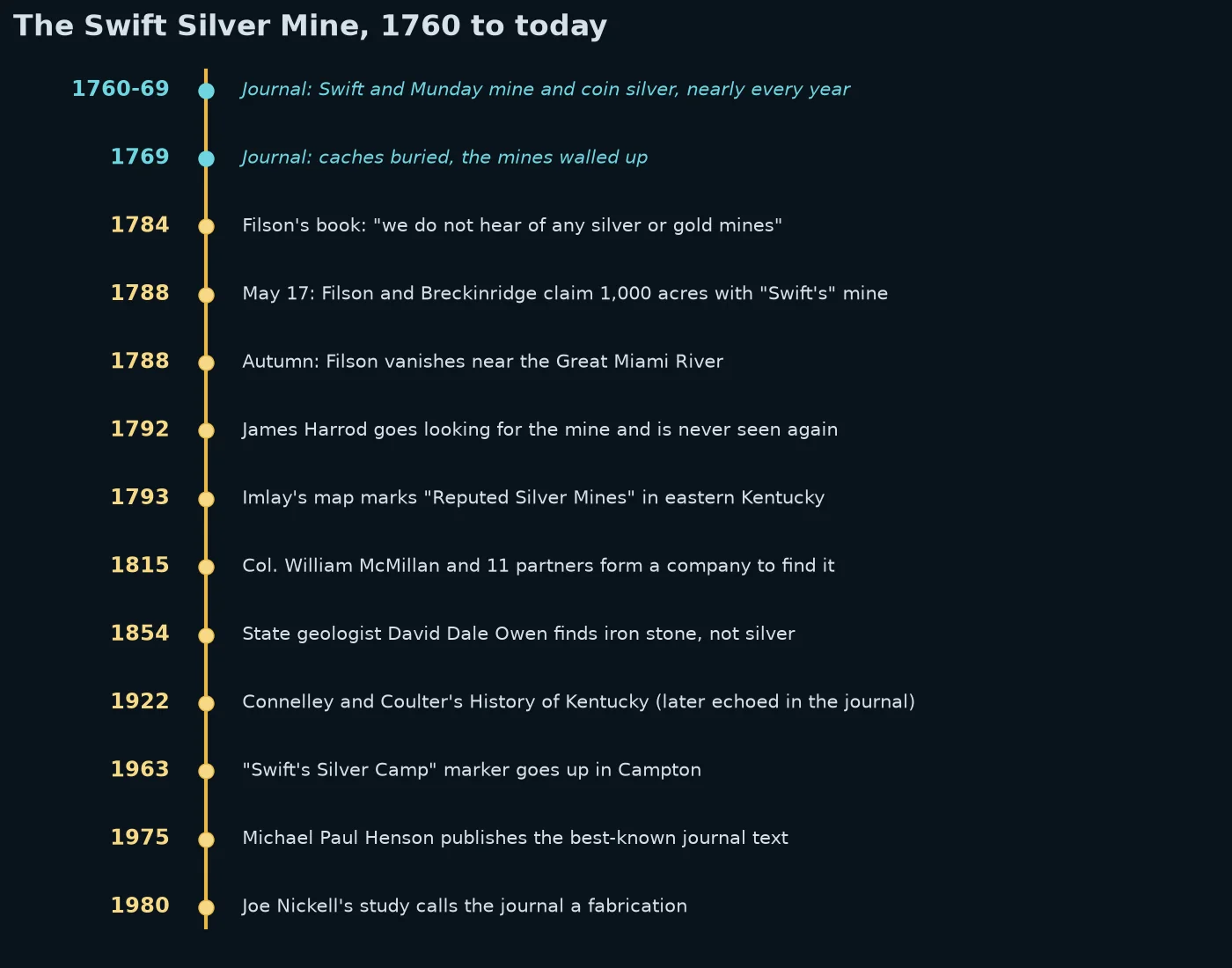
On May 17, 1788, Robert Breckinridge and John Filson entered a claim for 1,000 acres of land under Virginia Treasury Warrant No. 10,117 (Kentucky was still part of Virginia then). The land lay, the entry says, "about sixty or seventy miles North Eastwardly from Martins Cabbins in Powells Valley," and it was meant to take in a silver mine:
Improved about 17 years ago by a Certain man named Swift
The entry even says Swift had made silver dollars and left them, with his equipment, at or near the mine. It's the earliest known written mention of the Swift mine, and it's genuinely odd, because John Filson was no random prospector. He was Kentucky's first historian and mapmaker, author of the 1784 book The Discovery, Settlement and Present State of Kentucke and the man who wrote up Daniel Boone's adventures. In that book, just four years earlier, Filson had written:
we do not hear of any silver or gold mines as yet discovered
Four years later he was claiming one. A survey of the tract was never filed, and Filson didn't stick around to explain. In the autumn of 1788, while surveying near the Great Miami River in what is now Ohio (he had a stake in the new settlement that became Cincinnati), he vanished. Accounts differ on whether his party was attacked or he set off alone, but his body was never found.
The rumour didn't vanish with him. In 1791 two men entered 1,483 acres "supposed to be Swift's old camp," and a 1793 map by Gilbert Imlay marked "Reputed Silver Mines" in eastern Kentucky. In 1815 a Colonel William McMillan of Clark County and eleven partners formed a company to find the mines. Nothing came of any of it, except more maps.
James Harrod and the silver mine trip
The legend's most serious chapter belongs to James Harrod, founder of Harrodsburg, Kentucky's first permanent settlement, and one of the toughest frontiersmen of his day.
In 1792 (one old account says 1793), Harrod went into the wilderness with a man named Bridges, who said he had found Swift's silver mine and wanted Harrod's help to work it. The two had quarrelled over land years before, and according to the story his family told, Harrod's wife feared it was a trap. Harrod went anyway. He never came home, and his body was never found.
In that account, the party camped near the Three Forks of the Kentucky River, split up to hunt, and a shot was heard. Bridges said he had seen signs of Indians. Later, the story continues, Bridges sold furs and a pair of silver cuff buttons engraved with an "H" in Lexington, and Mrs. Harrod recognised them as her husband's. Bridges left and didn't come back. None of it was ever proven, and other explanations for Harrod's disappearance have been suggested, from an attack to illness. What is certain is that one of Kentucky's founders walked into the woods looking for Swift's silver and was never seen again.
The journal: a document with a lot of problems
Time to look hard at the star witness. The first problem is that there isn't one Swift journal. There are a great many. One local historian counts more than 30 known copies, and no two agree completely. Swift is "John" in some, "Jonathan" in others, and there's even a Tennessee version starring a "George William Swift," born in Salisbury, England, in 1689. A version found in Virginia's Clinch River country was judged spurious by a University of Virginia curator because of its wording, paper and ink.
The second problem is sneakier. The best-known, most detailed version was published by the Kentucky writer and treasure hunter Michael Paul Henson in 1975. When the investigator Joe Nickell compared it with William Connelley and E. Merton Coulter's History of Kentucky, published in 1922, he found passages that match the history book word for word. A diary from the 1760s quoting a book from the 1920s is a neat trick. Nickell also spotted an entry, supposedly written in 1765, that seems to predict events about twenty years in the future, and an ending written after Swift had gone blind.
The third problem is Swift himself. There was a real Jonathan Swift in Alexandria, Virginia, a merchant often pointed to as the man in the legend. Researchers say he was born in 1764, which would make him a toddler running a silver operation, and Nickell traced records showing he was still buying and selling property in 1809, years after the legendary Swift was supposed to have died. A signature printed as Swift's turned out to be in the handwriting of a county recorder who copied the deed. No proof has ever turned up that any John or Jonathan Swift mined silver in Kentucky.
Is there any silver in eastern Kentucky?
Over to the geologists, who, as usual, have brought the bad news.
The Kentucky Geological Survey, part of the University of Kentucky, says it is very unlikely that gold, silver or any precious metal occurs naturally in the Paleozoic rocks of eastern Kentucky, and that the surface rocks there are not a good place to look for either. The Survey has fielded hundreds of enquiries about the Swift mines from every county in eastern Kentucky, and its investigations found nothing to back the legend. Silver may show up in trace amounts, but nowhere near enough to mine.
The searches have tested this. In 1854 the state geologist David Dale Owen was taken to a supposed Swift mine on Log Mountain in Bell County; the "ore" turned out to be dark iron stone. Judge Haywood had described two very old furnaces on Clear Creek, with charcoal and cinders, though skeptics have suggested such furnaces could just as easily have been built by later treasure hunters. In more recent times, according to Nickell, a Wolfe County "silver nugget" tested as pyrite, a supposed silver find was actually mica, and one gleaming "silver vein" in the Red River country turned out to be scrapings from an aluminium canoe, put there by a friend with a wicked sense of humour. Brilliant.

The theories, weighed
- A real silver mine, still hidden. The romantic favourite, and the one with the least support. The rocks are wrong, and two centuries of searching, mining, logging and road building across the region haven't turned up a single vein of silver ore.
- A cover story for counterfeiting or piracy. An old idea, aired by historians including Thomas D. Clark: Swift was really melting down Spanish silver (taken at sea, or traded) and coining it in the backwoods, and the "mines" explained where the money came from. Kentucky's own historical marker in Campton mentions "ships on the Spanish Seas." Nickell isn't convinced: you could melt silver much closer to Alexandria, or on a ship, and writing a detailed journal of your crimes is a very odd way to hide them.
- A land promotion. The first written record of the mine is a land claim, made by men with land to sell, at a time when Kentucky land speculation was a frontier sport. A silver mine is a fine thing to have rumoured on your property. Some local historians think this is where the story really began.
- An allegory. Nickell's own theory. The journal is packed with Masonic-sounding symbols (marked trees showing a compass, a square and a trowel, a "triangle," a cave, a blinded seeker) and reads, he argues, like a moral tale about laying up earthly treasure. He suggests it was written around 1788 with Filson involved, possibly in connection with land schemes. It's clever, and it's a theory, not a proven fact.
- Several real people blurred into one. Some researchers point to other candidates for the "real" Swift, such as a North Carolina man named Flower Swift whose family tradition linked him to counterfeiting. In Virginia, a 19th-century counterfeiter nicknamed "Money-making Sol" Mullins was rumoured to have found the mine; prosecutors said he was making fake coins, and he fled the state in 1837.
Every so often a claim surfaces that someone has found coins or ingots in a mountain cave. One was reported from Pine Mountain in 1992. Nothing has ever been shown or verified.
The honest answer? Nobody knows whether Swift existed, whether there was ever a mine, or where it might be. Which, admittedly, is exactly why people are still looking.
Visiting Swift country today
Want to stand in the legend's footprints? You can, with your hands in your pockets.
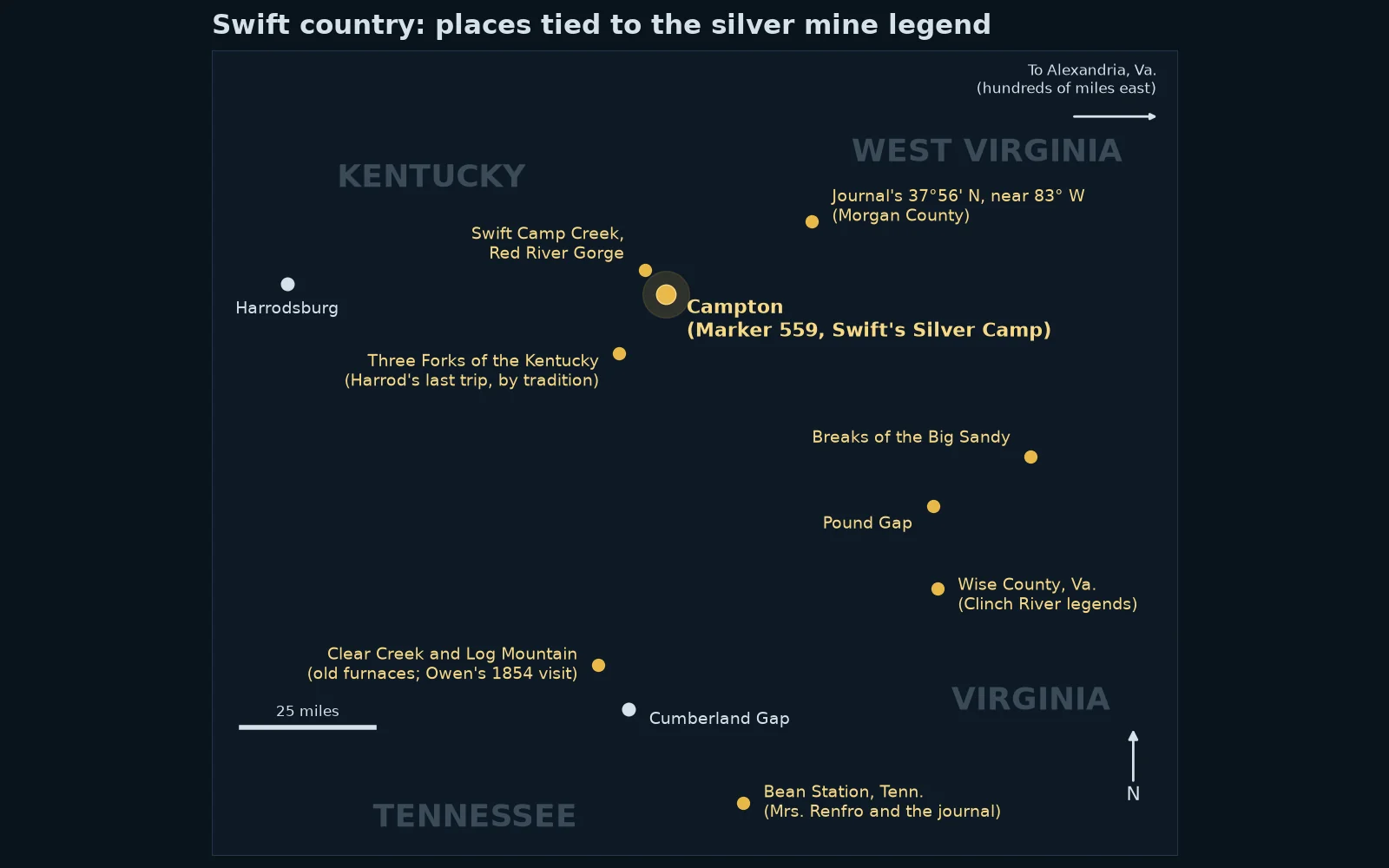
- Campton, Wolfe County. Kentucky Historical Marker No. 559, "Swift's Silver Camp," stands on the courthouse lawn. Installed in 1963, it calls the journals "fabulous," says intrepid searchers have found no trace of cache or mine, and notes that one of Swift's camps is reputed to have stood right where the courthouse is.
- The Swift Silver Mine Festival. Campton holds a festival named for the legend each year around the end of summer, with music, a pageant and a car show. Check local listings for the dates.
- The Red River Gorge. The gorge is part of the Daniel Boone National Forest and is a federally designated Geological Area, a National Natural Landmark and a National Archaeological District, listed on the National Register of Historic Places. The Swift Camp Creek Trail runs about eight miles through the Clifty Wilderness, rough, wet and remote, so it's for experienced hikers.
- The rules. The gorge's rock shelters hold thousands of years of Native American history; the Forest Service has recorded at least 6,700 archaeological sites in rock shelters across the Daniel Boone National Forest. Collecting and removing artifacts from federal and state land is against the law, and it's a felony. In plain English: look, photograph, wonder, and leave the shovel in the car.
- Harrodsburg. The town James Harrod founded, and the place to remember the man rather than the mine.
The silver may never have existed. The legend certainly does, and it has outlived the journal's author, whoever he was, by more than two hundred years and counting.
...and if you find it, remember who encouraged your questionable life choices.
The short version of this story is on YouTube at @TenToeExpress.
Deep dive yourself
- Uncovered: The Fabulous Silver Mines of Swift and Filson, by Joe Nickell (1980) · The Filson Club History Quarterly
- Jonathon Swift Silver Mines · Kentucky Geological Survey, University of Kentucky
- Swift's Silver Camp (Marker 559) · Kentucky Historical Society
- The Legend of John Swift's Silver · KET, Kentucky Life
- A Geographical Approach to the Legends of Swift's Silver Mine, by James A. Dougherty · Historical Society of Southwest Virginia (via VAGenWeb)
- Swift's Silver Mine, by Emory Hamilton (Daily News, Middlesboro, 1940) · VAGenWeb, Wise County
- Imlay's Map of Silver Mine, 1790, by Randall Osborne · Pike County Historical Society
- Red River Gorge · USDA Forest Service, Daniel Boone National Forest
- Archeologists work to preserve Native American artifacts in Kentucky's forests · WEKU
- Swift's silver mine · Wikipedia (a good starting point, with references to Nickell, Dougherty and Hamilton)