 Ten Toe Express
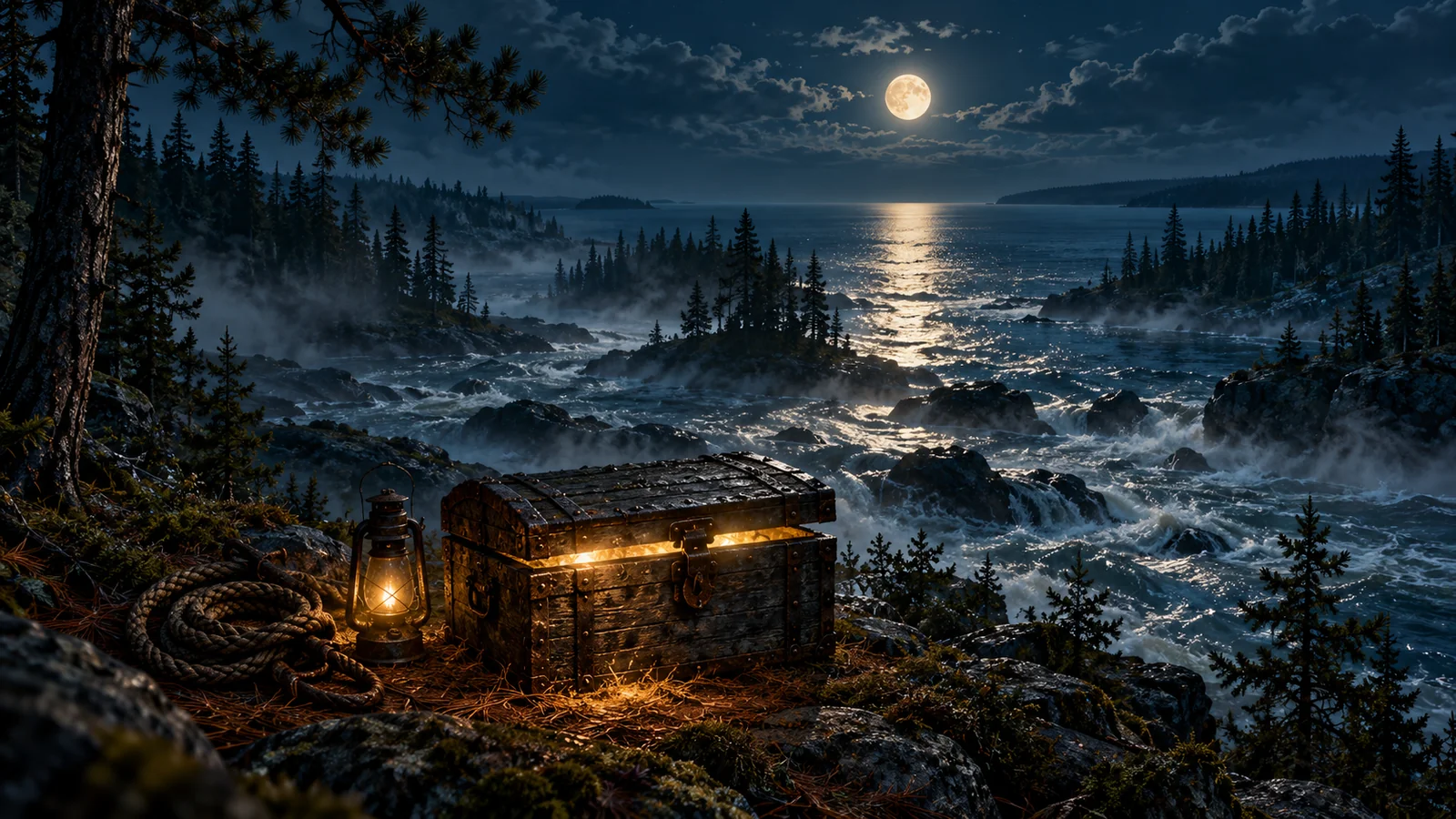
Picture the northwoods of Wisconsin a few centuries back. Dark pine forest, a river running hard over rock toward Green Bay, and somewhere in there, so the story goes, a vein of silver so rich it would make a Spanish galleon blush. French traders are said to have seen it. The Menominee people are said to have known exactly where it was. And then, after some long-ago trouble, the place simply slipped out of the record.
That is the Lost Silver Mine of the Menominee, one of the more elusive treasure tales in Wisconsin. Elusive is the right word, too, because when you go looking for the paper trail behind it, the trail is about as easy to follow as a deer track in a snowstorm. What you find instead is something rather better: a real people with a very long history on this river, real metal in the ground and in the graves, a famous "lost silver mine" in another corner of Wisconsin that turned out to be something else entirely, and a modern fight over actual silver that is still going on.
Right then. Boots on, torch charged. This one needs careful footwork.
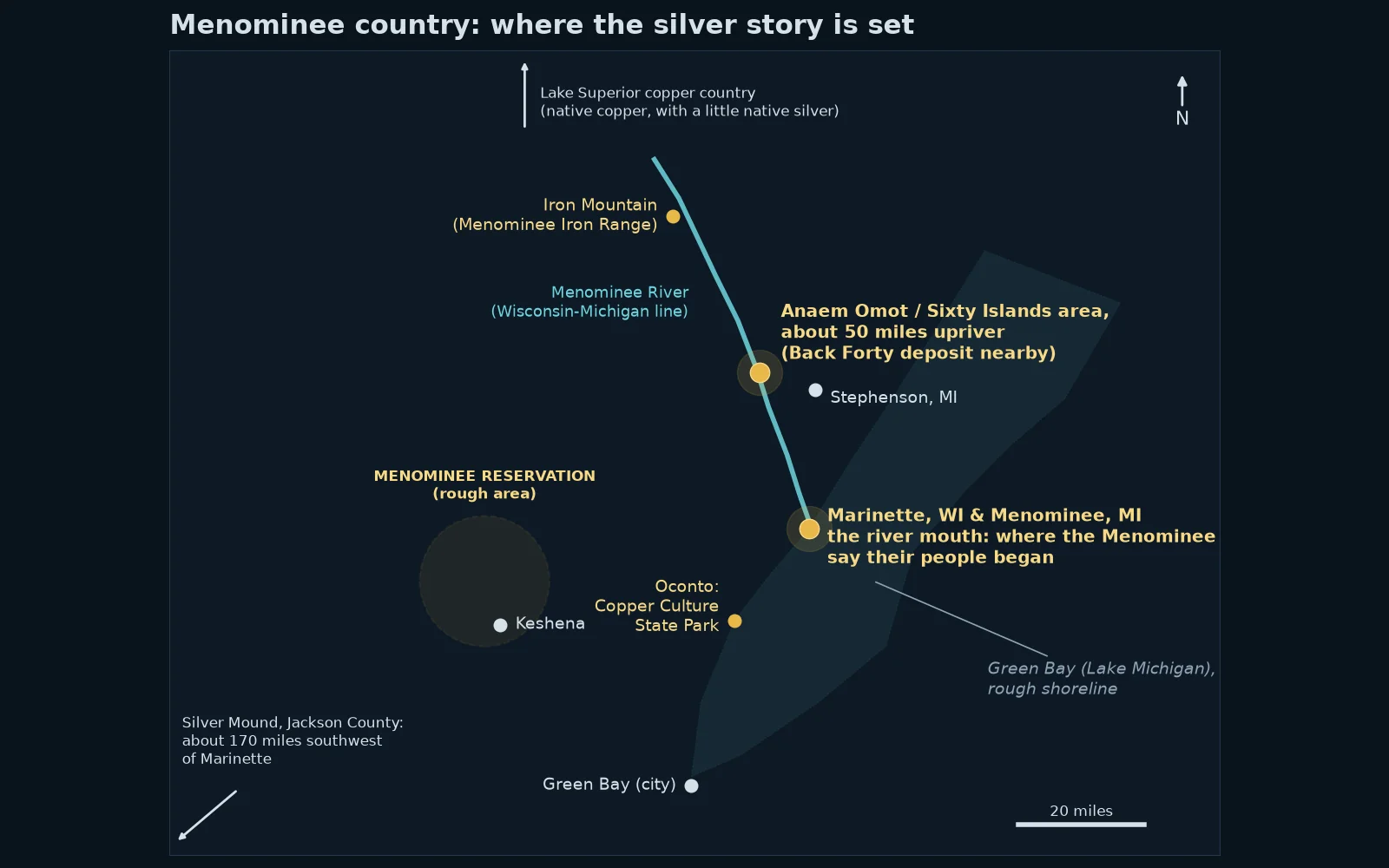
The legend of the lost Menominee silver mine
Here is the story as it is usually told today. In the 17th century, French explorers and fur traders pushed into the forests of what is now northeastern Wisconsin. With help from Menominee people, who knew the country far better than any newcomer, they came upon a rich deposit of silver. Then something went wrong. Depending on the telling, there was conflict with other tribes, or with settlers, or with the French themselves, and the mine was hidden or abandoned. Its location, the story says, was lost.
The usual clues are thin even by treasure-legend standards: somewhere in the dense forest near Marinette, perhaps along the Menominee River, perhaps near a known trail. One popular online list values the silver at "over $10 million" today, which is a wonderfully round number for a mine nobody has seen.
And here is the slightly awkward bit for anyone hoping to dust off a shovel. Research for this article could not find the legend in any early source. No French journal mentions a Menominee silver mine. No 19th-century county history or newspaper account turned up. The published histories from the Menominee Nation itself say nothing about one. The story appears, as far as can be traced, in modern treasure write-ups, told without names, dates or documents. Some versions say tribal stories describe the mine. If knowledge like that exists within the Menominee community, it belongs to them, and it has not been published in any source that could be checked.
So, a legend with no clear origin. That does not make it worthless. It makes it a mystery of a different kind: not "where is the mine?" but "where did this story come from?" And for that, you need to know the people it is named after.
Who the Menominee are (and how long they've been here)
The Menominee Nation says its people have lived in this region for more than 10,000 years. Their own account places their origin, their creation, at the mouth of the Menominee River, where it pours into Green Bay, on the spot where the twin towns of Marinette, Wisconsin, and Menominee, Michigan, stand today. That is about 60 miles east of the present reservation. The Ojibwe name that became "Menominee" means roughly "wild rice people," after the rice that grew thick in the region's waters.
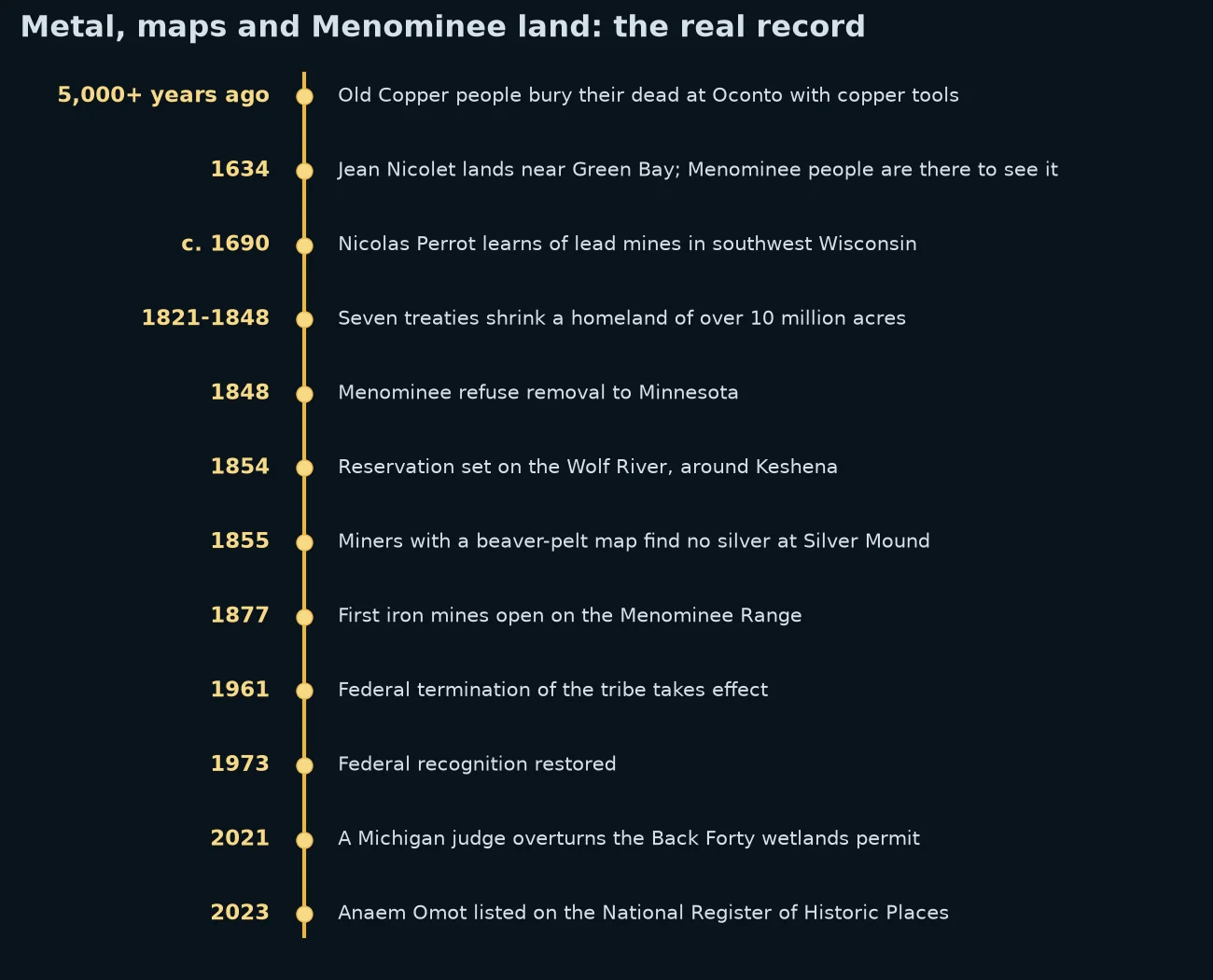
At its height, Menominee territory covered more than 10 million acres across what are now Wisconsin and Michigan's Upper Peninsula. That is the real lost treasure in this story, and there is nothing legendary about how it went. Through a series of treaties with the United States, most of them between 1821 and 1848, the land base shrank and shrank. In 1848 the government tried to move the Menominee west to Minnesota. They refused. In 1854 a treaty set aside a reservation on the Wolf River, around Keshena, and that is where the Nation's home is today.
The 20th century brought another blow. Under a 1954 law, Congress "terminated" federal recognition of the tribe, and it took effect in 1961. The result was hardship: Menominee County became the poorest and least populated county in Wisconsin. The Menominee fought back, and federal recognition was restored in December 1973.
Through all of it they kept their forest, and kept it well. An 1870 count put the timber at about 1.3 billion board feet; by 2002 there was more standing, about 1.7 billion, and in 1994 the tribe's forest enterprise became the first in the United States to be certified by the Forest Stewardship Council. If you want a Menominee treasure that is real, measurable and still growing, it's right there.
The French arrive, and so does the trade
The first recorded meeting between the Menominee and Europeans came in 1634 (some historians argue 1638), when the French explorer Jean Nicolet landed near present-day Green Bay. Menominee, Ho-Chunk and Noquet people were there to see it. Nicolet was, famously, looking for a route to China. He did not find one. Green Bay has many fine qualities, but it is not Beijing.
What followed was the fur trade, which reshaped life in Wisconsin for roughly two centuries. French traders wanted beaver pelts; Native communities traded for metal tools, cloth, guns, glass beads and, later, a great deal of silver jewelry. The Menominee became trading partners of the French, and Green Bay grew into one of the busiest hubs of that trade.
Did the French go looking for mines? Absolutely. They were keen on anything that came out of the ground. But the mine French Wisconsin actually got excited about was lead, not silver. The trader Nicolas Perrot learned of rich lead deposits in the southwest of the region, probably around 1690 (some old histories say 1699), and lead mining went on to build towns along the Mississippi. That is the far opposite corner of the state from Marinette. No record of a French silver mine in Menominee country turned up anywhere.
Real metal: the Old Copper people
Now for the twist that makes this legend more interesting than most. There really was ancient metalworking in this part of Wisconsin. It just wasn't silver.
Thousands of years ago, people around the western Great Lakes were hammering pure native copper, much of it from the Lake Superior region, into knives, spear points, awls and bracelets. Archaeologists call them the Old Copper Culture. In 1952 a 13-year-old named Donald Baldwin was digging in an old gravel quarry in Oconto, just down the bay shore from Marinette, when he turned up human bones. Excavations found 21 burial pits and eight cremation pits holding at least 45 people, some buried with copper tools, a copper bracelet, a swan-bone whistle and shells from as far away as the Atlantic coast. Dates for the site vary depending on who you ask, from roughly 5,000 to about 7,500 years ago, which still makes it one of the oldest known burial sites in Wisconsin. Today it is Copper Culture State Park.
Here is the geological footnote that a treasure hunter will love. The great native copper deposits of Michigan's Keweenaw Peninsula carry small amounts of native silver too, sometimes fused right onto the copper in lumps collectors call "half-breeds." So a bright, silvery fleck in a piece of ancient copper is not impossible. It is not a mine, and nobody has ever tied it to the Menominee legend, but it is the kind of real-world detail that could set a story going.
Silver Mound: Wisconsin's other "lost silver mine"
If you want to see how a lost silver mine gets invented, Wisconsin has a textbook example, and it is documented to the hilt.
In Jackson County, about 170 miles southwest of Marinette, stands a hill called Silver Mound. Its slopes are pocked with pits, some more than 10 feet deep and up to 30 feet across. When settlers arrived in the 1840s, they saw those pits and drew the obvious conclusion: somebody had been mining here, and it must have been for something valuable. The legend of a "lost silver mine" took hold. According to the story, in 1855 a party of miners turned up with a map drawn on a beaver pelt, obtained from a Frenchman in St. Louis. They found no silver. By 1860 geologists had dismissed the idea, but hopefuls tried again in 1871 to 1873 and once more in 1895.
The truth? Silver Mound is made of an exceptionally hard stone now called Hixton silicified sandstone, and Native people had been quarrying it to make stone tools for thousands of years, with some points made from it dating back nearly 12,000 years. Tools from this hill have turned up as far away as Kentucky. The pits were real. The work was real. The silver was entirely in the settlers' heads.
Keep that pattern in mind: newcomers see signs of Native knowledge of the land, assume it must be hiding precious metal, and a lost mine is born. It is a pattern that crops up in lost-mine legends right across the country, and it may well be part of what happened with the Menominee story too.
Trade silver: the silver that really was in Menominee hands
There is one more real kind of silver to add to the case file, and it might be the most important clue of all.
From the late 1700s, silver brooches and ornaments were a major trade good across the Great Lakes. Woodland Native people often wore them in large numbers, sometimes by the hundred, as a show of wealth, status and identity. Some of these pieces were made by European silversmiths for the trade; later, Native silversmiths made their own, and after about 1830 a cheaper alloy called German silver took over much of the work. Museums in Wisconsin, including the Milwaukee Public Museum, hold collections of them.

Now imagine you are a newcomer in the 1800s who sees a Menominee family dressed in gleaming silver. You don't know about the trade networks. You don't know where the brooches were made. Where does your mind go? Straight to a secret mine in the woods, of course. Nobody has documented that this is how the Menominee legend started, so treat it as a theory, not a finding. But it fits the evidence far better than a hidden silver vein that left no record at all.
Iron, not silver: the Menominee Range
The ground upriver did eventually make people rich, just not with silver. Iron ore was spotted in the region in the 1840s and 1850s, and actual deposits were found at Waucedah, Michigan, in 1866. The first mines on what became the Menominee Iron Range opened in 1877, and the railroad carried ore away by the million tons. Iron Mountain, Michigan, grew up as the range's hub, and Florence County was its Wisconsin end. Wisconsin's share of the iron mining wound down by 1937.
So for more than a century, prospectors, surveyors and mining companies combed this country for anything worth digging. They found iron in enormous quantities. Nobody, in any record that could be found, stumbled into a forgotten silver mine. Rather inconvenient for the legend.
The real silver on the Menominee River
And yet there is silver beside the Menominee River. Just not the romantic kind.
On the Michigan bank of the river, near Stephenson, lies a metal sulfide deposit known as the Back Forty. A Canadian company, Aquila Resources, proposed mining it for zinc, gold, copper, silver and lead in an open pit about 150 feet from the river. Plans described a pit around 750 feet deep across roughly 83 acres.
For the Menominee, this is not a treasure hunt; it is their homeland. The area along the river, including the place called the Sixty Islands, holds burial mounds, ancient raised garden beds, dance rings used in ceremonies by the Menominee and neighbouring tribes, and hammered copper artifacts from the Old Copper period. The Menominee call the cultural landscape Anaem Omot, "the Dog's Belly," and say people have lived there for something like 10,000 years. The tribe was moved to its reservation in 1854, but the site is still used for ceremonies.

The Menominee Nation, with environmental groups, took the fight to court. In January 2021 a Michigan administrative law judge, Daniel Pulter, overturned the mine's wetlands permit, finding the application did not reliably identify the damage to wetlands. Aquila later withdrew its pending permit applications. In late 2021 Gold Resource Corporation bought Aquila and the project, and proposed a revised plan. Meanwhile the Wisconsin and Michigan review boards backed listing Anaem Omot on the National Register of Historic Places, and the National Park Service listed it in June 2023. That listing does not ban mining, but it adds another layer of review.
As of early 2026, Gold Resource said it remained committed to the Back Forty and had agreed to merge with Goldgroup Mining, a deal expected to close in the second quarter of 2026. The Menominee's opposition has not changed. In January 2020 the tribe even passed a resolution recognising the rights of the Menominee River itself: the right to flow, to flourish and to stay unpolluted.
Which leaves this story with a rather wonderful irony. The legend says the Menominee hid a silver mine. In real life, the Menominee are working very hard, in courtrooms and hearings, to keep the silver in their ancestral river valley in the ground, because the ground holds their ancestors.
The theories, weighed
- A real, lost silver mine. The romantic option. The trouble: no record from the French, the settlers, the miners of the iron range or the Menominee themselves, and 150 years of serious prospecting in the region found iron, not silver.
- A settler misreading, like Silver Mound. Newcomers saw signs of Native knowledge of the land and assumed hidden riches. Wisconsin has a documented case of exactly that happening.
- Trade silver taken for mined silver. Menominee people really did own and wear silver, but it came through the fur trade. To an outsider, that could easily look like a secret source.
- Old copper with a silver glint. Ancient native copper from Lake Superior sometimes carries native silver. A real object could have grown into a mine in the retelling.
- A modern story. Without any early source, it is possible the legend as now told is fairly recent, stitched together from the region's real history of French traders, Native knowledge and mining.
The honest verdict? The silver mine itself has no evidence behind it. The people, the river, the copper, the trade silver and the very real Back Forty deposit are all thoroughly documented. A proper mystery, then, just not the one on the treasure map.
Visiting Menominee country today
Fancy seeing where the legend lives? Brilliant. Bring curiosity, leave the shovel at home.
- The river mouth at Marinette and Menominee. The towns sit either side of the Menominee River where it meets Green Bay, the place the Menominee name as their origin. The riverfront is the place to stand and take it in.
- Copper Culture State Park, Oconto. The Old Copper burial site, with a small museum about the Oconto finds. It is a burial ground, so treat it like one.
- The Menominee Reservation, around Keshena. This is sovereign tribal land, home to the Menominee Nation and its famous forest. Visitors are welcome at public events and businesses, but tribal rules apply, and prospecting or digging is not something to even think about.
- Silver Mound, Jackson County. A National Register archaeological district, parts of which are owned by The Archaeological Conservancy. It is protected land, not a place to collect stone.
- The upper Menominee River and the Sixty Islands area. Much of the land here is private, and the burial mounds and other sites are protected. Burial sites are protected by law, so any wandering is strictly look-and-leave.
The silver mine may never have existed. The river does, the forest does, and so do the people who have been looking after both for a very, very long time.
...and if you find it, remember who encouraged your questionable life choices.
The short version of this story is on YouTube at @TenToeExpress.
Deep dive yourself
- Who We Are · Menominee Indian Tribe of Wisconsin
- Michigan Board Votes to Add Ancient Menominee Site to National Register of Historic Places (2022) · Earthjustice
- Menominee site receives national historic designation as company seeks to mine for gold (2023) · Wisconsin Public Radio
- Michigan judge denies permit for Back Forty mine on banks of Menominee River (2021) · Wisconsin Public Radio
- Wisconsin tribe recognizes Menominee River rights (2020) · Great Lakes Echo
- Merger opens new chapter in Back Forty mine saga (2026) · The 906 Report
- Silver Mound · Mississippi Valley Archaeology Center, UW-La Crosse
- Copper Culture State Park · Wisconsin Historical Society
- Fluid Functionality: North American Indian German Silver Brooches at the Milwaukee Public Museum, by Victoria Pagel (2018) · University of Wisconsin-Milwaukee
- Menominee and Menominee Range · Wikipedia (good starting points, with references)