 Ten Toe Express
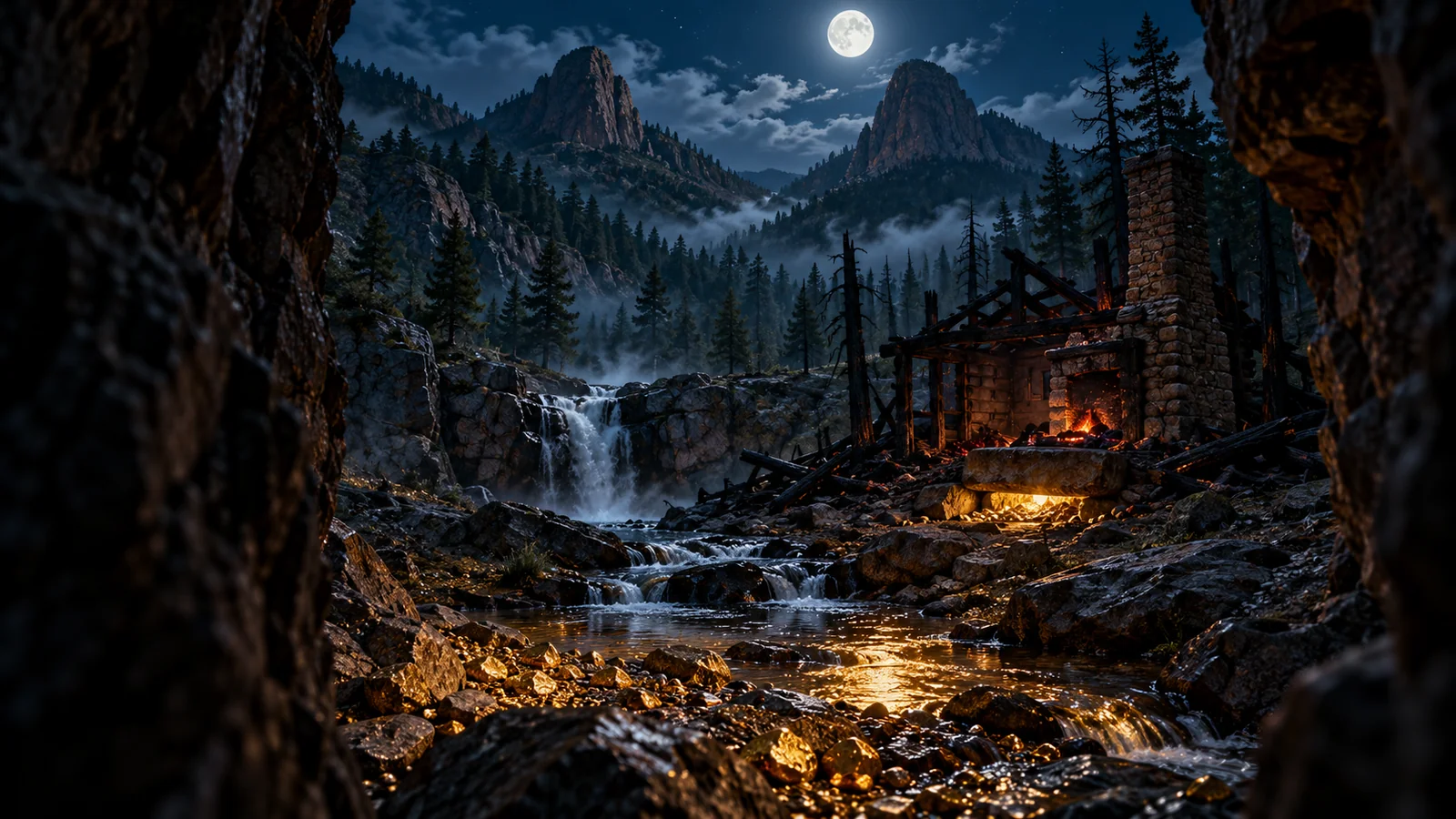
Picture a canyon somewhere in the mountains of western New Mexico, 1864. A creek runs over bedrock, and in the gravel there's gold. Not dust. Nuggets, some of them, in one telling, the size of hen's eggs, just lying there in the shallows like someone forgot to collect breakfast. A crew of hard-up prospectors can't believe their luck. They build a cabin, hide the takings under the hearthstone, and start dreaming about what they'll buy.
A few weeks later, almost all of them are dead, the cabin is burning, and one of the few survivors walks out of the mountains with nothing. He spends the rest of his life trying to find his way back. He never does.
That's the Lost Adams Diggings, New Mexico's most famous lost gold, and a story the folklorist J. Frank Dobie rated the greatest lost-mine tale in the United States. Nobody has proved where the canyon is, or whether it was ever quite what the story says. Right then: map, water, raised eyebrow. Off you go.

The Lost Adams Diggings: the story as it's told
A quick warning before the good bit. Nearly everything below comes from what Adams told people years afterwards, written down and polished by later writers, most of all Dobie in his 1939 book Apache Gold and Yaqui Silver. Details change depending on who's telling it. So treat this section as the legend, because that's what it is.
The story goes that in August 1864 a freighter named Adams was hauling goods across Arizona Territory when his wagon was attacked and burned. He saved a dozen horses and drove them toward Sacaton, on the Gila River south of today's Phoenix, to sell them. Even his first name is a muddle: some writers call him John, others Ed, Wikipedia's summary of the legend says nobody knows it, and one account gives his birth as 1829 in Rochester, New York.
At Sacaton he fell in with a band of around 20 miners led by a man named John Brewer. With them was a young guide, usually described as Mexican (or part Pima, part Mexican) and nicknamed "Gotch Ear" in many tellings because of a damaged ear. He'd spent time among the Apache, he said, and knew a place in the mountains where gold could be scooped out of a stream. All he wanted in return was a horse, a saddle, a gun and a little gold, enough to get home to Mexico.
Adams had horses. The miners needed horses. A deal was done, and Adams became a sort of co-leader. On about August 20, 1864, by the usual date, about 22 men rode out.
Into the mountains
The guide led them east, up the White River and into the White Mountains of eastern Arizona, then on into western New Mexico. Eventually he pointed out two peaks shaped like sugarloaves and said the gold lay at their foot. To get there, the party squeezed through a narrow gap in the rock, which Adams called "the little door," dropped down a zigzag trail into a canyon, and found a spring and a small waterfall.
And the gold was there. According to the legend, within days they were pulling nuggets out of the creek gravel and stashing them in an old stone corn-grinding basin. They built a cabin. The guide took his pay and left, with a warning: don't stay long, this canyon is an Apache camping place.
Then, the story says, Apache men rode into camp, led in most tellings by the Chihenne leader Nana. Their message was simple. Stay below the waterfall. Don't go above it.
It was, by any sensible reading, a fair warning. Which brings the story to the part where the prospectors stopped being sensible.
The cabin, the hearthstone and the end of it
Food ran low, so Brewer and five men rode off for supplies to Fort Wingate, a few days' ride away. While they were gone, some of the miners, so the story goes, crept above the falls anyway, found bigger nuggets, and kept quiet about it. Adams told them off. Too late to un-ring that bell.
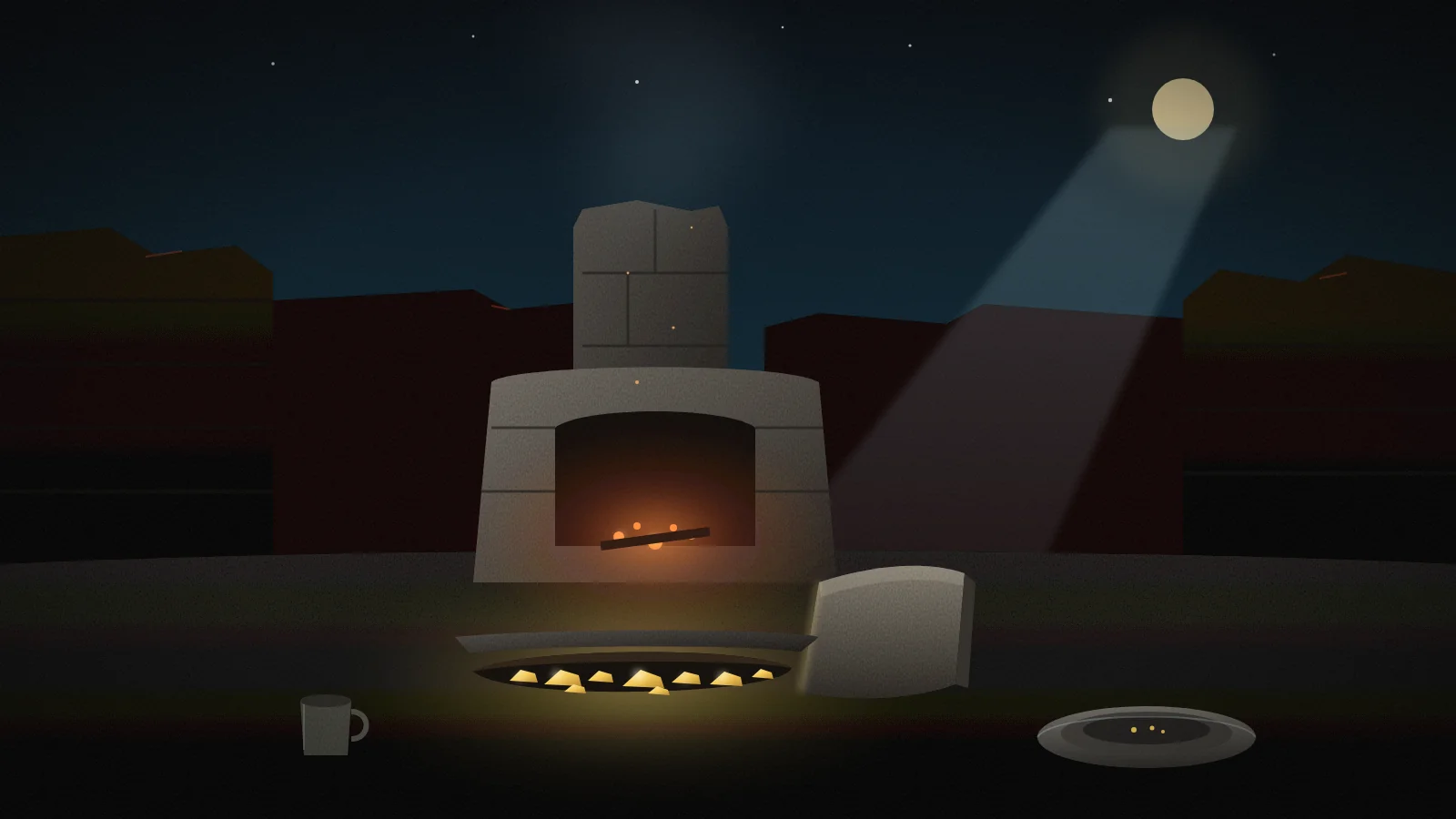
Brewer's party didn't come back on time. After about nine days, Adams and a miner named Davidson climbed out to look, and found five bodies on the trail. Brewer wasn't among them. When they got back to the canyon, the camp had been attacked, the men there killed, and the cabin burned. The gold under the hearthstone was still there, the legend insists, but the fire had made the stone too hot to touch, and nobody was in a mood to wait around.
Adams and Davidson fled into the mountains, living on what they could find. Days later, by the usual account, soldiers found them, half-starved and in a bad way. Different versions give different survivors: Brewer turns up alive in some and dead in others. Either way, the canyon had gone from paradise to graveyard in a matter of weeks, and the gold stayed behind.
Whose canyon was it?
Here's the bit the old campfire version tends to skip.
The canyon in this story wasn't empty wilderness waiting to be claimed. By the legend's own telling, it was an Apache camping place, in country that the Apache had lived in for generations. The prospectors were the outsiders, and in 1864 they were walking into the middle of a war.
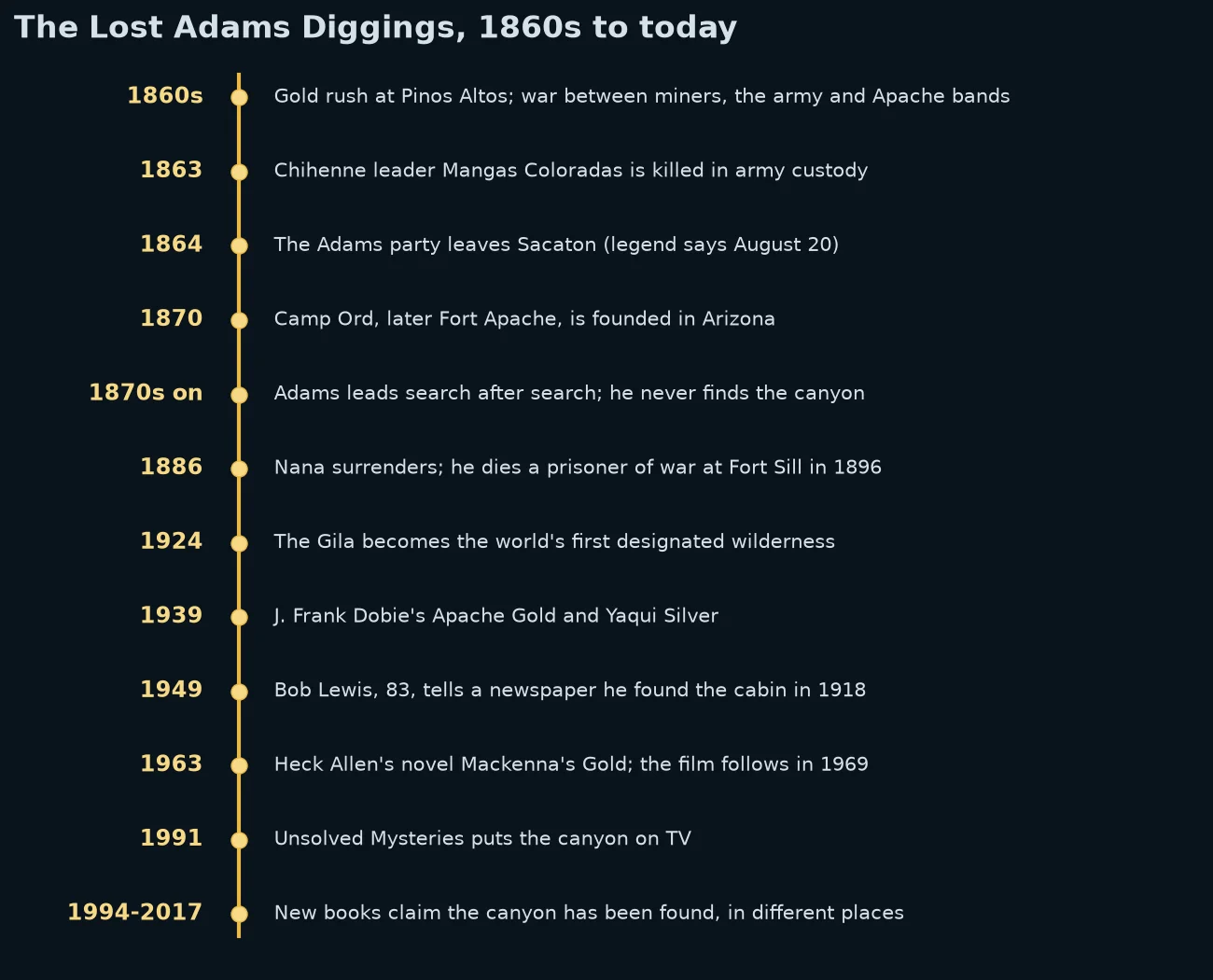
Gold strikes at Pinos Altos, near today's Silver City, had pulled miners into the homeland of the Chihenne (Warm Springs) Apache around 1860, and open conflict followed. In December 1860 a group of miners attacked a Bedonkohe Apache camp on the Mimbres River, killing four people and taking women and children captive, according to the historian Edwin Sweeney. In January 1863 the Chihenne leader Mangas Coloradas came in under a flag of truce to talk peace, was taken into custody by the US Army, and was killed. That same year and the next, the army was rounding up the Navajo for the forced march known as the Long Walk, staged from Fort Wingate itself.
So when a party of armed strangers turns up in an Apache camping canyon, starts digging, and ignores a clear warning about where not to go, the attack in the legend isn't a mystery. It's a war doing what wars do. The author Ralph Reynolds, who spent years on the story, argues the Apaches who struck the camp were mostly after the miners' supplies, guns above all, rather than their gold. That fits the history better than the old "guardians of the cursed gold" line ever did.
None of that makes the deaths any less real for the families involved, if they happened as described. It just means the Apache in this story should be seen as people defending their home in a brutal time, not as spooky set dressing for a treasure tale.
Is any of it real?
Time for the raised eyebrow. A few things don't sit well.
- The soldiers who found Adams. Some tellings say a patrol from Fort Apache, Arizona, rescued the survivors. Lovely detail. Rather inconvenient, though: Fort Apache didn't exist in 1864. Work on the post that became it, Camp Ord, began in May 1870.
- Fort Wingate does check out. In 1864 there really was a Fort Wingate, at Ojo del Gallo near San Rafael, just south of today's Grants. It was used from 1862 to 1868 before the post moved west toward Gallup. So "the old Fort Wingate," as the legend calls it, was a real place Brewer could have been riding to.
- The numbers wobble. Twenty-one miners, or 22 men, or 12. Two survivors, or three, or four. Brewer dead, or Brewer alive. Reynolds credits Brewer with finding the gold about three years before Adams ever arrived, which turns the whole story on its head.
- Nana's role is the legend's, not history's. Nana was a real and famous Chihenne leader, active in these mountains in the 1860s. But the scene of him warning the miners comes from the story, and no record used for this article confirms he was there.
- The paper trail is thin. The legend rests largely on Adams' own later telling and on Dobie. Wikipedia's article itself notes the dates jump around between the early 1860s and 1864.
That doesn't mean nothing happened. Plenty of miners really were killed in Apache country in the 1860s, and there was real placer gold in the region. It means the details, the ones a treasure hunter would need, are exactly the ones that can't be pinned down.
The clues (all of them argued over)
If you've caught the fever, here's the shopping list every searcher works from:
- Two sugarloaf peaks, with the canyon at their foot.
- The little door, a narrow, hidden gap in the rock leading in.
- A zigzag trail down into the canyon.
- A spring and a low waterfall, with richer gold above it.
- The burned cabin and its hearthstone, with the cache underneath.
- A few days' ride from the old Fort Wingate, near today's Grants.
The trouble is that western New Mexico has a frankly unreasonable number of rounded peaks, narrow gaps and canyons with a trickle of water in them. Every searcher's favourite spot ticks most of the boxes. That's what makes it brilliant, and maddening.
Adams goes back, again and again
Adams settled in California, but he couldn't leave it alone. In the years and decades that followed, he led expedition after expedition back into the mountains of New Mexico. Treasure hunters have been looking for the Adams Diggings since the 1870s. He never found the little door again.
He wasn't the last to fail. The US Forest Service's own history of the Southwest tells of Henry Woodrow, a ranger who spent more than 30 years on a district of the Gila. A prospector known as Horn Silver Bill, William P. Dorsey of Silver City, talked him into looking near the head of Mogollon Creek. Woodrow searched and came up empty. In a paper written after he retired in 1942, he summed it up nicely:
"it can stay lost now, as far as I'm concerned."
Then there's Robert "Bob" Lewis. In 1949, aged 83, he told a newspaper that he'd searched with Adams himself back in 1889, and that in 1918, on his own, he'd found the skeletons and the burned cabin about 35 miles northwest of Magdalena. The gold, he said, was already gone. A sheepherder from Magdalena had reportedly been paid $20,000 for it. Nobody has ever backed up Lewis's claim, and you'll notice it handily explains why there's nothing left to find.
Gold fever goes Hollywood
Dobie's book made the Lost Adams famous. In 1963 Heck Allen, writing as Will Henry, published a novel loosely based on it, Mackenna's Gold, which credits Dobie's account in its author's note. In 1969 it became a big-budget western starring Gregory Peck, all canyons of gold and desperate men. It flopped in North America and, oddly, became a huge hit overseas, from the Soviet Union to India.
In 1991 the TV show Unsolved Mysteries did an episode on Adams' treasure. And somewhere along the way the legend got itself onto the map for real: there's a spot in Catron County, New Mexico, officially named Lost Adams Diggings. Don't get excited. It's a name in the federal place-name records with a population of zero, not a canyon full of gold with a car park.
The theories, weighed
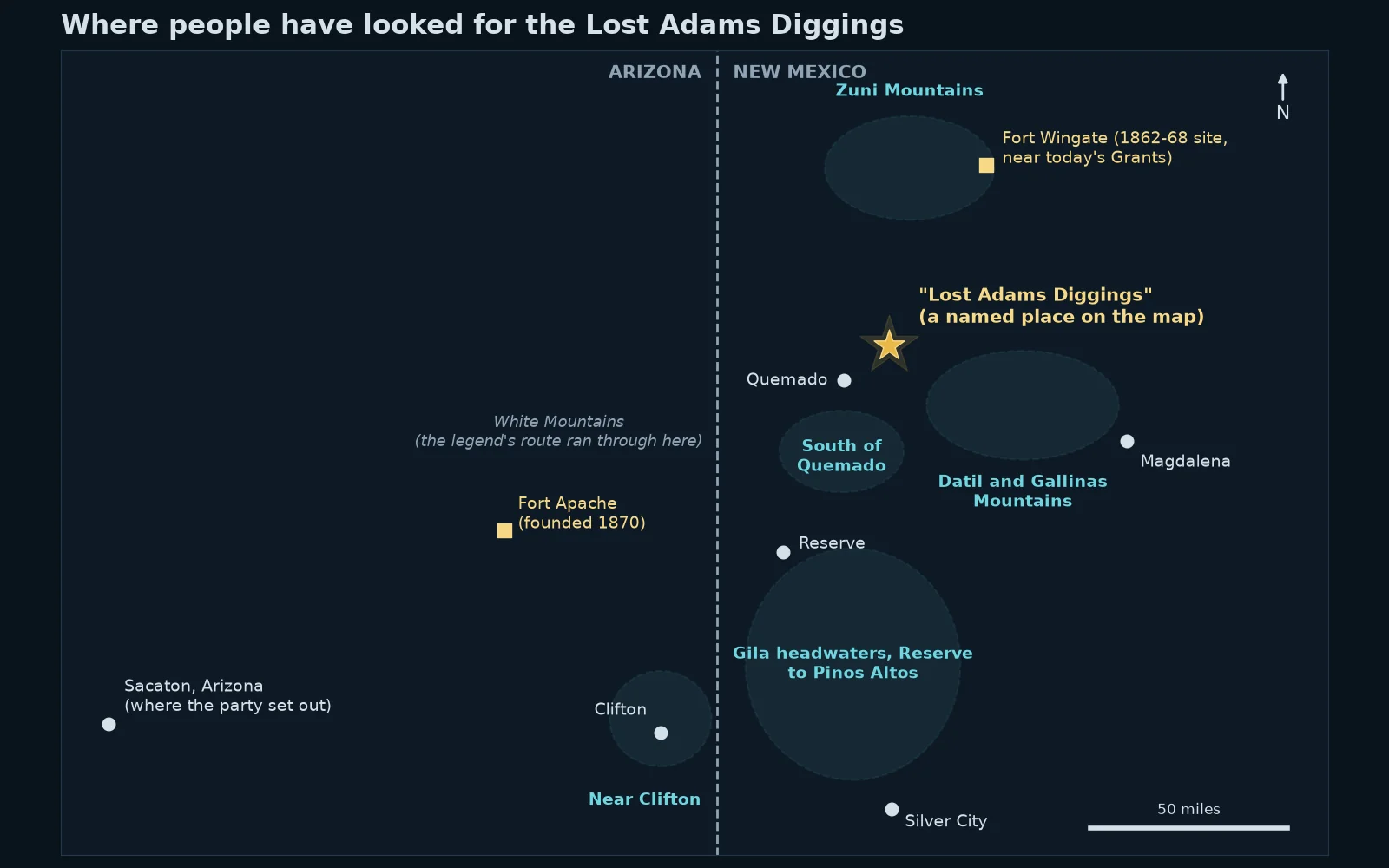
- The Zuni Mountains, near Grants. For years the favourite, since they're close to the old Fort Wingate. Prospectors combed them before the Second World War, and logging towns from about 1895 to 1930 kept the story going. Government geologists found no gold there, and interest faded by the middle of the century. Part of this country is Zuni and Navajo land, where outsiders can't simply go prospecting.
- The Datil and Gallinas Mountains, west of Magdalena. Dick French argued for this area in his 1994 book Four Days from Fort Wingate, and in a 2014 follow-up told the story of searchers Paul Hale and Ronald Schade, who he says found it. Bob Lewis's "northwest of Magdalena" claim points roughly this way too.
- South of Quemado. The writer Jack Purcell, author of The Lost Adams Diggings: Myth, Mystery, and Madness (2003), thinks the gold is real and may lie in the mountains here.
- The Gila country, from Reserve down to Silver City and Pinos Altos, where gold really was mined. Local theories favour the headwaters of the Gila, Black or Prieto rivers. Ranger Woodrow's search near Mogollon Creek belongs here.
- Eastern Arizona. Don Fingado searched near Clifton, and W. C. Jameson's 2017 book The Lost Canyon of Gold claims the discovery of the diggings, with its subject listed as Greenlee County, Arizona.
- Mostly legend. A real man, a real war and real gold in the region, stitched into a story that grew with every retelling, until no canyon on earth could match it.
So the score so far: at least two published claims that the canyon has been found, in different states, and no gold anyone has shown the public. The honest answer is that nobody knows, and that is exactly why people keep looking.
Nana, the real man behind the legend's cameo
Since the legend borrows his name, it's only fair to give the real Nana his due. Known to his people as Kas-tziden, usually glossed as "Broken Foot," he was born around 1810 and became one of the leading men of the Chihenne, the Warm Springs band of the Chiricahua Apache. He fought alongside Mangas Coloradas and later beside Victorio, whose sister he married.
In 1881, when he was in his seventies by most estimates, Nana led a small band on a raid across New Mexico that covered well over a thousand miles and ran rings around the army chasing him. He surrendered in 1886 and was sent, with the other Chiricahua, into years of captivity as a prisoner of war in Florida and Alabama. He died at Fort Sill, in what is now Oklahoma, on May 19, 1896, still a prisoner. Whatever part he did or didn't play in Adams' story, his own was a hard and remarkable one, and it's well documented.
Visiting Lost Adams country today
Fancy a look? The scenery alone is worth the drive. Here's how to do it right.
- National forest land. Much of the search country lies in the Gila, Cibola and Apache-Sitgreaves national forests. Looking for treasure trove there (hidden money or precious metals) needs a Forest Service special use permit, and metal detecting isn't allowed anywhere with archaeological or historic sites. Taking or digging artifacts is a federal crime.
- The Gila Wilderness. On June 3, 1924, the Gila became the first designated wilderness in the world, thanks largely to Aldo Leopold. It's some of the wildest country in the lower 48. Hike it, camp in it, gawp at it, but leave the shovel at home.
- Tribal land. The Zuni Pueblo and the Navajo Nation, and the White Mountain Apache lands in Arizona along the legend's route, are tribal lands with their own laws. Prospecting isn't open to visitors, so visit as a respectful guest and follow tribal rules.
- Private ranches. Big chunks of Catron and Socorro counties are private. A good story is not a gate key.
- Fort Apache. The White Mountain Apache Tribe looks after the old Fort Apache site, with its cultural center and museum, Nohwike' Bágowa. It's a good place to hear the region's history from the people whose history it is.
And the usual: carry more water than seems sensible, check the weather and fire closures, tell someone your route, and remember that this country has been swallowing optimistic prospectors for 160 years. It's not in a hurry to stop.
Somewhere out there, if you believe the old man, are two sugarloaf peaks, a narrow little door in the rock, and a hearthstone that has finally cooled down. Plenty have gone looking. The canyon is still winning.
...and if you find it, remember who encouraged your questionable life choices.
The short version of this story is on YouTube at @TenToeExpress.
Deep dive yourself
- Lost Adams Diggings · Wikipedia (a good starting point, drawing on Dobie, French, Purcell and a 1949 newspaper interview)
- Men Who Matched the Mountains: Lost Mines and Buried Treasure · USDA Forest Service history of the Southwest (via NPS History)
- Die Rich Here: The Lost Adams Diggings, by Ralph Reynolds (review) · Kirkus Reviews
- Nana (chief) · Wikipedia
- Mangas Coloradas · Wikipedia
- Fort Wingate · Wikipedia
- Fort Apache · FortWiki
- 1924: Gila Wilderness Designation · Forest History Society
- Mackenna's Gold · Wikipedia