 Ten Toe Express
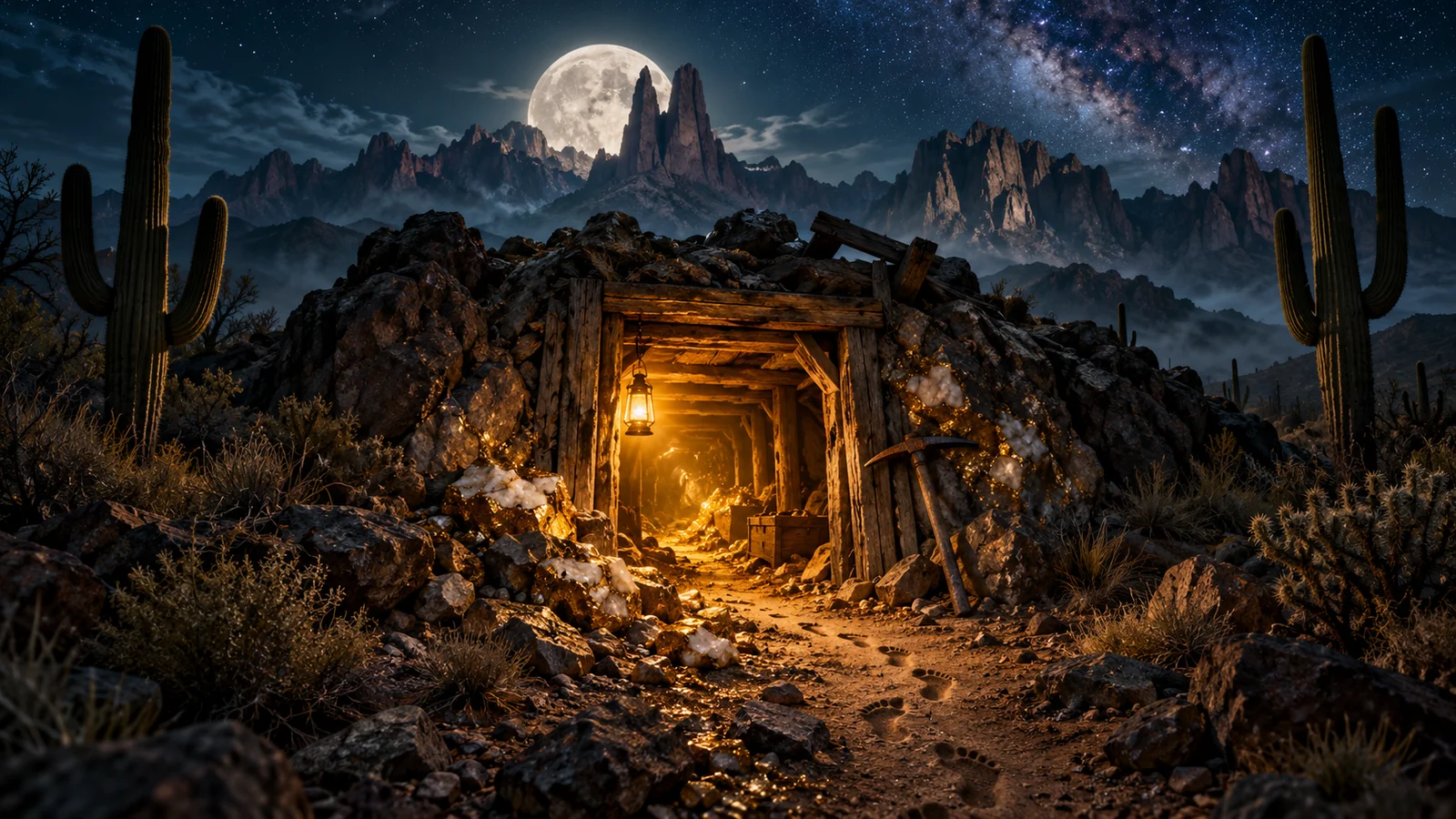
Picture it. October 1891, Phoenix. An old German prospector lies dying in a small house in town, and under his bed sits a box of quartz so stuffed with gold it practically hums. He has spent twenty-odd years wandering off into the Superstition Mountains and coming back with ore nobody could trace. Now he is out of time, and everyone in the room is thinking the same thing: right then, old chap, where did you get it?
That man was Jacob Waltz, the "Dutchman" (Dutch being how Americans of the day mangled Deutsch), and the place he supposedly got it is the Lost Dutchman Mine, the most famous lost gold mine in America. More than 130 years later, nobody has found it. Plenty have looked. Some never came back. And the mountains east of Phoenix are still quietly winning.
Let's sort out what's real, what's legend and what's pure Hollywood. Grab your hat and a frankly unreasonable amount of water.
Who was the Lost Dutchman, really?
Here is the slightly awkward bit for a legend: the real Jacob Waltz left a paper trail, and it is fairly ordinary.
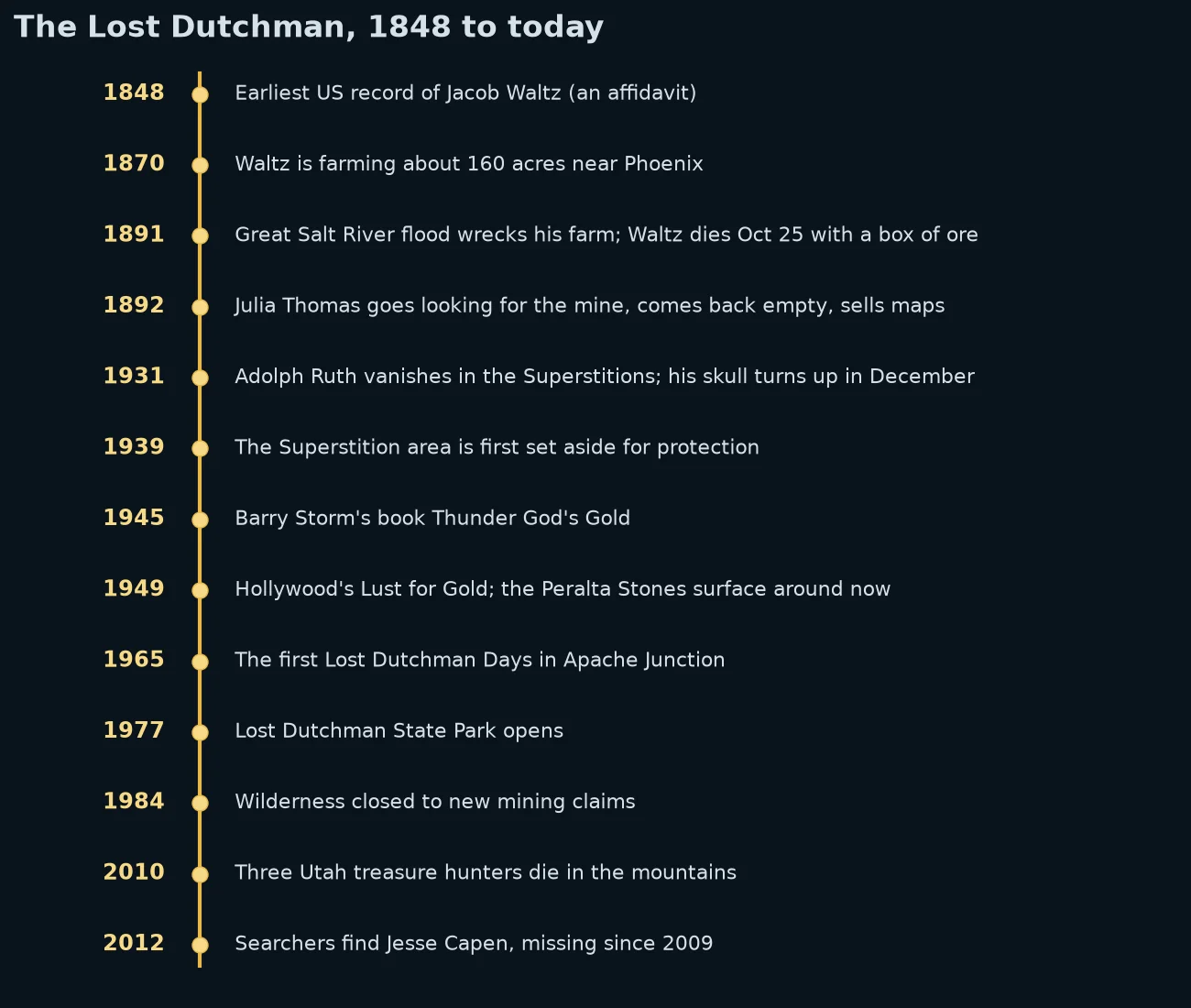
He was born in Germany around 1810. A Jacob Walz shows up in Württemberg birth records for September 1810, though historians stop short of swearing it is the same fellow, and his tombstone says 1808. His earliest known record in the United States is an 1848 affidavit giving his age as about 38. Secondary sources say he became a US citizen in Los Angeles in 1861, and he does appear in Los Angeles County voting and citizenship records.
He drifted into Arizona in the 1860s, like a lot of men with a pick and a dream, and by 1870 he was farming a homestead of about 160 acres near Phoenix. He filed mining claims over the years, but in California, not the Superstitions. There is no record of him ever getting rich from mining. A farmer with a prospecting hobby, in other words, which is not how legends usually start.
Then, in February 1891, the Salt River did something spectacular. The great flood of 1891 is the biggest on record for that river, with an estimated peak of around 291,000 cubic feet of water per second, and it wrecked Waltz's farm. Stories say he caught pneumonia clinging to a tree in the flood. That part is rumour. What isn't rumour is that his health went downhill fast.
The deathbed and the box of gold
Waltz spent his last months being looked after by Julia Thomas, a Black businesswoman who ran a bakery in Phoenix, with help from a young man named Rhinehart "Reiney" Petrasch. Waltz died at Julia's home on October 25, 1891, and he is buried in what is now Pioneer and Military Memorial Park in Phoenix.
And here is where it gets interesting. Accounts agree he kept a stash of very rich ore, and a box of it was found under his bed when he died. One telling puts it at about 48 pounds, though nobody weighed it for posterity. Gold in white quartz. Lovely stuff. The sort of thing that makes otherwise sensible people quit their jobs.

The legend says Waltz, on his deathbed, gave Julia directions to the mine. A rival story says a man named Dick Holmes got the directions instead. Either way, the directions are where the history ends and the campfire begins.
The clues (and why they're rubbish at being clues)
Over the decades, the "Waltz clues" have been repeated, embroidered and sold in so many books that it is hard to say which, if any, came from the man himself. The most famous ones you will hear:
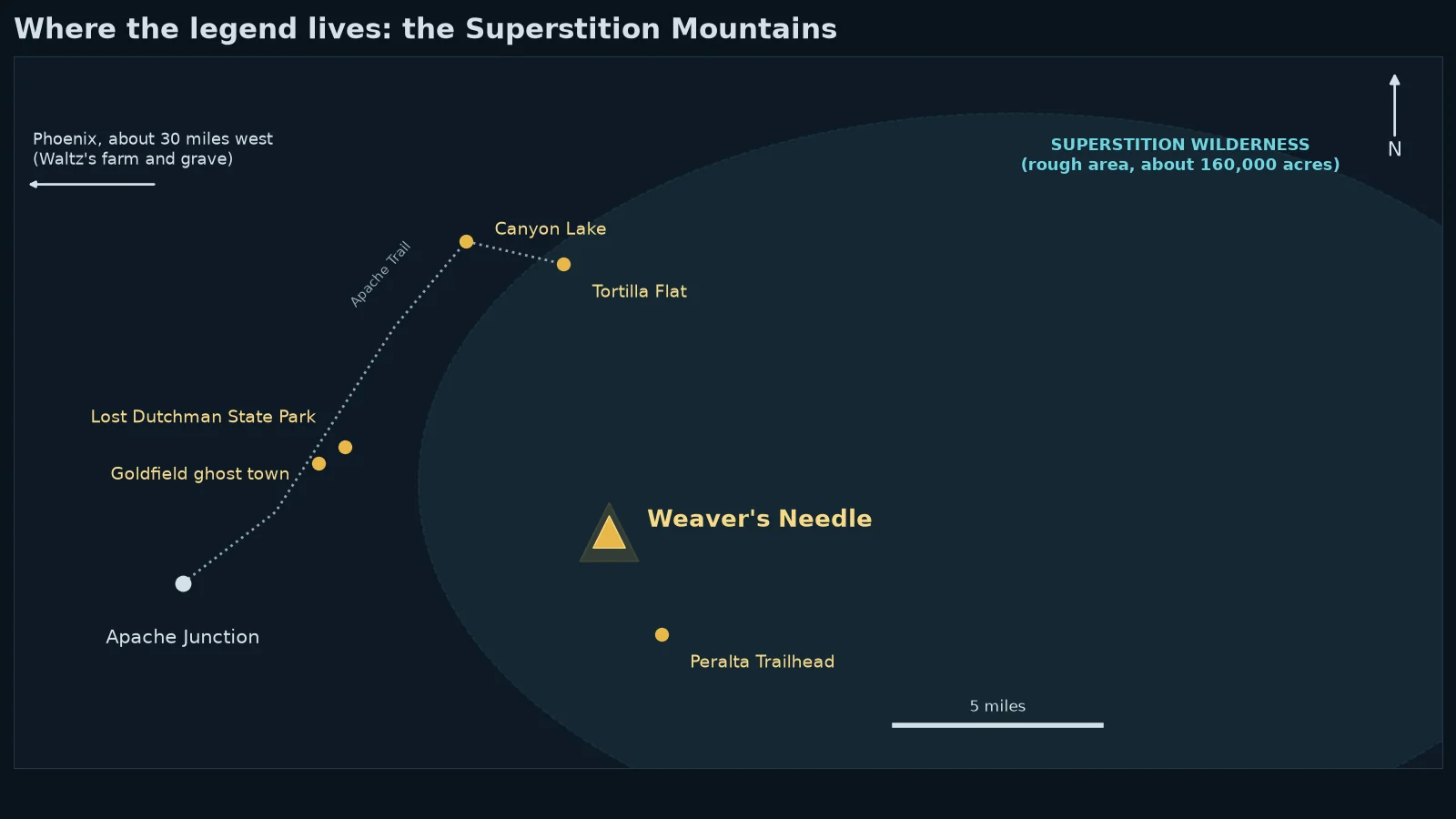
- The mine is in the Superstitions, within sight of Weaver's Needle, a towering volcanic spire that looks like someone dropped a giant's chess piece in the desert.
- Follow the shadow of Weaver's Needle at a certain time of day, and it points the way.
- You can see the military trail from the mine, but you can't see the mine from the trail.
- The entrance has been covered over with rocks and ironwood.
Lovely and atmospheric. Also, almost none of it can be traced back to Waltz in any document. Shadows move with the seasons, trails have changed, and every "clue" has been reinterpreted to point at a different canyon by a different author with a different book to sell. Rather inconvenient, if you're the one doing the walking.
The partner who might not have existed
Many versions of the story give Waltz a partner, Jacob Weiser (or Wiser, or Weisner, depending on who's telling it). In the legend, the two Jacobs work the mine together until Weiser is killed, either by Apaches or, in the darker telling, by Waltz himself.
Historian Robert Blair, who dug through the records in the 1970s, argued that Weiser probably never existed, and that the legend had split one Jacob into two. Skeptics since have called the partner a 20th-century embellishment. A shame, really. He made a cracking villain.
The Peralta legend: Spanish gold and a massacre
Now we go back further, to the most dramatic chapter of the legend. The story goes that a wealthy Mexican family, the Peraltas, worked rich gold mines in the Superstitions in the 1840s. Around 1848, loaded with gold and heading home, they were ambushed by Apaches in a bloody massacre. A spot in the foothills is still called the Massacre Grounds. Later, so the tale continues, Waltz learned the location from a Peralta, or found the abandoned mine himself.
Cracking story. Here's the catch. There was a real Miguel Peralta, and his family did run a profitable mine, earning about $35,000 in under a year. In California, near Valencia. There's no evidence the Peraltas ever mined in the Superstitions. To make it messier, a real Arizona con man, James Reavis, later built an enormous fraud called the "Peralta Grant" on a bogus deed traced back to the Peralta name, claiming millions of acres of Arizona. He was convicted. So the Peralta name was floating around Arizona in a big, crooked way, which is exactly the kind of thing that sticks to a treasure legend like a burr to a sock.
The Peralta Stones: a treasure map carved in rock?
Around 1949 (sources argue for 1949, 1952 and 1956, which tells you plenty), a set of carved stone tablets turned up near Florence Junction, south of the Superstitions. Several accounts credit a man named Travis Tumlinson with the find. The stones carry markings, symbols and what look like trail lines, plus a heart-shaped stone that fits into a hollow in another. They became known as the Peralta Stones, and treasure hunters have been squinting at them ever since, convinced they're a map.

Most researchers think they're fakes. The carving appears to have been done with modern power tools, and the Jesuit historian Father Charles Polzer called them a hoax, pointing out among other things that 19th-century Spaniards wouldn't have used a valentine-style heart. Hoax or not, they've been shown at the Superstition Mountain Museum and at the Arizona Museum of Natural History in Mesa. If you want to see them, call ahead to check where they are now, because they've moved before.
Julia Thomas goes treasure hunting
Back to 1892. Julia Thomas, armed with whatever Waltz told her and a lot of optimism, went looking for the mine with partners. Newspapers reported the search in September 1892. They came back with nothing.
So Julia did what any sharp businesswoman would do with a famous mine she couldn't find: she reportedly sold maps to it, for $7 each. You've got to admire the hustle. It also means that, from almost the very start, the Lost Dutchman was a story people made money from telling, which is worth keeping in mind every time a new "authentic" map turns up.
Adolph Ruth: the case that made it deadly
For decades the legend simmered. Then came the summer of 1931, and the story turned dark for real.
Adolph Ruth was 66 years old and carrying a map. His son, Erwin, had got hold of a Peralta-type map from the Gonzales family around 1912 or 1913, and Adolph was determined to follow it. In June 1931, in the brutal heat of an Arizona summer, he headed into the Superstitions. His last camp was at Willow Springs. He did not come back.
In December 1931, an expedition organised by the Arizona Republic newspaper, helped by a dog named Music, found a human skull in the mountains. It was sent to the Smithsonian, where the anthropologist Aleš Hrdlička identified it as Ruth's. It had two holes in it, and Hrdlička reported a strong possibility of a high-powered gun. In January 1932, the rest of his remains turned up about three-quarters of a mile away, with his pistol and his checkbook. In the checkbook was a note with directions, ending with the Latin line "Veni, vidi, vici": I came, I saw, I conquered.
The map was missing.
The sheriff concluded Ruth had died of thirst, and there was no criminal inquest. Writers have argued ever since that he was murdered for his map. It has never been proven, and to add a twist, one skeptic noticed that Ruth's directions closely copy a newspaper article published in 1895. Whether Ruth found something or simply carried someone else's story into the desert, the case lit a fire under the legend, and it has never really gone out.

Books, Hollywood and the gold rush that never ended
In 1945, a writer calling himself Barry Storm (real name John Griffith Climenson) published Thunder God's Gold, which leaned hard into the Ruth mystery and the "deadly mountain" angle. Storm even claimed a mysterious sniper had taken shots at him. He's the only witness to that, so take it with a generous pinch of desert salt.
Hollywood loved it. In 1949, Columbia Pictures released Lust for Gold, based on Storm's book and partly filmed in the Superstitions, with Glenn Ford as Waltz and Ida Lupino as Julia Thomas. Nothing sells a lost mine quite like a film star squinting into the sun, and the searchers kept coming. One 1977 estimate put the number of people out looking in some way at around 9,000 a year.
The searchers who didn't come home
This is the part of the story that isn't funny, so we'll tell it straight.
Published lists name around 20 deaths and disappearances linked to the legend since Ruth, including Tex Bradford in 1933, James Cravey in 1947, Joseph Kelley in 1952, Charles Massey in 1955, Walter Mowry near Weaver's Needle in 1961, Jay Clapp in 1961 and Walt Gassler in 1984. Some estimates run much higher, up to around 80, but no official count exists, and many of these deaths were from heat and falls rather than anything sinister.
The modern cases are well documented:
- Jesse Capen, a 35-year-old from Denver, went missing in December 2009. His Jeep was found on December 20. In November 2012, Superstition Search and Rescue volunteers found his remains in a crevice about 35 feet up a cliff near Tortilla Mountain, roughly half a mile from his camp.
- Three men from the Salt Lake City area, Curtis Merworth, Ardean Charles and Malcolm Meeks, went missing in July 2010 while searching for the mine. The search was suspended after about a week. Remains were found by hikers in January 2011.
- Another searcher, Khayman Welch, has been missing in the area since August 2020.
The Superstitions are rugged, confusing and, in summer, ferociously hot. Whatever you make of the gold, the danger is entirely real.
So is there gold in the Superstitions at all?
Time to bring in the geologists, who are, frankly, a bit of a buzzkill.
The Superstition Mountains are volcanic. The US Geological Survey describes the main rock, the Superstition Tuff, as ash-flow tuff formed inside an ancient collapsed volcano, the "Superstition cauldron." That's not the classic setting for rich gold veins, and skeptics point out that Waltz's ore was gold in quartz, which doesn't match the scraps of gold found around the range itself.
But, and it's a fair-sized but, there was gold nearby. In 1892, just a year after Waltz died, gold was found at the western foot of the mountains, and the boomtown of Goldfield sprang up. It had a post office by 1893, and the boom was mostly over by 1898. The researcher John Wilburn argued that the Superstitions themselves hold no real gold, and that Waltz's ore may have come from the area of the Bulldog Mine near Goldfield instead. Goldfield is now a ghost town turned tourist attraction, so you can at least stand where real miners really found real gold.
The theories, weighed
- A real, hidden mine deep in the Superstitions. The romantic favourite. The problem: geology isn't keen, and 130 years of searching hasn't turned it up.
- A mine just outside the Superstitions, around Goldfield. Fits the geology better, and Waltz really did have rich ore from somewhere.
- A cache, not a mine. Waltz may have had a stash of ore from somewhere else entirely, and "the mine" grew in the retelling.
- Mostly a story. Real man, real ore, real box under the bed, and everything else added by maps sold for $7, books, films and campfires.
The honest answer? Nobody knows. Which is, admittedly, exactly why it's still fun.
The mountain's own legends
You'll often read that the Apache held the Superstitions sacred as the home of a Thunder God, and that they warned outsiders away. Be a little careful with that one: most of the "Thunder God" retellings come from tourism and treasure-hunting books (Barry Storm's title did a lot of the work), not from tribal sources. Some accounts report Apache beliefs that the entrance to the lower world lies in these mountains, and the Akimel O'odham (Pima) have their own flood story tied to the range. These are living cultures, not spooky set dressing, so they're worth hearing on their own terms.
Visiting the Lost Dutchman country today
Fancy a look for yourself? Brilliant. Here's how to do it properly.
- Superstition Wilderness. Most of the range sits inside the Superstition Wilderness in Tonto National Forest, about 160,000 acres. The Forest Service says it was designated in 1939 and expanded to its present size in 1984. New mining claims can no longer be filed there, metal detecting isn't allowed in wilderness areas, and digging or treasure hunting needs permits from the Forest Service. In plain English: hike, look, wonder, but don't bring a shovel.
- Lost Dutchman State Park sits at the foot of the mountain near Apache Junction, with trails, camping and a superb view of the west face. It became a state park in 1977.
- Superstition Mountain – Lost Dutchman Museum has a Jacob Waltz exhibit and a 20-stamp ore mill, plus, for reasons best explained by a visit, the Elvis Chapel.
- Goldfield Ghost Town on the Apache Trail, for the real boomtown history.
- Lost Dutchman Days, held in Apache Junction since 1965, now a big rodeo and festival every winter.
- Waltz's grave is in Pioneer and Military Memorial Park in Phoenix.
And please: go in the cooler months, carry far more water than seems sensible, tell someone where you're going and when you'll be back, and turn around early. The mountain has had quite enough visitors who stayed.
The gold may be lost. The story isn't, and the hunt for the truth goes on, one canyon, one book and one sunburnt treasure hunter at a time.
...and if you find it, remember who encouraged your questionable life choices.
The short version of this story is on YouTube at @TenToeExpress.
Deep dive yourself
- Wilderness (Superstition Wilderness) · USDA Forest Service, Tonto National Forest
- Geology: mining claims, prospecting and metal detecting rules · USDA Forest Service, Tonto National Forest
- Lost Dutchman State Park: Park History · Arizona State Parks
- Dead Man's Tale, by John Annerino (April 2007) · Arizona Highways
- The Lost Dutchman Gold Mine, by Brian Dunning · Skeptoid
- Superstition Tuff · US Geological Survey, National Geologic Map Database
- Remains found near Arizona spot where Colorado man disappeared (2012) · CBS Colorado
- Third body found in Arizona (2011) · Deseret News
- Superstition Mountain – Lost Dutchman Museum · Smithsonian Magazine
- Lost Dutchman's Gold Mine and Peralta Stones · Wikipedia (good starting points, with references to Blair, Gentry and other historians)
- Phoenix flood of 1891 · Wikipedia