 Ten Toe Express
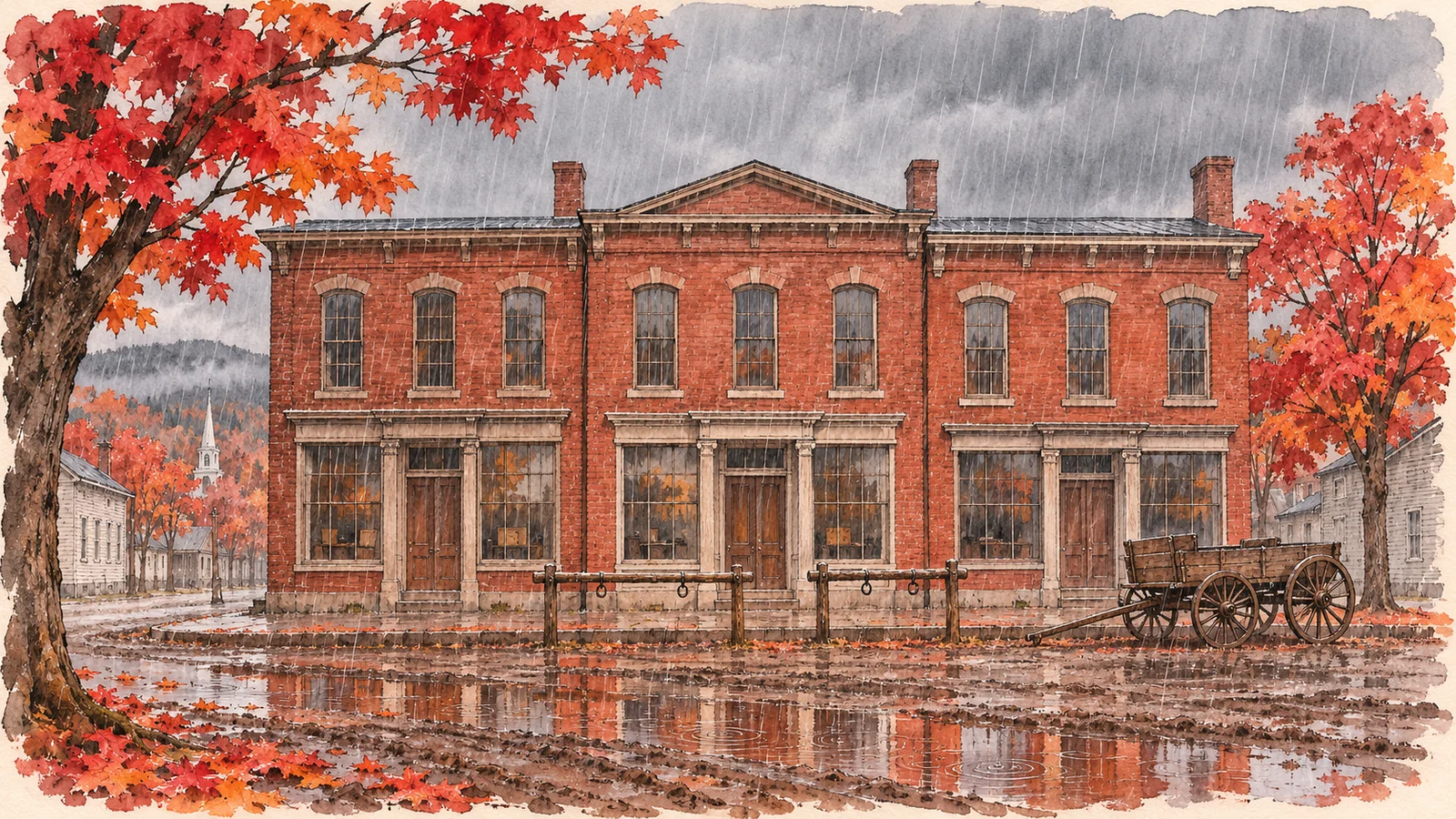
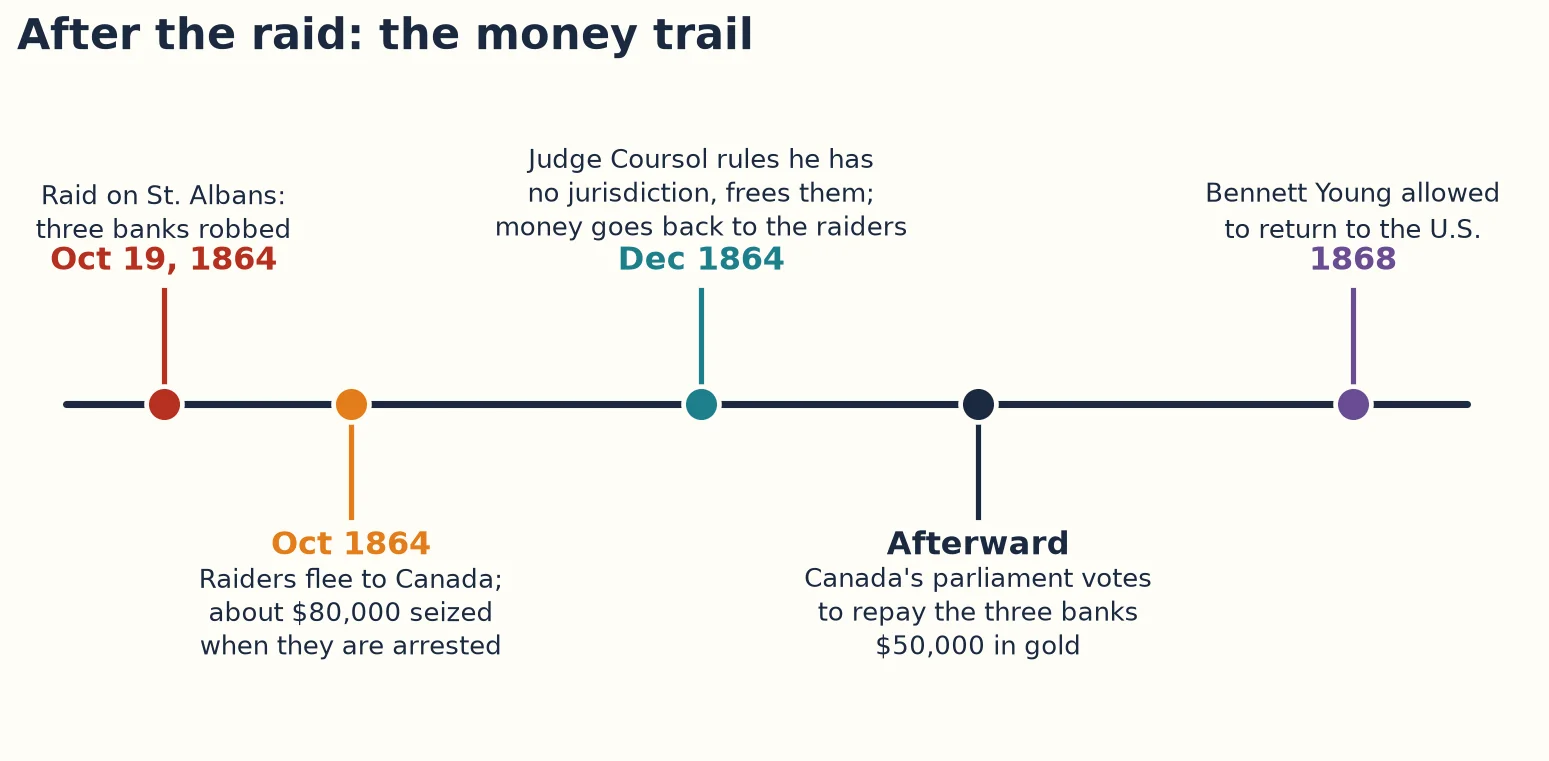
Wednesday, October 19, 1864. A sleepy Vermont town is having a perfectly dull afternoon, which is exactly why a young Confederate lieutenant picked it. By nightfall, the St. Albans Raid will have emptied three banks of roughly $208,000, killed one civilian, tried and failed to burn a town down in the rain, and sent twenty-odd riders galloping over the Canadian border with a posse behind them.
Here's the part that makes it a proper mystery. The money didn't stay in Canada's custody, and it didn't all come home. Of that $208,000, only about $88,000 ever found its way back to Vermont, and even that came as a repayment from the Canadian government rather than a recovery. The rest, something like $120,000 in 1864 dollars, simply vanished into the war. Fancy following the trail?
The St. Albans Raid: how a quiet Vermont town got robbed
By late 1864 the Confederacy was running short of nearly everything, money included. Bennett H. Young, a Kentuckian who had joined the 8th Kentucky Cavalry at seventeen and fled to Canada in the fall of 1863, had a bold idea: strike Union towns from the north, raise cash for the Confederate treasury, and make Washington worry about its own border. He held a Confederate commission, which turns out to matter enormously later.
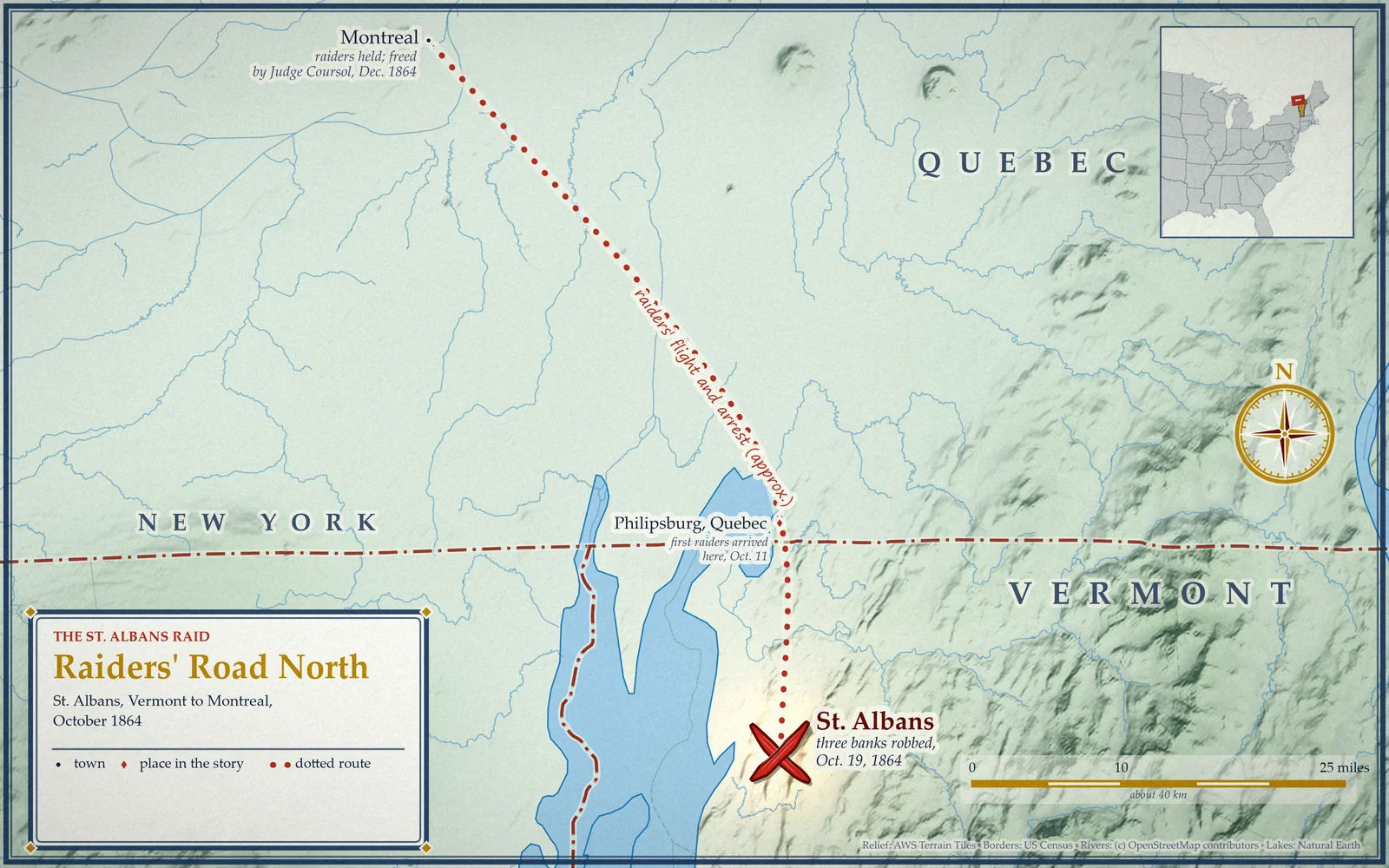
Young recruited escaped Confederates living in Canada. In the days before the raid, small groups drifted into St. Albans, a town of brick banks and a tidy green, a long way from any front line. The first raiders reached Philipsburg, on the Canadian side, on October 11, and Young looked over the town's banks the next day. The plan was set for October 18, then pushed back a day, because Wednesday looked like the dullest day of the week.
The afternoon of October 19, 1864
About 21 raiders spread through town. Some herded as many residents as they could onto the green and held them there at gunpoint, while others grabbed horses. The rest worked through three banks: the First National, the St. Albans Bank and the Franklin County Bank. At the St. Albans Bank they took cash from the counter and from customers in the middle of making deposits, yet left uncut banknotes and coins behind. One published account says they also missed $9,000 in gold certificates.
Not everyone stood still for it. A civilian named Elinus J. Morrison was shot and died two days later. Another civilian, Collins H. Huntington, was wounded. One raider, Charles Higby, was hurt too but got away with the rest.
Then came the worst part of the plan. Young ordered the town set on fire with Greek fire, an oil-based incendiary. It had rained, the buildings were soaked, and the stuff refused to catch. Only a shed burned. A raid meant to strike terror ended with a Vermont town sitting there, wet and furious, with its banks stripped.
Across the border with the cash
The raiders rode for Canada with a posse of about 50 Vermonters behind them. The Vermonters didn't catch them. Canadian authorities arrested the raiders themselves and kept the pursuers out, and British troops were sent to the border in case Americans decided to settle things the hard way. Canadian police took about $80,000 from the captured men (Wikipedia and one other source say $88,000; the exact figure shifts from account to account).
So the raiders were in a Montreal jail with a chunk of the loot sitting in a vault. At this point you'd expect the story to end. It doesn't.
Judge Coursol and the money that went back
Washington demanded extradition under the Webster-Ashburton Treaty. The raiders didn't deny the raid. Their defense was that they were soldiers carrying out orders, not common thieves, and the central question was whether Canada, officially neutral, could hand over men acting under military orders. In Montreal, Judge Charles Coursol ruled in December 1864 that his court had no jurisdiction, freed the prisoners, and ordered the money seized from them returned to them. Canada never sent them back.
Cash back in raiders' pockets did not go down well. Canada's Provincial Parliament passed a bill to repay the three banks $50,000 in Canadian gold, which one account equates to about $88,000 in US money, split among the banks in proportion to their losses. That's the only piece of this story documented in gold.
The banks were still out about $120,000 and had spent roughly another $20,000 chasing the extradition. If this were a poker hand, Vermont folded very expensively.
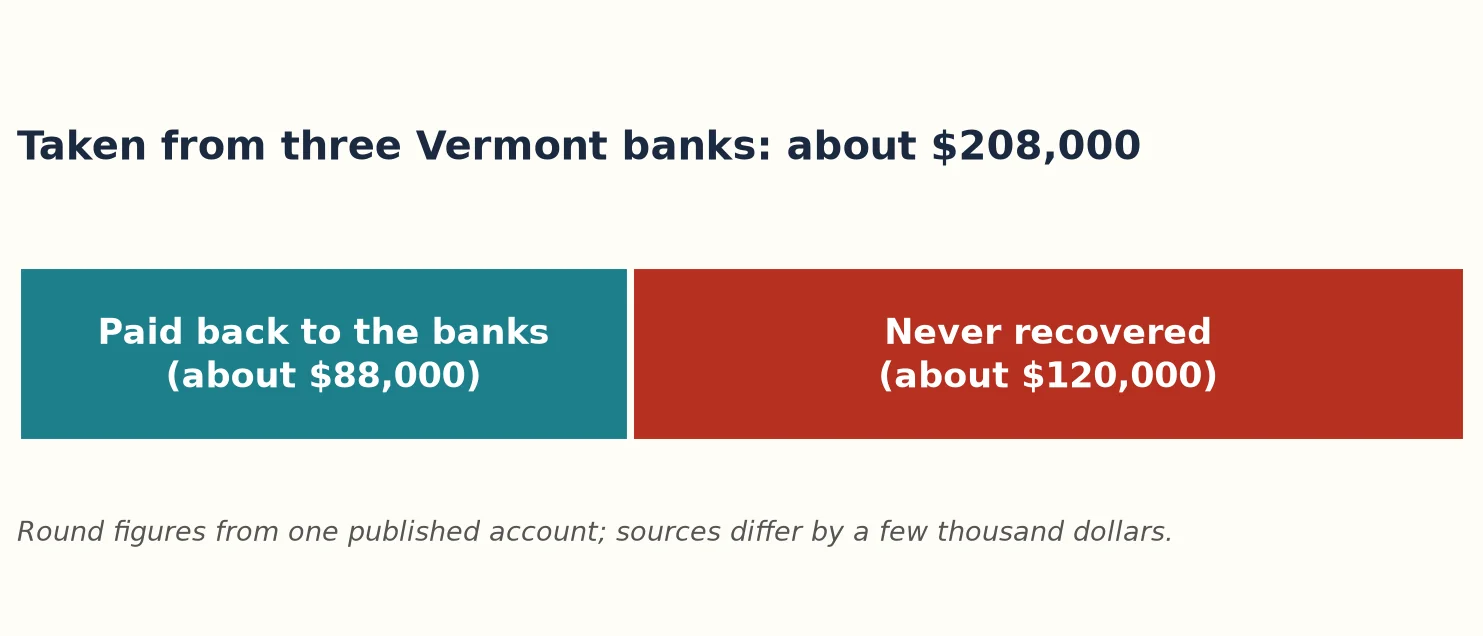
Where did the other $120,000 go?
This is where the record gets thin, and where the legend (such as it is) lives. The documented facts: the raiders were Confederate soldiers, they were operating from Canada, and a great deal of cash went north with them. What isn't documented is where most of it ended up.
Bennett Young later claimed the full $208,000 was delivered to Confederate commissioners in St. Catharines, Ontario. The American Heritage account calls that claim questionable. The same account says a good deal of the money was probably spent in Canada. Neither version has ledgers behind it that anyone has found.
Put plainly, the options look like this:
- It reached the Confederate cause. That's Young's account. It would make the raid a (mostly) successful fundraiser. Nothing independent confirms the delivery.
- It was spent in Canada. Raiders and their sympathizers lived there, the war had months to run and expenses were real. The money simply dissolved into everyday costs.
- It was buried somewhere in northern Vermont or southern Quebec. You'll hear this kind of thing from treasure forums, but none of the sources used here document a cache, a map or a confession. Treat it as a fun idea, not a lead.
One more wrinkle: the loot was cash, notes and bonds, not a wagon of gold bars. Bank notes from 1864 don't age like coins; if someone had buried them, they'd be mush by now. That's a decent reason to doubt the buried-treasure version of the story.
What happened to Bennett Young
Washington considered Young a criminal. President Andrew Johnson's postwar amnesty didn't include him, so he couldn't come home until 1868. In the meantime he studied law and literature in Ireland and Edinburgh. Back in the United States he practiced law in Louisville, Kentucky, wrote, worked in railroading and philanthropy, and founded an orphanage. He helped create the Louisville Free Public Library, was elected commander-in-chief of the United Confederate Veterans in 1913, and died on February 23, 1919.
Not bad for the man whose Greek fire couldn't light a wet shed.
Where it stands today
The St. Albans Raid is often called the northernmost land action of the Civil War, and it remains one of the stranger border incidents between the United States and Canada. Nobody is digging for St. Albans gold. Digging up private land or anywhere else without permission isn't a treasure hunt, it's trespassing. What survives is an argument about money: how much was taken, how much returned, who paid, and what became of the rest. The numbers differ between sources, and the missing $120,000 still has no confirmed destination.
The clearest part of the record is the least dramatic. A town was robbed on a quiet Wednesday, the thieves walked free, the money came back to Vermont in Canadian gold, and about $120,000 went somewhere nobody can show on paper.
...and if you find it, remember who encouraged your questionable life choices.
The short version of this story is on YouTube at @TenToeExpress.
Deep dive yourself
- St. Albans Raid · Wikipedia
- Bennett H. Young · Wikipedia
- The Hit-and-Run Raid · American Heritage
- The St. Albans Raid: The Confederate 'Invasion' of Vermont · Military History Now
- The St. Albans Raid: Civil War Tensions on the Canadian Border · Heartfelt History