 Ten Toe Express
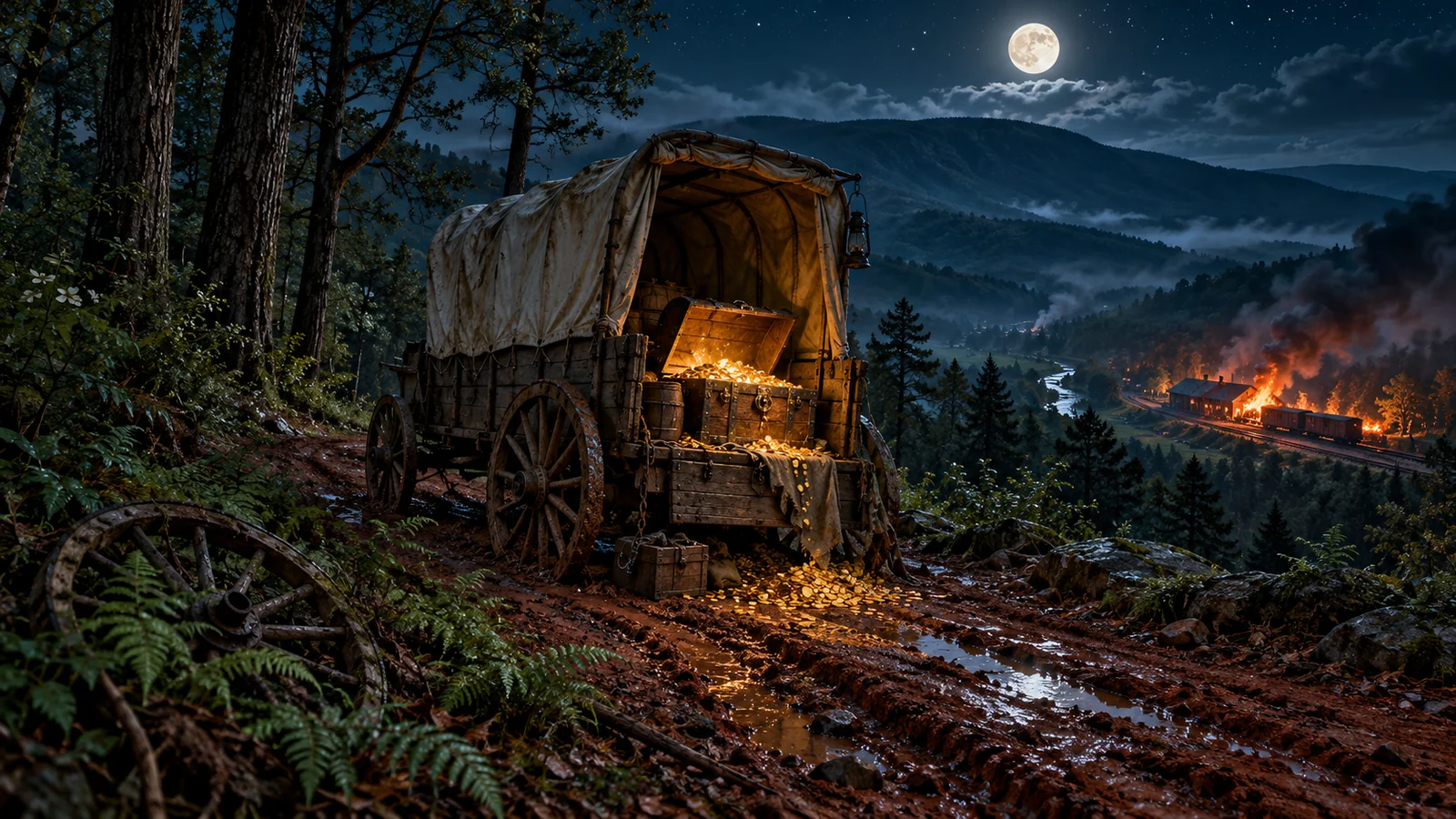
Spring, 1865. The war is coming apart at the seams, and in the hills of northeast Alabama, at the very end of a railroad line, sits a Confederate depot called Blue Mountain. Union cavalry are on the roads. Selma has already fallen. And somewhere in all that chaos, so the story goes, a wagon loaded with gold rolls off into the Blue Mountain hills and is never seen again.
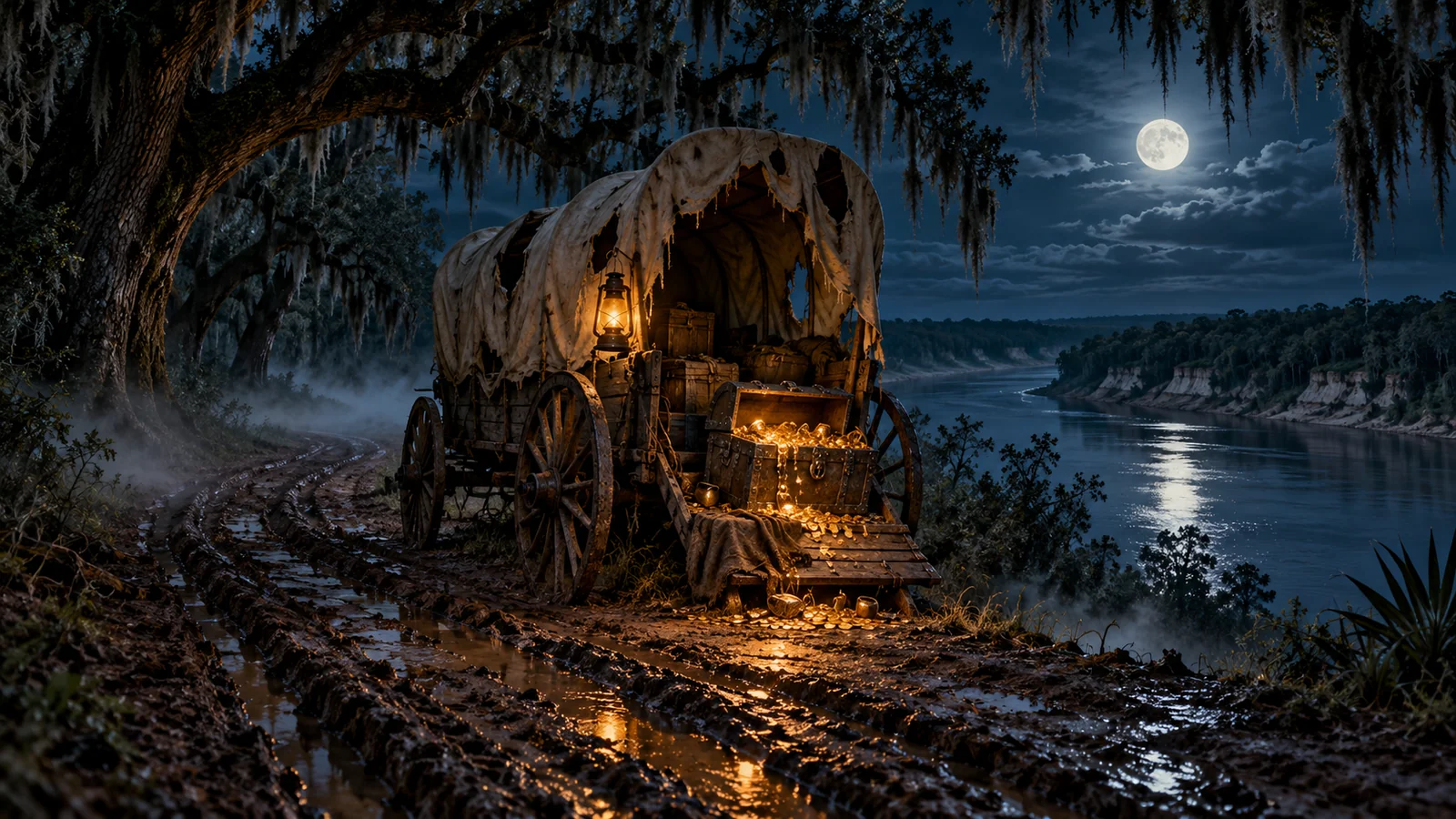
That is the legend of the Confederate gold of Blue Mountain, Alabama, and it has everything a good treasure tale needs: a war, a wagon, a mountain and a fortune nobody can account for. As the Ten Toe Express channel put it, Alabama didn't just misplace a wallet. It lost a whole wagon of gold.
Here's the slightly awkward news before anyone starts packing a shovel. The gold is the one part of this story with no paperwork at all. Almost everything around it, though, is real: the depot, the army camp, the railroad, the iron furnaces and the very bad week in April 1865 when Union raiders set the place on fire. So right then, let's sort the solid ground from the quicksand.
Where is Blue Mountain, Alabama?
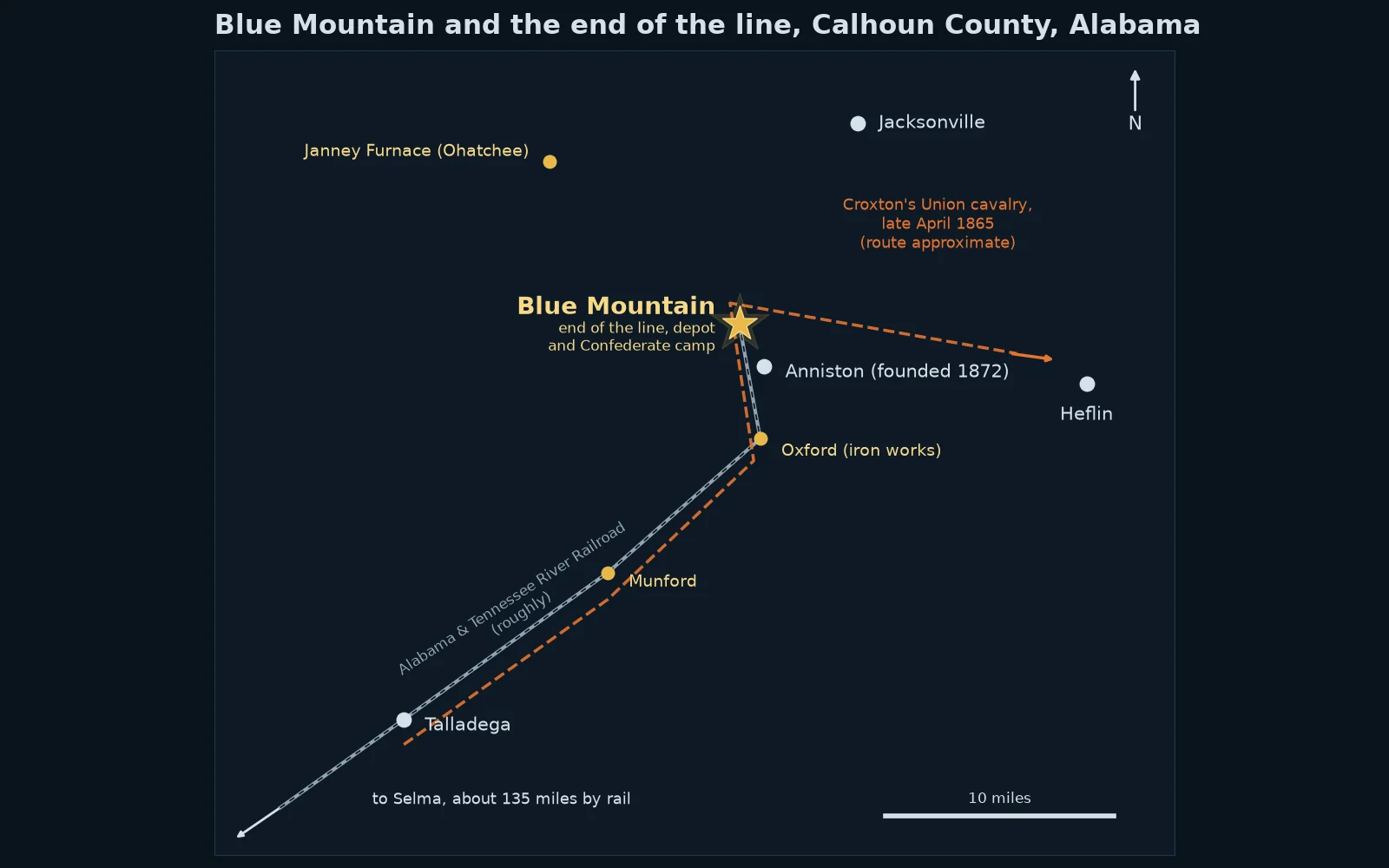
Blue Mountain sits on the northern edge of Anniston, about two miles from the middle of town, where the long, wooded ridges of the southern Appalachians run out into northeast Alabama. Anniston itself grew up on the slope of a ridge of the same name. Today Blue Mountain is mostly a quiet old mill neighborhood, and it hardly looks like the scene of anything dramatic. That is how the best treasure stories like to start.
In the 1860s there was no Anniston at all. There was a railroad, a scattering of houses, and a name on the timetable that mattered a great deal: Blue Mountain was the end of the line.
The end of the line from Selma
The railroad was the Alabama and Tennessee River Railroad, which ran north and east from Selma for 135 miles and stopped at Blue Mountain. (It was later reorganized as the Selma, Rome and Dalton.) For the whole war, Blue Mountain was the terminus, which made it the place where everything coming up from Selma stopped and everything heading down to Selma began.
And Selma, by the middle of the war, was a very big deal. Its Ordnance and Naval Foundry was the second-largest arms works in the Confederacy after Richmond's Tredegar Iron Works. It cast cannon, built four ironclad warships and, at its peak, ran more than 100 buildings with up to 10,000 workers. All of that needed iron, and the hills around Blue Mountain had iron ore.
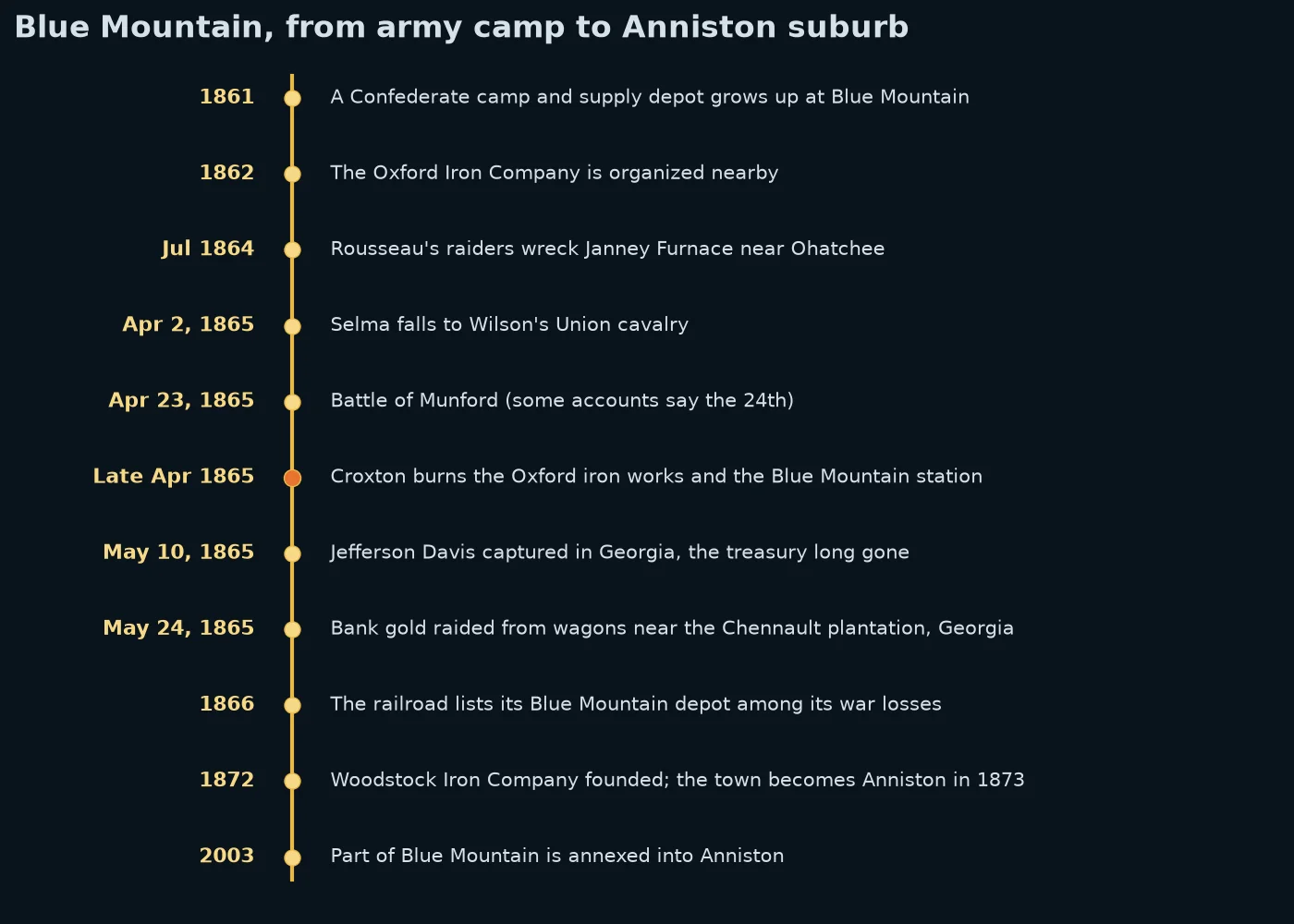
Local histories say the Confederate government operated both the railroad and the Oxford furnace nearby, shipping its pig iron down the line to Selma for the war effort. The Oxford Iron Company was organized in November 1862. A few miles northwest, near Ohatchee, a second furnace called Janney Furnace went up in 1863, built largely by enslaved laborers, to feed the same hungry foundries.
A Confederate camp on the mountain
Blue Mountain wasn't just a railroad stop. According to local historian Mac Gillam, as quoted by Alabama Pioneers, a Confederate camp grew up there from the spring of 1861, stretching from the railroad tracks up the slopes of the mountain. It had a hospital, a prison and grounds for organizing new regiments. A local preservation group claims thousands of Confederate soldiers trained there; no official count has turned up, so treat the number as their estimate rather than gospel.
By the last winter of the war, Blue Mountain was also a headquarters. Confederate General Benjamin J. Hill reported in 1865 that he had kept his headquarters at Blue Mountain and Jacksonville for three months while raising new regiments in the area. So you have soldiers, supplies, a hospital, iron, a rail depot and a general's office, all clustered at the foot of a mountain. If a wagon of anything valuable was going to roll through north Alabama in 1865, Blue Mountain is a perfectly sensible place to put it.
Which is, rather annoyingly, also exactly why someone might have made it up.
The legend of the lost gold wagon
Here is the legend in full, as it has come down: in the final days of the Confederacy, a wagon carrying gold went into the hills around Blue Mountain and the gold was lost. Hidden from the Yankees, buried in a hurry, tipped into a ravine, or simply never accounted for, depending on who is telling it at the time.
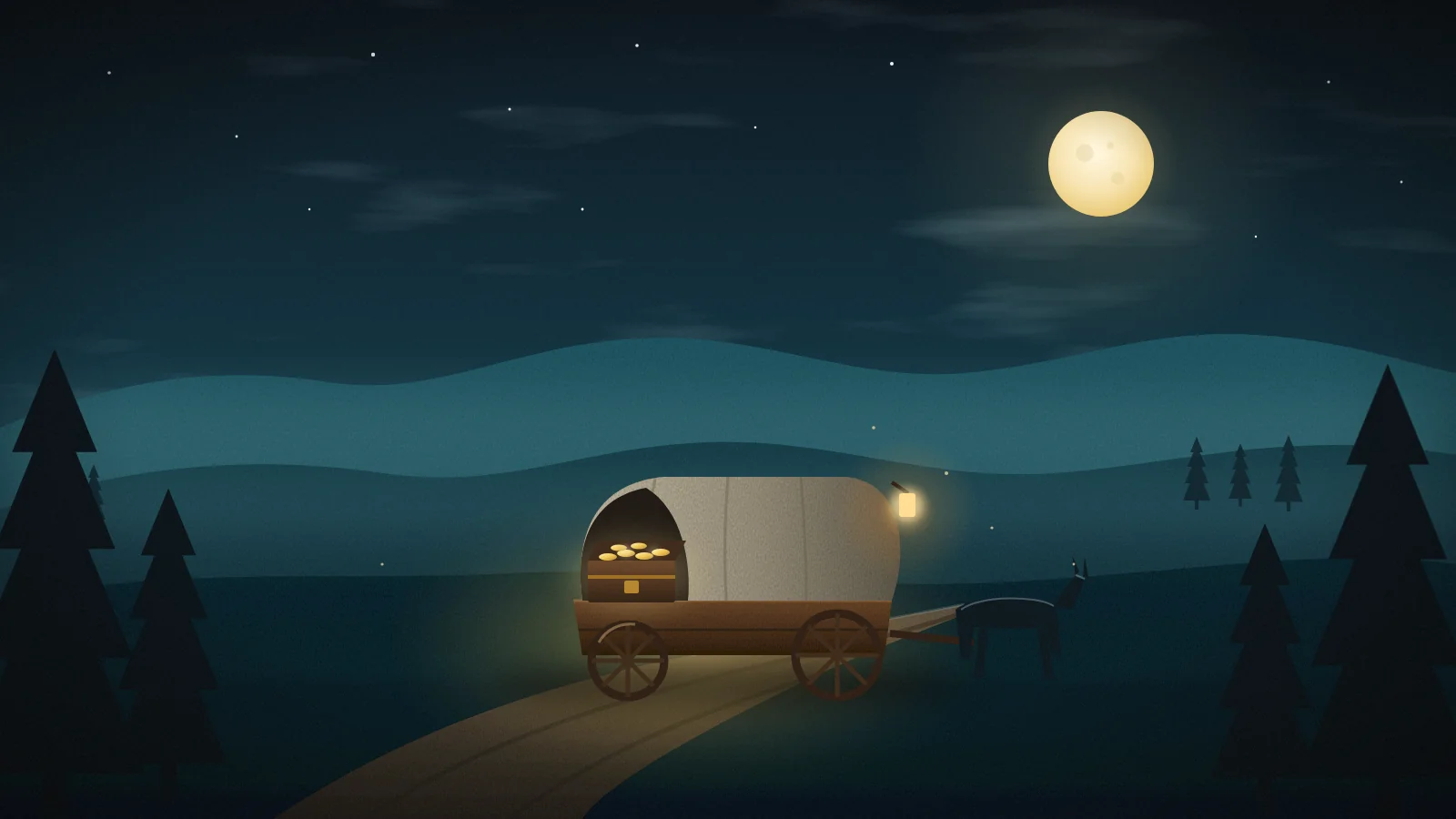
And that, honestly, is about all anyone agrees on. Unlike Alabama's better-documented treasure tales, the Blue Mountain story doesn't come with a named driver, a sum of money, a date, a creek crossing or a dying man's directions. There is no 1890s newspaper article to quote, no "authentic" map for sale and no deathbed confession. It is a legend in its purest, most frustrating form: a wagon, some gold and a mountain. The details are left as an exercise for the reader.
That vagueness is worth noticing. Lost Confederate wagons are something of a genre in the South. Up near Athens, in Limestone County, a much more detailed Alabama legend tells of crates of Confederate gold and silver sunk in a bog when a wagon got stuck as Union troops closed in. Treasure stories like these tend to travel from town to town, picking up local scenery as they go. That doesn't mean the Blue Mountain wagon is fiction. It does mean it needs evidence, and so far it hasn't got any.
April 1865: the raid that burned Blue Mountain
What does have evidence is the moment the legend would most likely belong to, and it is a proper drama.
The Union had already come close once. In July 1864, raiders under General Lovell Rousseau swept through Alabama, and a detail of his men wrecked the brand-new Janney Furnace near Ohatchee on July 14. It probably never made a single bar of iron. One local history also says the town of Blue Mountain was burned in 1864, though the railroad's own records and the Union accounts put the burning of its depot in the spring of 1865. The sources don't line up neatly on that one.
Then came the big one. In March 1865, Union General James H. Wilson led about 13,500 cavalry into Alabama. On April 2 they took Selma, smashing the arsenal, the foundries and the ironworks that Blue Mountain's iron had been feeding. The railroad's president later reported that Union forces also tore up the line between Talladega and Blue Mountain.
Meanwhile, one of Wilson's brigades had gone off on its own. General John T. Croxton and about 1,500 men had been sent west to Tuscaloosa, where they burned most of the University of Alabama on April 4. Cut off from the main army, Croxton's "lost brigade" then rode east across the state, wrecking iron works, rail stations and mills as they went. One account of the raid says Croxton heard early on of a Confederate supply depot at Blue Mountain, stocked with goods just evacuated from Selma.
Late in April, Croxton's men reached Calhoun County. Near Munford, they ran into a few hundred Confederates under General Hill, many of them convalescents and home guards, and scattered them. The fight is usually dated April 23, 1865, though some accounts give the 24th. A young Confederate officer, Lieutenant Andrew Jackson Buttram, was killed there, and he is often called the last Confederate soldier killed in battle east of the Mississippi. It is a sad footnote: the war was all but over, and nobody in that field could have known how close to the end they were.
Then the fires. The Oxford furnace was burned by Federal troops on April 23, according to the historic marker in Oxford. And on or about April 24, by the most detailed modern accounts, Croxton's men burned the railroad boxcars and the station at Blue Mountain before riding on east toward present-day Heflin and Georgia. The railroad's 1866 report to its stockholders lists the depot buildings, platforms and offices at Blue Mountain among its war losses, along with seven locomotives across the line.
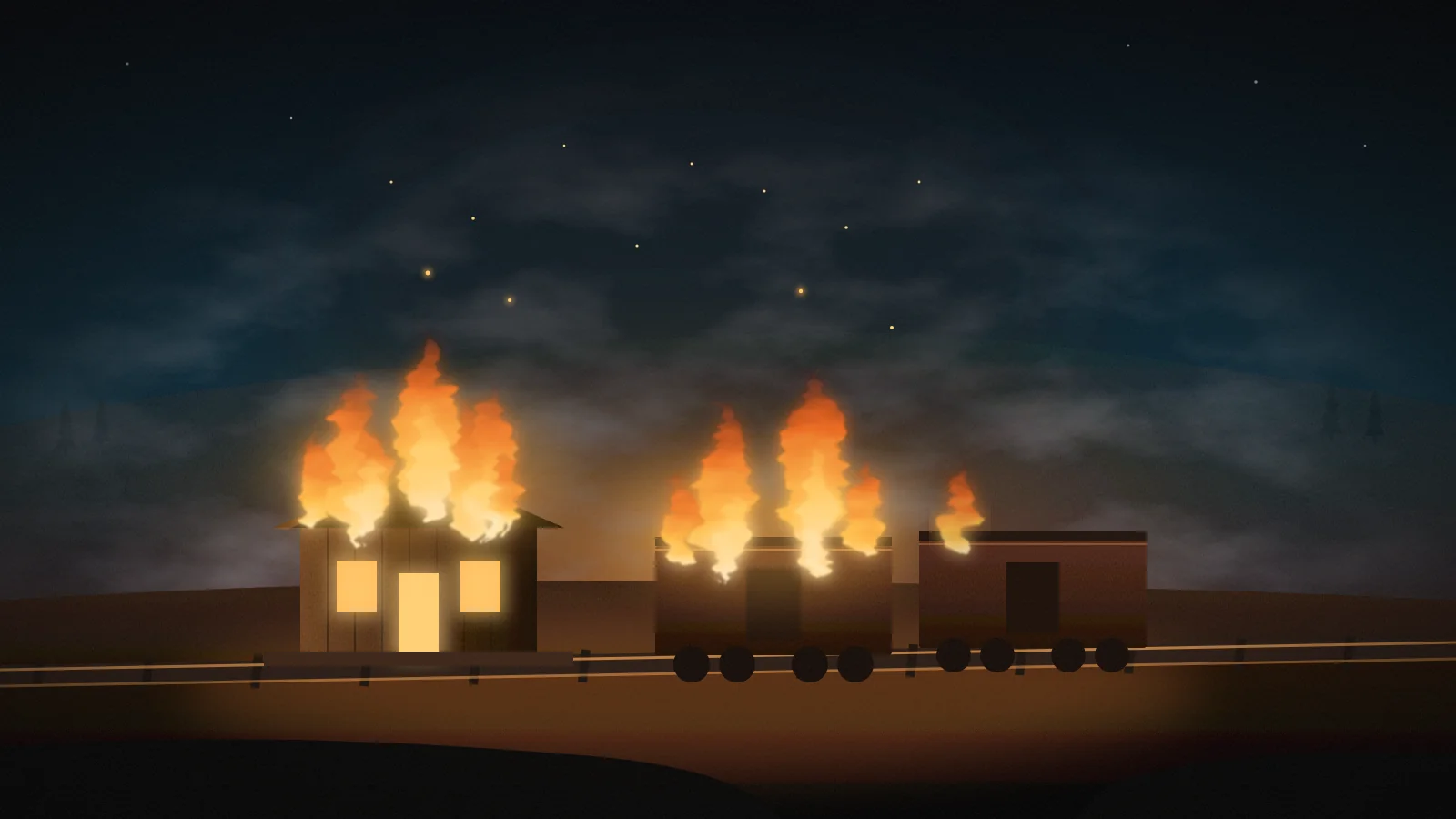
Croxton rejoined Wilson at Macon, Georgia, at the end of April or the first day of May. By then Lee and Johnston had both surrendered, and Blue Mountain was a burned-out depot at the end of a broken railroad.
Now, put yourself in the shoes of a storyteller in, say, 1890. You have a camp, a general's headquarters, a depot that may have held supplies rushed up from Selma, a Union raid, fires, panic and a lot of things that went missing in the confusion. You don't need much imagination to add a wagon of gold to that scene. The question is whether anyone needed imagination at all.
What about the lost Confederate treasury?
Every Confederate gold legend in the South eventually gets tied to the big one: the Confederate treasury that left Richmond with Jefferson Davis in April 1865. It's worth a quick look, if only to see why it almost certainly isn't sitting under Blue Mountain.
The treasury train left Danville, Virginia, on April 6, 1865, with roughly $327,000 in gold and silver coin and bullion, along with about $450,000 belonging to Richmond banks. It went south through the Carolinas into Georgia, paying out money to soldiers and officials as it went. When Davis was captured near Irwinville, Georgia, on May 10, the government's money was essentially gone. The bank money left behind in Washington, Georgia, was raided from wagons near the Chennault plantation on May 24, and much of it was never recovered.
None of that route comes anywhere near northeast Alabama. If there was gold at Blue Mountain, it was something more local: army pay, funds moved out of Selma ahead of Wilson, a merchant's savings or a family's silver. All of which are perfectly plausible. None of which has a paper trail.
The theories, weighed
- A real wagon, really lost. The romantic favourite. Blue Mountain was a supply hub, a headquarters and a target in April 1865, and moving valuables away from Union raiders is exactly what people did. The problem: not a single record, letter or newspaper report of the time has surfaced to say it happened.
- Selma's goods, misremembered. If supplies really were rushed up the line from Selma before Wilson arrived, a depot full of army stores could easily turn into "a wagon of gold" after a few decades of retelling. Gunpowder and bacon don't make good legends. Gold does.
- A small, private cache. Families all over the South hid money and silver from raiders, and some of it really was lost when the people who hid it died. A real local loss like that could have grown into "Confederate gold" over the years.
- A borrowed story. The lost Confederate gold wagon turns up in so many Southern towns that some versions are almost certainly copies. Blue Mountain had the perfect setting, so the story may simply have moved in.
The honest answer? Nobody knows, and without a scrap of documentation it's anyone's guess. Which, admittedly, is exactly what keeps the campfire going.
From war depot to Anniston
After the war, the burned-out end of the line didn't stay empty for long. In 1872, the Noble family of Rome, Georgia, and former Union general Daniel Tyler formed the Woodstock Iron Company and built a furnace in the valley. The town that grew around it was renamed Anniston in 1873, after Annie Tyler, the general's daughter-in-law. So the iron that once went to Confederate cannon ended up founding a city partly backed by a Union general. History does enjoy a little irony.
Blue Mountain itself became a cotton mill and iron mining community and later its own small town. When the textile mills faded, so did Blue Mountain. In 2003, part of it was annexed into Anniston and the rest went back to being unincorporated Calhoun County land.
Visiting the Blue Mountain area today
Fancy a look? Brilliant. Just leave the shovel in the shed.
- Blue Mountain itself is a mix of Anniston city neighborhoods and private property in unincorporated Calhoun County. There is no public treasure-hunting ground here, and digging or metal detecting on someone's land without their permission is trespassing, plain and simple.
- Janney Furnace Park near Ohatchee, run by Calhoun County Parks and Recreation, keeps the impressive stone stack of the furnace Rousseau's men wrecked in 1864, along with a Confederate museum, a Native American museum and the county's Confederate memorial.
- Munford, south of Anniston, has a memorial to Lieutenant Andrew Jackson Buttram near the site of the April 1865 battle.
- Oxford has a historic marker telling the story of its Civil War iron works and the furnace burned in April 1865.
- The Chief Ladiga Trail, a long rail trail, starts in Anniston and runs east toward Georgia, roughly in the direction Croxton's raiders rode out.
Historic sites are for looking, not digging, and Civil War ground anywhere deserves a bit of respect. If you want to hunt the Blue Mountain gold, the best tools are a library card and a lot of patience: old Calhoun County newspapers, family papers and the official records of the war are where a real lead would turn up, if one exists.
The wagon may be lost. The story isn't, and until someone finds a letter, a ledger or a muddy strongbox, the Blue Mountain hills are keeping their secret.
...and if you find it, remember who encouraged your questionable life choices.
The short version of this story is on YouTube at @TenToeExpress.
Deep dive yourself
- Blue Mountain in Calhoun County, Alabama was once a supply and training center for Confederate soldiers · Alabama Pioneers
- Report of the Alabama and Tennessee River Railroad Company, April 1866 · CSA Railroads (transcription)
- Croxton's Raid · Encyclopedia of Alabama
- Battle of Selma · Encyclopedia of Alabama
- Janney Furnace · Encyclopedia of Alabama
- Anniston · Encyclopedia of Alabama
- Battle of Munford · Wikipedia (a good starting point, with General Hill's report cited)
- Confederate Gold · New Georgia Encyclopedia
- Chasing the Myth of Confederate Gold, by Sarah Pruitt · History.com
- Alabama Treasure Legends · Digital Alabama