 Ten Toe Express
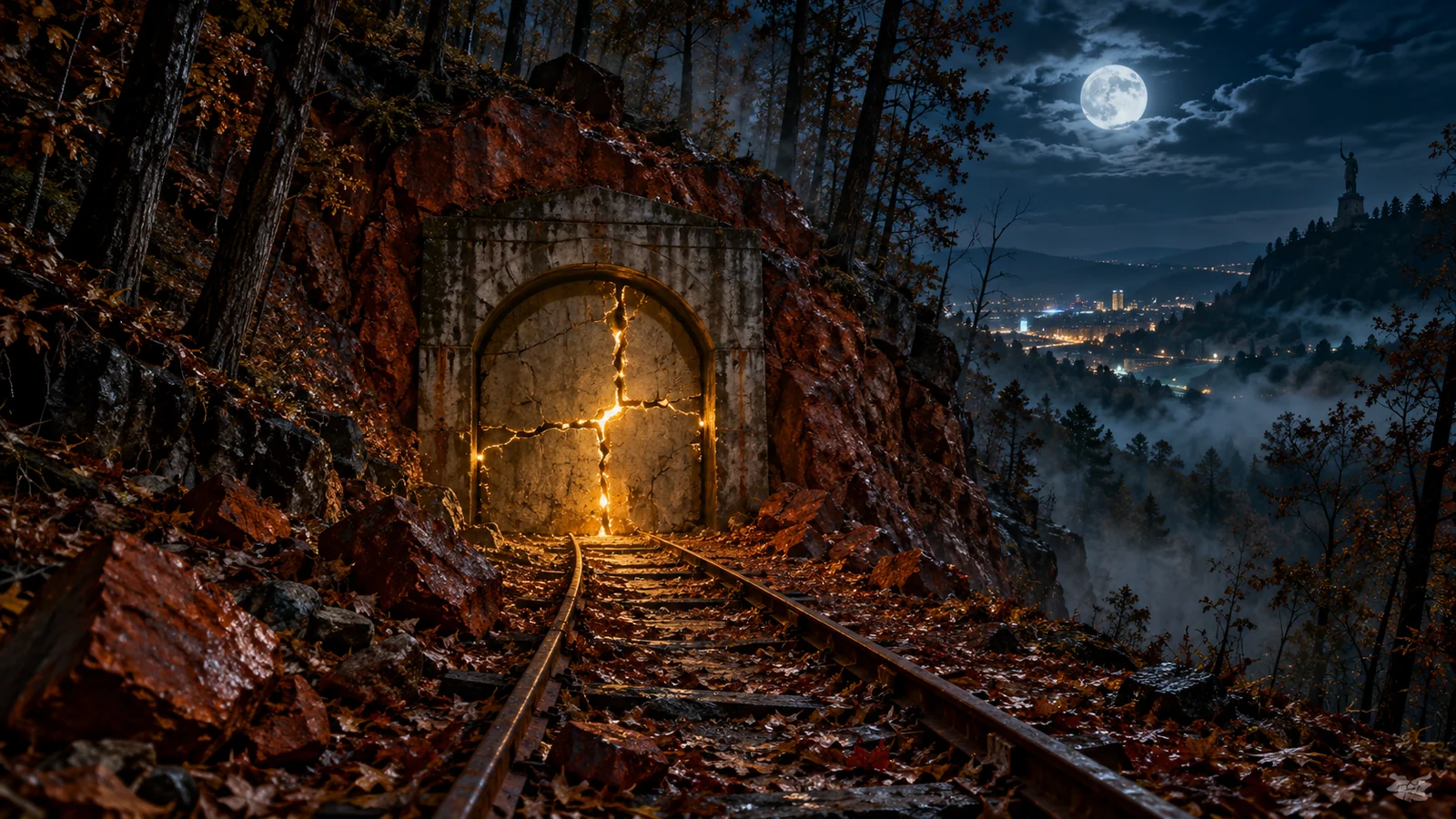
Picture a hillside above Birmingham, Alabama, after the last shift has gone home for good. Rusty rails disappear into a black hole in the rock. Somebody pours concrete over the mouth of the mine, the trees creep back in, and the mountain goes quiet. And somewhere down there, so the story goes, sits a stash of gold ore that a few miners smuggled out of somewhere they shouldn't have, and sealed inside the shaft for safe keeping.
That's the legend of the Red Mountain Mine gold cache, and it comes with one rather large problem. Red Mountain is famous for ore, all right. Iron ore, dug out for the best part of a century. It built the city of Birmingham, it fed the blast furnaces of the "Magic City," and it is about as far from a gold mine as Alabama gets.
So is there gold sealed under Birmingham's most famous ridge, or is this a treasure story that wandered into the wrong mountain? Right then. Hard hat on, lamp lit, and mind your head.
Red Mountain: the ridge that built Birmingham
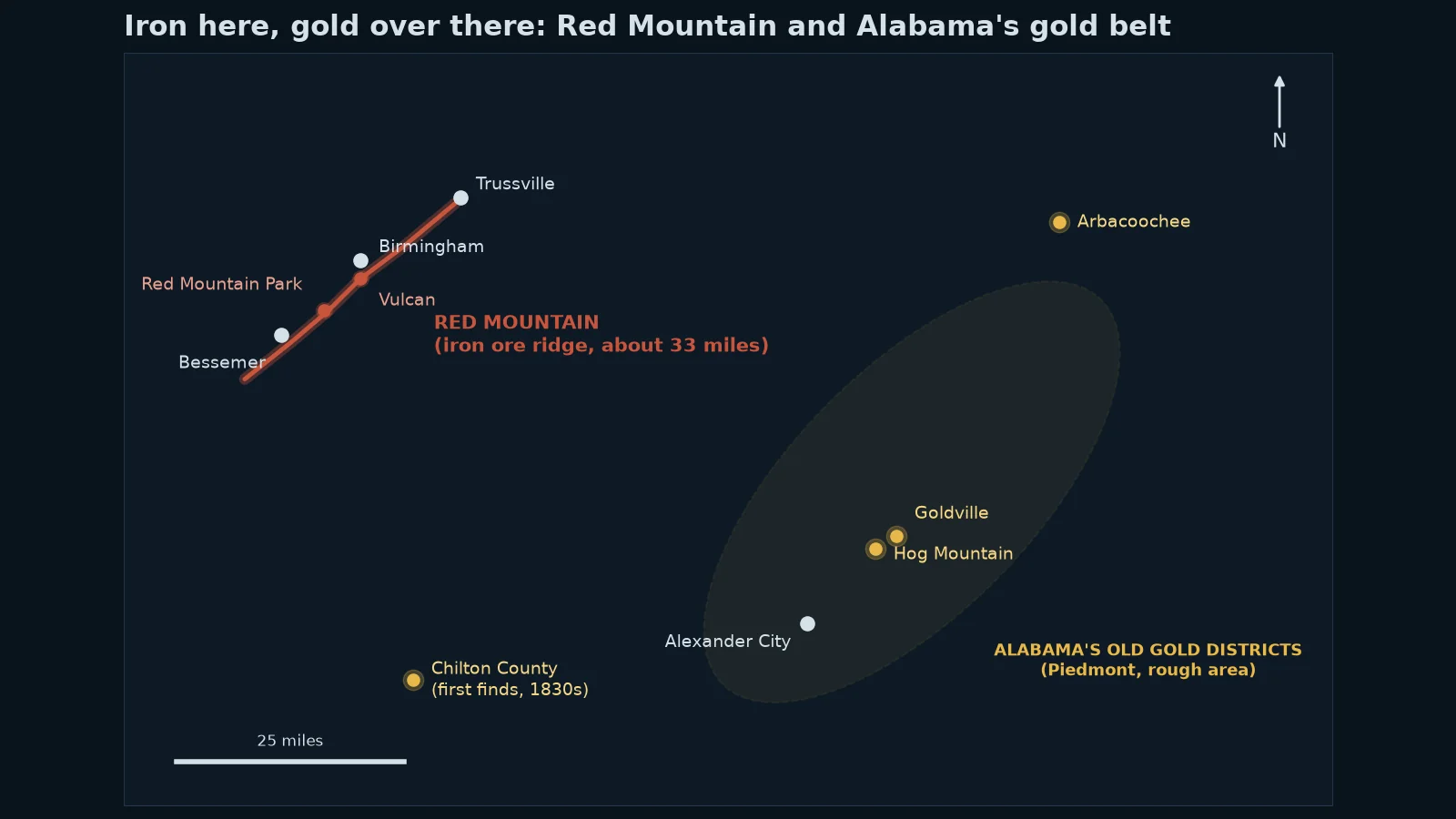
Start with the mountain, because the mountain is very real. Red Mountain is a long ridge running southwest to northeast across Jefferson County, splitting Jones Valley, where downtown Birmingham sits, from Shades Valley to the south. It stretches about 33 miles, from Sparks Gap in the southwest to Trussville in the northeast, and tops out at around 1,025 feet.
It earned its name honestly. The rock faces are stained the colour of rust, and running through them are seams of red hematite, an iron ore. Those seams belong to a set of hard, ancient Silurian rock layers known as the Red Mountain Formation. The thickest, the Big Seam, was the miners' bread and butter, and engineers in the early 20th century put it at roughly 20 feet thick in places. Brilliant for iron. Useless for gold.
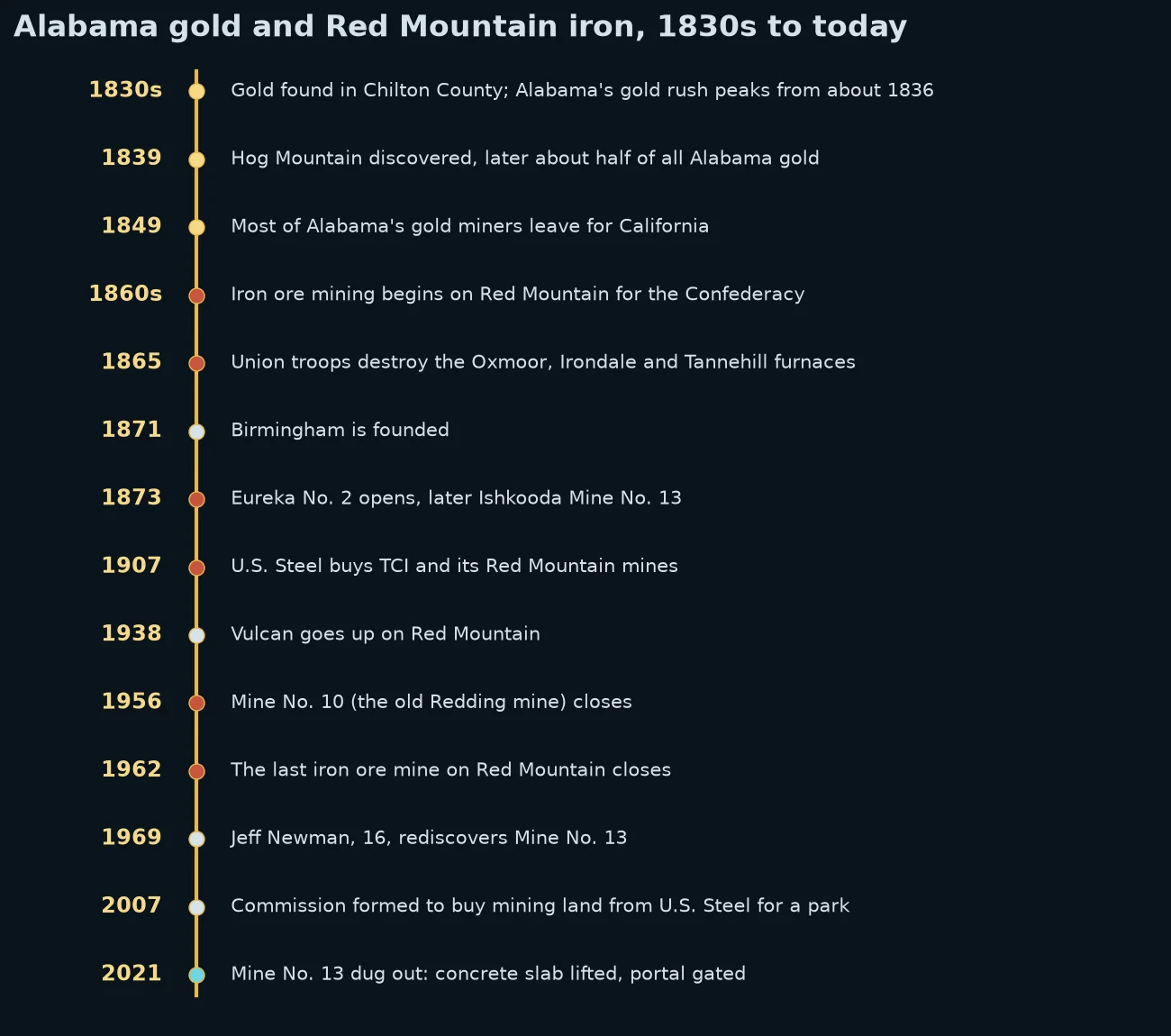
Mining on the ridge began in the early 1860s, when the Confederacy needed iron and the furnaces at Oxmoor, Irondale and Tannehill needed ore. In 1865, Union troops destroyed those furnaces, and mining along the mountain stopped. After the war it came roaring back. Birmingham was founded in 1871, and industrialists such as Henry DeBardeleben, James Sloss, T.T. Hillman and the Woodwards opened mine after mine along the slopes. Iron ore from one side of the valley, coal and limestone from nearby, and a city sprang up in the middle so fast it got called the Magic City.
Life inside the iron mines
These were proper underground mines, not a few men with pans. Many followed the ore seam down at a steep slope, between about 18 and 35 degrees, using a room-and-pillar system: dig out rooms of ore, leave pillars of rock to hold up the roof. Some spots started as open cuts and went underground once stripping off the rock on top got too expensive. The Sloss No. 2 mine, opened in 1890, reached 1,330 feet down its slope by 1908. A deep, dark, dangerous place to spend a working life.
The miners lived in company camps on the mountainsides, with names like Ishkooda and Wenonah. The Tennessee Coal, Iron and Railroad Company, known as TCI, ran many of the mines, and after U.S. Steel bought TCI in 1907 the camps became U.S. Steel towns. Retired miners interviewed for a University of Alabama at Birmingham oral history project remembered company houses, company stores and badge numbers that tracked their hours, pay and purchases. They also remembered segregation: Black workers lived in separate camps and were shut out of the better-paid management jobs.
Mining was dangerous work. A single accident at Sloss No. 2 in January 1895 killed two people, and it was far from the only one on the mountain. Behind every ton of ore was a lot of sweat and, sometimes, a funeral.
How the mines were sealed
Here's where the legend finds its foothold. When mining slowed down, the mountain didn't just leave its holes open for passers-by to fall into. Mine No. 10, the old Redding mine, closed in 1956. The last iron ore mine on Red Mountain, run by U.S. Steel, shut in 1962, done in by rising labour costs, faults that made the ore harder to reach, and cheaper ore from far away. The last ore mine anywhere in the Birmingham district, the Pyne Mine near Bessemer, held on until 1972.
Most of the old entrances were sealed. And the best example of how it was done is a mine with a cracking backstory of its own: Ishkooda No. 13, which started life in 1873 as Eureka No. 2, one of the oldest mines on the mountain. When mining there ended, the miners backfilled it and capped the entrance with a concrete slab about 18 inches thick. Then the woods took over, and it vanished from view.
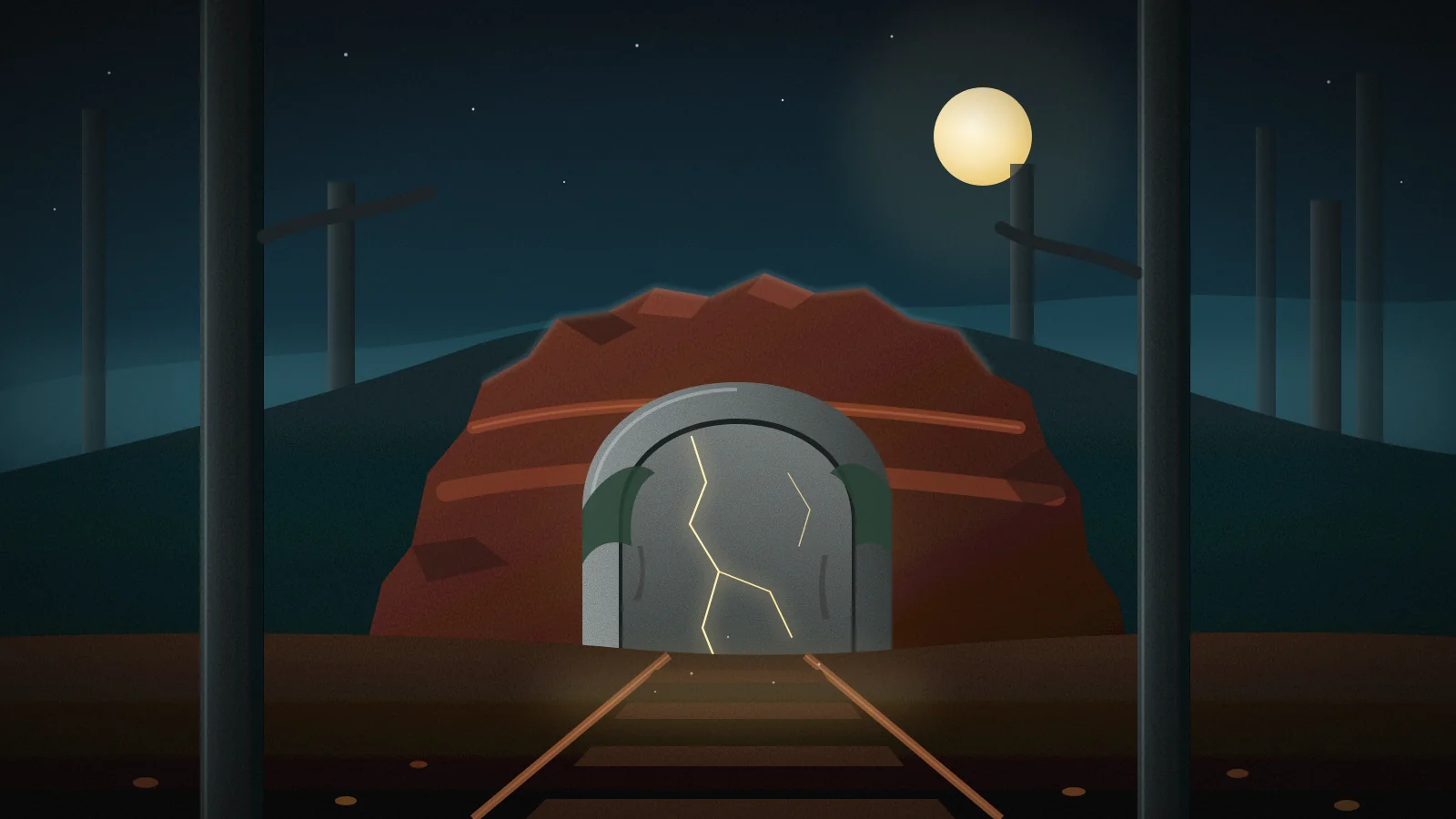
In 1969, a 16-year-old named Jeff Newman rediscovered it. He went on to explore dozens of Birmingham's old mines and co-found a group called Underground Birmingham. In 2021, Red Mountain Park dug out No. 13, lifted the slab and found the portal undamaged underneath. Was there a glittering stack of gold behind it? Nobody reported so much as a nugget. The park put steel bars across the entrance so visitors can look in safely, and that was that.
Still, you can see why a story like this grows here. A mountain full of tunnels, entrances buried under concrete and dirt, a whole working world that went silent within living memory. If you were going to make up a place to hide something, you'd struggle to design a better one.
The legend of the Red Mountain gold cache
The story, as the channel's Short tells it, is short and sweet: miners claimed that smuggled gold ore was sealed inside an abandoned shaft beneath Birmingham's Red Mountain.
That's it. No names. No date. No mine number. No mention of whose gold it was, who did the smuggling or who did the sealing. And here's the awkward bit for any would-be treasure hunter: search the park histories, the mining papers, the oral histories and the local reference works, and the tale doesn't turn up in writing at all. It lives where a lot of mining stories live, in the telling.
That doesn't make it worthless. Mining towns all over America were full of stories about stashes, hidden pay and secret pockets of rich ore. But it does mean every detail you hear about this one should come with a raised eyebrow and a pinch of red Alabama dust.
"Smuggled" gold: a real habit, in other places
The smuggling part, at least, isn't a wild idea. In the gold camps of the American West it had a name: high-grading. Miners pocketed the richest bits of gold ore and walked out with them. In the Cripple Creek district of Colorado, ore went home in clothes, boots and lunch pails, in hollowed-out pick handles and in wide canvas belts, and was sold on through saloons, laundries and boardinghouses. In 1900 the Independence Mine there answered with a change room: miners stripped, a guard checked the lunch buckets, and everyone walked under watch to put their street clothes back on. Many miners saw a few rich rocks as a fair perk of a deadly job, and local juries were slow to convict. The owners called it theft.

The trouble is that Red Mountain was an iron range, and there was no gold coming out of it to high-grade. If anyone had smuggled gold ore into a Red Mountain mine, it would have had to come from somewhere else first.
So where was Alabama's gold?
Alabama really did have a gold rush, and it's one of the state's better-kept secrets. According to the Encyclopedia of Alabama, gold was found in Chilton County in the 1830s, and mining peaked from around 1836. The gold lies in the old igneous and metamorphic rocks of the Piedmont, in a band of districts running southwest to northeast across the east side of the state.
- Hog Mountain, in Tallapoosa County, discovered in 1839, was the champion, producing about 25,000 ounces, roughly half of all the gold Alabama ever turned out.
- Goldville, also in Tallapoosa County, was founded in 1842 and at its peak had 14 stores and at least 3,000 people.
- Arbacoochee, in what is now Cleburne County, employed about 600 men and had around 5,000 residents by 1845.
Then 1849 came along, and most of the miners packed up for California. There were small revivals later, including in the 1880s and in 1903, but Alabama never produced gold in big quantities again.
Notice where all of that is: well to the east and south-east of Birmingham, in different rocks entirely. To end up inside an iron mine on Red Mountain, any gold ore would have needed a journey of the better part of a hundred miles, plus a reason to be hidden there rather than sold. Not impossible. Just rather a lot of effort for a hiding spot.
The theories, weighed
- A real stash from the gold belt. Someone carried gold ore from the eastern districts and hid it in a Red Mountain shaft before it was sealed. Romantic, but there's no record of it, and the timing is awkward: Alabama's gold rush was largely over by 1849, while Red Mountain's mines didn't really get going until the 1860s and later.
- A western story that moved east. High-grading and secret ore caches are classic tales from the gold camps out West. It's easy to imagine one getting retold with a local mountain dropped in. That's an idea, not a documented fact.
- Not gold at all. Maybe the "gold" was something else in the retelling: hidden pay, tools, or just a good story about rich ore. Again, that's a possibility, not something anyone has documented.
- Pure campfire. A mountain full of sealed tunnels practically begs for a ghost story or a treasure story. This may simply be one of those.
The honest verdict? Red Mountain's tunnels are real, the sealing was real, and smuggling gold ore was a real habit in the gold camps. Put together, they make a cracking story. What nobody has produced is a shred of evidence that the gold ever existed.
Visiting Red Mountain today
Fancy a look for yourself? You can see a remarkable amount of the mining past, just not from the inside.
- Red Mountain Park covers more than 1,500 acres of the old mining land on the western part of the ridge, with over 18 miles of trails. The land came from U.S. Steel, starting with about 1,200 acres bought by a public commission formed in 2007. Old mine sites, hoist houses and other remains turn up along the trails.
- Mine No. 13 and Mine No. 10 have been uncovered and gated, so you can peer in at the portals. Every mine opening in the park is closed to the public for safety, and it's a park for hiking and history, not for digging.
- Vulcan, the giant cast-iron statue of the Roman god of the forge, stands on Red Mountain overlooking the city. He was made for the 1904 St. Louis World's Fair and has stood on the ridge since 1938, a rather fitting landlord for an iron mountain.
- The Red Mountain Expressway Cut was finished in 1970 after years of cutting through the ridge, and it showed off the ore seams in cross-section. It became a National Natural Landmark in 1987, though its walking trail has since closed because of the risk of falling rock.
And a serious word: old mines anywhere are no place to go poking around. Abandoned openings can mean collapses, bad air, deep shafts and water you can't see the bottom of. Plenty of Red Mountain is also private land and neighbourhoods. Look at the portals from the trail, read the signs and leave the shovel at home.
The gold, if there ever was any, is still behind the concrete. The iron that made Birmingham is everywhere you look. Not a bad consolation prize.
...and if you find it, remember who encouraged your questionable life choices.
The short version of this story is on YouTube at @TenToeExpress.
Deep dive yourself
- Red Mountain Park · Jefferson County Greenways
- Sneak Peek: Red Mountain Park opens 147 year old mine · Bham Now
- Excavation of historic Red Mountain Park mine complete · WBRC
- Red Mountain Mines Tour · Mining History Association
- Mountain of Memories · University of Alabama at Birmingham, College of Arts and Sciences
- Gold Production in Alabama · Encyclopedia of Alabama
- Cripple Creek high grading: The untold stories · New Mexico Mineral Symposium, New Mexico Bureau of Geology and Mineral Resources
- Red Mountain (Birmingham) and Sloss Mines · Wikipedia (good starting points with further references)