 Ten Toe Express

Picture a summer night on Lake Lanier, Georgia. Boat lights blink across the water, music drifts over from a cove, and somewhere down in the dark, 150-odd feet below the hulls, lies a whole valley that used to be dry land. Farm roads. Chimneys. Tree trunks still standing where the clearing crews left them. And, if you listen to the local lore, a fortune in Confederate gold that was hidden in those valleys long before anybody thought of building a lake on top of it.
It is a cracking idea. A rebel treasure, buried in a hurry at the end of the Civil War, then sealed under a reservoir by the US government ninety-odd years later, so that nobody could ever dig it up. Rather convenient, if you are the one telling the story.
So, right then: what was really down there before the water came, where did the real Confederate gold of Georgia actually go, and does any of it point at Lake Lanier? Fetch a torch. It gets murky.

The legend of Lake Lanier's Confederate gold
Here is the story, in the shape it is usually told. As the Confederacy collapsed in 1865, gold was carried into the hills of north Georgia and hidden in the river valleys. Whoever hid it never came back for it. The valleys stayed quiet farm country for nearly a century, and then the Army Corps of Engineers dammed the Chattahoochee and let the water in. The gold, so the tale goes, is still down there, now under a lake that some ten million people a year use for boating and swimming, none of them with the faintest idea what they are floating over.
And that is about all the legend gives you. No named Confederate officer. No wagon count. No sum. No farm, no landmark, no deathbed confession, not even a dodgy map sold for a few dollars. Compared with most treasure tales, which come stuffed with clues and suspiciously precise numbers, the Lake Lanier story is remarkably thin. It is lore in the purest sense: something people say.
That does not make it worthless. It means the interesting question shifts from "where is it?" to "where did this come from?" And for that, you need two real stories: the gold, and the lake.
Gold country first: the north Georgia gold rush
Long before any Confederate anything, this corner of Georgia had gold. Real gold, in the ground and in the creeks.
Nobody is quite sure who found it first. The New Georgia Encyclopedia lists rival claims, including a Hall County man named Benjamin Parks, who is said to have found gold west of the Chestatee River in 1828. The earliest solid evidence is a notice in the Milledgeville Georgia Journal on August 1, 1829, and by spring 1830 one report had about 4,000 miners working along a single creek near what became Dahlonega. It made fortunes for some, and it was a disaster for the Cherokee Nation, whose land it was. The rush fed the pressure that ended in the forced removal of the Cherokees in 1838 and 1839, the Trail of Tears, in which at least 4,000 people died.
In 1838 the federal government opened a branch mint at Dahlonega. Before it closed in 1861, it struck almost 1.5 million gold coins with a face value of more than $6 million. Here is the point to keep in your back pocket: the Chestatee River runs south from that gold country, and today it flows straight into the northern arm of Lake Lanier. Lumpkin County, Dahlonega's county, even owns a small sliver of the lake.
So when people say "there's gold under Lake Lanier," they are not entirely making it up. Gold country and lake country touch. Whether a single Confederate coin ever sat in that valley is another matter entirely.
The Confederacy takes the mint
When Georgia left the Union in 1861, the Confederacy took over the Dahlonega mint, which held $23,716 in gold and silver at the time. It was not a working mint for long, but it was used: in autumn 1862, $40,000 in gold and silver from New Orleans was turned into bars there and sent on to Augusta.
That is the closest the documented Confederate treasury ever comes to the Lake Lanier country: a mint in the hills to the north, handling a modest amount of bullion early in the war, and shipping it away to the south-east. Nothing in the record has it hiding anything in the river bottoms on the way.
Where Georgia's real Confederate gold went
Now for the famous bit, which really happened, and which happened somewhere else.
In early April 1865, with Union troops closing on Richmond, the Confederate government fled south by train with its money. The New Georgia Encyclopedia puts the treasure leaving Danville, Virginia, on April 6, 1865, with $327,022 in gold and silver coins, bullion and donated jewelry, plus, rather charmingly, floor sweepings from the Dahlonega mint. Travelling with it was about $450,000 in coins and specie belonging to Richmond's private banks.

By early May the fleeing government reached Washington, Georgia, in Wilkes County. Jefferson Davis held his last meetings there, and most of the government's own money was paid out to soldiers and spent along the way. Davis pushed on south and was captured near Irwinville, in south Georgia, on May 10, 1865.
The Richmond bank money stayed behind in Washington. Union troops set off to move it to a railhead in South Carolina, and on the night of May 24, 1865, with the wagons halted at or near the Chennault Plantation in Lincoln County, a gang of raiders struck. The New Georgia Encyclopedia puts the loss at $251,029. How much came back depends on whom you ask: the Encyclopedia says bank officials recovered about $111,000, while History.com puts the figure at about $140,000. Either way, a large chunk vanished into the countryside, and Lincoln and Wilkes counties have been whispering about it ever since.
The aftermath was ugly. Union general Edward A. Wild, convinced the Chennault family was hiding the gold, had them arrested and mistreated. They were innocent, and Ulysses S. Grant removed Wild from his command over it. Decades later, in 1893, the US Court of Claims was still sorting out the Richmond banks' money.
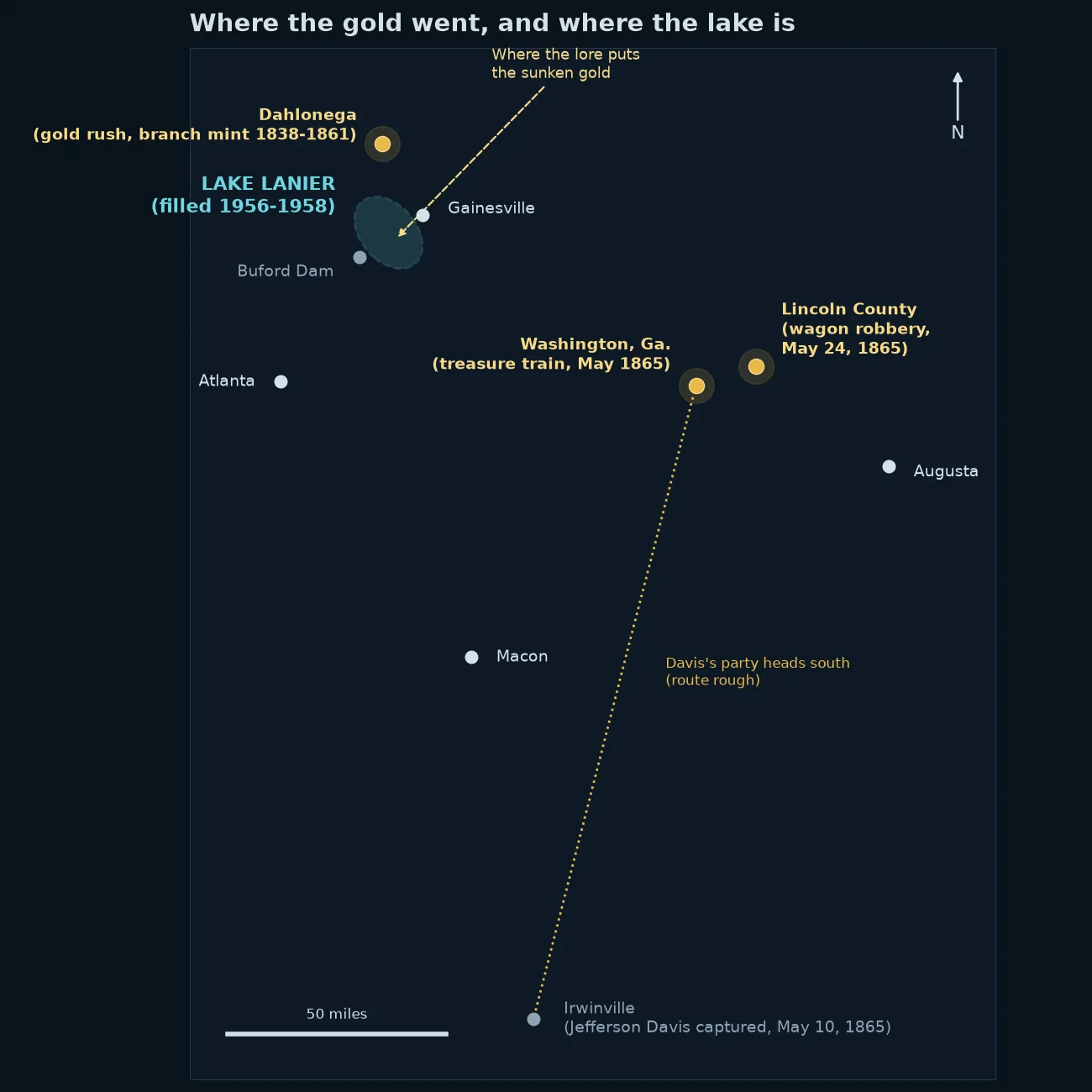
Look at the map below and you will see the snag. The documented treasure trail runs from Washington, Georgia, east toward the Savannah River and south toward Irwinville. Lake Lanier sits roughly 75 miles north-west of Washington as the crow flies, in a direction the treasure never went.
The valley before the water
So what was under Lake Lanier before 1956? Mostly, the ordinary stuff of rural north Georgia, which is somehow more haunting than gold.
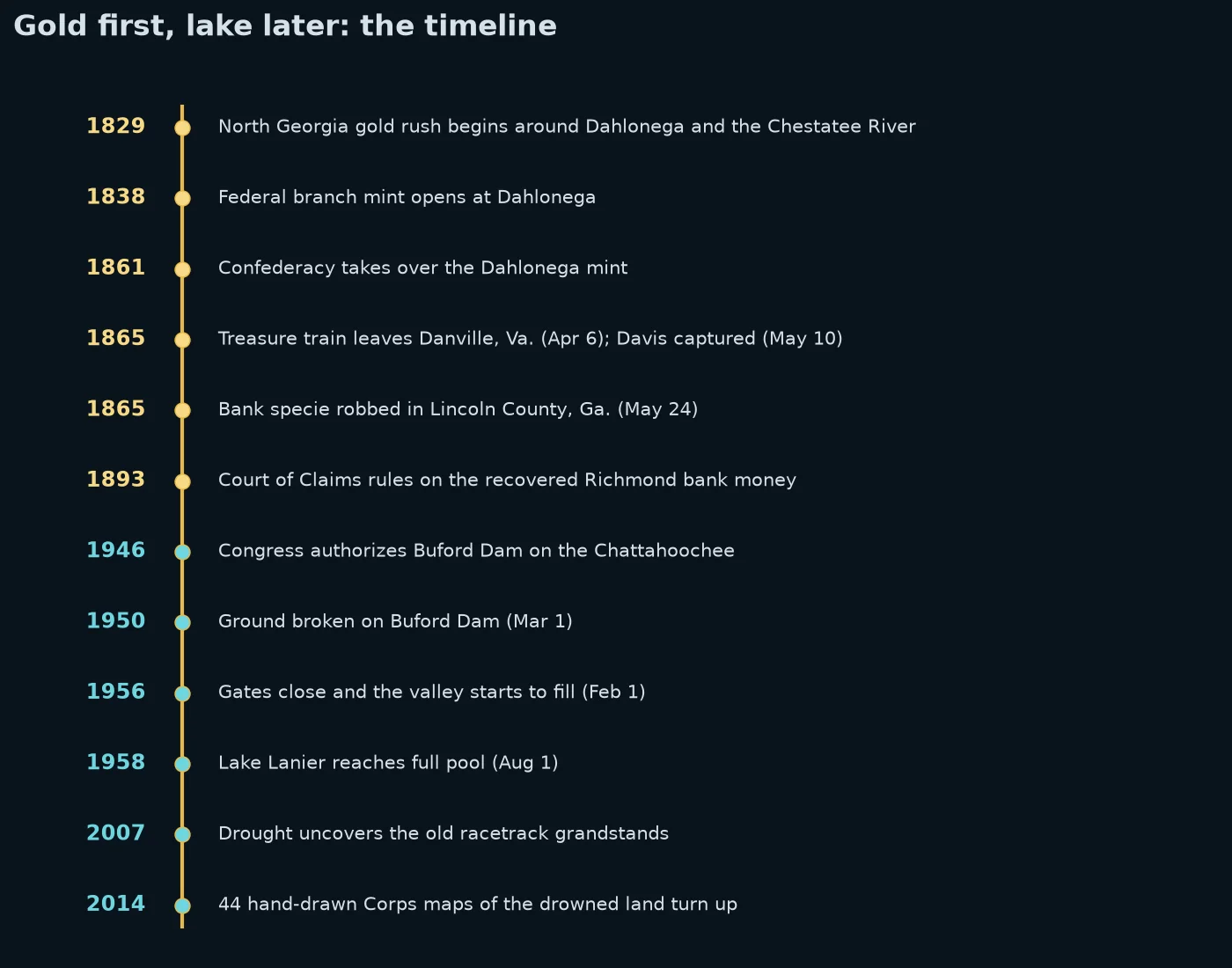
Congress authorized the Buford Dam project in 1946, and the Corps of Engineers made its first land purchase two years later. Ground was broken on March 1, 1950. Money ran short in 1951 and the work stalled until Congress found more funds in 1955. On February 1, 1956, the sluice gates closed and the Chattahoochee began backing up into its own valley and into the valley of the Chestatee. Drought slowed the filling, and the lake did not reach full pool until August 1, 1958. Today it covers about 38,000 acres, with nearly 700 miles of shoreline and a deepest point of about 156 feet.
What went under:
- Farms and homes. More than 50,000 acres of farmland. Wikipedia's figures say more than 250 families and 15 businesses were moved out; a 2014 WSB-TV report on old Corps maps put it at about 700 families. Sources disagree, so the honest answer is "hundreds".
- Cemeteries. About 20 cemeteries were relocated, remains and all. Some unmarked graves are believed to have been missed, a sad fact that feeds a lot of the lake's ghost stories.
- Roads. A stretch of Georgia Highway 53 was abandoned, and in droughts the old road surfaces and house foundations come up for air.
- A racetrack. Gainesville's Looper Speedway was condemned. In the 2007 drought its old grandstands reappeared out of the mud.
- Trees. Crews cut the timber but left tall stumps, some standing close to the surface, which is one reason boaters are told to respect the charts.
In 2014, Corps ranger Russ Lundstrum got a call about 44 hand-drawn maps of the land under the lake, sitting in a government warehouse near Washington, D.C., and about to be thrown away. He took them. "It was like Christmas," he told WSB-TV. The maps show farmhouses, cemeteries, businesses, a racetrack and railroad tracks, along with what people were paid: one Forsyth County farm and home, belonging to Henry Shadburn, sold for $4,100.
Not a single one of them, as far as anybody has reported, is marked "rebel gold, dig here". Rather inconvenient.
The enigmatic rock pile
There is one genuine underwater puzzle worth knowing about. Where the Chattahoochee and Chestatee rivers meet, near Davis Bridge Road in north Hall County, Gainesville police sergeant Chris Robinson spotted a large mound of rocks when the lake dropped in the early 1980s, and again in later low water. It is covered at full pool. He told the Gainesville Times he thought it may once have stood around 100 feet high.
What is it? Nobody knows. Cherokee elders shown photographs suggested a chieftain's burial. An archaeologist with the Society for Georgia Archaeology said rock piles are hard to read without digging, and that someone may have dug into this one in the late 1800s. A Corps ranger called it an "enigmatic rock pile" and said the Corps knows of other cultural sites around the lake, from small grave plots to rock piles, which it checks with archaeologists and keeps quiet about. Treasure hunters, take note of the important bit: it is federal property, and taking artifacts from it counts as theft.
Oscarville, and the history that really haunts the lake
Ask about what lies under Lake Lanier and many people will mention Oscarville, a Forsyth County community near the Chattahoochee. This part deserves care, because it is not a legend: in September 1912, three Black men were accused of assaulting Mae Crow, a white woman from Oscarville. One was lynched by a mob in Cumming, and two were executed after an all-white jury convicted them. White residents then drove more than 1,000 Black residents out of Forsyth County, and Black people were effectively kept out of the county for decades afterward.
What is disputed is the popular claim that Lake Lanier was built to drown a thriving Black town. Some accounts say parts of the Oscarville area went under the water in the 1950s. The Atlanta History Center, which has researched Forsyth 1912 in depth, says the story that the lake flooded a predominantly Black town named Oscarville is untrue. The violence and the expulsion are documented history, more than 40 years before the dam. The lake is a later layer on top.
Lake Lanier also has a sadly real safety record. Georgia Department of Natural Resources figures reported by USA Today counted more than 200 deaths at the lake between 1994 and 2022, most of them drownings. Explanations offered include the sheer number of visitors, alcohol, and hazards under the surface such as old stumps and debris. Those are real people and real families, and the "haunted lake" reputation that has grown up around them, and around the moved and unmoved graves, is best handled gently. As one historian quoted by Yahoo News put it, in effect, the thing haunting the area is its history.
So where did the gold legend come from?
No written source located for this article traces the Lake Lanier gold story to a particular person, family or year. So what follows is a weighing of possibilities, not a solution.
- Borrowed from the real Georgia treasure. Georgia genuinely did lose Confederate-era gold in 1865, and the New Georgia Encyclopedia notes that hidden caches of it have fed "numerous Georgia legends". It is easy for a famous story from Wilkes and Lincoln counties to drift a few counties over and settle somewhere more dramatic. A lake is about as dramatic as it gets.
- Gold rush gold in the river. The Chestatee valley was real gold country, and the Dahlonega mint was a Confederate mint for a while. Somewhere along the line, "there was gold up the Chestatee" and "the Confederates had the mint" may have fused into "Confederate gold under the lake".
- The drowned-valley effect. Any reservoir that swallowed homes, roads and graves invites stories about what was left behind. Lake Lanier already has ghosts, a drowned racetrack and a mystery mound. Treasure was perhaps inevitable.
- Someone really did hide something. Plenty of Southern families buried valuables during the war, and it is not impossible that somebody in the valley did and never dug it up. But "not impossible" is carrying the entire weight of that sentence, and there is no record pointing to it.
The honest verdict: the gold rush is real, the Confederate treasure is real, the drowned valley is real. The link between them, under Lake Lanier, is lore.
Visiting Lake Lanier today
Fancy a look at the water that supposedly hides it all? Brilliant. Lake Lanier is one of the busiest lakes in the country, with more than 90 parks, beaches, marinas and campgrounds, and it is genuinely lovely on a clear evening.
- Who runs it. The lake and its shoreline are managed by the US Army Corps of Engineers from the Buford Dam area. It is federal land.
- The rules for treasure hunters. Corps regulations prohibit damaging, removing or altering public property, including historical and archaeological features, without written permission from the District Commander. Metal detectors are allowed only on designated beaches or other already disturbed areas, and can be banned to protect archaeological sites. In plain English: swim, boat, look, wonder, but leave the shovel at home, and check with the Corps before you switch on a detector.
- When the water drops. In droughts, old roads, foundations and the racetrack have surfaced. They are still on federal land and still protected, so photographs only.
- Be safe on the water. Wear a life jacket, keep an eye on the charts for shallow stumps, and leave the drinking for dry land. The lake has seen far too many tragedies.
- Want real gold? Head north to Dahlonega, where the old gold country is still the main attraction, and the gold you can see was actually found.
The Confederate gold of Lake Lanier may never have existed at all. But the valley under the water did, with its farms, its roads, its families and its graves, and that is a story worth remembering every time the lake drops a few feet and the old Georgia comes up for air.
...and if you find it, remember who encouraged your questionable life choices.
The short version of this story is on YouTube at @TenToeExpress.
Deep dive yourself
- Confederate Gold · New Georgia Encyclopedia
- Gold Rush · New Georgia Encyclopedia
- Chasing the Myth of Confederate Gold, by Sarah Pruitt · History.com
- Newly discovered Lake Lanier maps uncover submerged history (2014) · WSB-TV
- What lies beneath? · Gainesville Times
- Forsyth 1912 · Atlanta History Center
- Georgia's Lake Lanier has claimed over 200 lives. Why do people believe it's haunted? (2023) · Yahoo News
- 36 CFR 327.14: Public property (Corps of Engineers projects) · Legal Information Institute, Cornell Law School
- Lake Lanier · Wikipedia (a good starting point for the dam dates and what was flooded)