 Ten Toe Express

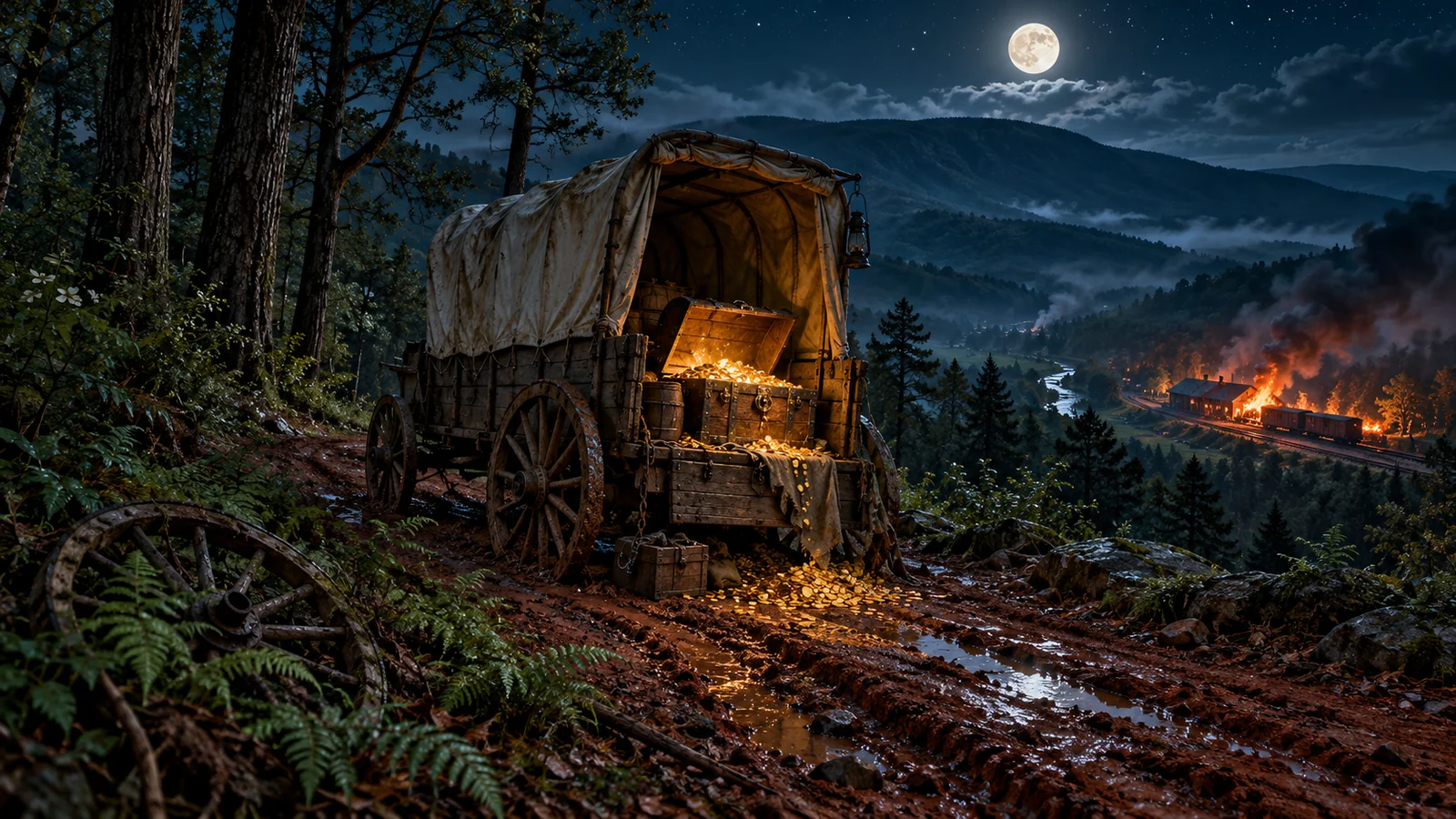
May 1865, west Alabama. The Civil War is over in everything but the paperwork. Lee has surrendered in Virginia, the Confederate government is on the run somewhere in the Carolinas and Georgia, and in a little cotton town on the Tombigbee River, Nathan Bedford Forrest's worn-out cavalrymen are waiting to be handed their paroles and sent home. Somewhere on the roads around that town, so the story goes, a wagon carrying Confederate gold rolled off into the dark and was never seen again.
The town is Gainesville, Alabama, in Sumter County, and the legend is the lost Confederate gold of Gainesville. It's a short story with a long shadow: no names, no map, no famous deathbed confession, just a wagon, a fortune and a war ending all around it. Rather inconvenient for treasure hunters. Rather perfect for a mystery.
Right then. Here's what the records say about Gainesville in those last weeks of the war, what the legend says, and why a story like this was almost bound to grow on the banks of the Tombigbee.
Gainesville, Alabama: the cotton port that time forgot
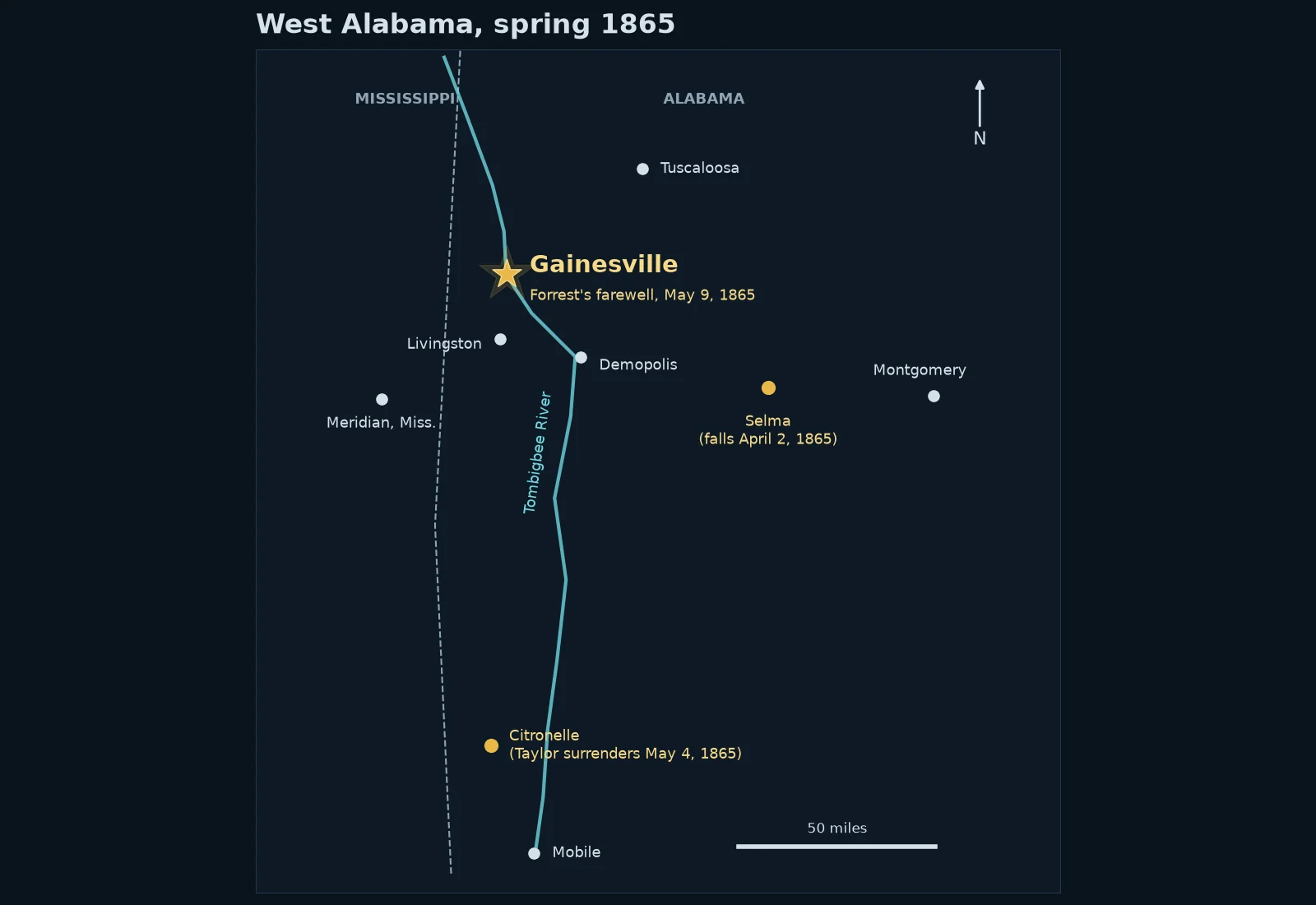
Before it was a footnote in a treasure legend, Gainesville was a proper boomtown. A New Englander, Col. Moses Lewis, bought 640 acres on the Tombigbee in the 1830s and sold off lots, and the town was incorporated in 1835. It was named for George Strother Gaines, the federal agent to the Choctaw, on what had been Choctaw land.
The river made Gainesville rich. Cotton came down to the landings by the wagonload and went off downstream by steamboat toward Mobile, and the Encyclopedia of Alabama says that in some years the town was the largest cotton shipping port in the world. By 1840 it was the third most populous town in the state. So many settlers came from the North that Main Street picked up the nickname "Yankee Street." The Gainesville Bank, founded in 1835, was important enough to print its own currency.
Money, in other words, was not a stranger here. Hold that thought.
Then the luck turned. An accidental fire in 1855 tore through downtown and destroyed around 30 of the original buildings. During the war the town took in the wounded: after the Battle of Shiloh in 1862, injured soldiers were nursed in the town's women's school, and about 250 of them died and are buried in the Confederate Cemetery in town.
Spring 1865: the war comes apart in Alabama
To understand why gold stories cling to Gainesville, you need the calendar of that spring, because it moved fast.
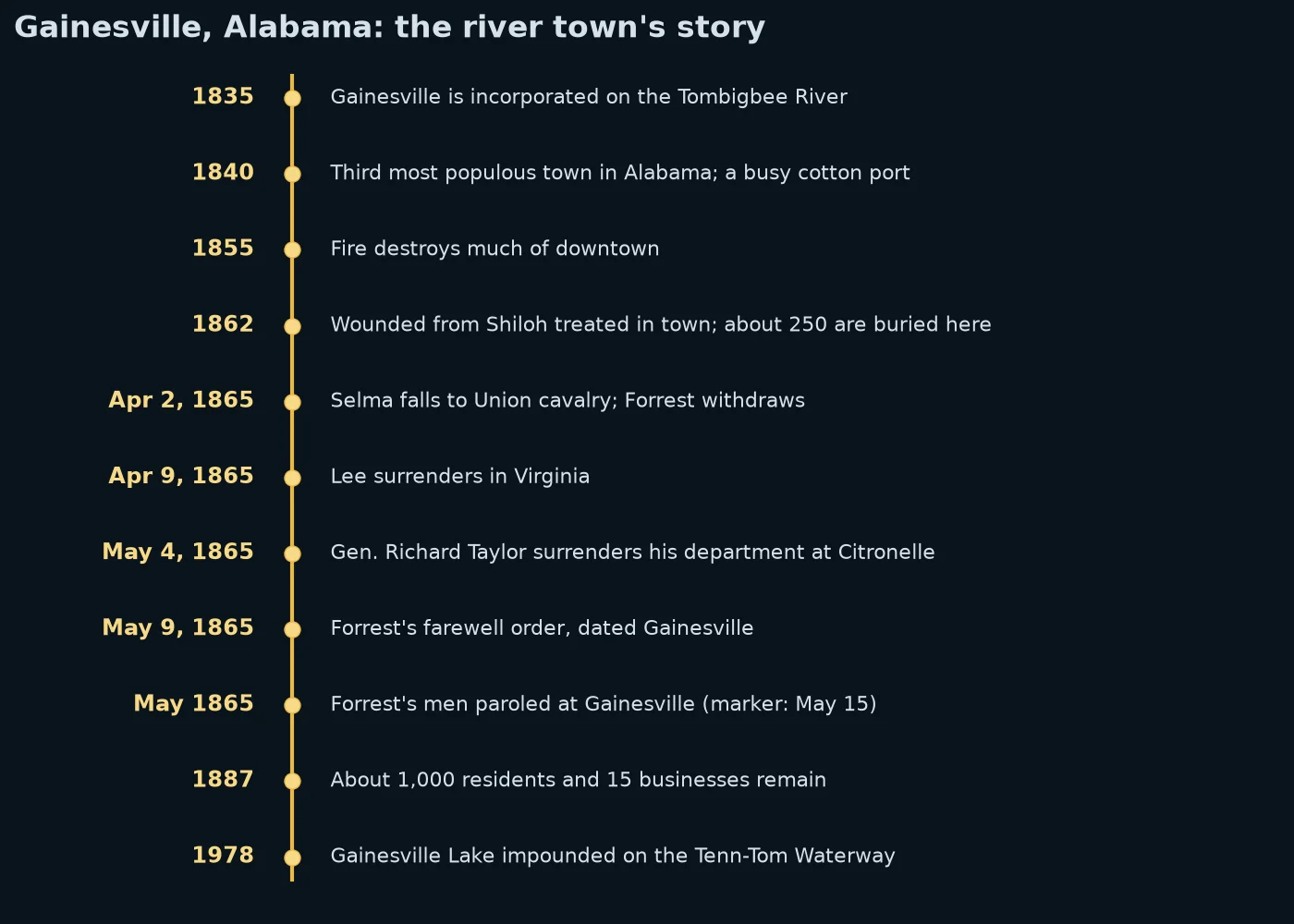
In late March 1865, Union cavalry under Gen. James H. Wilson swept down through central Alabama in what became known as Wilson's Raid. Forrest, with roughly 5,000 cavalry, was the only Confederate force that could stand in the way, and he lost: at Montevallo, at Ebenezer Church and finally at Selma on April 2. He slipped out of Selma that night, and Wilson's men destroyed the city's arsenal, ironworks and foundries before moving on to Montgomery and into Georgia.
A week later, on April 9, Lee surrendered in Virginia. The Confederate government had already fled Richmond and was heading south with what was left of its treasury.
In Alabama, the end came by agreement rather than by battle. On May 4, 1865, at Citronelle, north of Mobile, Lt. Gen. Richard Taylor surrendered his Department of Alabama, Mississippi and East Louisiana to Union Maj. Gen. Edward Canby. Forrest's cavalry was part of that department, and his men were gathered at Gainesville.
Forrest's surrender at Gainesville
On May 9, 1865, Forrest issued a farewell order to his troops, headed "Gainesville, Ala." It told the men that they had been surrendered under the agreement between Taylor and Canby. Men were offered paroles, and soldiers who were away from camp were told to report to Gainesville, Jackson in Mississippi, or the nearest Union post.
The dates wobble a bit depending on who you ask, which is very on-brand for a treasure legend. The farewell order is dated May 9, and the Encyclopedia of Alabama gives May 9 for the surrender. The local monument information says the paroles came on May 15, and Wikipedia's page for the town says May 19. The likeliest explanation is the boring one: paroling a whole cavalry corps took days, and different sources picked different days.
Forrest himself was a slave trader before the war, and after it he became the first Grand Wizard of the Ku Klux Klan. His troops were accused of killing surrendering U.S. Colored Troops at Fort Pillow, Tennessee, in 1864. He is a deeply controversial figure, and his role in this story is simple and factual: his surrender happened here, and that is what puts Gainesville on the map of the war's last days. His men were among the last Confederate troops east of the Mississippi River to lay down their arms.
Which brings the scene into focus. Picture a small river town in early May, swollen with soldiers, horses and wagons. Units disbanding. Officers settling accounts. Property being counted and handed over to the U.S. Army. Plenty of people with good reason to hide things, and nobody keeping a very tidy inventory. If a wagon was ever going to quietly go missing, this was the week for it.
The legend of the Gainesville gold wagon
Here's the legend in full, and it won't take long. At the end of the Civil War, a wagon carrying Confederate gold was moving near Gainesville. Then, according to the story, it vanished. The gold was never recovered.
That's it. The legend doesn't come with a captain's name, a figure in dollars, a guarded cave or a cryptic map. Some lost treasure stories arrive with a dozen conflicting details. This one arrives with almost none, which makes it rather hard to disprove and rather harder to find.
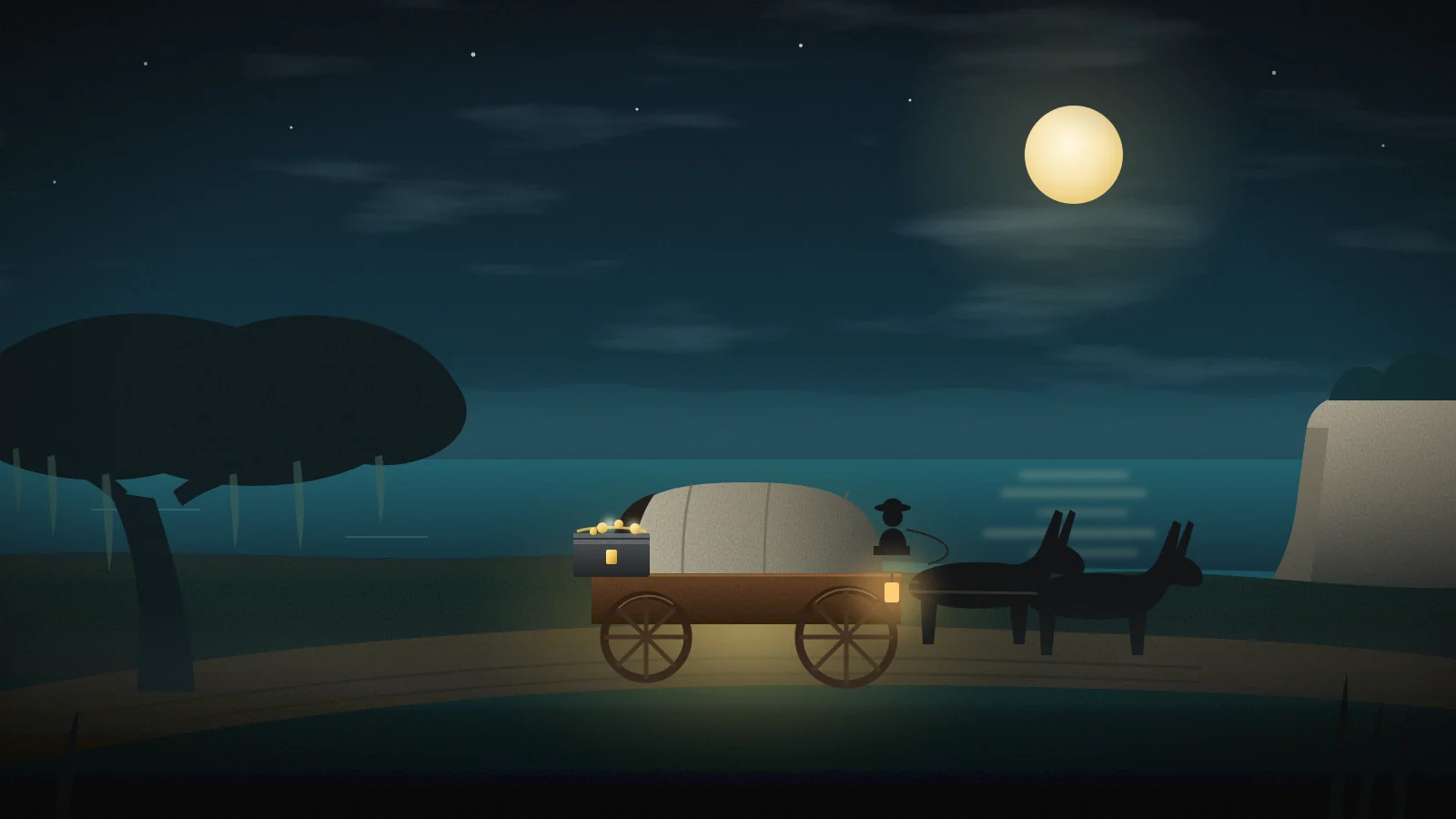
It's worth being blunt about the paper trail. No official record, newspaper account or historical society page found for this article names the Gainesville wagon, says whose gold it was, or says how much was aboard. The Encyclopedia of Alabama's history of the town, which covers the surrender in detail, doesn't mention lost gold at all. That doesn't mean nothing happened. It means that, as of now, the Gainesville gold lives in legend, not in the archives.
Gainesville does have a habit of hiding things
Now for the bits that are real, and that help explain why the legend sounds believable to people in Sumter County.
- The cannon in the river. A cannon now in Gainesville's Confederate Cemetery was cast at the Selma ordnance works. It was thrown into the Tombigbee to keep it out of Union hands and was hauled back out in the early 20th century. So the river genuinely did swallow Confederate property in 1865, and it genuinely did give some of it back.
- The house that exploded. The Forrest monument stands on the site of the old Ellis home. According to the regional tourism group RuralSWAlabama, when that house burned years later, explosions were heard across town, because powder horns and guns had been hidden in its walls. Hidden weapons, then. Hidden gold is not a giant leap for a storyteller.
- A town with money in it. A cotton port with its own bank and its own currency had planters, merchants and families with valuables to protect when armies came through. Families burying the silver ahead of the armies is a familiar wartime story across the South.
None of this proves there was a gold wagon. But it does mean Gainesville is exactly the sort of place where a gold wagon story would take root and grow.
The bigger mystery: where did the Confederate treasury go?
Every lost Confederate gold legend in the South leans on one real puzzle, so here it is in short.
When Richmond fell in April 1865, the Confederate treasury left by train. The Georgia historian Robert Scott Davis, writing for the New Georgia Encyclopedia, says the train that left Danville, Virginia, on April 6 carried $327,022 in gold and silver coins and bullion, plus about $450,000 in coins and checks belonging to Richmond banks. Most of the Confederate money was paid out to soldiers heading home before Jefferson Davis was captured in Georgia on May 10. On May 24, bandits raided the wagons carrying the Richmond bank funds in Lincoln County, Georgia, and about $251,029 vanished. Bank officials got back roughly $111,000.
Two things matter for Gainesville. First, the national treasury's route ran from Virginia to Georgia, a very long way east of the Tombigbee, so the famous treasury itself is not the obvious source of a west Alabama wagon. Second, as the historians Wesley Millett and Gerald White point out, Union officials inflated the Confederate treasury to several million dollars, when it was probably worth not much more than $500,000. Numbers that big were bound to send people looking for gold all over the South, Alabama included. A real mystery out east, in other words, has a way of growing local branches.
The searches since
Here's an unusual entry for a treasure story: there's no documented search to report. No newspaper headlines about expeditions, no famous treasure hunter who staked a career on it, no published find. Treasure-legend roundups for Alabama tend to focus on other stories, such as the Athens boxes of gold and silver in north Alabama and the Confederate gold legends elsewhere in the state. The Gainesville wagon stays quietly in the background, which may be exactly how a wagon of missing gold would prefer it.

The theories, weighed
- Army money, paid out. At the end of the war, Confederate funds were often handed to soldiers as they disbanded. A wagon of cash near a surrender camp that "disappeared" may simply have been spent on the men waiting for paroles. Plausible, and very unromantic.
- Private valuables, hidden. A wealthy cotton town had good reason to bury its coins and silver as armies moved through. Some caches were dug up later; a few may never have been. Time and retelling can turn a family's buried savings into "Confederate gold."
- Into the river. The Tombigbee already swallowed one Confederate cannon on purpose. If anything valuable went in during those weeks, good luck: the river has since been dammed into Gainesville Lake.
- A traveling legend. Lost Confederate gold stories pop up across the South, and they tend to gather around places with a famous last-days moment. Gainesville, the site of Forrest's surrender, is just such a place, so the legend may have attached itself to the town rather than started there.
The honest answer is that nobody knows, and with a legend this thin, nobody may ever be able to know. Which, of course, is half the fun.
Visiting Gainesville today
Gainesville today is a quiet town of a few hundred people, a far cry from the bustling river port of the 1840s. Fancy a look? The town is worth a wander for its history alone.
- The historic district. The Gainesville Historic District is on the National Register of Historic Places, and the town has a long list of individually listed buildings, including the Main and Yankee Street district, the old Coffin Shop and the park and bandstand on the town's unusual triangle-shaped center.
- The surrender site. An obelisk and monument near the junction of Highway 39 and Highway 116 mark where Forrest's men were paroled.
- The Confederate Cemetery, where the soldiers who died in the town's wartime hospital are buried, along with the cannon that spent decades in the river.
- The river. The Tombigbee here is now part of the Tennessee-Tombigbee Waterway. The Howell Heflin Lock and Dam (formerly Gainesville Lock and Dam) holds back Gainesville Lake, a reservoir of about 6,400 acres impounded in 1978 and popular for fishing.
A plain word on the shovel question. The land around Gainesville is mostly private property, so you'd need the owner's permission to set foot on it, let alone dig. The waterway and its shoreline are federal, managed by the U.S. Army Corps of Engineers, and federal law protects historic artifacts on public land, so relic digging there is off the table. The good news: the stories are free, the historic district is open to look at, and the river is lovely at sunset.
So the gold of Gainesville stays where it has always been: somewhere between a muddy riverbank, a disbanding army and a story told on a front porch. A wagon rolled off into the last days of the war, and it hasn't rolled back yet.
...and if you find it, remember who encouraged your questionable life choices.
The short version of this story is on YouTube at @TenToeExpress.
Deep dive yourself
- Gainesville · Encyclopedia of Alabama
- Wilson's Raid · Encyclopedia of Alabama
- Forrest's Farewell · Emerging Civil War
- Gen. Nathan Bedford Forrest Monument at Gainesville, AL · RuralSWAlabama
- End of Hostilities · National Park Service, Appomattox Court House
- Confederate Gold, by Robert Scott Davis · New Georgia Encyclopedia
- Nathan Bedford Forrest, by Brian S. Wills · Tennessee Encyclopedia
- Mystery of Lost Confederate Gold, by Wesley Millett and Gerald White · History News Network
- Gainesville Reservoir · Alabama Department of Conservation and Natural Resources
- Gainesville, Alabama and Howell Heflin Lock and Dam · Wikipedia (starting points)