 Ten Toe Express
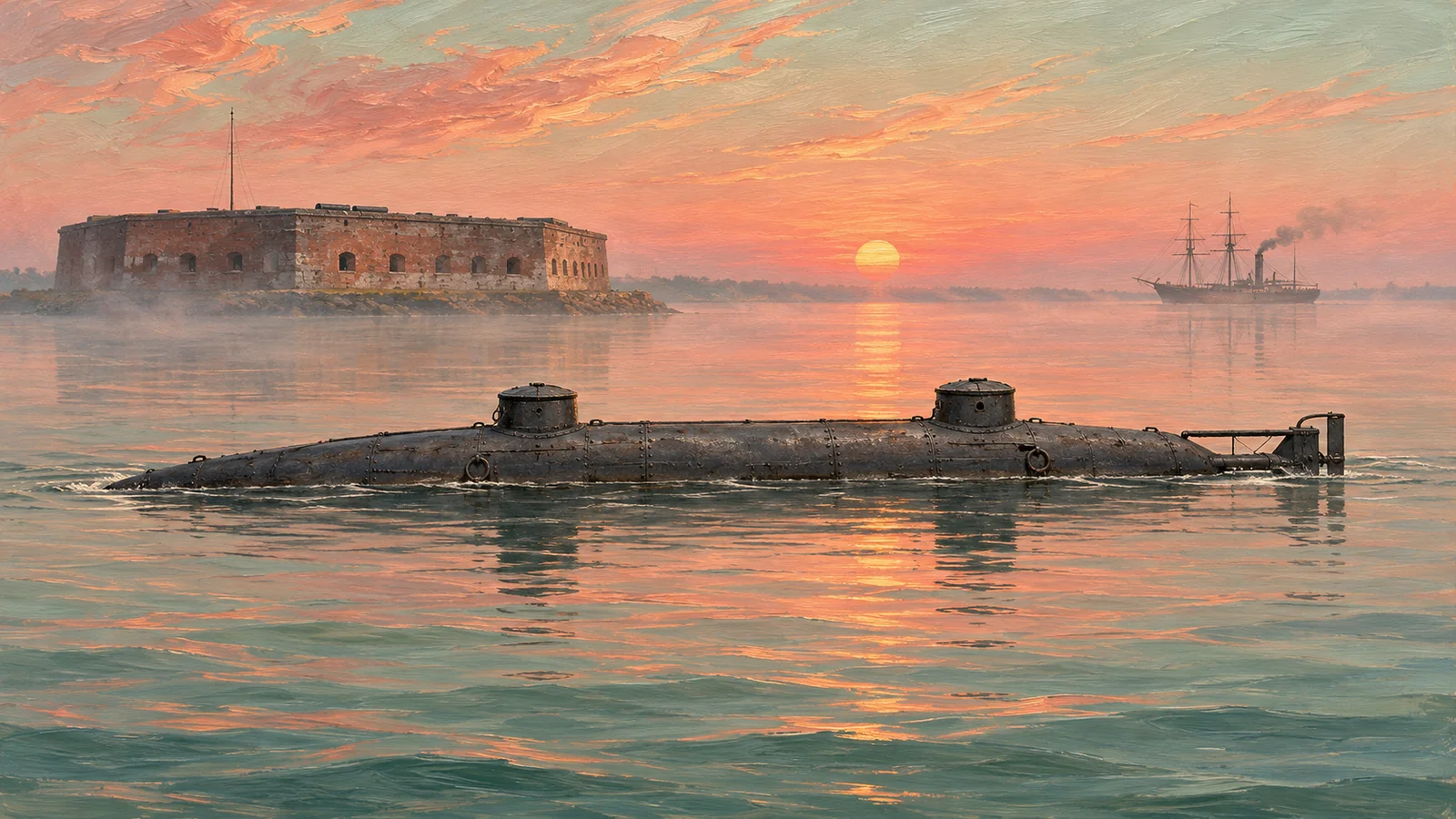
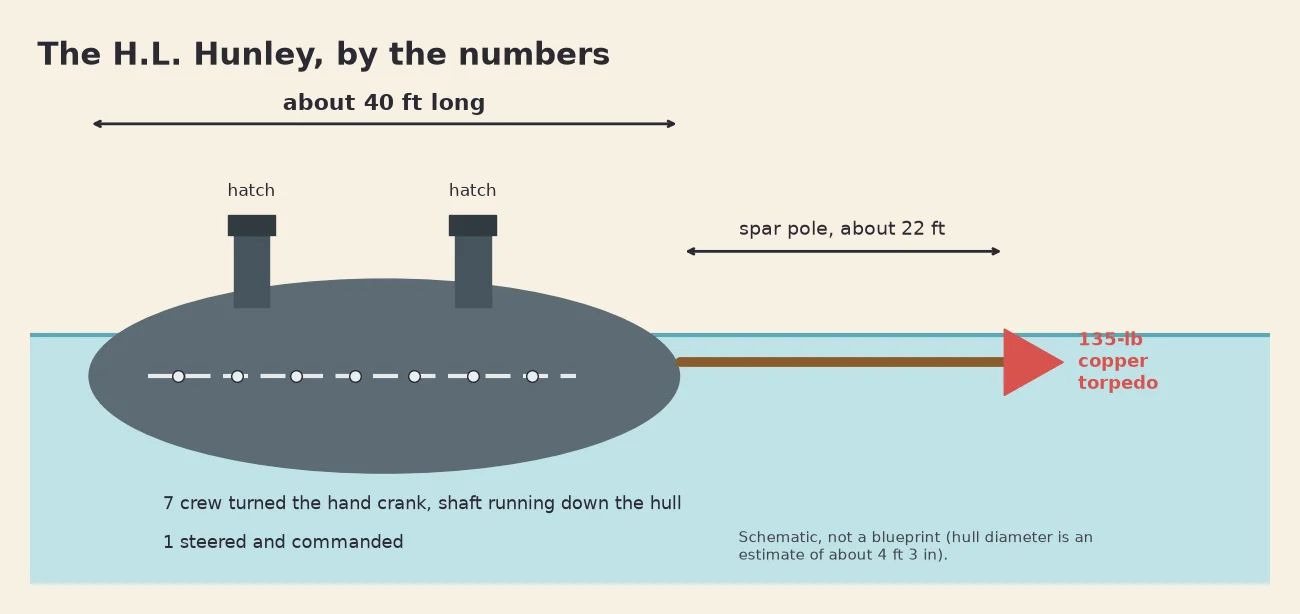
Picture a tube of riveted iron, roughly forty feet long, with eight men folded inside it like sardines in a very bad tin. Seven of them are turning a hand crank. The eighth is steering and trying not to think about the long pole sticking out the front, which has a copper keg of gunpowder on the end. It is the evening of 17 February 1864, off Charleston, South Carolina, and the H.L. Hunley is about to do something no submarine has ever done: sink an enemy warship.
She does it. Then she vanishes with every man aboard, and for the next 131 years, right then, nobody knows where she went. The H.L. Hunley is South Carolina's great submarine mystery, and the surprising bit is that the wreck has since been found, raised and put in a tank. The question of what actually happened to the crew is still being argued over.
A submarine built by people who kept sinking
The Hunley was the third attempt at the same idea. Horace Lawson Hunley financed the designs of James McClintock. Their first boat, the Pioneer, was scuttled in 1862 when Union forces closed in on New Orleans. The second, the American Diver, was built in Mobile, Alabama, and sank in January 1863 while being towed toward Fort Morgan. Her crew got out. The boat was never recovered.
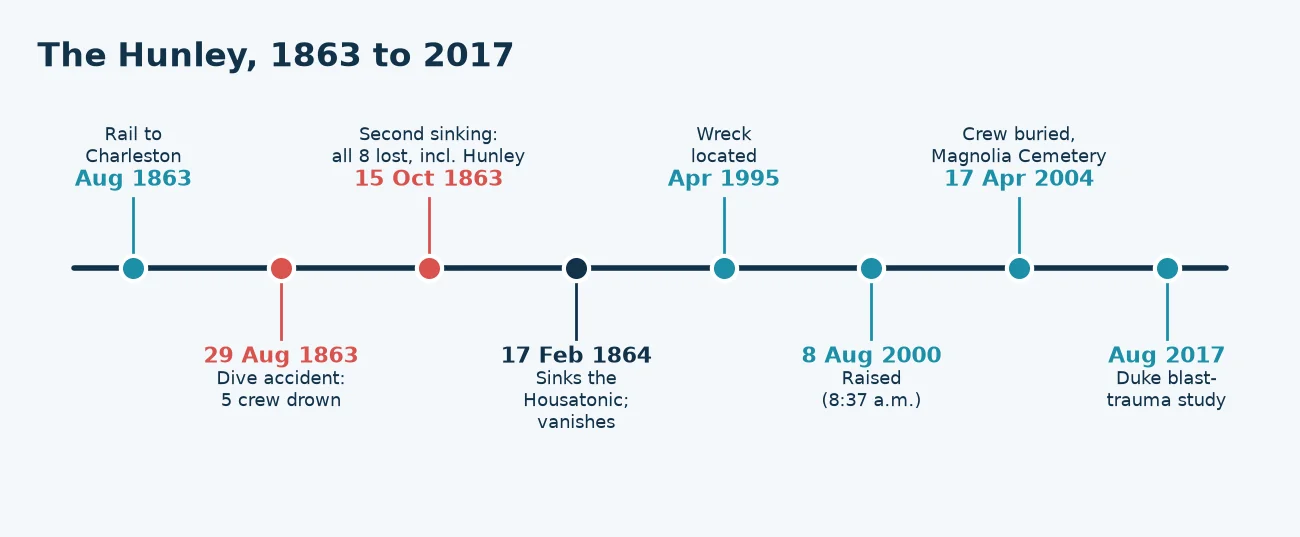
The third was built in Mobile too and launched in July 1863. She went by rail to Charleston, arriving on 12 August 1863, where the Confederate Army promptly took charge of her. She was about 40 feet long, with a hull roughly 4 feet 3 inches across (an estimate), and she carried ballast tanks at each end plus iron weights that could be unbolted in an emergency. Seven men turned the crank that drove the propeller and one steered. Top speed was about four knots on the surface, on a good day, with a following current and a keen crew.
The boat that killed her own crews
Here is the part the recruitment poster left out. The Hunley sank twice before she ever met the enemy, and both times she was raised and sent back to work.
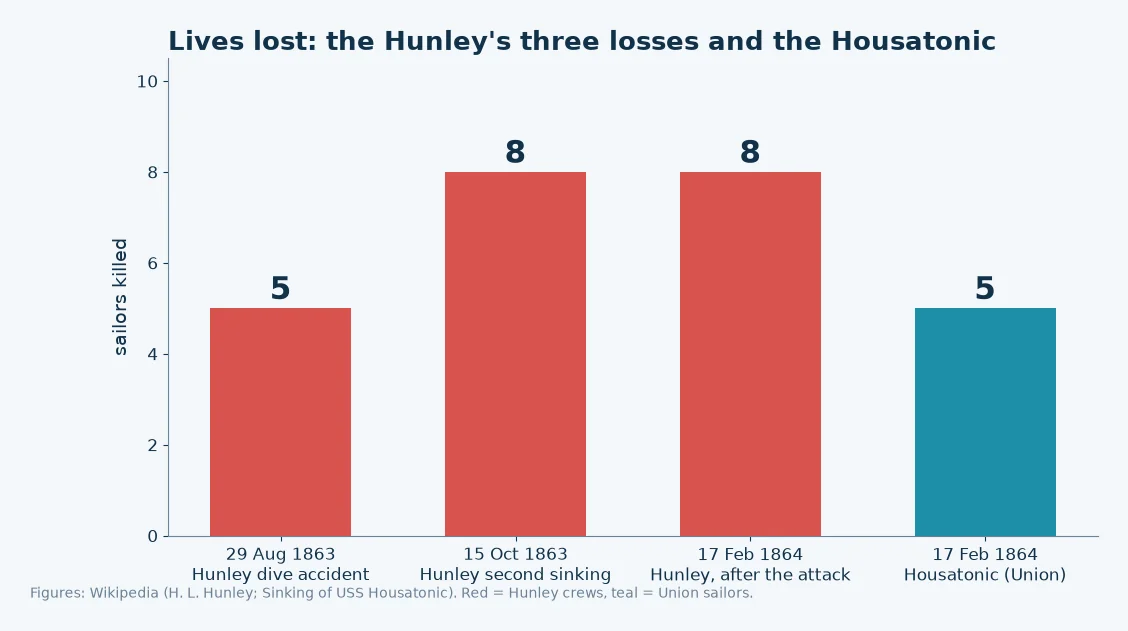
- 29 August 1863: During a test dive, Lieutenant John A. Payne, who had volunteered as captain, stepped on the diving-plane lever while she was on the surface and with a hatch open. She dived. Payne and two others escaped. Five men drowned: Michael Cane, Nicholas Davis, Frank Doyle, John Kelly and Absolum Williams.
- 15 October 1863: After a mock attack, she failed to surface. All eight aboard died, including Horace Hunley himself. By then Lieutenant George E. Dixon had been placed in charge by the Army.
After a second drowning, you might expect volunteers to be thin on the ground. They were not. Dixon found a new crew.
The night of 17 February 1864
The target was the USS Housatonic, a 1,240-ton wooden steam sloop-of-war with twelve guns and a crew of about 150, on blockade duty a few miles off Charleston. She was only a few months old. Her captain was Charles W. Pickering.
Dixon commanded the Hunley. By most accounts she set out from Breach Inlet on Sullivan's Island. Records and later accounts disagree on details of the approach, but at about 8:45 that evening she came in just under the surface and drove a spar torpedo, carried on a pole about 22 feet long, into the Housatonic's hull. The explosion sank the sloop stern first within a few minutes. Five Union sailors died: two officers and three crewmen. Survivors climbed the rigging or took to boats, and the nearby USS Canandaigua was first on the scene.
The Hunley was the first combat submarine to sink a surface warship. And then, quite rudely, she never came home.
The blue light that may not have been blue
The old story says the Hunley survived the blast long enough to flash a blue-lantern signal to the shore, where a fire was lit to guide her in, before something finished her off on the way back. It is a lovely, tragic image. Here is what the record supports, and what it doesn't.
- Documented: Confederate correspondence says prearranged signals were seen from shore. A postwar account speaks of two blue lights, and a sailor in the Housatonic's rigging testified to seeing "a blue light on the water."
- Doubtful: In 1864, "blue light" meant a hand-held pyrotechnic flare, used by the US Navy, that burned with a bright white flame, not a lantern with a blue lens. The lantern later found in the Hunley has a clear lens and looks like a general-purpose dark lantern. Some researchers also suggest the light seen from the Union side may have been a recognition signal from another Federal vessel.
So the light may have been the Hunley's, or someone else's, or both. Nobody can say for sure.
Lost for 131 years: how the wreck was found
The Hunley stayed lost for more than a century. E. Lee Spence said he had found her in 1970 and published a location in 1995. In April 1995 diver Ralph Wilbanks located the wreck during a NUMA expedition funded by author Clive Cussler and directed by Dr. Mark M. Newell of the South Carolina Institute of Archaeology and Anthropology, who credited Spence with the original discovery. She lay about four miles offshore in roughly 30 feet of water, buried in silt. On 14 September 1995, Spence donated the wreck to the State of South Carolina. A string of lawsuits between Cussler and Spence rumbled on until 2008, and the less said about that the better.
The Hunley was raised on 8 August 2000 at 8:37 in the morning, the first time she had broken the surface in 136 years. She was taken to the Warren Lasch Conservation Center in North Charleston and put in a freshwater tank, where conservators have been working on her ever since.
What the wreck says about the crew
Inside the hull the crew were found at their stations. There was no sign anyone had tried to escape. The eight were Lieutenant George E. Dixon, Frank Collins, Joseph F. Ridgaway, James A. Wicks, Arnold Becker, Johan Frederik Carlsen, C. Lumpkin and Augustus Miller. Analysis of the remains found four were born in America and four in Europe. Dixon and three other Americans were identified through records and DNA, and Carlsen, from Denmark, through the Danish National Archive.
One famous detail sits on the border of fact and legend. A $20 gold piece minted in 1860 was found near Dixon in 2002, inscribed "Shiloh April 6, 1862." The family story says Dixon was wounded in the thigh at Shiloh and the bullet struck the coin in his pocket, saving his leg. The coin is real. The bullet story is a family legend.
On 17 April 2004, all eight crew were buried at Magnolia Cemetery in Charleston with full Confederate honors. Tens of thousands of people attended.
Why did the Hunley sink? The theories
The wreck was in surprisingly good shape, which makes the mystery more annoying, not less. The leading ideas:
- She was too close to her own bomb. A 2012 examination suggested the Hunley was about 20 feet from the Housatonic, and in January 2013 a copper sleeve on the spar suggested the torpedo was attached directly to it, which may have put her within about 16 feet (5 metres). A Duke University team led by biomechanist Rachel Lance reported in 2017, in the journal PLOS One, that the blast likely killed the crew by air blast trauma inside the hull. They put each man's chance of surviving at under 16 percent.
- The blast study has critics. Archaeologists at the Naval History and Heritage Command dispute the conclusions, and forensic expert James Downs said it had been discounted on the evidence, noting the crew's brains showed no trauma.
- Something went wrong after the attack. A 2008 report suggested the crew had not operated the pump, and a 2018 report found the keel blocks, the emergency ballast weights, were never released. Both fit a crew that did not realize, or did not have time, to save themselves.
- Older ideas: that she was swamped, struck by a Union vessel, or dived deep to avoid detection and never made it back to the surface.
Pick your favourite, but nothing is settled. The researchers themselves do not agree.
Where it stands today: seeing the Hunley
The Hunley is on display at the Warren Lasch Conservation Center, 1250 Supply Street, North Charleston, SC 29405, on the old Charleston Navy Yard by the Cooper River. Weekend tours are ticketed through the Friends of the Hunley (hunley.org), and group tours of 20 or more can be arranged on weekdays with advance notice. A replica sits at the USS Alabama Battleship Memorial Park in Mobile, Alabama. Conservation continues, so the boat is still in her treatment bath, not a glass case.
...and if you find it, remember who encouraged your questionable life choices.
The short version of this story is on YouTube at @TenToeExpress.
Deep dive yourself
- H. L. Hunley (submarine) · Wikipedia
- About the Hunley · Friends of the Hunley
- Sinking of USS Housatonic · Wikipedia
- H.L. Hunley · American Battlefield Trust
- The Sinking of America's First Combat Sub · Task & Purpose
- The Myth of the H.L. Hunley's Blue Lantern · Civil War Monitor