 Ten Toe Express
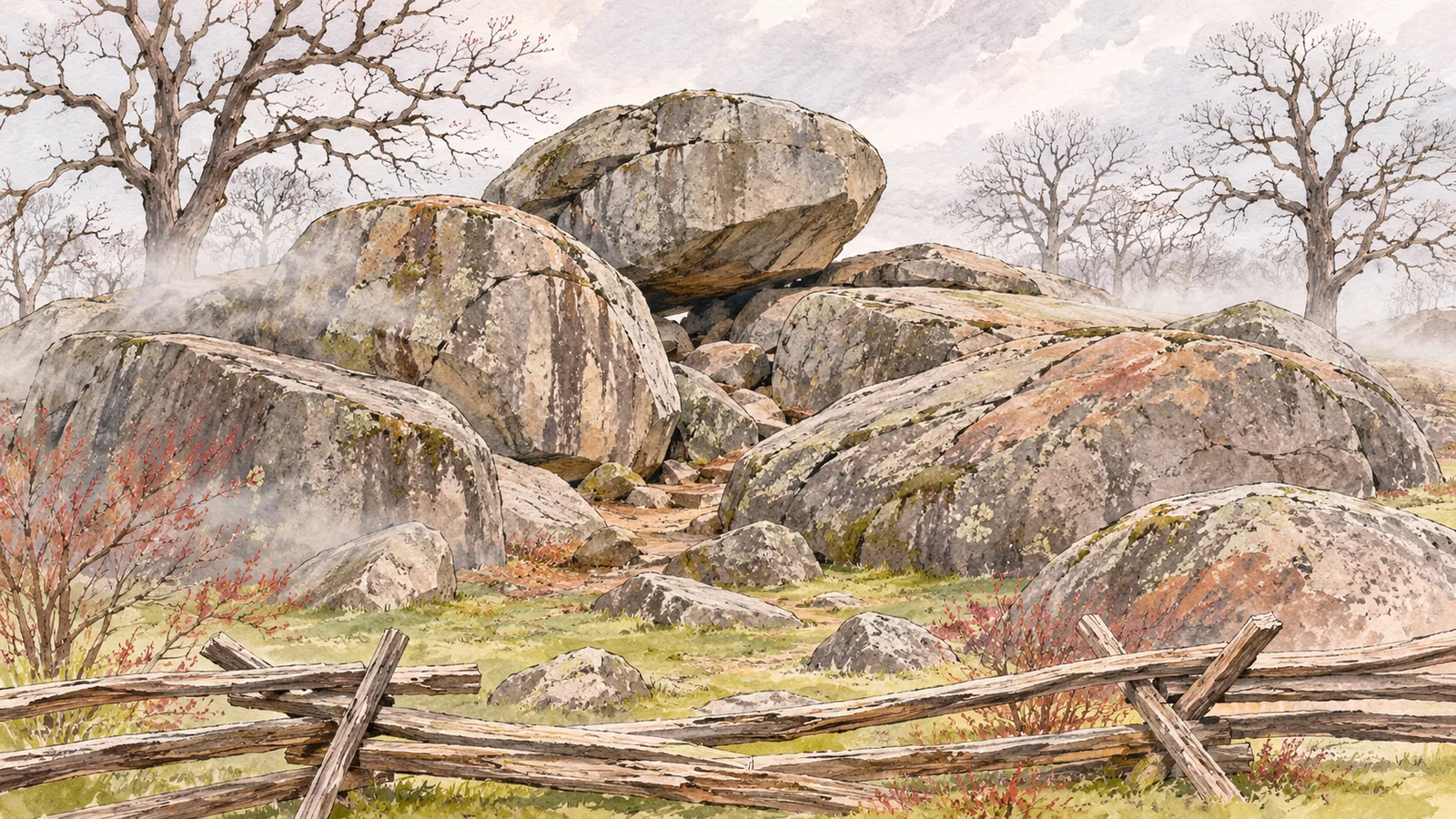
Picture a field in southern Pennsylvania on a still evening, long after the tour buses have gone. The boulders at Devil's Den are cooling, the cannons are silent, and somewhere in the gloom a camera that worked perfectly well a minute ago has decided to stop. Welcome to Gettysburg, the town that has spent a century and a half being called the most haunted place in America.
Here is the cheeky bit: not one of those ghosts has ever been proven. Not one. And yet people keep coming, because few places on earth have packed so much dying into three summer days. Right then. Fancy a proper look at what's documented, what's legend, and what's just very good storytelling?
Why Gettysburg Is the Haunted Capital of the Civil War
Start with the numbers, because everything else hangs on them. The Battle of Gettysburg was fought on 1, 2 and 3 July 1863. Between the two armies, roughly 46,000 to 51,000 men were killed, wounded, captured or missing. Nearly 8,000 were killed outright, and their bodies had to be buried quickly in the summer heat. More than 3,000 dead horses were burned in piles south of town, and the smell made residents ill.
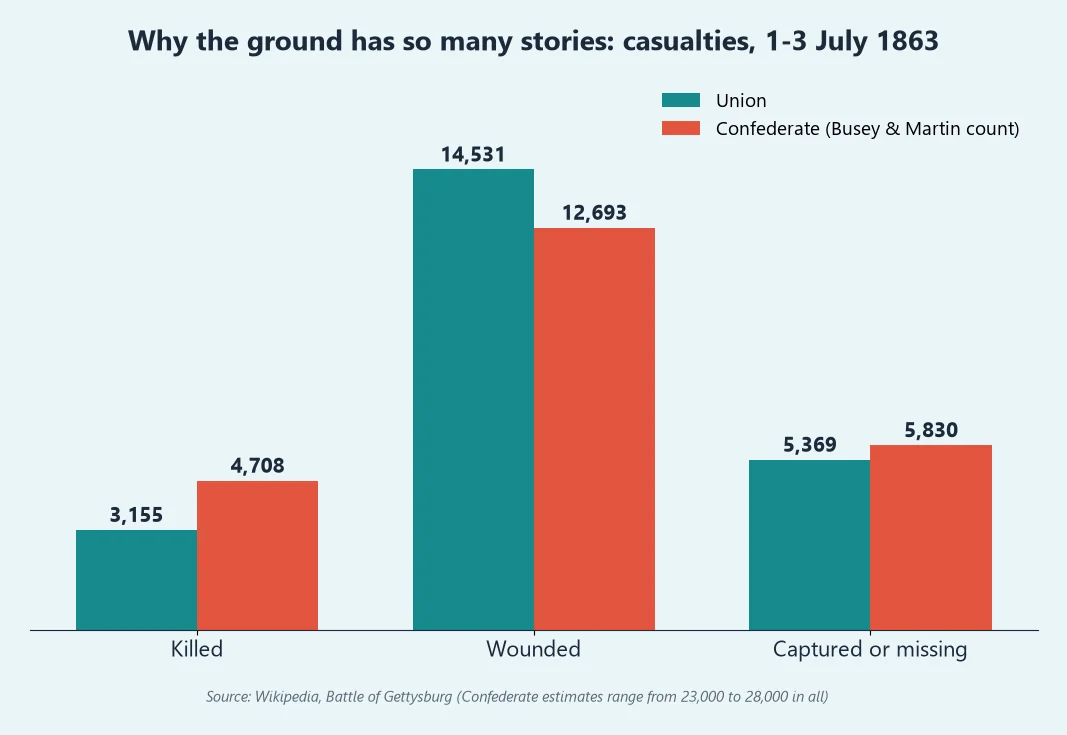
Now add the town. Gettysburg had about 2,400 residents, and by the time the guns stopped it was caring for roughly 14,000 wounded Union soldiers and about 8,000 Confederate prisoners. Churches, barns, homes and college halls became hospitals. Four and a half months later, on 19 November 1863, Abraham Lincoln stood at the dedication of the soldiers' cemetery and gave the Gettysburg Address. Few small towns have been asked to carry that much, that fast.
It is no great mystery, then, why people feel something here. The mystery is where the feeling stops and the stories begin.
The Earliest Ghost: A Horseman on the Road to Gettysburg
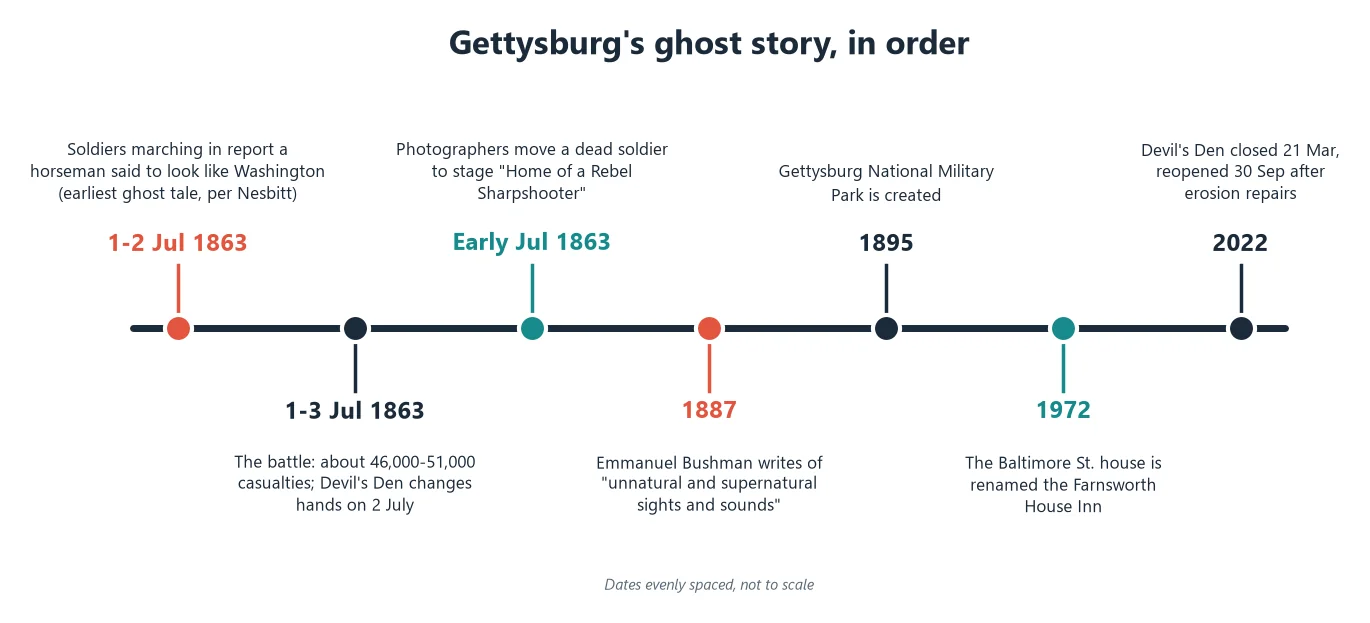
According to Mark Nesbitt, a former National Park Service ranger who has written several books on Gettysburg's ghosts, the earliest battle-related ghost story he found dates to the night of 1 July into the early hours of 2 July 1863. Union Fifth Corps soldiers marching toward the town reportedly saw a mysterious horseman in a Revolutionary War-style uniform. Many believed they had seen George Washington.
Note the wording: the story goes. It is a ranger-turned-author's retelling, not a signed statement from a soldier on the road, so treat it as a lovely piece of lore with a raised eyebrow. A tired army, a dark road and a famous battle ahead are all the ingredients a good tale needs.
There is another tantalising thread. Gettysburg writer Emmanuel Bushman is reported to have written in 1887 about "many unnatural and supernatural sights and sounds" around the Round Tops, an area he called the "Indian Fields." Nesbitt has used that to float a theory of a much older Native American turf war, though he himself calls such ideas speculative.
Devil's Den: Boulders, Sharpshooters and a Staged Photograph
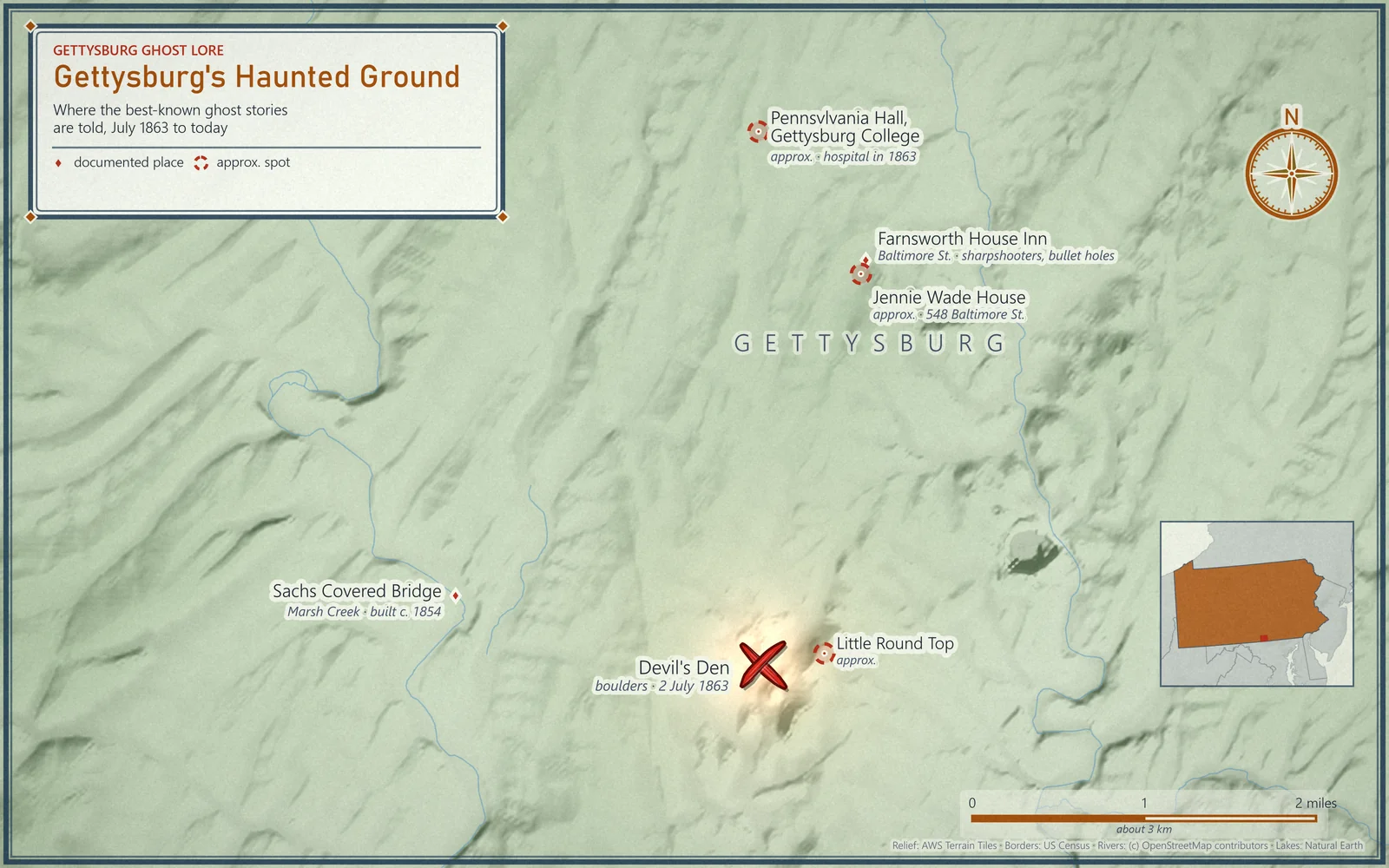
If Gettysburg's ghosts have a headquarters, it is Devil's Den. This boulder-strewn hill sits at the south end of Houck's Ridge, and on the afternoon of 2 July 1863 it was right in the thick of things. Hood's Confederate assault began about 4 pm. Union troops held Devil's Den as the far left of the Third Corps line, and the First Texas Regiment eventually reached the crest and drove off a Union battery. Confederate sharpshooters tucked between the rocks fired on nearby Little Round Top, and their fire killed or wounded General Stephen Weed and Lieutenant Charles Hazlett.
The name, by the way, is older than the battle and has nothing to do with ghosts. It comes from a mid-19th-century local belief in a large snake, called "The Devil," said to live in the crevices.
The photograph that is half true
Devil's Den also gave the war one of its most famous photographs, "Home of a Rebel Sharpshooter." Taken in early July 1863 by photographers working for Alexander Gardner's circle, it shows a dead Confederate soldier among the rocks with a rifle at his side. Here is the twist. Historian William Frassanito showed in the 1970s that four of the related photos were taken where the man probably died, and that the photographers then moved the body to a rocky niche about forty yards away because it looked like a sniper's lair. The rifle was probably brought along as a prop. In 2018 the body was tentatively identified as a Georgian soldier.
That is worth remembering whenever a ghost story leans on one dramatic image. Even the war's own pictures were sometimes arranged for effect.
What visitors say happens now
Modern ghost reports from Devil's Den are famously gadget-related: cameras malfunction, batteries drain, figures turn up in photographs, and people hear distant gunfire or screams. A favourite character is a barefoot, dishevelled man who says, "What you're looking for is over there," and then vanishes. Draining batteries and moody light on a boulder field in the dusk are, for the record, not unknown to photographers elsewhere either.
Devil's Den is part of Gettysburg National Military Park, so the usual park rules apply, and the National Park Service closed it for about six months in 2022 (21 March to 30 September) to repair erosion and unofficial social trails. Stick to the marked paths.
The Houses: Farnsworth, Jennie Wade and the Bullet Hole Question
Gettysburg's second great ghost district is Baltimore Street, where two houses have built the best reputations in town.
The Farnsworth House Inn
The Farnsworth House Inn at 401 Baltimore Street dates to the early 1800s; its owners say 1810, though the exact date is unclear. The house was used during the battle, and today it is marked by bullet holes and has been described as a one-time Confederate sharpshooter stronghold. It was renamed in 1972 by owner Loring Shultz after Brigadier General Elon J. Farnsworth. Its owners say as many as 16 spirits keep the place busy, each with a name and personality, and the inn runs ghost tours. That is a business, and a successful one, so weigh the evidence accordingly. One claim, that General Lewis Armistead was treated there before dying on 5 July, is called historically debatable, since other reports place his death at the George Spangler Farm.
The Jennie Wade House
This one is sad history first and ghost story second. Jennie Wade (Mary Virgin Wade, 1843-1863) was a 20-year-old seamstress and the only civilian directly killed in the battle. On the morning of 3 July she was at her sister's home on Baltimore Street, kneading bread dough, when a stray bullet passed through two doors and struck her. Historians disagree on which side fired it, though some blame an unknown Confederate sharpshooter. She was later buried in Evergreen Cemetery, and the house is now a museum.
Visitors and staff report doors opening and closing on their own, disembodied voices and the feeling of being watched. That feeling, in a small house where a young woman died, hardly needs a ghost to explain it.
Sachs Covered Bridge and Pennsylvania Hall
Sachs Covered Bridge spans Marsh Creek west of town and was built around 1854 at a cost of $1,544, with David S. Stoner credited as builder. Its real history is lively enough. On 1 July 1863 two brigades of the Union First Corps crossed it, and four days later most of Lee's Army of Northern Virginia retreated over it. The haunting legends, which usually centre on three Confederate deserters said to have been hanged from the bridge, come from ghost-tour sources. Documentation for the hangings is another matter: none turned up in this research, so call it a story and leave it there.
Over at Gettysburg College, Pennsylvania Hall was used as a hospital and command post. The best-known tale has two administrators riding the elevator and seeing a Civil War hospital scene, complete with wounded soldiers and blood-covered doctors. No names or dates are given, which is typical of a good ghost story and rather unhelpful for historians.
Weighing the Theories
The believers' case. Authors such as Nesbitt and folklore writer Jeff Belanger argue that Gettysburg is haunted because it should be, given the scale of death and suffering. Nesbitt has also floated a "stone tape" idea, in which a place somehow records strong events and replays them. He calls that speculative.
The skeptics' case. Many of the stories are retold so often, and by so many tour companies, that their origins blur. The photographs people treasure are sometimes staged. Cameras and batteries fail for dull reasons. And plenty of the sources are businesses that sell ghost tours.
The honest middle. Nobody has produced a recording, a document or a repeatable test that proves a ghost. What can be shown is that this was a place of enormous loss, that the stories began early, and that retelling has made them grow.
Gettysburg Ghosts Today
The ground itself is protected: Gettysburg National Military Park was created in 1895 and now draws hundreds of thousands of visitors a year. Walk its trails, tour the houses, sit through a ghost walk if you like a shiver with your history, and bring a spare phone battery just in case. The history there is real, the loss is real, and the ghosts, well, that is up to you.
...and if you find it, remember who encouraged your questionable life choices.
The short version of this story is on YouTube at @TenToeExpress.
Deep dive yourself
- Gettysburg: Ghost Stories From the Civil War Battlefield · History.com
- Battle of Gettysburg · Wikipedia
- Devil's Den · Wikipedia
- Devil's Den · National Park Service, Gettysburg National Military Park
- A Harvest of Death · Wikipedia
- Jennie Wade · Wikipedia
- Farnsworth House Inn · Wikipedia
- Sachs Covered Bridge · Wikipedia
- Gettysburg National Military Park · Wikipedia