 Ten Toe Express
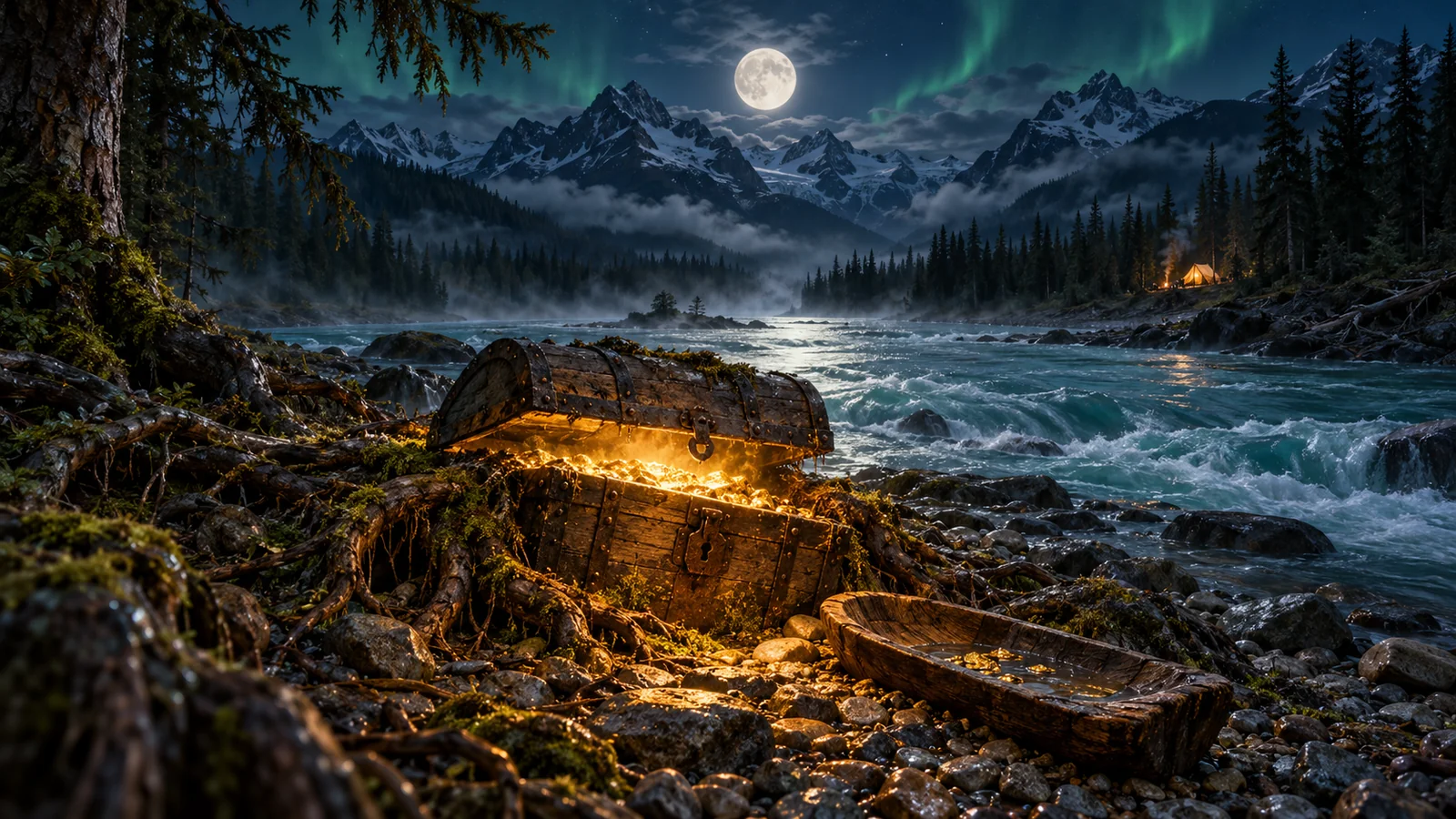
Picture a summer evening on the Kenai Peninsula, Alaska, around 1850. The river runs a milky, impossible turquoise. Snow still clings to the peaks. On a gravel bar near the mouth of a smaller river, a Russian mining engineer's crew swirl a carved wooden pan, tip out the sand, and squint. There, in the bottom: a few bright specks of gold.
That much is history. What comes next is the bit that keeps treasure hunters up at night. The story goes that the Russians found more than a few specks, that they kept very quiet about it, and that when Russia sold Alaska to the United States in 1867, a hoard of gold was left hidden somewhere near the Kenai, waiting for whoever is clever enough (or lucky enough) to find it. This is the legend of the lost gold of the Russian miners.
Right then. Pull on your waders, mind the bears, and sort the gold from the gravel.
Long before the Russians: Dena'ina country
Before any of this is about gold, it is about people. The Kenai Peninsula is the homeland of the Dena'ina, an Athabascan people, and the Kenai Peninsula Dena'ina today are represented by the Kenaitze Indian Tribe, based in the town of Kenai. The Kenai River is the Kahtnu in Dena'ina, and before Europeans arrived, the stretch of river between Kenai and present-day Cooper Landing was one of the most densely settled places in all of Alaska, thanks to its extraordinary salmon runs and the clever ways the Dena'ina found to preserve them.
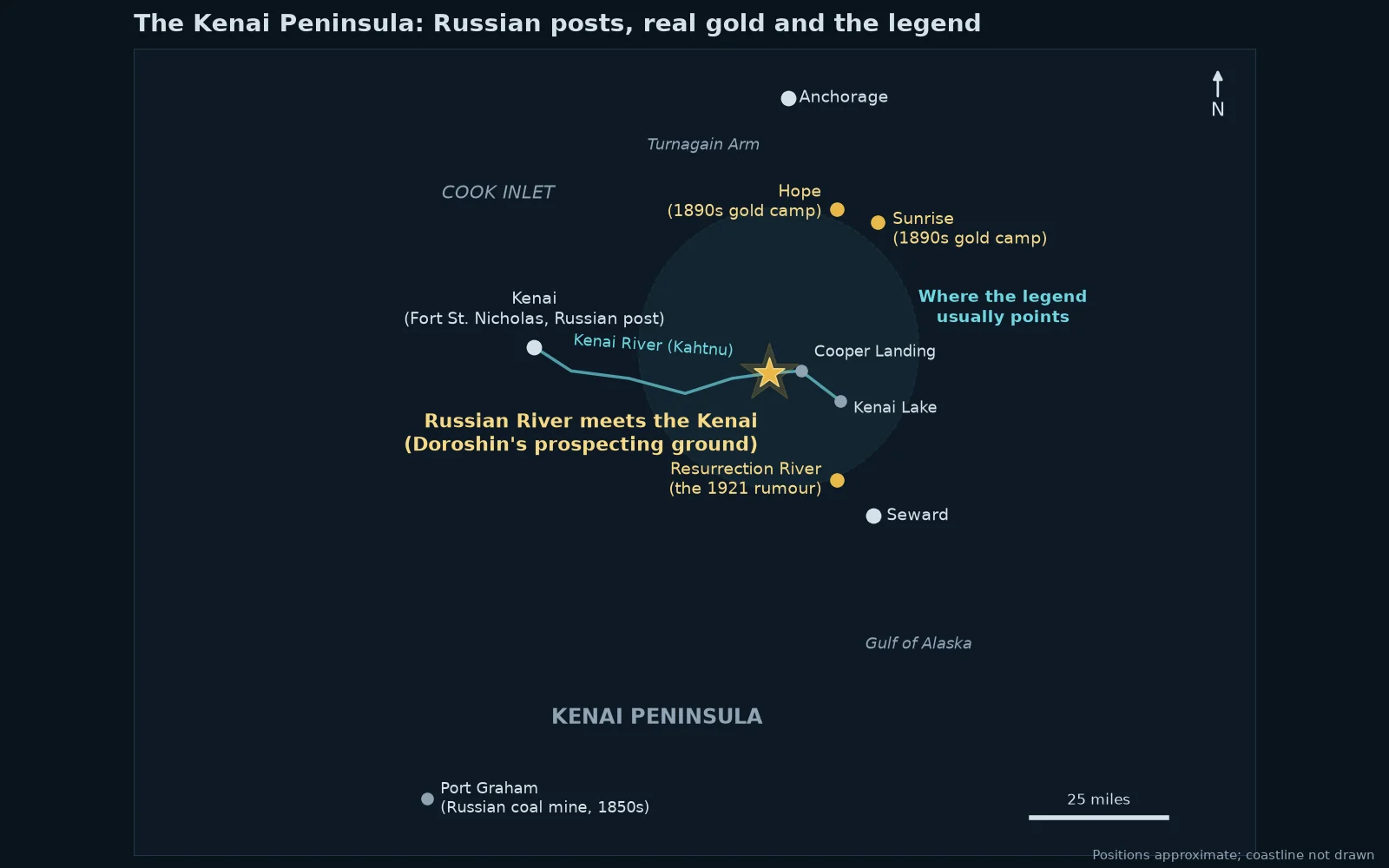
Where the Russian River meets the Kenai is a place the Dena'ina call Sqilantnu. It has been a gathering place for thousands of years, and its archaeological sites were judged eligible for the National Register of Historic Places in 1981. Keep that spot in mind. It is exactly where the gold story starts, and it was nobody's empty wilderness.
The Russians arrive on the Kenai
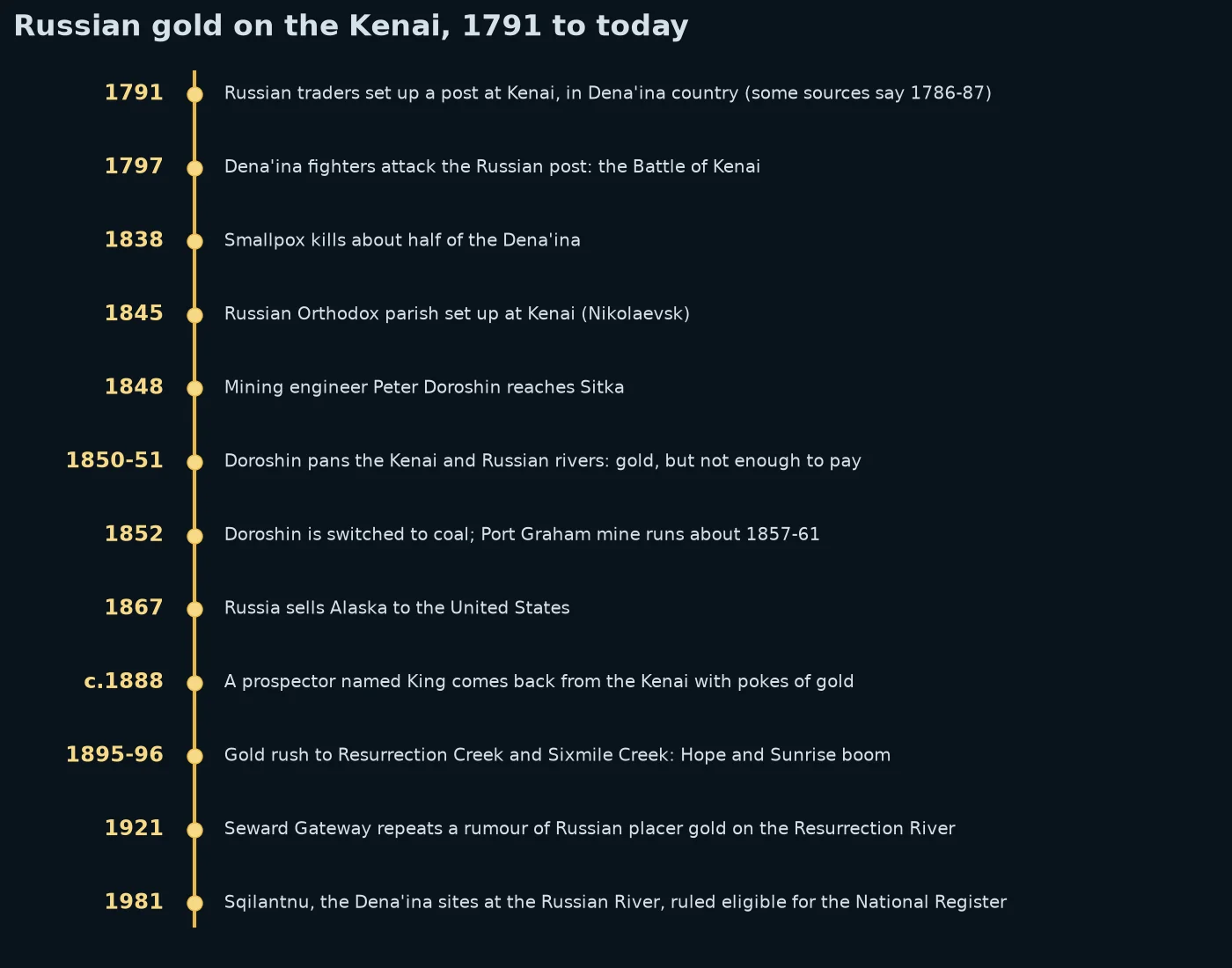
Russian fur traders pushed into Cook Inlet in the late 1700s. Around 1791 (some sources say 1786 or 1787), men of the Lebedev-Lastochkin Company built a fortified post at the mouth of the Kenai River, called Fort St. Nicholas, or Nikolaevsk. It was no cosy trading cabin: one account describes two large blockhouses and a battery of cannon.
Relations with the Dena'ina went badly. In 1797, after years of harsh treatment by the company's men, Dena'ina fighters attacked the fort in what is remembered as the Battle of Kenai. Sources differ on the details and the number of dead, but historians treat it as a turning point: the Russians never really ruled the Kenai Dena'ina, who stayed largely independent until the sale of Alaska. Russian traders instead relied on Dena'ina partners at Kenai, Tyonek, Knik and elsewhere to bring in furs from the interior.
The Dena'ina also paid a terrible price for contact. A smallpox epidemic in the late 1830s killed about half of them. In 1845 the Russian Orthodox Church set up a parish at Kenai, and its church, rebuilt in 1895 and 1896 as the Holy Assumption of the Virgin Mary Church, still stands today as a National Historic Landmark.
Peter Doroshin: the engineer who found gold in Alaska
Now for the man at the centre of the legend, and he is refreshingly real.
Peter Petrovich Doroshin was born in 1823 in Petrozavodsk, in Russian Karelia, and graduated from the St. Petersburg Mining Institute in 1845 as a lieutenant in the Corps of Mining Engineers. The Russian-American Company, which ran the colony, wanted to know whether Alaska held anything more valuable than sea otter pelts. So in 1847 Doroshin was assigned to Russian America, and he stepped ashore at New Archangel (today's Sitka) on April 15, 1848.
His timing was almost comic. That same year, gold was found in California, and the company promptly sent Doroshin south to take a look. In early 1849 his small crew worked the Yuba River diggings and, according to the Alaska Mining Hall of Fame, came away with nearly 12 pounds of gold in 49 days, enough to buy a ship and sail it back to Sitka. Not bad for a business trip.
Then he turned to the Kenai. The best-documented seasons are 1850 and 1851, though some accounts say his first panning on the peninsula happened as early as 1848. His party, made up of Russians, Creoles (people of mixed Russian and Native descent) and Tlingit men, worked their way up the Kenai River toward Kenai Lake, camping near today's Cooper Landing and panning with a traditional Russian wooden trough pan called a lotok. Local histories say the Russian River got its name because Doroshin camped there.
How much gold did the Russians really find?
Here is the slightly deflating answer: not much. Doroshin found gold, but nowhere in amounts worth mining. Estimates of his total haul run from a few ounces to about a pound. The American geologist Alfred Brooks wrote that Doroshin "sluiced out a few ounces of gold," and called it the first gold known to have been recovered in Alaska.
The 1850 season was hampered by forest fires. In 1851 he spent 66 days in the field and noticed the grains got bigger the further upstream he went, which is exactly the kind of clue that makes a prospector's heart race. But he never reached the mountain core where he thought the source veins might lie, and in 1852 the company switched him to a far less glamorous job: finding coal. He did, and a Russian coal mine ran at Port Graham, near the tip of the peninsula, from the late 1850s until about 1861, when fire damage and cheaper foreign coal finished it off.
Doroshin left Alaska in 1853, went on to a distinguished mining career back in Russia, and died near Moscow in 1875. No portrait of him has ever been found, which is rather fitting for the ghost at the heart of a lost-gold legend.
Did the Russians keep the gold a secret?
This is where history starts to blur into legend. A popular account in Alaska's historical columns says the Russians didn't announce their gold because they feared a rush of American, British and other gold seekers into their colony. It is a perfectly believable motive. California had just shown the whole world what a gold rush does to a place, and Russia's grip on Alaska was thin.
But "kept it quiet" is a long way from "buried a fortune." Doroshin's own reports were published in a Russian mining journal in 1866, and every account of his work describes small amounts of gold and a man reassigned to coal. That isn't the paper trail of a secret bonanza. If there was a hidden hoard, nobody wrote it down.
1867: the sale, and the rumours left behind
In 1867 Russia sold Alaska to the United States for $7.2 million. Russian officials and many of the company's people went home, and in Alaska's imagination, the Russians became the perfect owners of a lost treasure: they knew the country, they had looked for gold, and they had gone home.
Sure enough, the rumours followed. In 1921 the Seward Gateway newspaper ran an item, quoted in a National Park Service history of the Kenai Fjords coast, reporting a story that the Russians had found placer gold up the Resurrection River, near Seward, and abandoned it because of the change in ownership. Even the paper hedged. It called the tale:
"like unto a legend that placer gold was found by the Russians on the high reaches of Resurrection River"
"Like unto a legend" is about as honest as a treasure story ever gets. Brilliant.
The Kenai gold rush that came true
Meanwhile, real gold was waiting, just not where anyone expected a Russian to have hidden it.
Around 1888, a prospector remembered as King (some writers call him Alexander King; others say his first name is unknown) talked a Kenai trading post into grubstaking him, rowed up Turnagain Arm and came back late in his second summer with four pokes of gold. He never properly revealed where he got it. Gold was later found on Resurrection Creek, and a July 1895 discovery set off a stampede the following year.
By 1896 the Upper Kenai was swarming. Two camps sprang up: Hope, at the mouth of Resurrection Creek, and Sunrise, at the mouth of Sixmile Creek. One estimate puts the summer's arrivals at up to 3,000 people; another says Sunrise briefly held about 800 and was, for a few weeks, the biggest town in Alaska. By the winter of 1896 and 1897, only about 80 people were left in Hope and about 150 in Sunrise. The boom faded after 1898, and Sunrise eventually emptied, while Hope hung on and is still there today.
And here is the detail that pours fuel on the legend: according to local history, American miners in the Hope area found old abandoned workings that they put down to the Russians. Nobody has proved who dug them, or when. But imagine being a cold, broke 1896 prospector stumbling on someone else's old diggings in the woods. It's not hard to see how "the Russians were here first" became "the Russians hid their gold here."
The legend, as it's told today
Ask around, read the treasure lists, or watch a short video, and the story usually runs like this: early Russian prospectors on the Kenai found far more gold than they admitted, stashed a large amount of it somewhere near the peninsula, and never came back for it after the sale of Alaska. Some modern online lists go further, with dollar values in the millions and mystery prospectors with names like "Old Joe," but they cite no sources at all, so treat those numbers as campfire talk.
What you won't find is a named Russian who buried it, a date, a map, a letter, a ship's manifest or a court case. For a legend about a hoard, it is rather short on hoard.
The theories, weighed
- A real hidden cache. The romantic favourite. The trouble: Doroshin's records show small amounts of gold, the company moved him to coal, and no document mentions gold being stored or hidden on the Kenai.
- A real Russian strike, lost rather than hidden. Maybe someone, Russian or Creole, found a richer spot than the official reports admit and the knowledge died with them. Possible, and impossible to check. The 1921 Resurrection River rumour fits this version.
- The old workings explained. The abandoned diggings near Hope may have belonged to the Russians, to early American prospectors like King, or to someone else entirely. Either way, holes in the ground grow into legends very easily.
- A story built on a true fact. The most likely answer. Russians really did find the first gold in Alaska on the Kenai, they really did leave in 1867, and the gold rush of 1896 really did prove the country held gold. Put those three facts together and the "lost Russian gold" practically writes itself.
The honest verdict? The Russian gold was real. The Russian hoard is a story. But nobody can prove a negative, which is precisely why people keep looking.
Visiting the Kenai's Russian gold country today
Fancy a look for yourself? Splendid. The good news is that this is some of the most beautiful country in Alaska, and much of it is easy to reach from Anchorage along the Seward and Sterling highways. The land, though, has owners and rules, so here's how to do it properly.
- The Russian River and Kenai River confluence. Doroshin's prospecting ground is now a busy fishing spot near Cooper Landing, inside the Chugach National Forest and next to the Kenai National Wildlife Refuge. The Sqilantnu lands around it were conveyed to Cook Inlet Region, Inc., the regional Alaska Native corporation, and are managed together with the Kenaitze Indian Tribe and the federal agencies. Archaeological sites here are protected by law: look, learn and leave everything exactly where it is.
- K'beq' Cultural Heritage Site. The Kenaitze Indian Tribe runs this site on the Kenai River near mile 52 of the Sterling Highway, across from the Russian River Campground, with a Dena'ina house pit, fish cache pits and a boardwalk trail. It reopened in 2024 after the 2019 Swan Lake fire and is open in summer. Easily the best way to hear this valley's history from the people whose history it is.
- Hope. The surviving 1890s gold camp at the mouth of Resurrection Creek, with old buildings and the start of the Resurrection Pass Trail nearby.
- Recreational gold panning. The Forest Service and the Bureau of Land Management publish a guide to recreational gold panning on the Kenai Peninsula, with stretches of Resurrection Creek and Sixmile Creek set aside for it. Panning there is a privilege, not a mining right: work only the active stream channel or bare gravel bars, don't dig into stream banks, and no hydraulic or earth-moving equipment. Much of the rest of the creek country is covered by active mining claims, which are private property, so check the current maps with the Forest Service before you dip a pan.
- Kenai's Russian past. In Old Town Kenai, the Holy Assumption of the Virgin Mary Church, a National Historic Landmark, is the most visible reminder of Russian America on the peninsula.
And the Alaskan small print: this is bear country, the rivers are cold and fast, and the weather changes its mind several times a day. Tell someone where you're going, carry bear spray, and don't wander off chasing a sparkle.
The Russians went home. The gold they found was real but tiny. The hoard they supposedly left behind has never turned up, and on the Kenai, a good story has always been easier to find than a good nugget.
...and if you find it, remember who encouraged your questionable life choices.
The short version of this story is on YouTube at @TenToeExpress.
Deep dive yourself
- Peter Petrovich Doroshin · Alaska Mining Hall of Fame Foundation
- From Russia with Love: Celebrating Russian mining engineer Peter Petrovich Doroshin, by Thomas K. Bundtzen (2015) · Alaska Historical Society
- A Stern and Rock-Bound Coast, Chapter 7: The Lure of Gold · National Park Service, Kenai Fjords Historic Resource Study
- Russian America on the peninsula in the mid-1800s, by Shana Loshbaugh (2017) · Peninsula Clarion
- Gold brings prospectors to Cook Inlet, by Laurel Downing Bill (2018) · Senior Voice Alaska
- Hope is only surviving gold camp from Upper Kenai Peninsula gold rush · Sketches of Alaska
- Communities · Dena'ina Qenaga
- Kenaitze cultural site reopens after five years (2024) · KBBI / KDLL Public Radio
- Gold Panning: Guide to Recreational Gold Panning on the Kenai Peninsula, Chugach National Forest · Bureau of Land Management and USDA Forest Service
- Holy Assumption of the Virgin Mary Church · Wikipedia (a starting point, with references to the National Park Service landmark nomination)