 Ten Toe Express
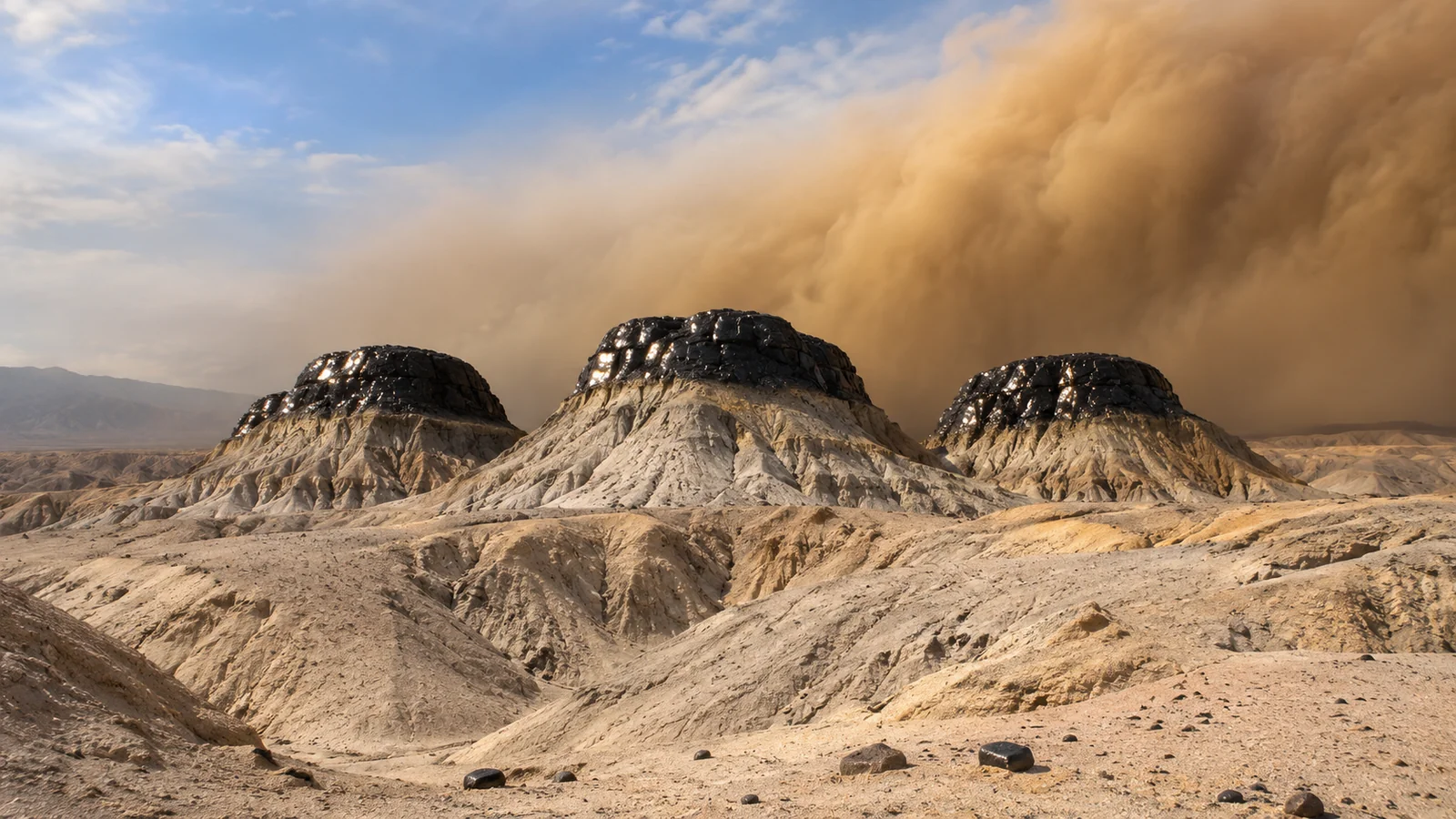
Picture a sandstorm roaring across the California desert, a one-legged fur trapper clinging to a rock, and a pocketful of ugly black pebbles that turn out to be gold. Right then. That is the story of Pegleg Smith's lost black gold, the most famous treasure legend in California's Colorado Desert, and it has sent people tramping around the badlands near Anza-Borrego for close to two centuries.
The trouble is the buttes. Smith supposedly found the black nuggets on one of three hills, never managed to find them again, and spent the rest of his life selling the story to anyone with a shovel and a thirst for adventure. Whether any of it is true is a very good question, and the answer is hiding in a very hot place.
Who Was Pegleg Smith?
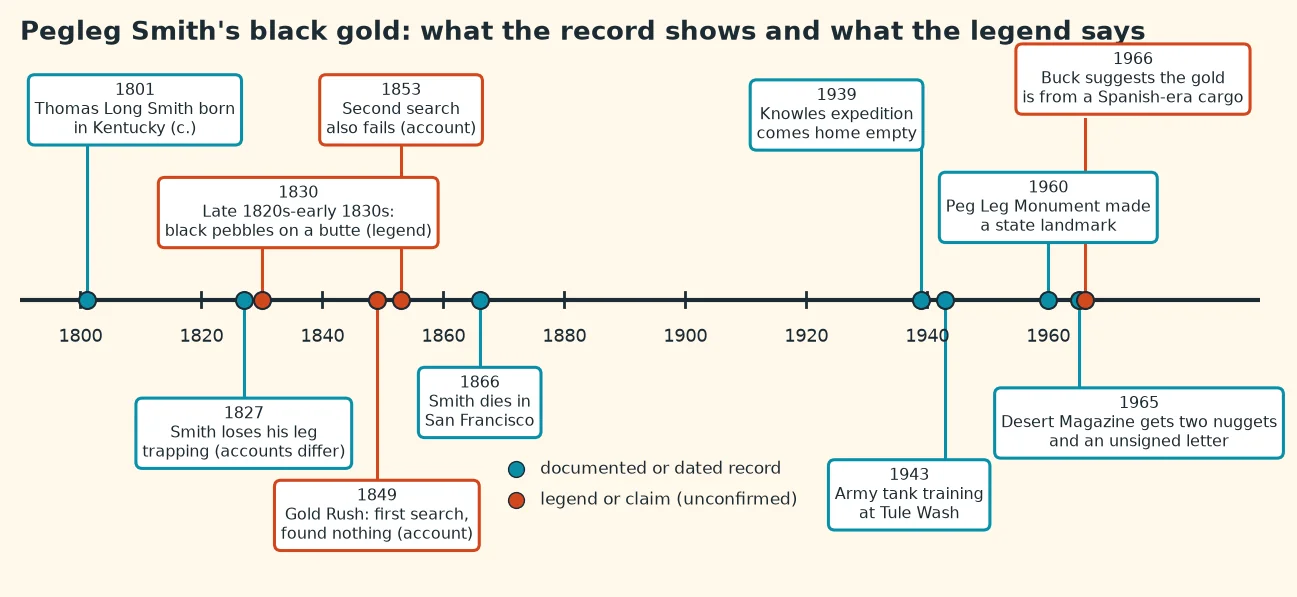
The man was real. Thomas Long Smith was born in Kentucky around 1801 and drifted west into the fur trade, working the Rockies and the Southwest alongside the sort of characters who fill history books. He lost part of a leg, and the wooden replacement gave him his nickname. How he lost it depends on who is telling the tale: one account has an arrow in the fall of 1827, another a gunshot to the knee followed by infection. Some versions say he cut the leg off himself. That detail is unsourced, so treat it with a raised eyebrow.
When the fur trade faded, Smith turned to horses, and not politely. By the 1840s he was running stolen horses out of Mexican ranchos in California, working with the Ute leader Walkara. He also ran a trading post for emigrants along the Oregon Trail. He died in San Francisco in 1866. That is the documented part. Notice what is missing: any record of a gold find.
The Legend: Black Pebbles on a Butte
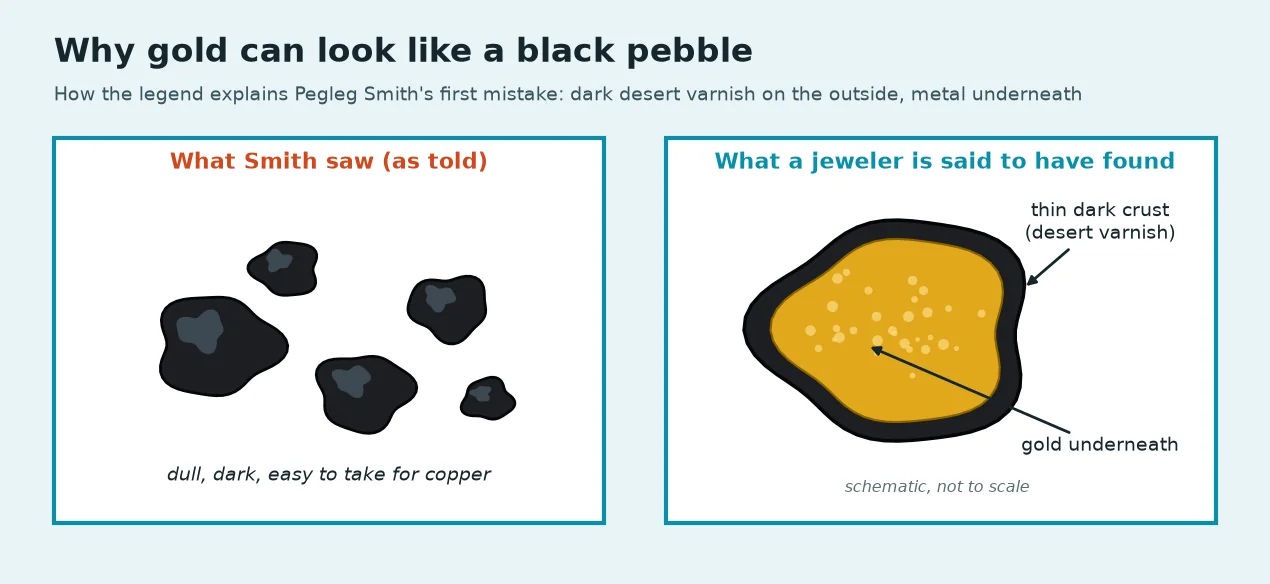
Here is the story as it is usually told. In the late 1820s or early 1830s, Smith was hauling furs toward Los Angeles through the Colorado Desert when a sandstorm trapped him. To get his bearings, he climbed a rocky butte and, almost idly, picked up a few black pebbles. He took them for copper. In Los Angeles, the story goes, a jeweler told him they were gold nuggets coated in dark desert varnish, the thin dark crust that forms on rocks in dry country.
Most versions say the butte was one of three. That is the entire map. Three hills in a country with plenty of hills, seen once through a sandstorm, by a man who then went on a drunken spree in town, got thrown out of Los Angeles and stole 300 to 400 horses on his way to Taos, New Mexico. As an exit strategy it was memorable.
The searches that went nowhere
- After the 1849 Gold Rush, Smith reportedly led a party back to the desert. It found nothing, and he deserted it.
- In 1853 he organized a second search. That one failed too.
- Along the way he sold hand-drawn maps and stories about the site. One account says he did it with a mine that may never have existed.
Other Black Gold Stories
Smith's tale did not stay alone for long. Over the years the desert collected more black-nugget legends, and they are worth knowing as legends, not records.
- The Apache story: a desert area littered with gold nuggets, whose location tribal law forbade revealing.
- The lost woman: a Native woman, parched and wandering, is said to have climbed one of three buttes, found black-coated nuggets, and then been helped at a railroad construction camp she spotted from the top.
- The Yaqui man: a Yaqui worker near Warner's Ranch reportedly vanished into the desert whenever he needed cash and came back with black gold. After he died in a fight, the story says, about $4,000 in gold was found in his bunk.
- The soldier and the doctor: a discharged soldier is said to have followed Smith's trail, found the buttes and died with his party near the San Ysidro Mountains, while a miner with about $7,000 in gold died in Los Angeles after being cared for by a Dr. DeCourcy, who searched for years and never found the hills.
Warner's Ranch became the usual starting point for expeditions. Jonathan Tibbet Sr. led searches in the late 1800s, and in 1939 a well-funded party under Charles Knowles combed the Tule Wash and Ocotillo Wells area and came home with nothing. Another tale has a prospector, Walter "Dutch" Everett, vanishing on a search, with his mules wandering back to Warner's Ranch alone. That one is told as lore and the desert certainly did not argue with it.
The 1965 Letter That Restarted Everything
For decades the legend simmered. Then, in February 1965, Desert Magazine received a package: a letter, an unsigned manuscript and two gold nuggets, one still black, one cleaned to gold. The sender signed it "The Man Who Found Peg Leg's Black Gold." The letter ran in the March 1965 issue, and the nuggets were reported as confirmed real gold.
The writer claimed he had collected about $315,000 worth between 1955 and 1965 while hunting rocks and wildflowers within 30 miles of the Salton Sea. He pointed toward the Ocotillo Wells area but never named the spot. He mentioned a corroded buckle and a sword scabbard hilt, possibly tied to Juan Bautista de Anza's expedition of 1775-76. Follow-up letters offered clues about volcanic formations and washes, never a location. The black coating, he suggested, might be copper oxidation. Some followers say so; nobody has proved it.
The story set off a treasure-hunting frenzy and a surge in metal detector sales. It also revived the idea that the black gold might not be Smith's at all. Writer Robert Buck suggested in Desert Magazine in June 1966 that it came from the cargo of an old Spanish-era expedition. And at least four other black nuggets have reportedly turned up within about 30 miles of each other in the Colorado Desert. Intriguing. Also not a gold mine.
Where Is It Supposed to Be?
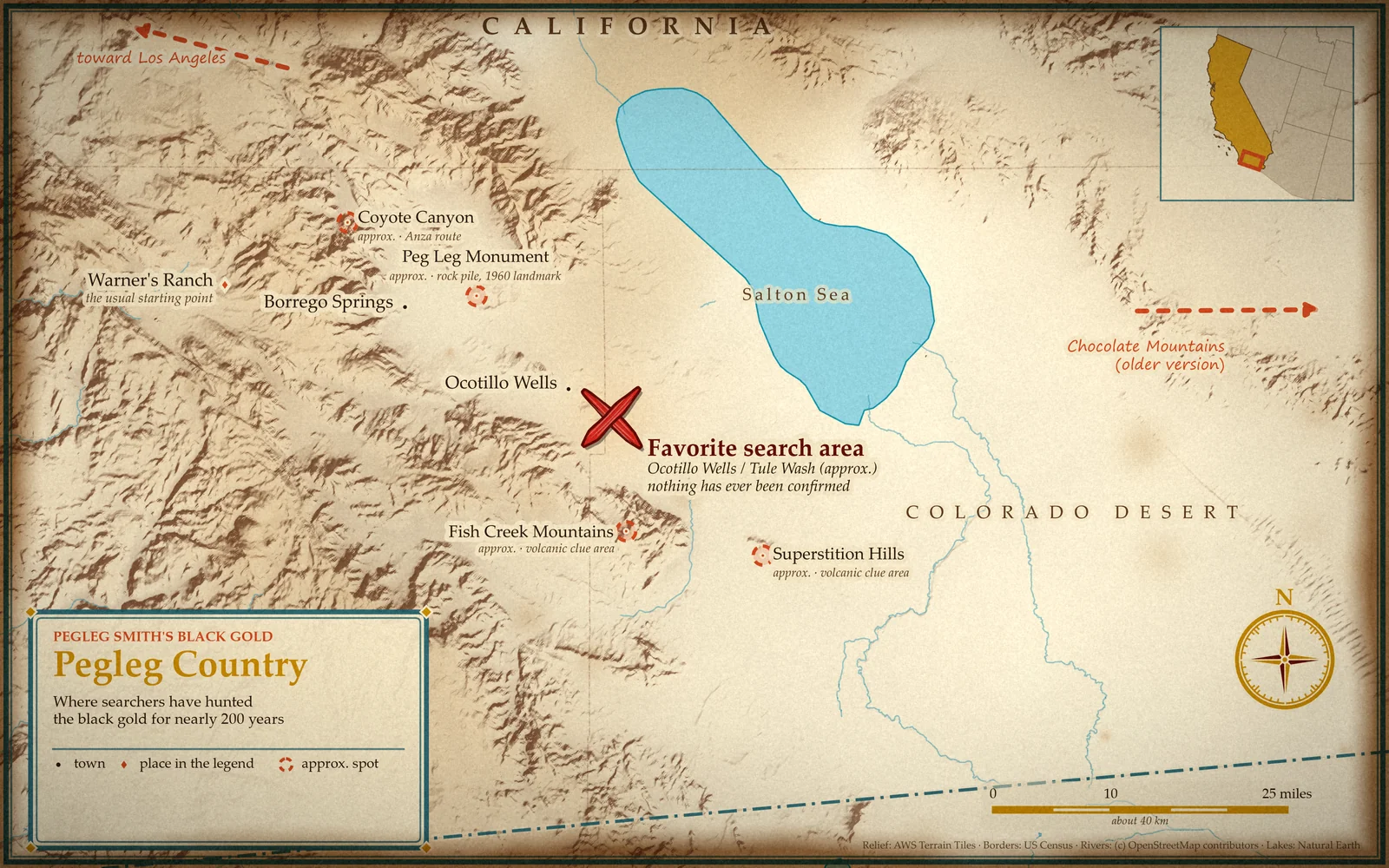
Searchers have pointed at several places, none of them confirmed:
- Ocotillo Wells and Tule Wash: the favorite since 1965. The Army trained tank units there in 1943, which left thousands of metal fragments, so a detector goes off at everything.
- The Superstition Hills and Fish Creek Mountains: volcanic country that fits the "volcanic formations" clues.
- The Anza route: Coyote Canyon, San Felipe Wash, Borrego Sink and San Sebastian Marsh.
- The Chocolate Mountains: an older version of the legend, farther east, nearer the Colorado River.
The honest summary is that the legend places the buttes somewhere in a huge area, and no documented record of Smith's find has ever turned up. Skeptical versions argue that he sold a mine that did not exist. Believers answer that a man who could not find the buttes again had every reason to sound unconvincing. Pick your side.
The Liars Contest and the Rock Pile
If the gold is lost, the legend certainly is not. Harry Oliver, an Academy Award-winning Hollywood art director, built a rock pile as a monument to Smith near Borrego Springs. Oliver called Smith "the greatest prevaricator of all" and dated a liars contest to 1916 informally and 1948 formally, though accounts of the first public contest differ. California made the monument a state historical landmark in October 1960. Tradition says you add ten rocks to the pile for luck.
The Pegleg Smith Liars Contest is still held every year around Borrego Springs. The tales are limited to five minutes, and judges score the story, the costume and whether Pegleg Smith is included. Calling him "Pegleg Pete," who was a different person, costs you points. It has moved from the first Saturday in April to the first Saturday night in March, and in recent years to the American Legion hall, after new state park rules required a special permit, a ranger and a large insurance policy. Fittingly, the best-known treasure legend in the desert now has a contest where lying is the whole point.
Where It Stands Today
You can visit the Borrego Springs area, camp, hike and drive its dirt roads, and the Anza-Borrego Desert State Park is the largest state park in California. But do not bring a shovel or a metal detector to the party. In the park, metal detecting, digging and removing artifacts are prohibited, and fines and confiscated equipment await violators. Nearby Ocotillo Wells is a state vehicular recreation area with fewer restrictions, though vehicles must stay on designated trails. The Tule Wash area is on federal Bureau of Land Management land just outside the park. Heat and flash floods are serious hazards: a 2023 expedition near Tule Wash was abandoned because of the weather.
No one has ever shown where Smith's butte stands, or that it exists at all. The legend keeps growing in the one place it cannot be checked.
...and if you find it, remember who encouraged your questionable life choices.
The short version of this story is on YouTube at @TenToeExpress.
Deep dive yourself
- Thomas L. Smith · Wikipedia
- Pegleg Smith's Lost Gold: A Desert Legend Reimagined · DesertUSA
- Pegleg Smith's Gold · DesertUSA
- Pegleg's Gold Found? · DesertUSA
- Pegleg Liar's Contest · DesertUSA
- Peg Leg Smith · Digital-Desert
- Anza-Borrego Desert State Park · California State Parks