 Ten Toe Express
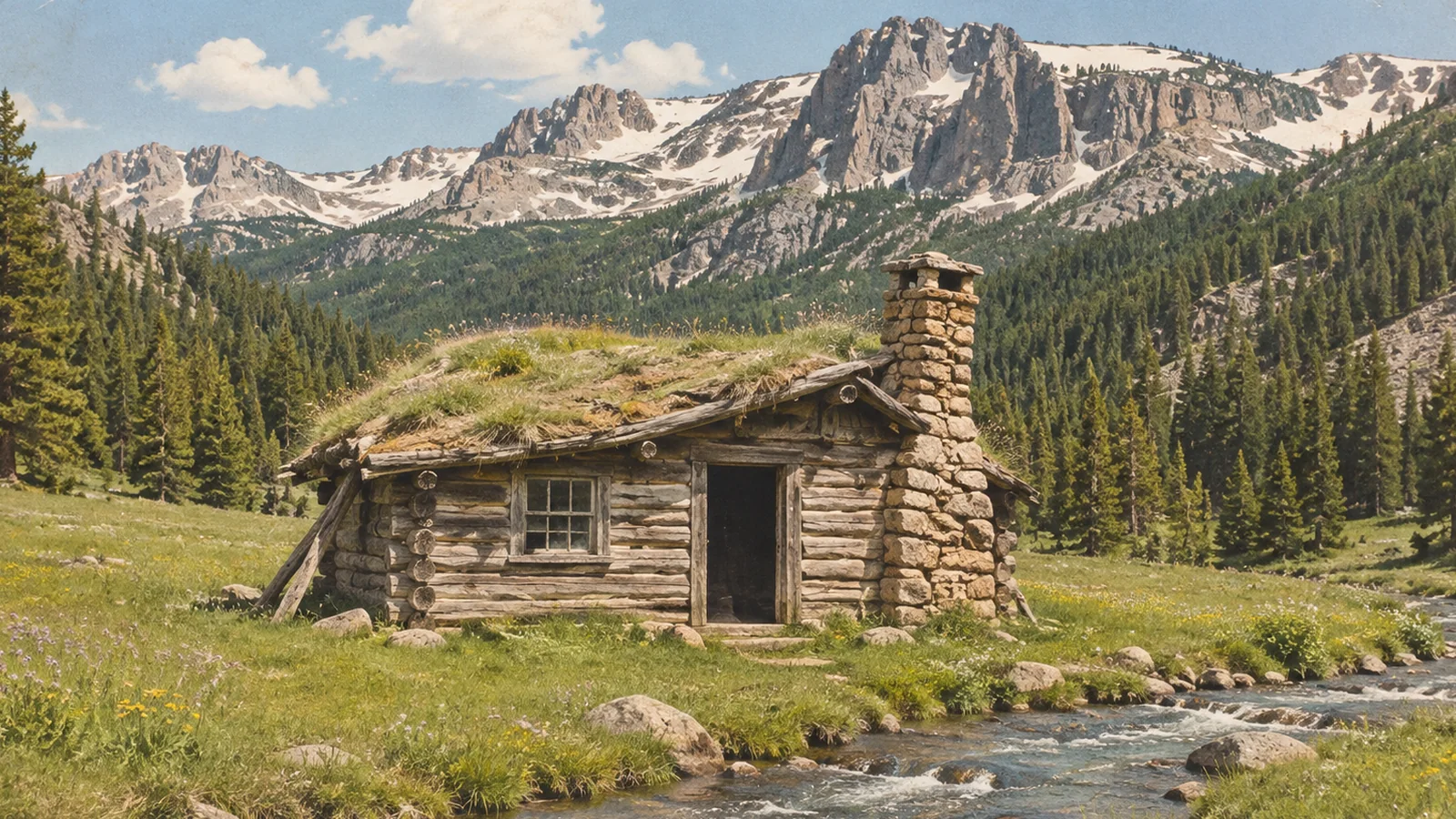
Right then, picture a cabin. Logs, a stone chimney, a little stream chattering past the door, and inside it a gold deposit so rich that men were supposedly stuffing their pockets before the kettle boiled. Now picture trying to find it again. That is the whole problem with the Lost Cabin Mine, Wyoming's most stubborn gold legend, said to be tucked away somewhere in the Bighorn Mountains.
For well over a century, people have gone looking. They have followed creeks, argued over carved rocks, shouted in saloons and named a whole settlement after the thing. What they have not done, as far as any record shows, is bring home the gold. The mine is, officially, lost. Unofficially, it may never have been there at all.
Where is the Lost Cabin Mine?
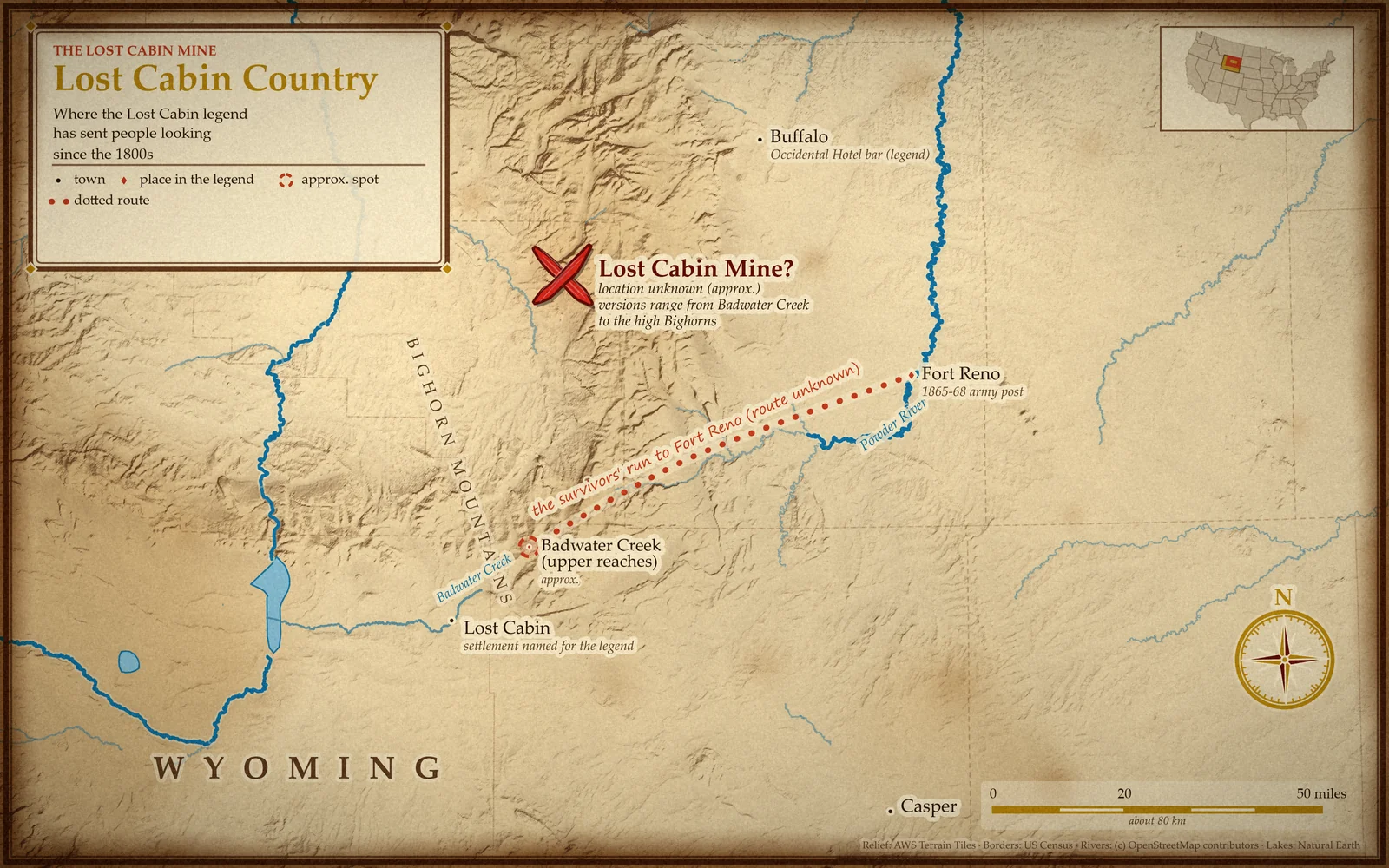
The Bighorns are a sister range of the Rockies, a long wall of granite, meadows and dark forest that rises over the grasslands of north-central Wyoming, roughly halfway between Mount Rushmore and Yellowstone. Plenty of lost mines hide in big country. This one hides in a particularly big, particularly vague corner of it.
Some tellings put the cabin along Badwater Creek, which runs west along the southern edge of the range and joins the Wind River. Others shrug and say it is somewhere in the Bighorns, which is a bit like telling a postman the parcel is "in England". The Wyoming State Library's record of the legend nudges the spot to the hills northwest of the little settlement of Lost Cabin. Nobody has pinned it down, which is rather the point of a lost mine.
The Lost Cabin legend, version one: seven Swedes
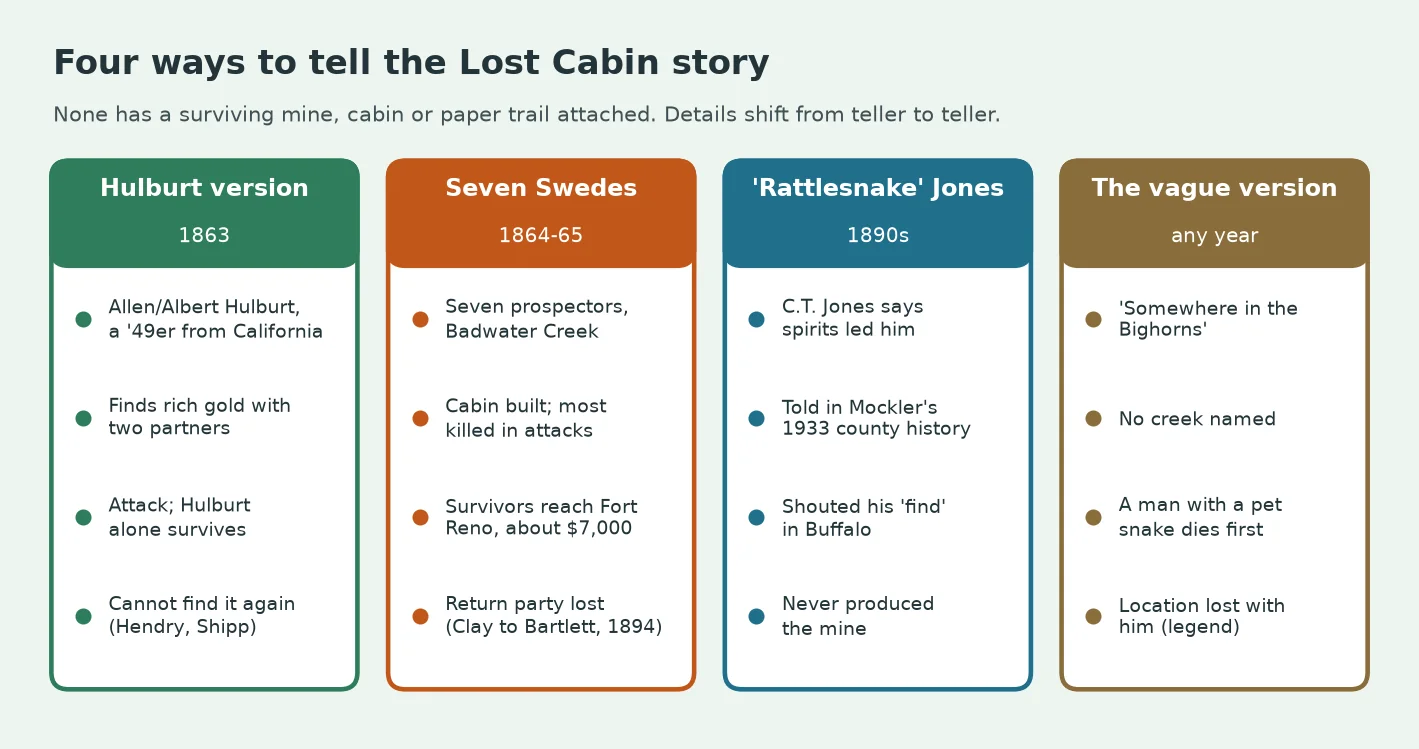
The best-known telling goes like this. In the 1860s, seven prospectors, often described as Swedes, struck gold in the Bighorns. They built a cabin and got to work. Then, the story goes, Native American raiders attacked the camp and killed most of the men.
Two (some tellings say three, or one) escaped. They crept out by night, reportedly carrying around $7,000 in gold, and made for Fort Reno, the army post on the Powder River in what is now Johnson County. The survivors had never bothered to note landmarks or name the creeks, so when they tried to lead a party back, the trail went cold. Details beyond that depend on which storyteller you ask.
The most detailed version comes from the Swedish professor Hans Lonegren, who dug through military records, newspapers and early histories. In his account, seven Swedes left the Black Hills in late fall 1865 and found gold on Badwater Creek. The survivors reached Fort Reno, were briefly arrested as deserters, and later deposited about $7,000 in gold at a Laramie bank. A second expedition of twelve men set out in May 1866 and vanished.
That version leans on a real-sounding paper trail: a man named Charles Clay reportedly told it to a Mr. Bartlett in March 1894 (Clay said he heard it from the survivors), and it was published in 1919. Note the gap. That is a story told nearly thirty years after the events, then printed another twenty-five years later.
Version two: Hulburt and the vanishing cabin
Another account credits a man named Hulburt, a California '49er (the sources disagree on whether he was Albert or Allen, which is not a promising start). In this version, dated to 1863, Hulburt found rich gold near the Bighorn River with two partners, Cox and Jones. Attackers struck, only Hulburt survived, and he made his way to the Fort Casper area. A search party he led never found the mine. The Wyoming State Library's record says much the same: he discovered a rich mine, built a cabin, and then lost track of both.
A related Wyoming State Library entry notes that the story of a "Lost Cabin" mine turns up in other parts of Wyoming too, which suggests the name belongs to a whole family of tales, not one location.
Version three: "Rattlesnake" Jones
Then there is the cast member every good legend needs. C.T. "Rattlesnake" Jones was, by the telling, an eccentric man who kept rattlesnakes as pets and claimed spirits had directed him to the mine. One account has him in 1890 blowing open the doors of the Wyoming Saloon in Buffalo and announcing that he had found it. His version appears in Alfred James Mockler's 1933 History of Natrona County, Wyoming.
Another telling folds in a Buffalo man who wore a live rattlesnake around his neck. About to reveal the location at the bar of the Occidental Hotel, he was bitten and died before he could say a word. The Jim Gatchell Museum in Buffalo confirms a real "Rattlesnake Jack," a wrangler in the late 1800s and early 1900s who wore a live snake, but his link to this legend is only possible, not established. It is, nevertheless, the best use of a snake in any treasure story.
Fact versus legend: what the records show
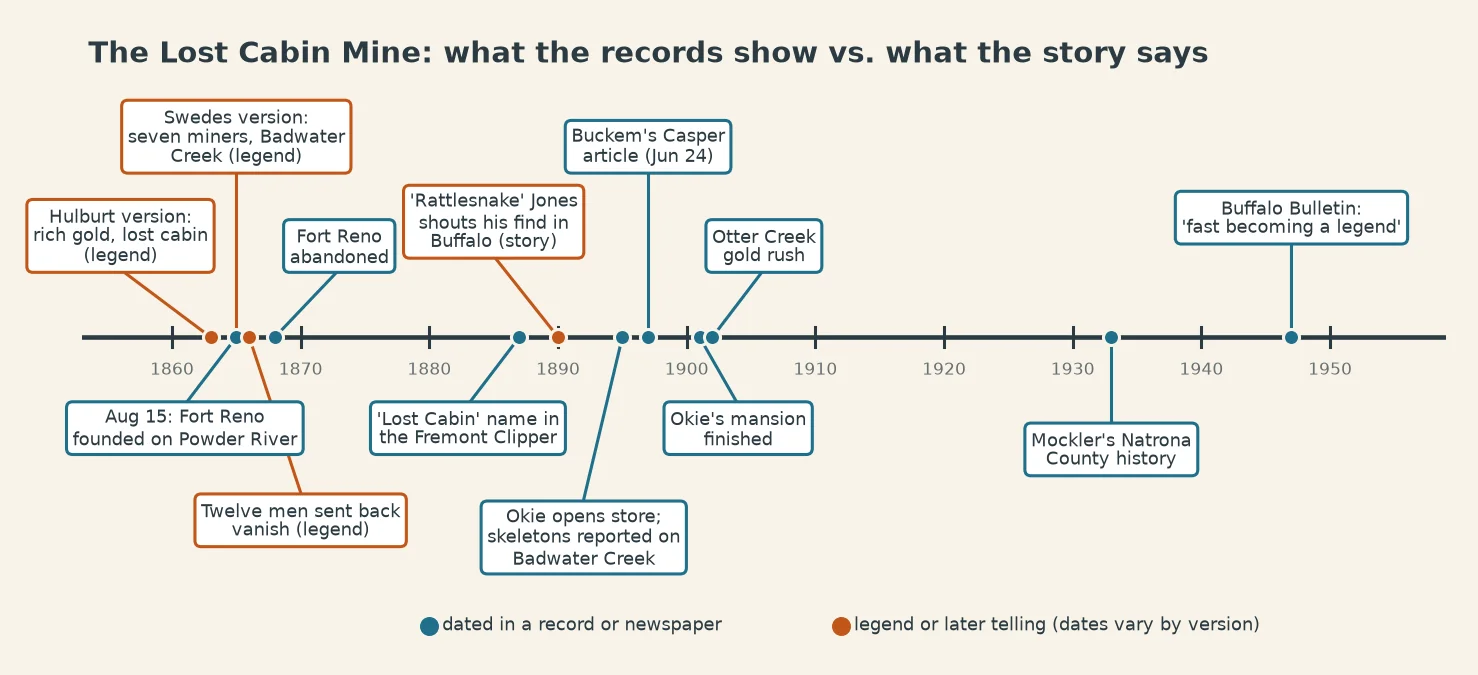
Strip away the retellings and the paper trail is thin. Here is what can actually be pinned to a date:
- Fort Reno is real. It was founded on August 15, 1865, on the Powder River, garrisoned until 1868 and abandoned under the Fort Laramie Treaty of 1868. Cheyenne warriors burned it soon after the soldiers left.
- The name "Lost Cabin" is in print by 1887, in the Fremont Clipper.
- The story had been written down by the 1890s. Mockler's history cites a Casper article by Charles K. Buckem dated June 24, 1897.
- A newspaper in 1947 called the mine "fast becoming a legend" and said countless expeditions had gone looking.
And what cannot be pinned down? The seven prospectors. The attack. The $7,000. The cabin. Sylvia Bruner, director of the Jim Gatchell Museum, found no record of the attack and no paper trail for it. Lonegren, after all his digging, found no proof the mine existed, though he did not rule it out. His point: the dates and places fit real events, such as Fort Reno standing in 1865.
The clues: a carved boot and twelve skeletons
Every lost mine needs a clue or two. This one has several, none of them solid.
First, a carving resembling a Spanish boot, cut into a granite boulder in the Bighorns. It was photographed in December 1966 and described by the historian Mary Hendry. Prospectors have long believed it is a map to the mine, with its arrows pointing into or out of the design. Documented fact: a boot-shaped carving exists and was photographed. Legend: that it has anything to do with gold.
Second, a newspaper reported in 1895 (the dates in some accounts wobble between 1894 and 1895) that cowboys found twelve skeletons in an aspen grove on Badwater Creek, with soldier's uniform buttons among them. Twelve, conveniently, is the number of men said to have vanished in 1866. Whether the two are connected is guesswork, and it is worth saying plainly that nobody has linked those remains to the legend.
The town named for a mine nobody found
Here is the part that is solid. The settlement of Lost Cabin, on Badwater Creek in Fremont County, was named for the legend. Sheep rancher J.B. Okie, known as the "Sheep King" of central Wyoming, opened a store near Badwater Creek in 1895. One account says a remark that the store would be "a gold mine" inspired the name, though the name was already in the Fremont Clipper eight years earlier.
Okie made himself at home. By 1901 he had finished a two-story, 16-room mansion of wood and local stone, with a veranda on three sides and an octagonal tower on top. Shoshone visitors reportedly called it the "Big Teepee," and the name stuck. It is now owned by ConocoPhillips and is closed to the public. The man who named his empire after a lost mine, it seems, found his own gold in sheep.
The searches since
The Bighorns have had real gold excitement, just not the Lost Cabin kind. Bald Mountain City boomed in the western Bighorns and then went bust. The historian John Woodward notes the small amounts of gold found there rarely covered the cost of getting it out, and that the range's geology is not associated with major gold deposits.
In 1902, the Otter Creek rush briefly looked promising. Two men claimed a strike about 60 miles from Buffalo, and the Buffalo Bulletin reported it on August 13, 1902. A townsite was reportedly chosen. The rush produced only traces of gold, much like other Bighorn streams.
The Summer 1967 issue of Long John Latham's True Treasure covered the mine, and visitors driving Highway 16 across the Bighorns will pass a "Lost Cabin Road" sign. Whether any modern searcher has spotted the cabin is a very short story: none has been confirmed.
Theories, weighed
- It was real, and the wilderness swallowed it. Plausible in a big range with few landmarks, but it needs the whole paper trail to have gone missing, and gold geology says the Bighorns are a poor bet.
- It was a real strike, wrongly placed. The "Lost Cabin" name turns up in other Wyoming legends, so the tale may have drifted from somewhere else entirely.
- It is a campfire story that grew. Versions disagree on names, dates, numbers and places, and the first telling in print comes decades after the events. This one is hard to argue against.
Can you visit the Lost Cabin Mine today?
Nobody can visit what has not been found, but you can certainly visit the country. The Bighorn Mountains are managed as Bighorn National Forest, with the supervisor's office in Sheridan (307-674-2600), and the settlement of Lost Cabin sits on Badwater Creek in Fremont County. Public land has rules on digging, mining claims and cultural sites, so check with the Forest Service before packing a shovel. The scenery alone makes the drive worth it, which is just as well.
...and if you find it, remember who encouraged your questionable life choices.
The short version of this story is on YouTube at @TenToeExpress.
Deep dive yourself
- The Legend of Lost Cabin · WyoFile
- Treasure Hunters Still Search for Lost Cabin Gold Mine · Cowboy State Daily
- J. B. Okie, Sheep King of Central Wyoming · WyoHistory.org (Wyoming State Historical Society)
- Lost Cabin · Wyoming State Library digital collections
- Lost Cabin Mine, Bighorn Mountains · Wake Up Wyo
- Fort Reno (Wyoming) · Wikipedia
- Bighorn National Forest · U.S. Forest Service