 Ten Toe Express

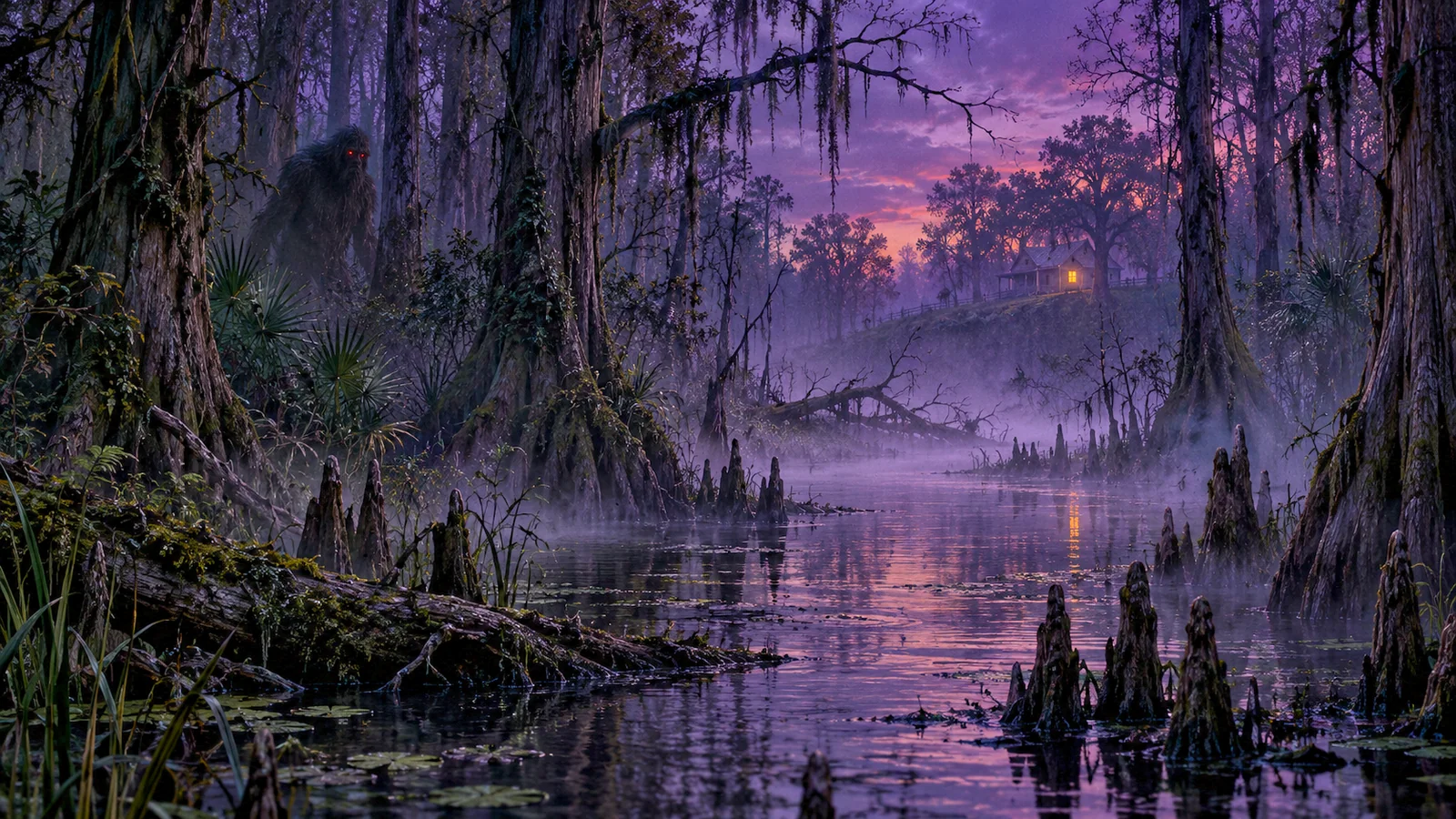
Four young adults, one car and a long, empty road. It is the evening of November 15, 1966, and something very large, very dark and very much not a pigeon is standing near an abandoned World War II explosives plant outside Point Pleasant, West Virginia. By the time the story ends, a whole town will have a monster of its own, a bridge will have fallen into the Ohio River, and people will still be arguing about it all decades later. Right then: meet the Mothman.
Be warned before you start: this is a legend with a very real tragedy parked right next to it. The Mothman sightings are stories people told. The Silver Bridge collapse is a documented disaster that killed 46 people. Keep the two apart in your head and the story gets a lot more interesting, not less.
The TNT area: a very odd place to start a legend
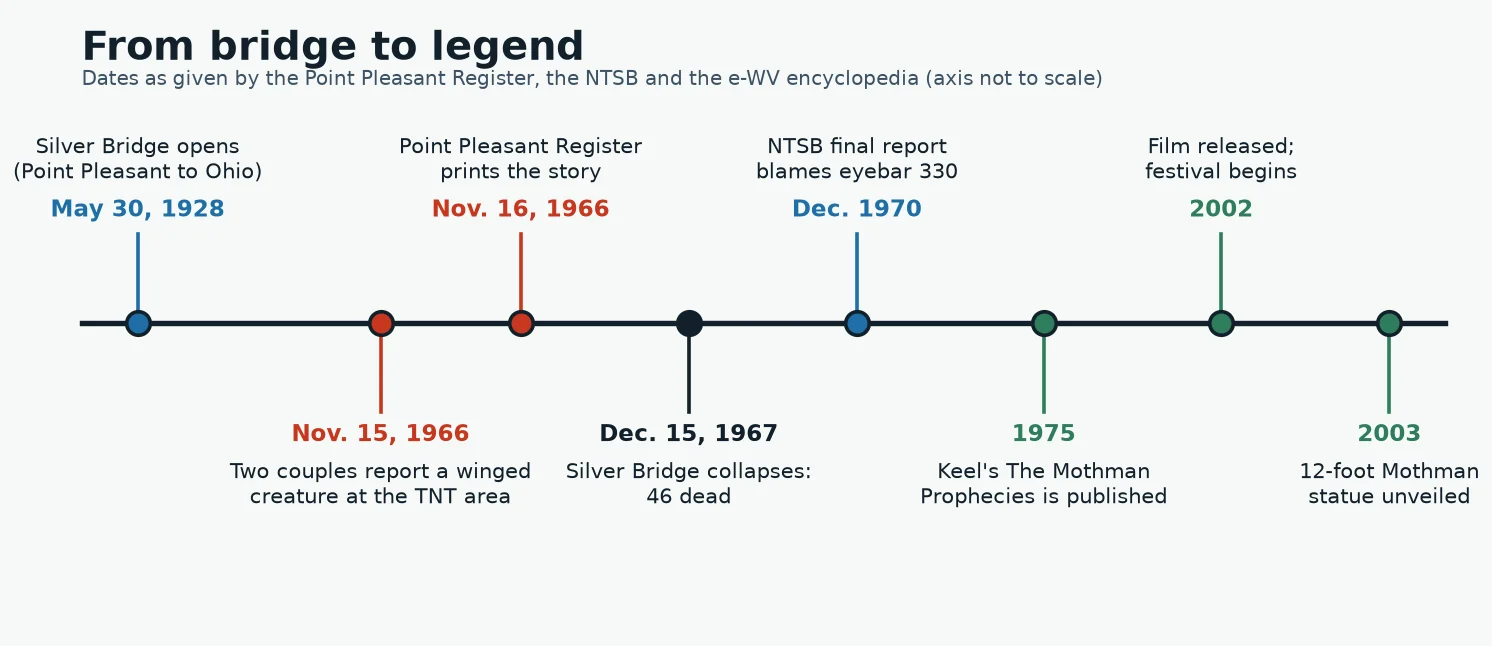
Point Pleasant sits where the Kanawha River meets the Ohio, across the water from Gallipolis, Ohio. A few miles north, along State Route 62, lies the "TNT area". During the Second World War it was an ammunition plant covering more than 8,000 acres, with explosives stored in scattered bunkers hidden under thick layers of earth. After the war the land became a wildlife management area, and parts of it were used as a landfill. Overgrown concrete igloos, empty roads and thick woods: if you were designing a spot for a monster story, you would be fairly pleased with the result.
November 15, 1966: the night in the Point Pleasant Register
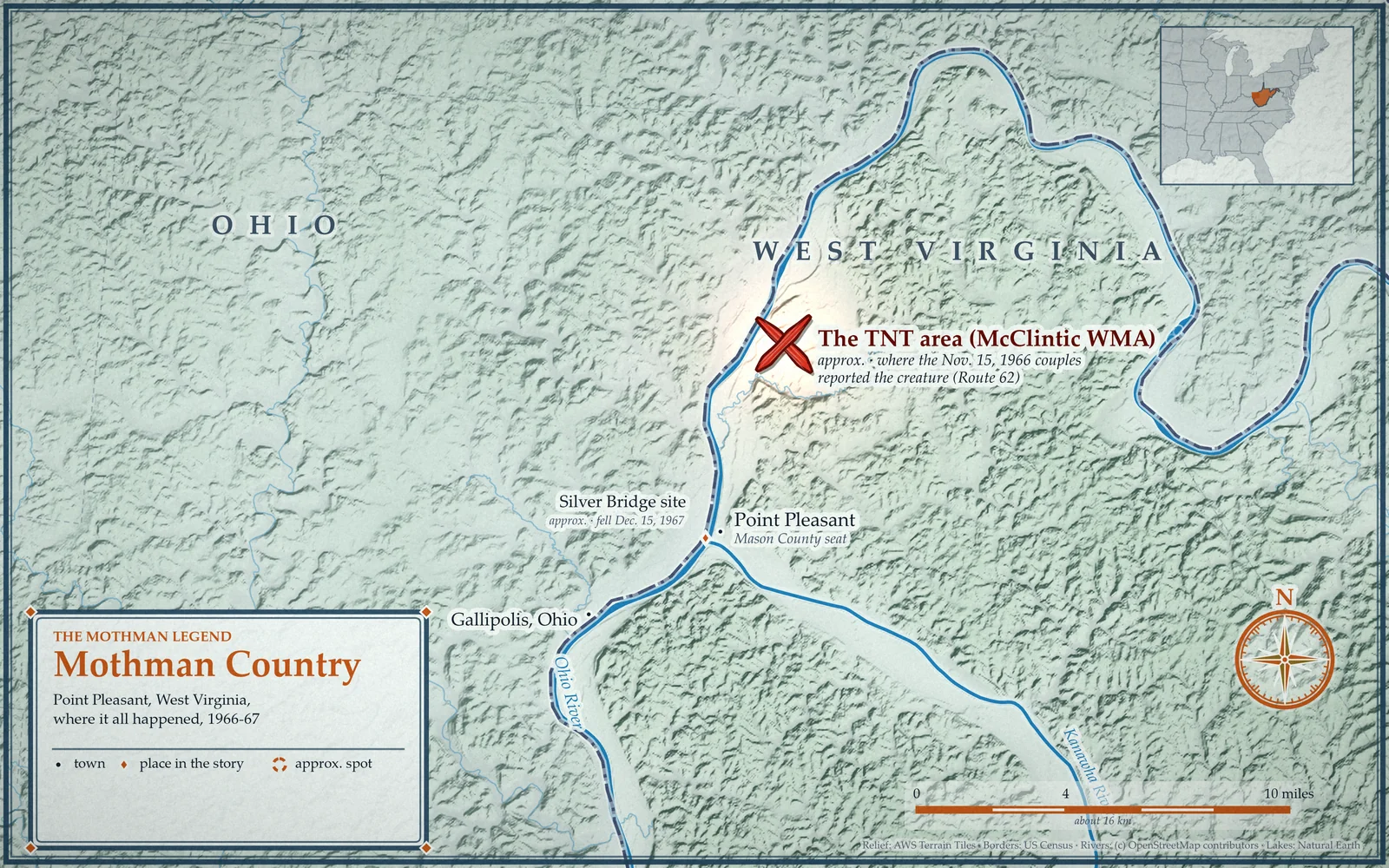
On that November night, two young couples, Roger and Linda Scarberry and Steve and Mary Mallette, were out driving near the TNT area. According to the accounts that make up the legend, they saw a large winged creature with glowing red eyes. Roger Scarberry took off, the creature supposedly followed, rising like a helicopter and keeping pace with the car at around 100 miles an hour. They went straight to the police.
The Point Pleasant Register ran the story the next day under the headline "Couples See Man-Sized Bird... Creature... Something." You have to admire the honesty of that last word. National newspapers soon picked it up, and a small West Virginia town found itself in a very odd spotlight.
More reports followed. Two volunteer firemen described a large bird with red eyes. Contractor Newell Partridge said that when he shone a flashlight at something in his field, its eyes glowed like bicycle reflectors, and he later blamed the creature for the disappearance of his German Shepherd, Bandit. The West Virginia Encyclopedia counts 26 sightings over about a year. You will find much bigger numbers online, but those come from later retellings rather than a documented tally.
The official answers: a very large heron
Mason County Sheriff George Johnson had a plain explanation: an unusually large heron. Robert L. Smith, a wildlife biologist at West Virginia University, offered another: a sandhill crane that had strayed off its migration route. A big grey-brown bird, standing tall, with a long neck and pale red patch on the head: it is not a crazy suggestion. It is also a less exciting headline, which may explain why nobody printed it in letters four inches high.
Later skeptics added their own. Joe Nickell, writing in the Skeptical Inquirer in 2002, first thought of a barn owl, then settled on a barred owl. His clue was eyeshine, the reddish glow an owl's eyes can throw back when light hits them, and the fact that the TNT area is wildlife habitat with plenty of owls. Another writer, Daniel Reed, suggested a great blue heron. The weak spot for the owl idea is size: witnesses described something close to human height, and no owl is that big.
Strange phones, strange visitors
As the weeks went on, the local stories got stranger. According to the West Virginia Encyclopedia, people also reported disrupted phones, police radios, televisions and car engines, along with UFO sightings. Writer John Keel, a New Yorker who arrived to chase the story, added tales of "men in black" visitors to the mix. This is where the record and the legend part ways: the sightings are documented only as things witnesses said, and the electronic oddities and visitors rest on Keel and later retellings rather than on any official file.
December 15, 1967: the Silver Bridge falls
Here the legend runs into a hard fact. The Silver Bridge opened on May 30, 1928. It was an eyebar-chain suspension bridge, 2,235 feet long, carrying U.S. Route 35 over the Ohio River between Point Pleasant and Gallipolis. On December 15, 1967, in heavy rush-hour traffic, it fell. Forty-six people died, and two of them were never found.
Investigators later found a cause that had nothing to do with winged visitors. A single link, eyebar 330, had failed. A crack about 0.1 inch (2.5 millimetres) deep, formed by fretting wear and stress corrosion, had grown in a place nobody could see. Each link in the chain had only two eyebars, so when one let go the other was overloaded and failed too. State inspections, one as recently as December 6, 1967, did not catch the crack: the part was inaccessible to visual inspection. The National Transportation Safety Board's final report was adopted on December 16, 1970, after an interim report in October 1968. In plain terms, the design made the bridge very hard to inspect and, in the end, very likely to fail.
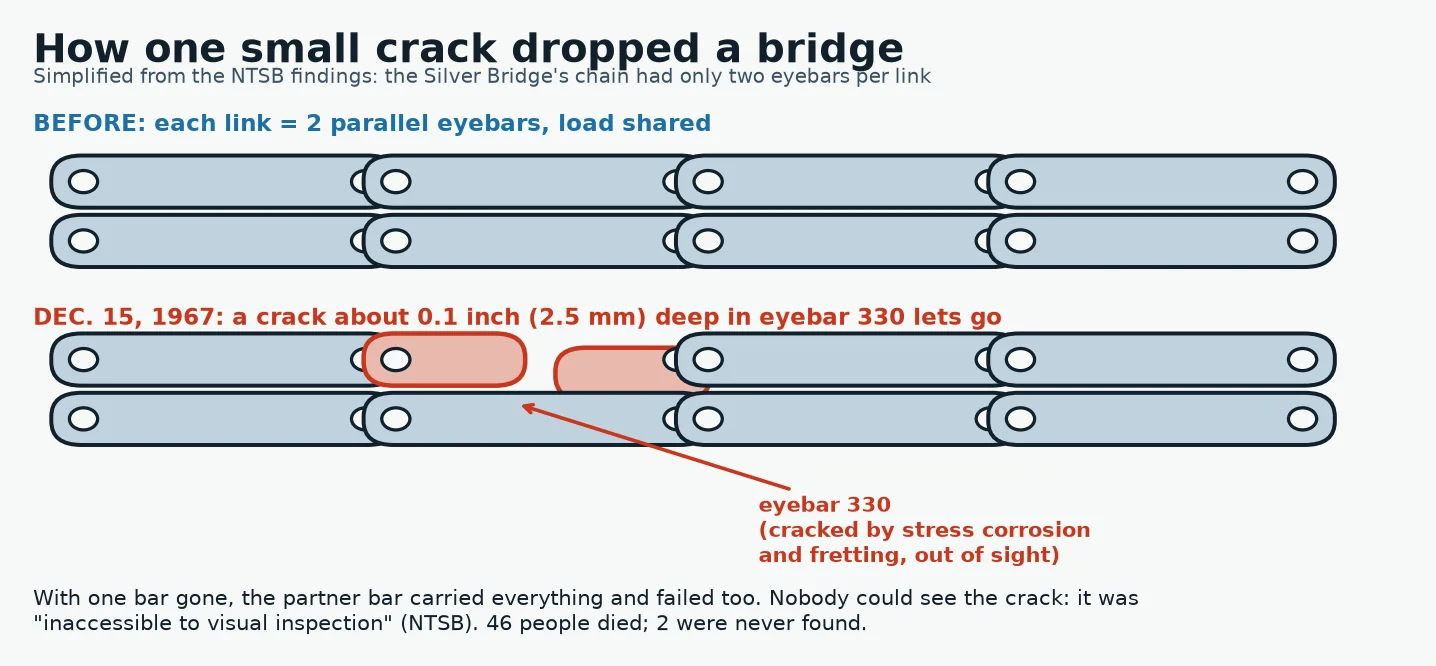
Something good came out of the wreckage. The disaster pushed the United States into its first national bridge inspection program under the Federal-Aid Highway Act of 1968, and the Silver Memorial Bridge opened on December 15, 1969, about three-quarters of a mile downstream. Bridges across the country get checked today partly because of what happened in Point Pleasant.
How the Mothman got blamed for a bridge
After the collapse the Mothman sightings faded. Some people later claimed they had seen the creature on or near the bridge the day before it fell, and the idea took hold that the creature had been a warning. Gray Barker pulled the two stories together in a 1970 book, The Silver Bridge, and John Keel made the idea famous in his 1975 book The Mothman Prophecies. A popular local theory goes even further back, linking the whole thing to a curse said to have been laid by the Shawnee chief Cornstalk, who was killed at Point Pleasant two centuries earlier. That is folklore, and the records do not support it.
The simplest reading is also the least thrilling: a wave of sightings in the autumn of 1966, a tragedy a year later, and a storyteller who joined the dots. Nobody has produced evidence that the creature predicted anything. Then again, nobody has produced evidence that the creature was a heron, either. That, rather inconveniently, is how legends survive.
Mothman today: statue, museum and a festival
Point Pleasant decided long ago to lean in. A film version of The Mothman Prophecies, starring Richard Gere, came out in 2002, and the same year the town held its first Mothman Festival, now held in September and drawing thousands of visitors. In 2003 a 12-foot metallic Mothman statue by Bob Roach went up downtown, and in 2006 Jeff Wamsley opened the Mothman Museum and Research Center. The statue is the easy bit to visit: it stands in town, in public view, and photographs very well.
The TNT area is a wildlife management area today, so treat it as you would any managed public land and follow the posted rules. The bridge site is just a stretch of the Ohio River now, with the newer Silver Memorial Bridge downstream.
Fact versus legend
- Documented: the November 15, 1966 report, the Point Pleasant Register story of November 16, the Silver Bridge collapse, the 46 deaths, the eyebar failure and the NTSB findings.
- Told as legend: a creature that kept pace with a car, the glowing red eyes as a warning, the Cornstalk curse, the men in black.
- Nobody knows: what the witnesses actually saw. A bird is plausible, and some people will never accept it.
...and if you find it, remember who encouraged your questionable life choices.
The short version of this story is on YouTube at @TenToeExpress.
Deep dive yourself
- Mothman · Wikipedia
- Silver Bridge · Wikipedia
- Mothman · e-WV: The West Virginia Encyclopedia
- The Mothman of West Virginia · Legends of America
- Is the Mothman of West Virginia an Owl? · Audubon
- Silver Bridge Failure 1967 (aka Point Pleasant Bridge) · STRUCTURE magazine