 Ten Toe Express
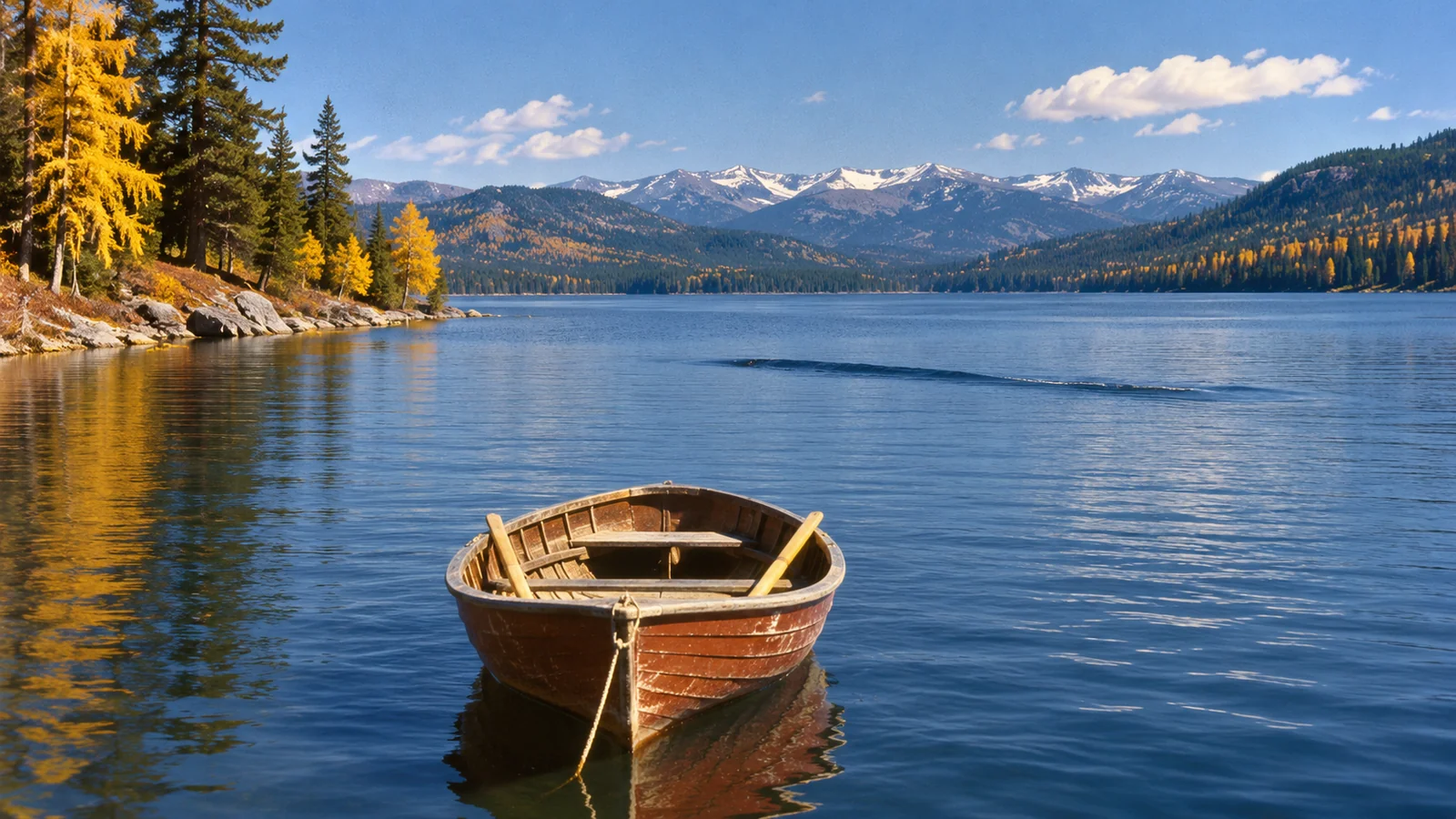
Picture a lake so big and so deep that the United States Navy decided it was the perfect place to test submarines. Now picture a rowboat on top of it, a bit of dark water rippling where nothing should be rippling, and a local telling you, perfectly calmly, that it's "just the Paddler". Welcome to Lake Pend Oreille in northern Idaho, home of the Pend Oreille Paddler, a lake monster with a Navy base for a neighbour and a papier-mache catfish for an alibi.
Right then. Is there something big and strange swimming in Idaho's deepest lake? Nobody has ever pinned one down. What you do get is a thoroughly entertaining pile of newspaper clippings, a college professor with a theory, a Navy commander with a retort, and one very awkward fact about sturgeon. Fancy a look?
Lake Pend Oreille: Idaho's Deep, Cold Hiding Place
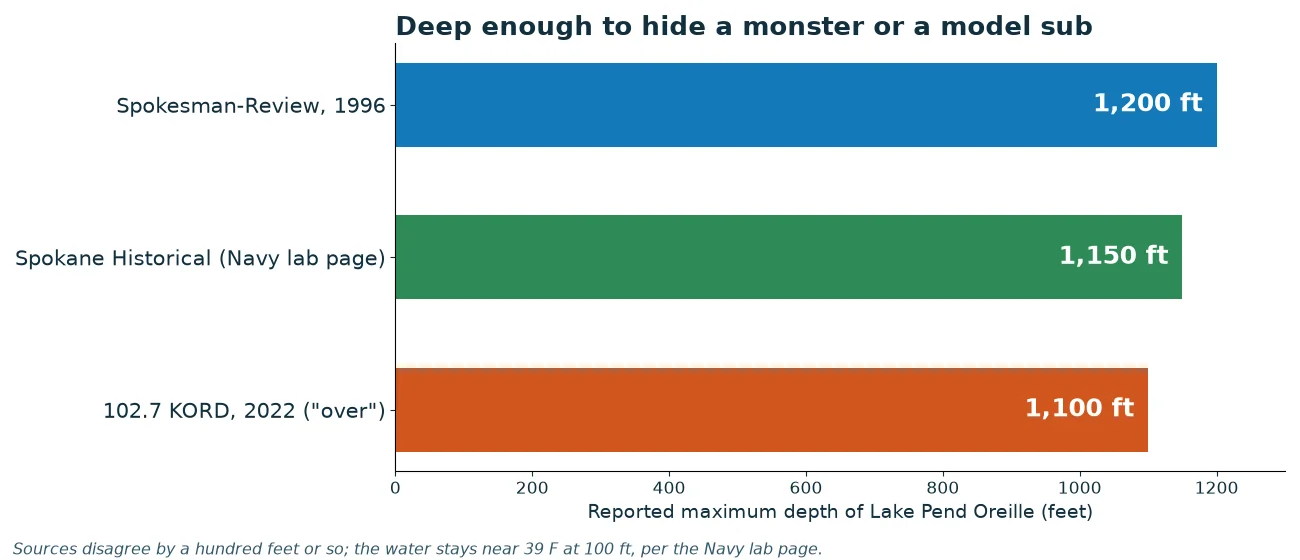
Start with the stage. Lake Pend Oreille (locals say "pond-der-ray") is a long, glacier-carved lake in the Idaho Panhandle, with towns like Sandpoint at the top and Bayview near the bottom. Sources give slightly different sizes: a 1996 Spokesman-Review story called it 43 miles long and 1,200 feet deep, while a Spokane Historical page on the Navy's lake work says 46 miles long and about 1,150 feet deep near the southern end. Either way, it is a big, serious lake, and the water at 100 feet down sits at a constant, chilly 39 degrees Fahrenheit.
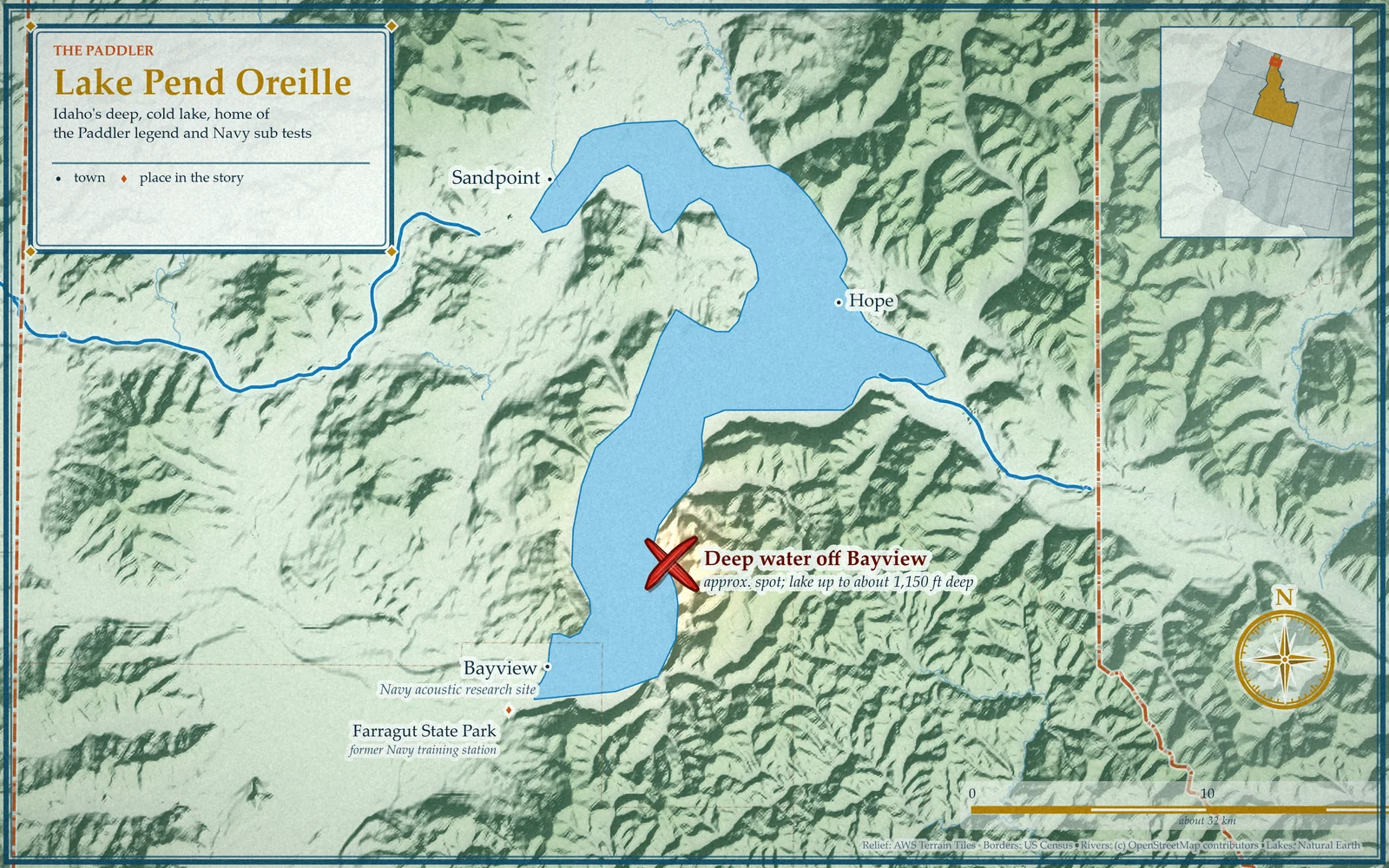
Deep, cold and calm turns out to be exactly what a navy wants for quiet-running tests, and that matters later. The Navy's Farragut Naval Training Station was built near Bayview in the 1940s (it is now Farragut State Park), and an acoustic research site on the same shore grew up alongside it. The sources disagree on the exact dates: one says 1942, another says the lake facility opened in 1946, and a third says the research detachment was part of Farragut "since 1955". Treat the decade as the reliable bit.
The Pend Oreille Paddler: A Monster With a Date Problem
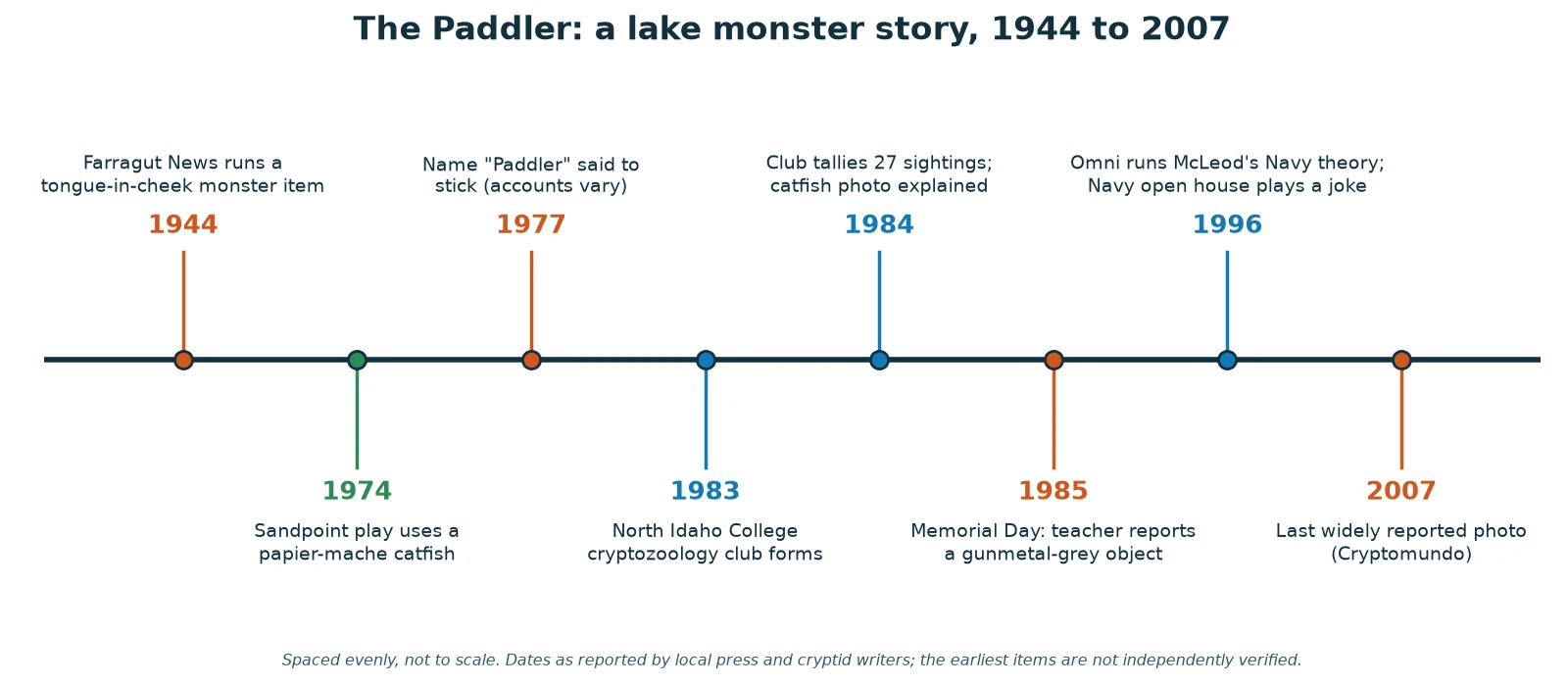
The Paddler's earliest reference is "said to date to" 1944. According to the Spokesman-Review, one of the first reports came from the Farragut base itself that year, when the base newspaper, the Farragut News, covered a monster "somewhat tongue-in-cheek" and ran a photo. That is the account the Navy-theory camp leans on, and it traces back to one researcher's telling, so it is best held with a raised eyebrow.
Then things go quiet in the record until the 1970s, when reports pick up again around Bayview, in the very years the Navy was testing torpedoes. The name "Paddler" is usually pinned to 1977. The popular version has a young girl playing at Sandpoint's City Beach and surviving a monster attack, and a reporter or two dubbing the creature the Pend Oreille Paddler. Sandpoint Magazine, retelling it, notes the name dates from 1977 "when what turned out to be a papier-mache catfish supposedly attacked a young girl near city beach". Yes, you read that correctly. The attacker may have been a prop.
The Papier-Mache Catfish
Here's the bit the monster hunters would rather skip. According to Wikipedia, a Sandpoint play in October 1974 featured a papier-mache catfish, and that prop is the origin of a tabloid photo of the "monster". By late 1984, the article says, the Paddler was found to be a 12-foot papier-mache catfish from that play, and the nickname stuck regardless. In other words, at least one famous Paddler picture is a stage prop. Which is rather inconvenient for anyone hoping for a clean-cut cryptid.
Professor McLeod Goes Monster Hunting
Enter James R. McLeod, a teacher at North Idaho College in Coeur d'Alene. In 1983 he started a cryptozoology club there, after reading a lake-monster appendix in Loren Coleman's book Mysterious America. His students dug into the Paddler, and McLeod later published a book, Mysterious Lake Pend Oreille and its "monster": fact and folklore, in 1987. A 1989 Bonner County Daily Bee article reportedly counted 27 sightings as of 1984 from the club's work (a tally nobody has been able to check against the original newspaper). By 1996 the Spokesman-Review said he had "chased the legendary Pend Oreille Paddler for 14 years".
What did he conclude? Not that it was a plesiosaur. The club agreed the tabloid photo was the catfish, but McLeod still floated the idea that a real deep-water fish, perhaps a very big, very old-looking sturgeon, might explain some reports. He also said the story "may have started as a drunken hoax by some locals", which is a very Idaho kind of research finding.
Memorial Day, 1985
One of the better-known individual accounts comes from Memorial Day 1985, told in a 2022 write-up by 102.7 KORD, a radio station. A Coeur d'Alene teacher named Julie Green is said to have watched a large V-shaped wave cross about 200 yards in front of her 22-foot boat. Something "gunmetal-grey" was undulating in and out of the water. She gave chase, and it outpaced her. The article draws on a cryptid wiki, not a contemporary newspaper, so there is no way to confirm the details. Make of it what you will.
Was the Paddler Actually the Navy?
This is where the story gets properly interesting. McLeod's research led him to a bigger idea. The sightings, he said, "oddly coincide with Navy submarine tests". At the lake's south end, the Navy's acoustic research centre (the Spokesman-Review calls it the David Taylor Acoustic Research Center) works with scale models of submarines and torpedoes, designing craft that are hard for sonar to hear. According to the paper, model weapons were towed out, released at depth and, once they broke the surface, "can fly 20 to 40 feet in the air". Other gear was towed just below the surface on 300-foot cables. Nothing quite like that for starting a monster rumour.
The Spokane Historical page lists the fleet: quarter-scale models with fish names (Dolly Varden, Pike, Whitefish, Steelhead and friends), plus a larger vessel, the 110-foot Cutthroat, named by an elementary school student. It even quotes local rumours such as "They stirred up the 'Paddler'!" The Navy, the paper added, was not forthcoming about its lake tests until roughly the 1980s.
McLeod's theory made the cover of Omni magazine in November 1996. He said the early witnesses most likely saw model submarines and were dismissed as fools or pranksters. He was careful, though: he did not claim the military had a policy of concocting the story, only that its people helped foster the lake monster myth.
The Navy was having none of it. Commander Rick Schulz, who headed the research centre, told the paper the Navy would not go to that extent or effort to create a story to cover up its submarine testing, and called the idea "definitely false". He added that he could not rule out a worker chatting over a drink and saying, in effect, a little too much. And at an October 1996 open house, the base played recordings made in the lake and then, as a joke, played the sound made by the Paddler. Dry, that.
The Sturgeon Problem
The giant-sturgeon idea has its fans, and monster writers like to say sturgeon can grow up to 20 feet and over 1,500 pounds. The trouble is Idaho. A fisheries manager with Idaho Fish and Game's Panhandle Region told Sandpoint Magazine that the department has never documented a sturgeon in the lake. Sturgeon, he said, never colonized Pend Oreille because of downstream migration barriers. The same piece suggests some reports might be down to the unmanned submarines that ply the lake. So much for a prehistoric fish in the deep.
The KORD write-up adds one more oddity: a sonar company reportedly searched part of the lake and found "large blips", which it took to be very large fish swimming below 200 feet and weighing well over 200 pounds. The company is not named, so that stays a rumour, but a big, ordinary fish is a respectable candidate.
So What Is It? The Theories, Weighed
- A prop: The papier-mache catfish is documented to the extent that Sandpoint's own magazine and Wikipedia both mention it. It explains one famous photo, not the lot.
- The Navy: Models and subs on the lake are real and documented. Sightings and tests overlapping is plausible. A deliberate cover story is McLeod's claim, which the Navy flatly rejects.
- A giant sturgeon: Appealing, but Idaho's own fish manager says none has ever been documented in the lake.
- Logs, boats and railway cars: Wikipedia's list of mundane explanations includes waterlogged trees, stolen boats and railroad cars gone off the rails. The lake has seen its share of odd things.
- A hoax: McLeod himself thought the whole thing may have begun as a prank.
- Something unknown: Not ruled out, but not supported by any specimen, bone or clear photograph.
Where It Stands Today
Sightings have thinned. Wikipedia calls the 2007 photo (taken by a staff photographer for The River Journal and sent to the blog CryptoMundo) the last officially documented sighting. In 2009 a Washington State University English professor even ran a "Monsters" course that used McLeod's book. Meanwhile the Navy is still in business on the lake, and the lake still holds its cold secrets.
If you fancy a visit, Lake Pend Oreille is a lovely, public place to be: Sandpoint and Hope have waterfront access, and Farragut State Park, on the former training station, is a state park with its own rules and hours. The Navy research site is a working facility, so treat it as off-limits unless it holds an open day. A lake this beautiful hardly needs a monster, though it certainly wouldn't hurt the tourism.
...and if you find it, remember who encouraged your questionable life choices.
The short version of this story is on YouTube at @TenToeExpress.
Deep dive yourself
- Pend Oreille Paddler · Wikipedia
- Did Navy Use Fish Story As Cloak? Pend Oreille Paddler Said To Be Subs · The Spokesman-Review
- Idaho's Submarine Fleet: Acoustic Development Research Center · Spokane Historical
- Even Wilder Encounters · Sandpoint Magazine
- See the Secrets of the Northwest Lake Monster · 102.7 KORD