 Ten Toe Express
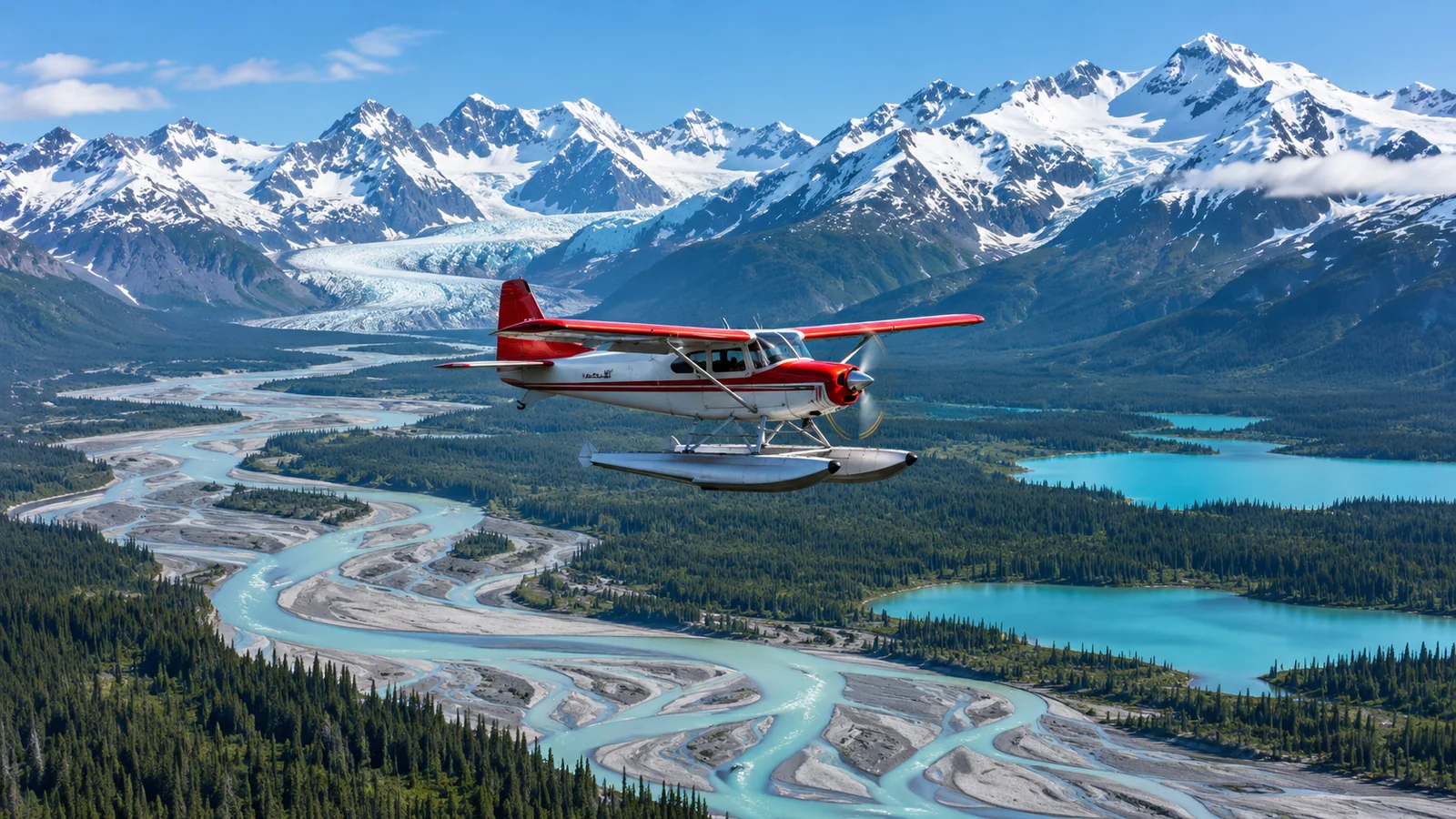
On the morning of October 16, 1972, a twin-engine Cessna 310 climbed out of Anchorage, Alaska, with four men aboard, one of them the House Majority Leader of the United States Congress. Ten minutes later the pilot made a routine radio call. Then the plane simply stopped existing. No wreckage, no bodies, no distress signal, not so much as a seat cushion, despite one of the biggest searches the state had ever seen.
Half a century on, that disappearance is the cornerstone of the Alaska Triangle: a supposed patch of wilderness between Anchorage, Juneau and Utqiagvik where people are said to vanish at a rate that would make the Bermuda Triangle blush. Right then, let's separate what the record shows from what the television shows.
The Alaska Triangle: what the name means
Draw lines from Anchorage to Juneau to Utqiagvik (the town long called Barrow, at the top of the state) and back, and you get a very large triangle. The most generous version covers about 185,000 square miles, close to the size of Spain. It holds mountain ranges, glaciers, rivers, tundra, rain forest and very few people.
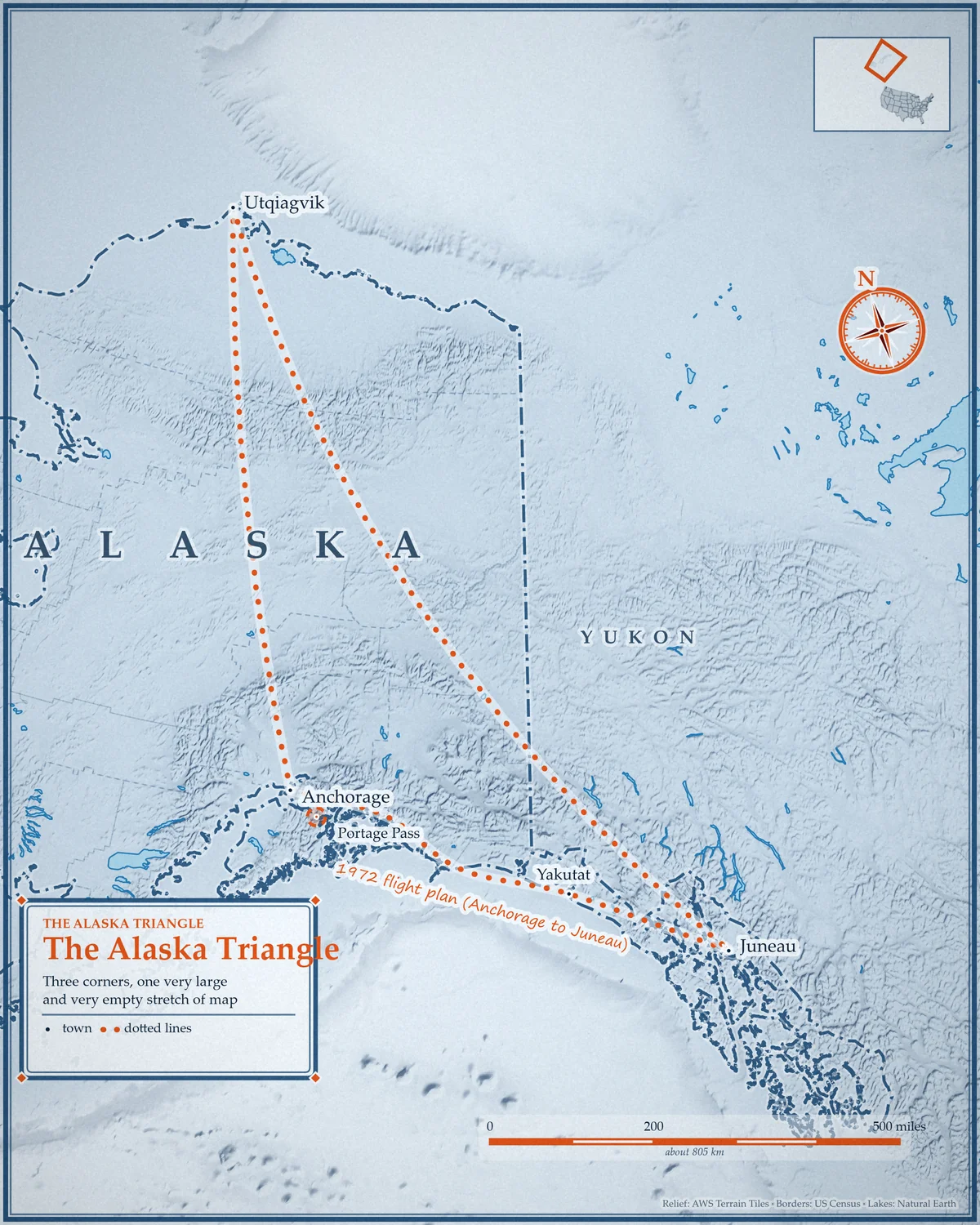
Here is the first plot twist. The name is much younger than the mystery. Skeptoid's search of print records found no use of "Alaska Triangle" in 1972, or anywhere else in the twentieth century in this sense. The nearest ancestor is "Alaska's Bermuda Triangle," which turns up in a 1978 publisher's description of poems by Alaska poet Sheila Nickerson, who used the idea again in her 1996 book Disappearance: A Map. The shorter name appears to arrive with a 2001 television episode of History's Mysteries. The legend, in other words, is a retrofit.
The flight that vanished: Boggs and Begich, 1972
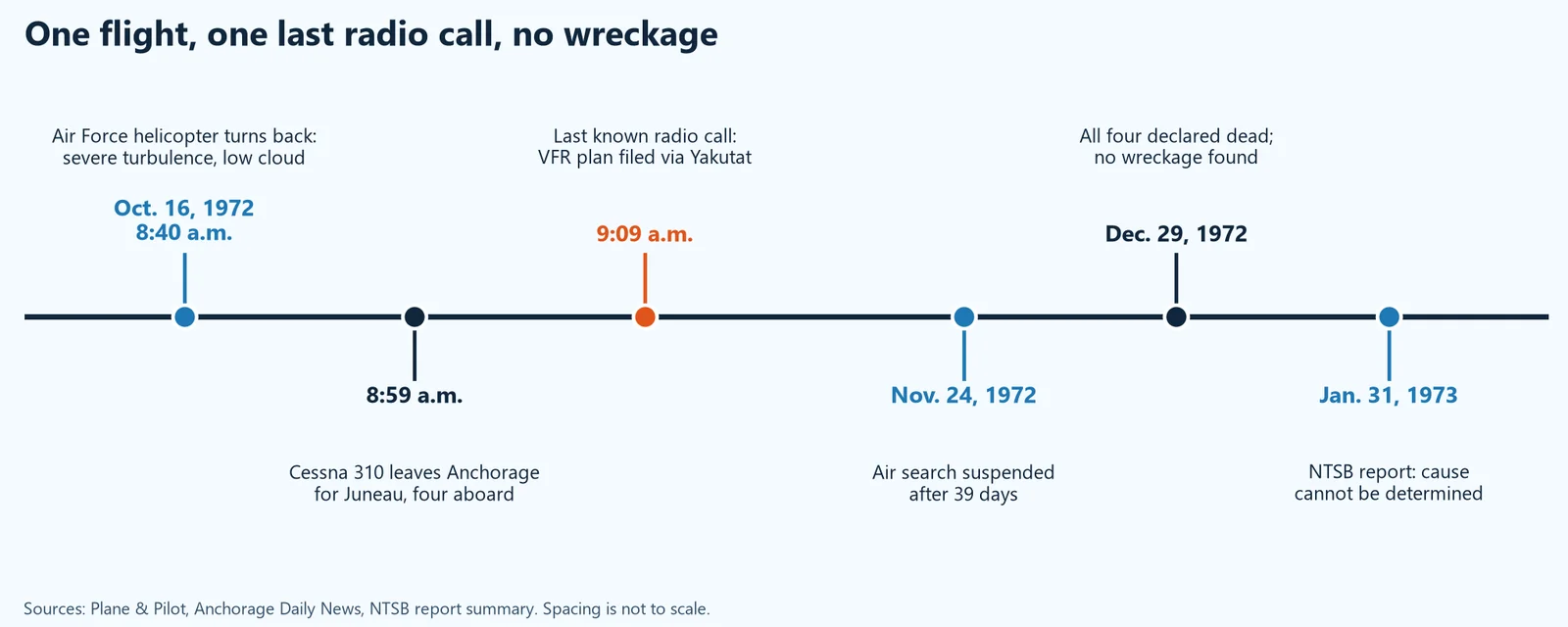
The real, documented core is the Cessna 310C, tail number N1812H. It left Anchorage International Airport at about 8:59 a.m. for Juneau, a trip of roughly 550 to 575 miles depending on who is measuring. The passengers were Hale Boggs, the House Majority Leader from Louisiana (age 58), and Nick Begich, Alaska's sole member of the House (age 40), plus Begich's aide Russell Brown (37). At the controls was Don Jonz (38), who owned the air service that supplied the plane. The two congressmen were on a campaign trip, and Begich was in the middle of an election he would go on to win.
Jonz was no rookie. The National Transportation Safety Board credited him with around 17,000 flight hours, and that very month he had a magazine article out titled Ice Without Fear. In February he had walked 18 to 20 miles in minus 54 degrees after a forced landing in the Brooks Range. Which is either reassuring or a bit of a warning, depending on your mood.
The weather, however, was lousy. The forecast called for moderate icing in cloud over Cook Inlet and the closure of Portage Pass. At about 8:40 that morning an Air Force helicopter had given up on its own route after meeting severe turbulence, strong headwinds and cloud only a couple of hundred feet above it. About ten minutes after takeoff, at 9:09 a.m. by one account (another puts the last contact a few minutes later), Jonz radioed Anchorage Flight Service and filed a visual flight plan via Yakutat. Asked whether the plane carried a locator beacon and survival gear, he said yes. That was the last anyone heard.
The search that found nothing
When the plane failed to reach Juneau, officials spent about half an hour ringing round airports before an Air Force C-130 already in the air became the first search aircraft. The hunt that followed ran 39 days and grew into the largest in Alaska's history at that point, with dozens of ships, more than 70 aircraft by one count (and many more by another), hunters, volunteers and even spy planes from Elmendorf Air Force Base. Searchers did stumble on another aircraft that had been missing for 17 years. Not the right one.
The air search was called off on November 24, 1972. All four men were declared dead on December 29. Boggs and Begich were both re-elected in November, and the House recognised their deaths on January 3, 1973. Boggs's wife, Lindy, won the special election for his seat and served nine terms. A joint cenotaph stands in Congressional Cemetery in Washington.
The NTSB's report, dated January 31, 1973, found there was not enough evidence to determine a probable cause, and said it would reopen the case if the aircraft turned up. It has not. The board also concluded that the plane had no emergency locator transmitter and lacked the survival gear a charter was meant to carry, although Jonz's portable beacon was later found in another of his company's aircraft. Journalist Jon Walczak has challenged parts of the NTSB's findings, including the claim about de-icing equipment.
Theories, weighed
- Weather and terrain. By far the most commonly cited explanation: ice, cloud and mountains. The route threads through Portage Pass, where valley walls rise 3,000 to 6,000 feet, and over forested, glaciated country where a small plane can sink out of sight. Heavy ice and snow do an excellent job of hiding things.
- A bomb. Walczak's podcast Missing in Alaska sets out a case for sabotage, and the FBI looked at the matter again in the 1990s after a prison inmate, Jerry Max Pasley (who had married Begich's widow, Pegge, shortly after the disappearance), described a possible plot. It remains unproven, and there are no wreckage or forensics to test it against.
- The Warren Commission angle. Boggs had doubted the commission's single-bullet conclusion, which fuelled whispers about silencing him. Skeptical accounts point out that J. Edgar Hoover, the usual villain in this version, had died months earlier, and that Boggs later defended the commission's majority view on television. Plenty of smoke, no fire anyone has shown.
- Portals, magnetism and "dark pyramids." The television end of the market. No evidence supports any of it.
Is Alaska really a vanishing machine?
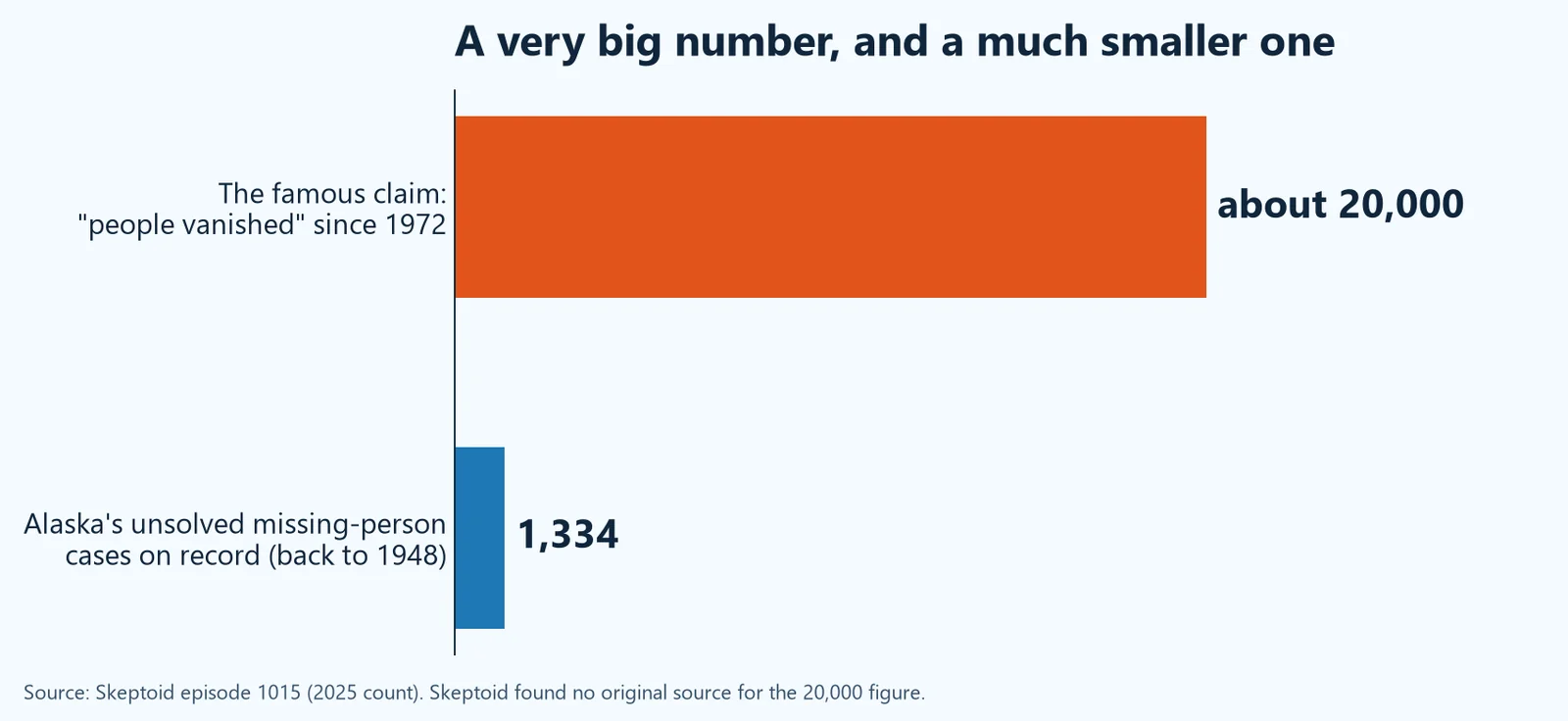
Here is where the numbers matter. The famous claim, repeated by countless videos and shows, is that some 20,000 people have disappeared in the triangle since 1972. Skeptoid calls it roughly 15 times too high and could not trace where it started. The state's own unsolved missing-person cases come to 1,334 as of 2025, dating all the way back to 1948. Skeptoid's counts also show about 1,250 missing-person reports filed in a typical year, with roughly 96 percent eventually resolved, and a summer peak when everyone is out hiking, fishing and flying.
There is something genuine underneath. Alaska's per-capita rate of open missing-person cases is the highest in the country by a wide margin, though the exact figures vary from source to source depending on what gets counted. The reasons are not mysterious: it is enormous, thinly populated, and full of people who fly small planes, hunt, trap and fish far from help. A handful of lost people moves the per-person rate a long way when the population is small. And a great many of those missing are Alaska Native people, with missing and murdered Indigenous women and girls a serious and mostly separate issue that Alaskans themselves take far more seriously than any triangle.
Aircraft vanish too, but not often. Skeptoid counts only five planes known to have disappeared without trace in the state (in 1947, 1951, 1972, 1992 and 2013), six if a wartime Navy flying boat is included, and few of those routes lay inside the triangle. One of them, in May 1992, carried a state fisheries biologist and was part of the story in Nickerson's book.
Even cases that look supernatural sometimes close with something ordinary. Gary Frank Sotherden, a New York man, went missing while trapping near the Porcupine River in the fall of 1976. A hunter found a human skull about eight miles from the Canadian border in July 1997. It sat unidentified for decades, until DNA work and genetic genealogy named him in 2022 and troopers announced it in early 2023. Tooth marks on the skull pointed to a bear. Sad, plain and, until then, mysterious.
Where it stands today
The Alaska Triangle is not a protected site or a place you can visit; it is an idea laid over a huge piece of the state. The sensible lesson from the Boggs-Begich flight is the boring one: Alaska's weather and terrain punish small aircraft and unprepared travellers, and the wilderness here includes national parks, forests and other public lands with their own rules. Check the forecast, file a flight plan, carry a working beacon, and do not rely on a legend to keep you safe.
As for the plane, nobody has ever found it. The coast is rugged, the mountains are steep, and the ice does not give things back on request. For a mystery, that is quite enough.
...and if you find it, remember who encouraged your questionable life choices.
More mysteries and lost treasure are on YouTube at @TenToeExpress.
Deep dive yourself
- Skeptoid episode 1015: The Alaska Triangle · Skeptoid
- 1972 Cessna 310C Alaska Disappearance of Hale Boggs and Nick Begich · Plane & Pilot
- Plane carrying Cokie Roberts' father disappeared in Alaska in 1972; it was never found · Anchorage Daily News
- The Alaska Triangle: one big hoax · The Northern Light
- The mystery of the Alaska Triangle · HISTORY UK
- Skull found along Porcupine River belonged to a man likely killed by a bear in the '70s · KTOO
- DNA IDs 1997 skull found near Canadian border as missing New York man · Alaska Public Media
- Disappearance: A Map, review · Kirkus Reviews