 Ten Toe Express
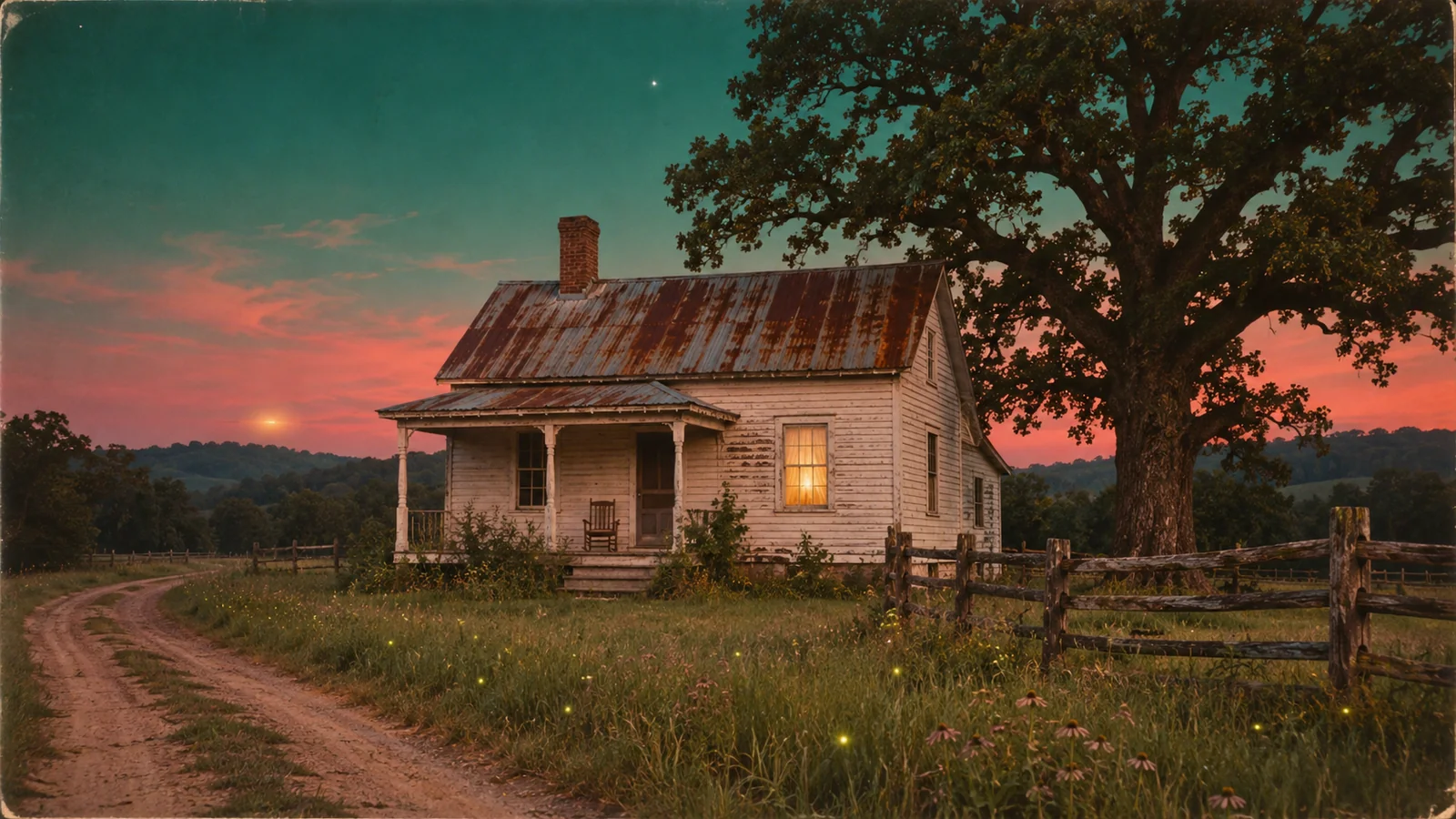
Right then, picture a hot Sunday night in August 1955, a three-room farmhouse in Kelly, Kentucky, no running water, no telephone, no television, and eleven people inside it who are about to spend the evening shooting at something in the yard. By the end of the night the whole lot of them will pile into cars and drive to the Hopkinsville police, babbling about small glowing men with long arms. This is the Kelly-Hopkinsville encounter, also known as the Hopkinsville Goblins, and it is still the most famous "little green men" story in America.
Here's the awkward bit: nobody ever said they were green. Here's the other awkward bit: the people who told the story were not drunk, not famous and not after anything, as far as anyone could ever show. So what happened at that farm? Fancy a proper look?
The farmhouse in Kelly, Kentucky
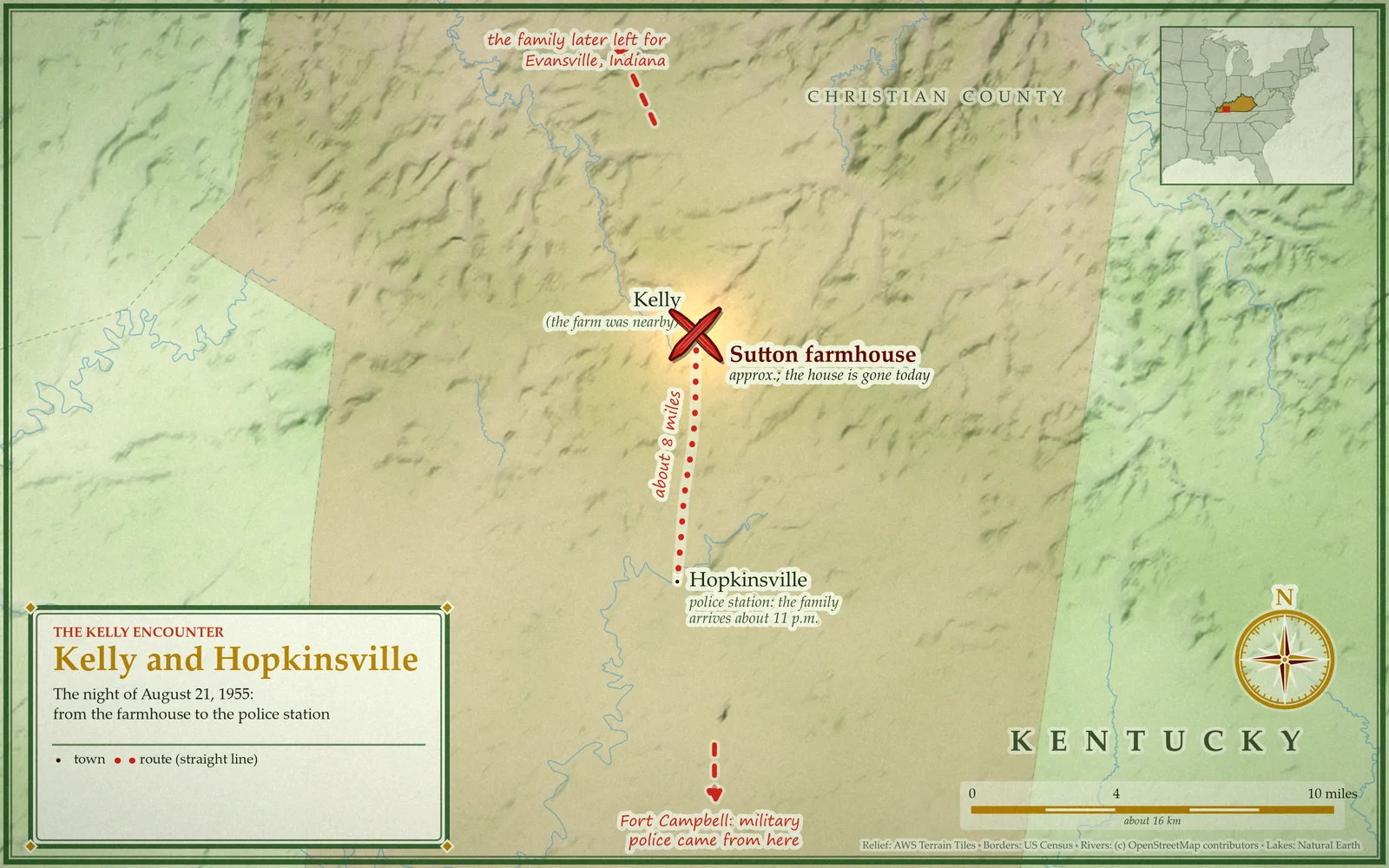
Kelly is a tiny community on U.S. Route 41 in Christian County, about eight miles from Hopkinsville. In 1955 the farmhouse there was rented by Glennie Lankford, then about 50. Her sons Lucky and J.C. Sutton lived there too, along with other relatives and friends, among them a young couple named Billy Ray Taylor and his wife, who are said to have been carnival workers from Pennsylvania. Accounts differ a little on exactly who was home, but the usual count is eleven: eight adults and three children, aged roughly seven to twelve.
Sources also disagree about the family's name. Most call them the Suttons, which is why you'll see "Sutton farm" everywhere. Mrs. Lankford is the matriarch in the accounts, and later investigators found her a plain-spoken, no-nonsense woman with no obvious reason to invent anything.
August 21, 1955: the siege
Here is the family's account, which is the one everything else argues with.
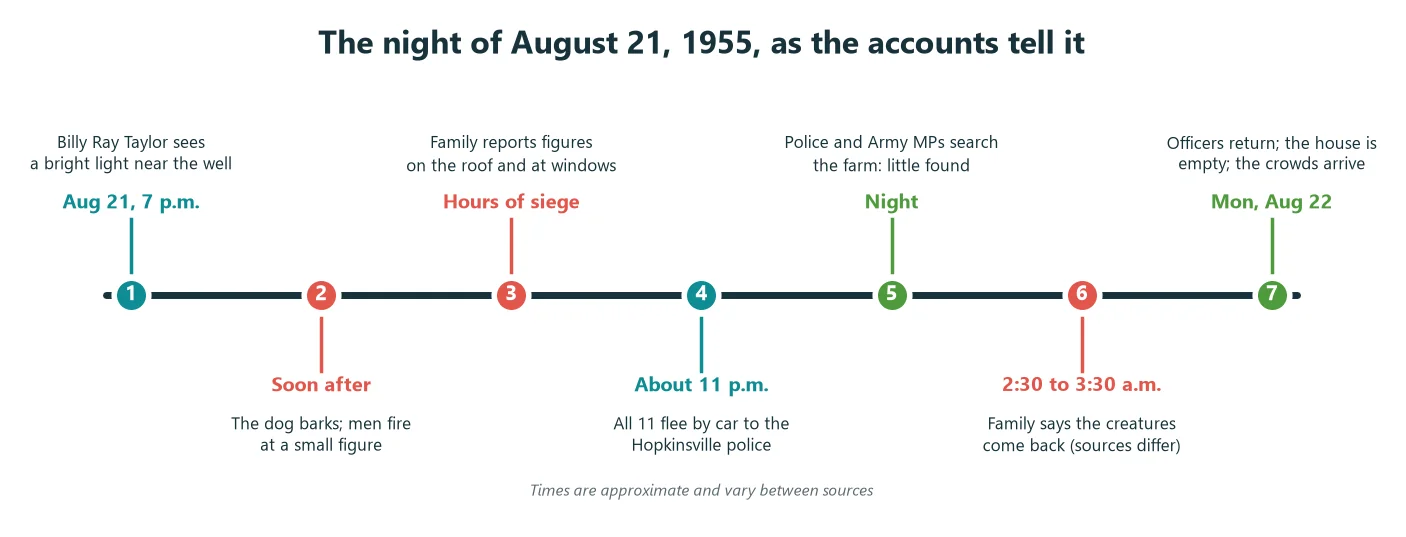
Around 7 p.m., Billy Ray Taylor went out to the well for water and saw something bright cross the sky. In the telling that became famous, it was silvery, trailed rainbow colors, flew over the house and came down in a field. In the first newspaper report, it was only a bright shooting star. He went back inside and told everyone. They laughed.
About an hour later the dog started barking and then bolted under the porch. Lucky Sutton and Taylor went to the back door and saw a faint glow in the dark and, walking toward them, a small figure about 3 and a half feet tall, with an oversized round head, long arms, clawed hands and eyes that glowed yellow. Both men fired: sources say a shotgun and a rifle, and one says a .22 pistol. The creature flipped over and scampered off. It did not seem hurt. Then another face appeared at a window.
From there the evening turned into a siege. The family reported shooting again and again at figures at the windows, in the yard and in a tree. At one point a clawed hand is said to have reached down from the small overhang above Taylor and touched his hair. Something was heard scratching and moving on the roof. By the family's telling it went on for nearly four hours, and the figures seemed to shrug off the bullets.
About 11 p.m.: the dash to the Hopkinsville police
At about 11 p.m. the family gave up on defending the house. They crowded into cars, drove to the Hopkinsville police station and told the one officer on duty what had happened. Their state was noted: frightened, shaken, and, by the press accounts of the time, not drunk. Mrs. Lankford later said liquor was not allowed in the house.
Chief Russell Greenwell was called in, and so were the state police and military police from Fort Campbell, the Army base on the Kentucky and Tennessee line. Different accounts give different head counts, but one common tally is four city police, five state troopers, three sheriff's deputies and four Army MPs, plus a reporter and photographer from the local paper. A convoy rolled out to Kelly. Note that the military police were from the Army, not the Air Force, a detail some retellings get wrong.
The searchers stayed a couple of hours. They found little: some spent shell casings, a bullet hole or two in the screens, some broken glass and no little men, no landing marks and no blood. One account mentions a green glow near a fence that was gone by the next day. The officers drove back to town.
The creatures come back
This is where it gets cheekier. According to the family, the creatures returned in the early hours, somewhere between about 2:30 and 3:30 a.m. Mrs. Lankford is said to have seen a face and a hand against a bedroom window screen. Some accounts have the family back in the house defending it until daylight; others say they had already left for relatives in Evansville, Indiana. By the next morning, officers who returned found the house empty. They also found the neighbors, who said the family had gone.
By Monday, August 22, local radio and newspapers had the story. Kentucky New Era ran it under a headline about a spaceship and a dozen little men. Hundreds of sightseers started driving out to Kelly. A local radio man, Bud Ledwith, interviewed the adults and drew sketches of what they described. Mrs. Lankford spent the day turning tourists away.
What did the family actually see?
The number of creatures was also never settled. The figure most often repeated is 12 to 15, from early press coverage, though several accounts talk of "a dozen or more" and the more careful retellings describe one or two at a time. The color is a mess too: early articles did not say green, and the "little green men" label got attached later, partly through confusion with a separate eastern Kentucky report.
The Air Force's Project Blue Book is sometimes said to have investigated. The paper trail suggests otherwise. One account says it listed the case as a hoax; another, after combing the archive, found only a passing mention on a lecture outline about hoaxes. Nobody has shown an Air Force team at the farm.
The believers' best-known investigators were Isabel Davis and Ted Bloecher, whose roughly 200-page report, Close Encounter at Kelly and Others of 1955, was published decades later. They found the witnesses consistent and sincere.
Owls, meteors and foxfire: the skeptics' case
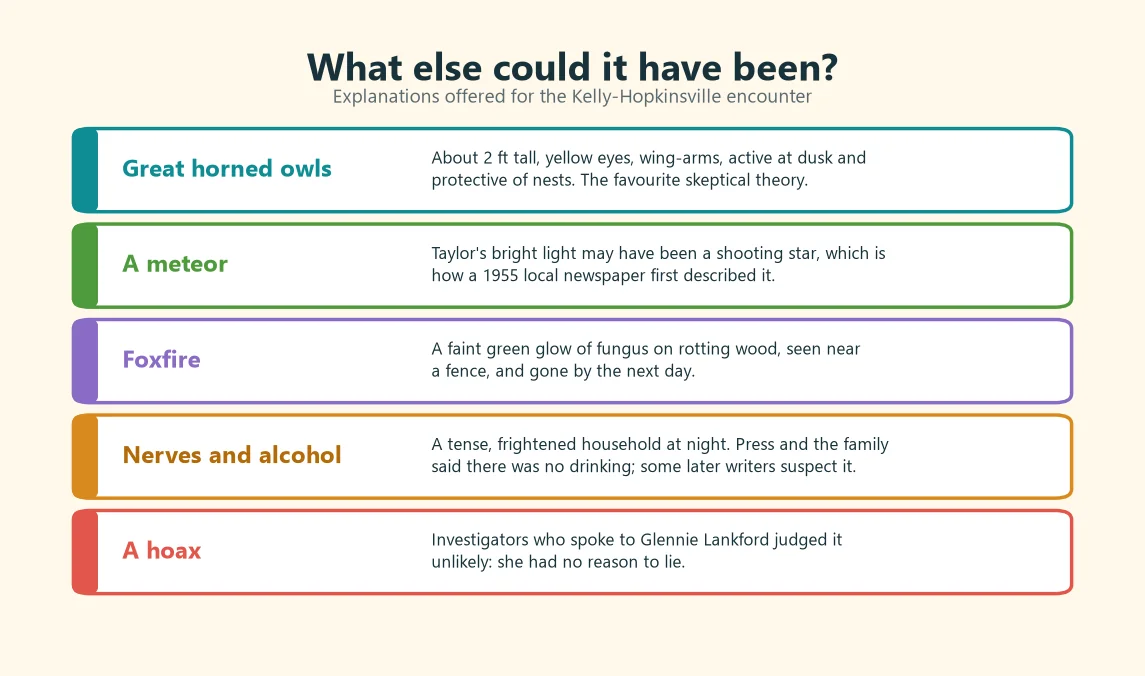
The skeptical explanation is delightfully ordinary. Joe Nickell, a skeptical investigator hired by the Hopkinsville chamber of commerce for the 50th anniversary in 2005, interviewed surviving witnesses and went through police and newspaper records. His reading, in Skeptical Inquirer in 2006, was that a meteor started the evening off and that great horned owls did the rest. French researcher Renaud Leclet argued the same.
Consider the owl. It stands about two feet tall, has yellow eyes, "ears" that look like horns, wings that can look like long arms and talons that look like claws. It is active at dusk and fiercely protective around a nest. A twitchy house full of people who've just heard about a flying saucer, plus shotguns and a dark farmyard, does the rest. Add a faint green glow of foxfire on rotting wood near the fence, and you have the other half of the story.
The believers' reply is that the family stuck to their story, that a hoax was out of character, and that owls do not behave like that. The skeptics' reply is that tired, scared people at night remember a lot of things badly. Both sides agree on one thing: the physical evidence is thin.
Where it stands today
The mystery never went away, only commercial. Hopkinsville held a big 50th-anniversary festival in 2005, and the Kelly community runs a Little Green Men Days festival. A 70th-anniversary look-back in 2025 noted that the property has since been sold and the house demolished, so there is no farmhouse to visit. The story has been linked to Steven Spielberg's unproduced Night Skies project and to the 1986 film Critters.
The honest summary is that a real, frightened family really did drive into Hopkinsville that night, and police and soldiers really did turn out. What came into the yard is the part nobody has pinned down.
...and if you find it, remember who encouraged your questionable life choices.
The short version of this story is on YouTube at @TenToeExpress.
Deep dive yourself
- Kelly–Hopkinsville encounter · Wikipedia
- How the "Little Green Men" Phenomenon Began on a Kentucky Farm · HISTORY
- The Kelly-Hopkinsville Encounter · Skeptoid
- 70 years later: Revisiting the Kelly-Hopkinsville Encounter · WBKO
- An Alien Encounter? The Mystery of the Hopkinsville Goblins · Historic Mysteries