 Ten Toe Express
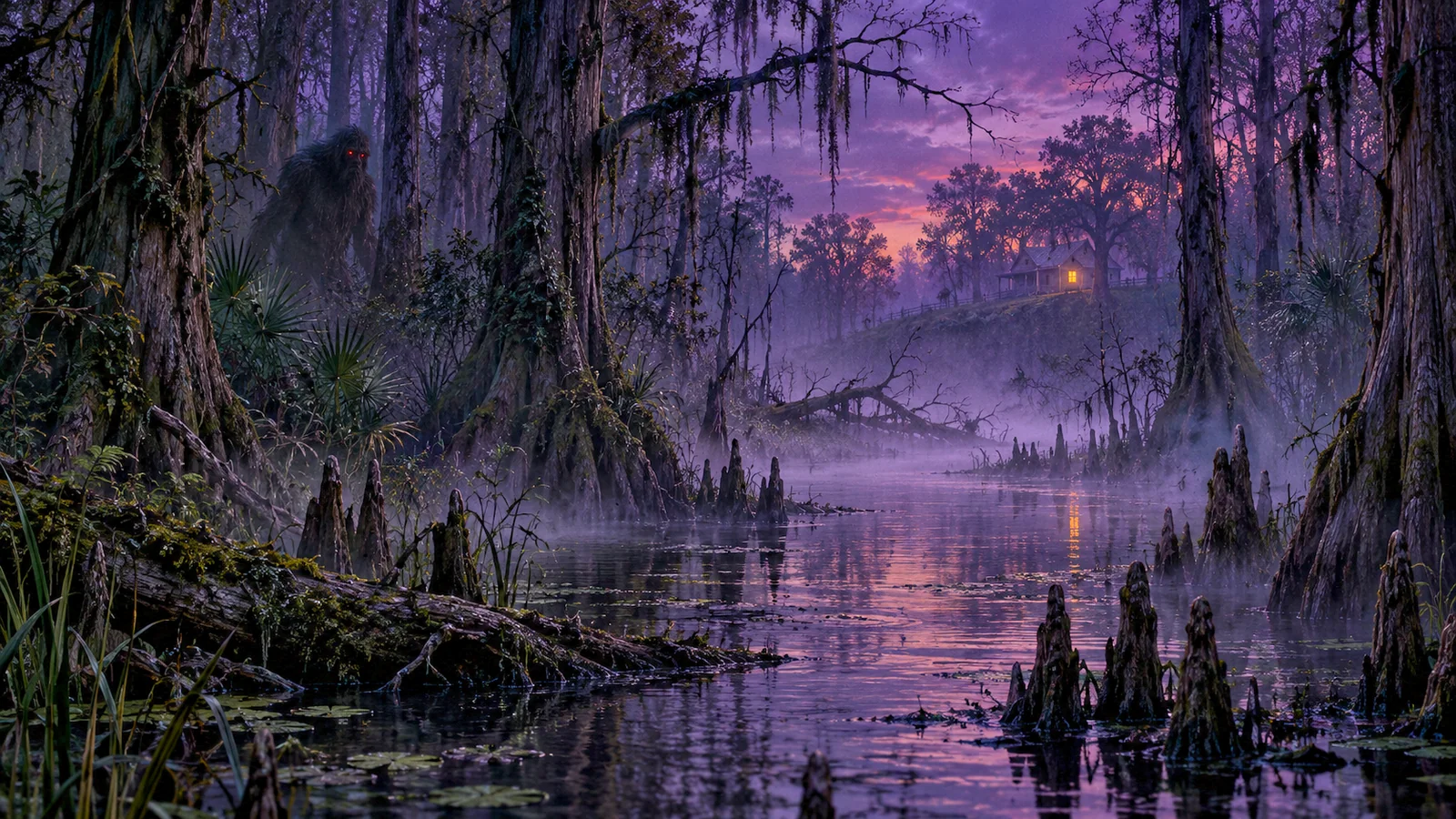
It is a warm spring night in 1971 on the edge of Fouke, Arkansas, a speck of a town in the creek bottoms south of Texarkana. A young woman is dozing on the couch of a rented house. Then something reaches through the window screen. It is an arm, she will say later: big, hairy, tipped with claws. She screams, the men of the house grab their guns, and within days the whole family has packed up and left.
That is the opening scene of the Fouke Monster, also called the Boggy Creek Monster, the shaggy, red-eyed, seven-foot something said to prowl the swamps and river bottoms of Miller County. It turned a town of a few hundred people into a household name, launched a drive-in hit, and has kept hunters, skeptics and souvenir buyers coming back for more than fifty years. Nobody has ever caught it, photographed it properly or produced a body. Right then, let's look at what's on the record.
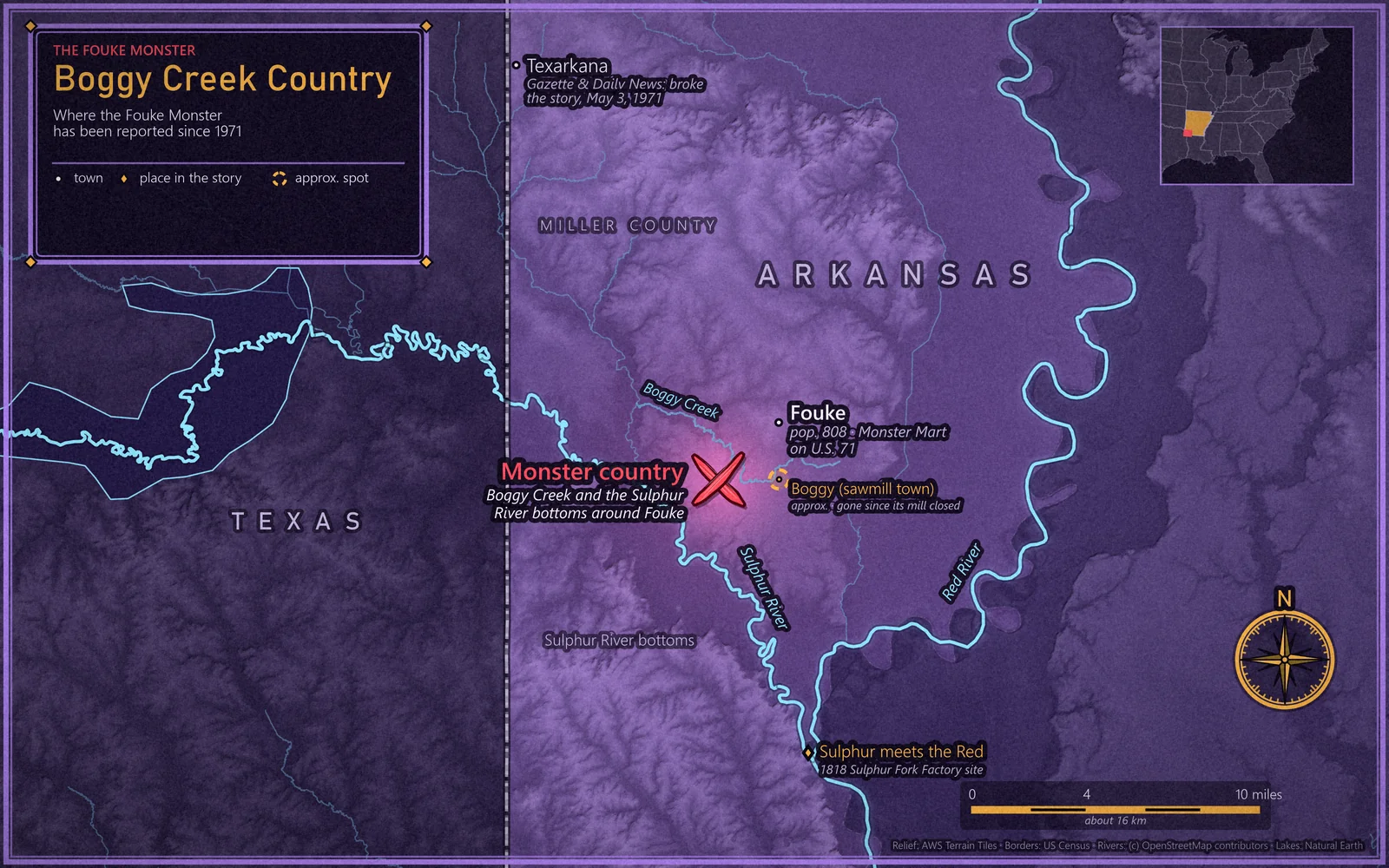
Fouke, Arkansas: a sawmill town on Boggy Creek
Before it had a monster, Fouke had lumber. In the late 1880s a railroad and timber group led by George W. Fouke ran a line south from Texarkana, and a sawmill went up on Boggy Creek. Around 1890 a colony of Seventh Day Baptists led by minister James Franklin Shaw bought land nearby and laid out the town, naming it after the lumberman. Two miles south sat a second mill town called Boggy, which vanished when its sawmill closed.
The country around it is classic southern bottomland: slow creeks, cypress sloughs, thick hardwood forest and the wide, flood-prone bottoms of the Sulphur River, which joins the Red River a few miles south of town. Local reporting describes those bottoms as tens of thousands of acres, some of it rarely walked. If you were inventing a place for a big hairy thing to hide, you'd sketch something very like this. Rather convenient, that.
The night at the Ford house, May 1971
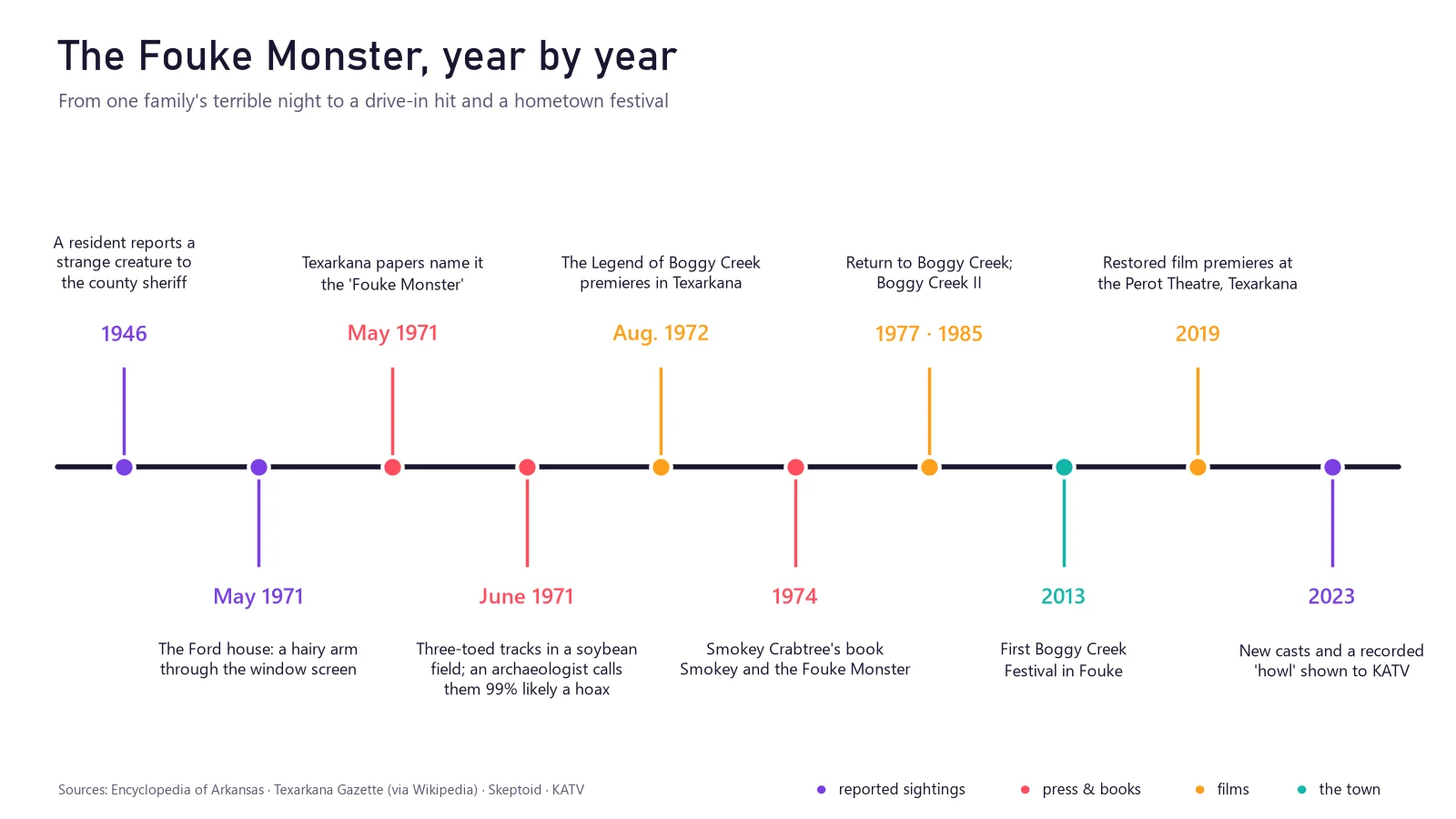
The story everyone tells starts with Bobby and Elizabeth Ford, who had just rented a house outside Fouke with relatives. Sources disagree on whether it was the night of May 1 or May 2, 1971. According to the accounts, Elizabeth was sleeping on the couch when she saw a hand and arm, hairy and clawed, reach through the window screen. At first she thought it was a bear.
The men, Bobby and his brother Don among them, went after it and fired several shots. No blood was found. Bobby Ford then reported to the Fouke constable that a creature had attacked him at the house. He described it as about seven feet tall and three feet across the chest, breathing heavily, with red eyes, and moving very fast. The Encyclopedia of Arkansas records that he was treated at a local hospital for minor scratches and shock.
Investigators from the sheriff's department found strange tracks and claw-like scratches on the porch. Later accounts add damage to a window and the siding. What nobody found was the creature.
How a newspaper named a monster
Jim Powell, a reporter for the Texarkana Gazette and the Texarkana Daily News, drove out to the Ford place with Dave Hall of Texarkana radio station KTFS. They found the family moving out. Powell's story ran on May 3, 1971, and the follow-up the next day gave the thing its name: the Fouke Monster. "Bigfoot" wasn't yet the household word in the South that it is now, so a local label stuck.
The headlines that week show a town split between excitement and common sense. The Gazette went with "Fouke fields combed in search of monster." The Daily News offered "Monster may be mountain lion." The Associated Press and United Press International carried the story across the country, and Fouke was suddenly full of strangers with rifles.
The sightings kept coming. On May 23, 1971, a group from Texarkana, D. C. Woods Jr., Wilma Woods and a Mrs. R. H. Sedgass, reported an ape-like creature crossing U.S. Highway 71. The Texarkana papers ran report after report for months.
The three-toed tracks
In June 1971, the most famous evidence turned up: big footprints pressed into a soybean field near Fouke. They were about 13.5 inches long and 4.5 inches wide, and they had three long, straight toes. The local game warden examined them and couldn't say they were real.
Three toes is a rather inconvenient number for an ape. Every primate has five. Frank Schambach, an archaeologist at Southern State College (now Southern Arkansas University), looked at the tracks and put the odds that they were a hoax at 99 percent. He also pointed out that apes are active by day, not by night.
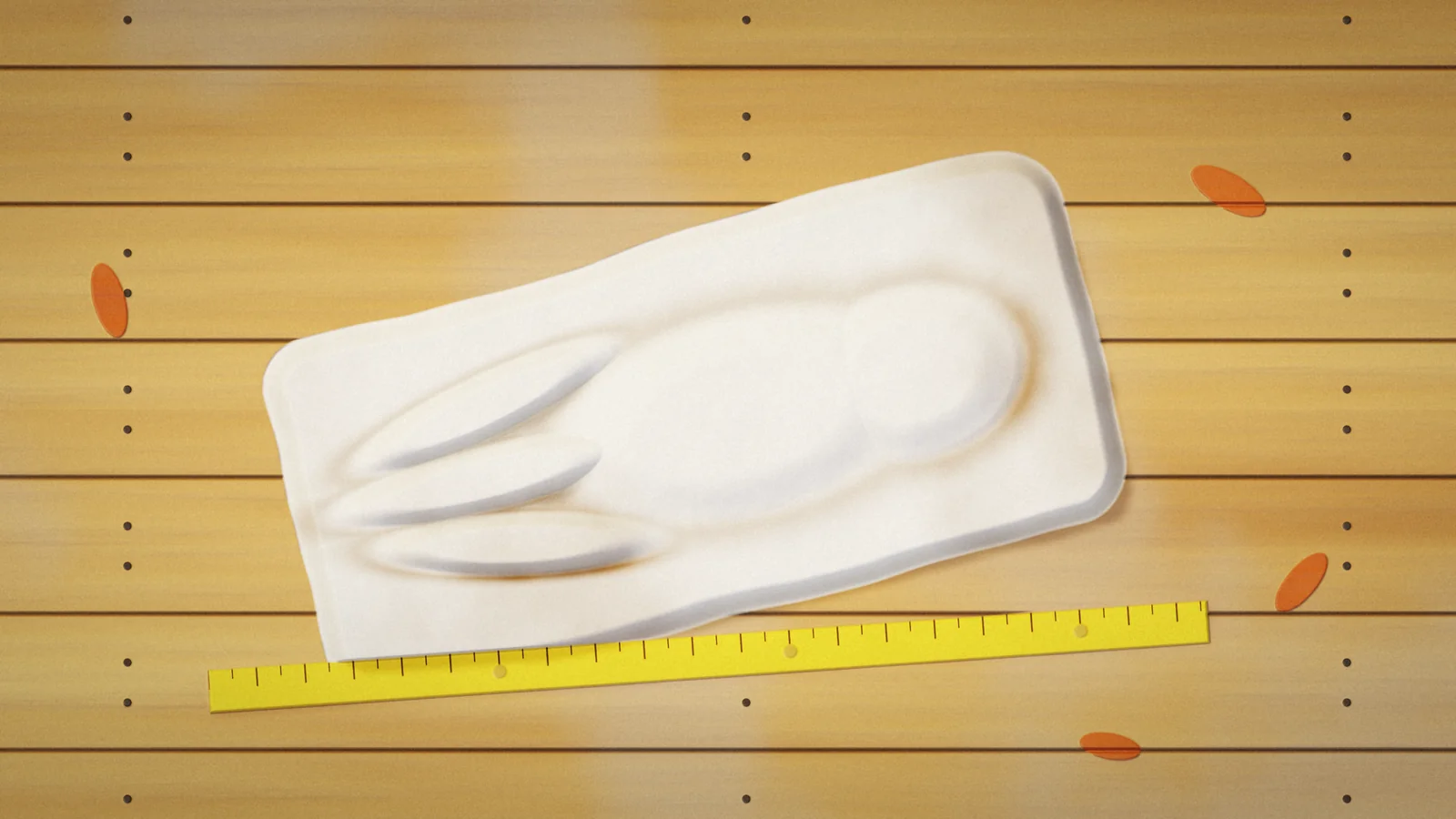
Skeptoid's Brian Dunning later noticed something odd about the casts collected since. The earliest ones have three identical toes. Later casts look more like gorilla or orangutan prints, with a thumb-like big toe. A few look like ostrich feet. His conclusion: whoever was making them seemed to be learning anatomy as they went.
Things got bad enough in 1971 that Miller County Sheriff Leslie Greer imposed a temporary "no guns" rule for monster hunters, and three people were fined $59 each for filing a false monster report. A town full of armed strangers wandering the woods at night was, sensibly, the bigger danger.
Was the Fouke Monster around before 1971?
This is where fact and legend start to tangle. The Encyclopedia of Arkansas notes that a resident reported a strange creature near her home to the county sheriff in 1946. Locals also tell of sightings in the 1950s and 1960s. One reported 1955 encounter involved a teenage boy who said he saw a reddish-brown hairy creature that shrugged off birdshot. Skeptic Joe Nickell suggested a black bear.
The Crabtree family became the heart of the legend. After the 1971 story broke, they told of many earlier encounters, including a 1965 meeting in which Lynn Crabtree said he fired at the creature again and again without effect. His father, J. E. "Smokey" Crabtree, never claimed to have seen it himself, but he wrote about what the family went through in his 1974 book Smokey and the Fouke Monster.
Here is the inconvenient bit. Lyle Blackburn, who wrote The Beast of Boggy Creek (2012), searched Arkansas newspapers and found no printed mention of a Fouke-area monster before Powell's 1971 story. The 1960s accounts were collected afterward. Arkansas does have two old newspaper stories of hairy wild men, from the Memphis Enquirer in 1851 and the Caddo Gazette in 1856, but both describe places far from Fouke. So the creature may have lurked in local talk for decades, or the memories may have grown after 1971. Nobody can say for certain.
The Legend of Boggy Creek: the film that made it famous
Enter Charles B. Pierce, a Texarkana man with a camera and a plan. He borrowed $160,000 from a trucking company, roped in local high school students as crew and shot a monster movie in the real Fouke bottoms. The Legend of Boggy Creek is a docudrama: a narrator (Vern Stierman), lots of swamp scenery and dramatized encounters, with many local residents playing themselves, Smokey and Travis Crabtree among them.
No major studio wanted it, so the film premiered in Texarkana in August 1972 and went on to become a drive-in sensation. The Encyclopedia of Arkansas says it grossed more than $20 million. Variety recorded $4.8 million in North American rentals by 1975, and the more boastful figures can't be checked. Either way, that's not bad for a film paid for with a trucking firm's money.
It had a long tail, too. The Blair Witch Project director Daniel Myrick has called it an influence. Return to Boggy Creek (1977), starring Dawn Wells of Gilligan's Island, was a fictional story with little tie to the original. Pierce came back with Boggy Creek II: And the Legend Continues (1985), playing a University of Arkansas professor on the creature's trail. That one was later roasted on Mystery Science Theater 3000 in 1999. In 2019 a restored print of the original premiered at the Perot Theatre in Texarkana.
The film also caused friction. Smokey Crabtree's book describes his unhappiness with how the production treated locals whose stories ended up on screen. Skeptics point out that a filmmaker with a monster movie to sell had every reason to make the creature bigger, scarier and harder to dismiss.
Sightings since the movie
Reports slowed after the mid-1970s but never quite stopped. By 1986, an Associated Press story quoted Fouke's mayor, Virgil Roberts, and former sheriff Greer saying they believed the 1971 tracks were man-made. Even so, reports of the creature continued through the 1990s, including some forty sightings logged in 1997 and a report in 1998 of something walking a dry creek bed about five miles south of town.
In 2023 KATV in Little Rock visited Fouke and heard the latest. Denny Roberts, who owns the Monster Mart, described his own first sighting of something reddish-orange and too big to be a deer. A local hunter, Doyle Holmes, showed casts he and his son made of tracks they found. Roberts's brother Ricky shared an audio recording that some locals say is the monster's howl. Proof? No. A proper mystery that refuses to lie down? Very much so.
The theories, weighed
An unknown animal
Believers point to decades of consistent descriptions: tall, upright, hairy, red-eyed, smelly, fond of water. The trouble is that every piece of evidence is a story or a cast of unknown origin. No hair, blood, bones or clear photograph has ever been confirmed.
Black bears
The simplest suspect. Bears live in Arkansas, stand on their hind legs, and look very large in the dark. Elizabeth Ford's first thought was a bear, and a mountain lion made the papers in the first week. Bears don't explain the three-toed tracks, though.
Hoaxes
The three-toed prints are hard to square with any known animal, and both a professional archaeologist and the town's own officials judged them man-made. Fines for false reports in 1971 show that at least some people were having a laugh.
Folklore and a film
The strongest skeptical case is that a frightening night, a hungry news cycle and a clever filmmaker built a legend that local memories then filled in. That doesn't make the Fords liars. It does mean the creature everyone now pictures was shaped as much in a Texarkana editing room as in the swamp.
Visiting Fouke today
Fouke has made peace with its famous neighbor. The Monster Mart, a convenience store on U.S. 71, doubles as a gift shop and a small museum with old newspaper clippings, track casts, photographs and maps, plus a life-size monster for photos. The Fouke Monster Festival, held since 2013 and first called the Boggy Creek Festival, raises money for the Fouke School District with tours, vendors and talks by Bigfoot researchers. Check the dates before you drive down, because they change.
A word on the swamp itself. Much of the land around Fouke is private, and the river bottoms flood, hide snakes, and have no interest in your plans. Stick to public roads and public land, ask before you wander, and leave the guns at home. The 1971 sheriff already tried that experiment.
So what came to the Ford house that night? A bear, a prankster, or something the Sulphur River bottoms are still keeping to themselves? The tracks are cast, the film is restored and the shop is open. The creature hasn't commented.
...and if you find it, remember who encouraged your questionable life choices.
The short version of this story is on YouTube at @TenToeExpress.
Deep dive yourself
- Fouke Monster · Encyclopedia of Arkansas
- The Legend of Boggy Creek (Movie) · Encyclopedia of Arkansas
- Fouke (Miller County) · Encyclopedia of Arkansas
- The Boggy Creek Monster · Skeptoid
- Fouke Monster · Wikipedia
- The Legend of Boggy Creek · Wikipedia
- 'That's no deer': Fouke Monster legend haunts swamplands of southwest Arkansas · KATV