 Ten Toe Express

Picture a January morning in the New Jersey Pine Barrens, 1909. Snow lies thick on the sandy cart roads, the pitch pines are dusted white, and somewhere under the ice a cranberry bog is keeping very quiet. Then the footprints start turning up: cloven, hoof-shaped, crossing roofs, fences and frozen yards as if the thing that made them had no interest in the rules of walking. Within a week, hundreds of people say they have seen the Jersey Devil. Schools shut, hunting parties form, and a state famous for diners and turnpikes becomes briefly, gloriously terrified.
Right then. Nobody ever caught it, nobody ever claimed the reward, and the story has been running for the best part of three centuries. Here is what the record shows, what the legend adds, and why the whole thing refuses to lie down.
Where the Jersey Devil lives: the Pine Barrens
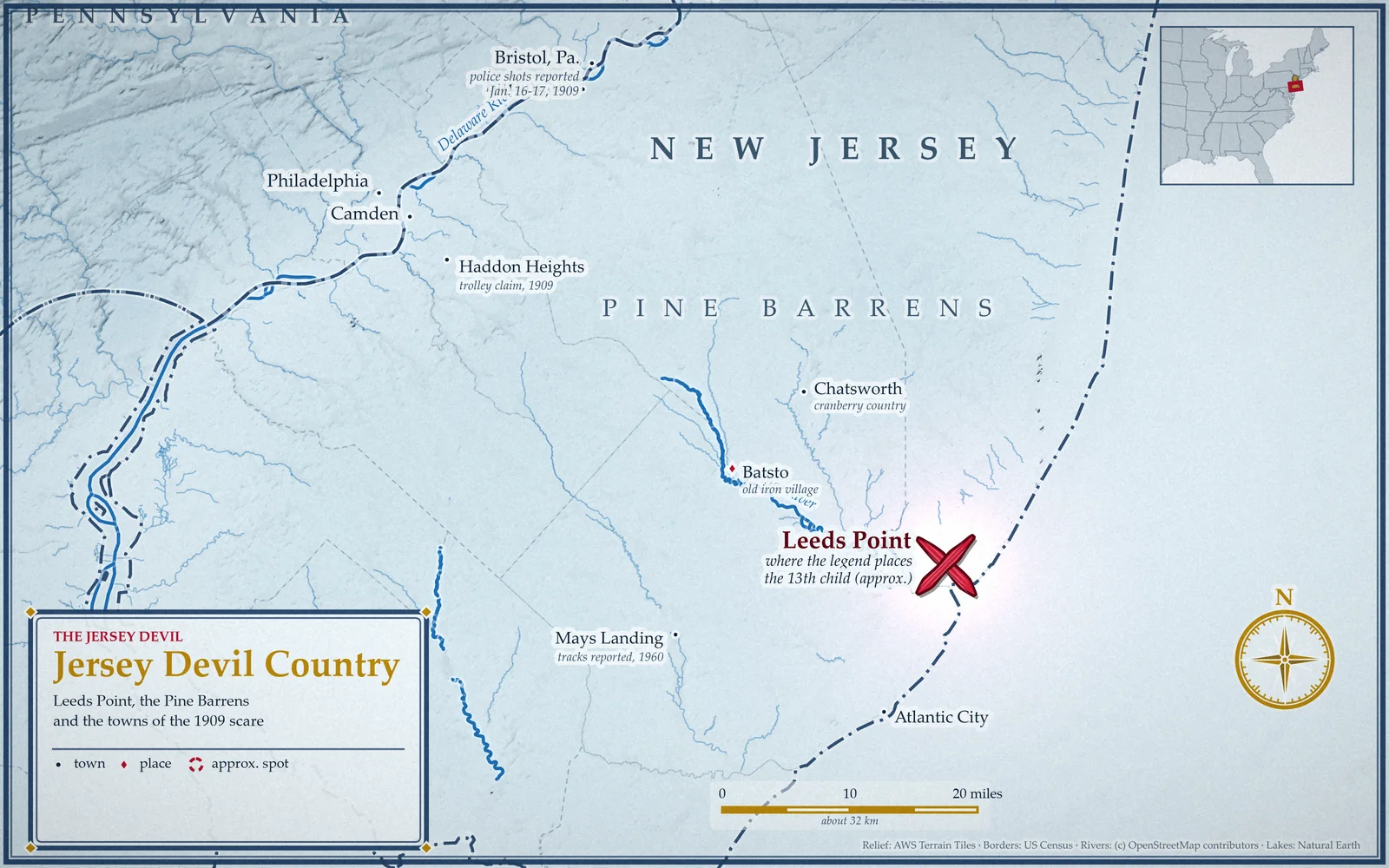
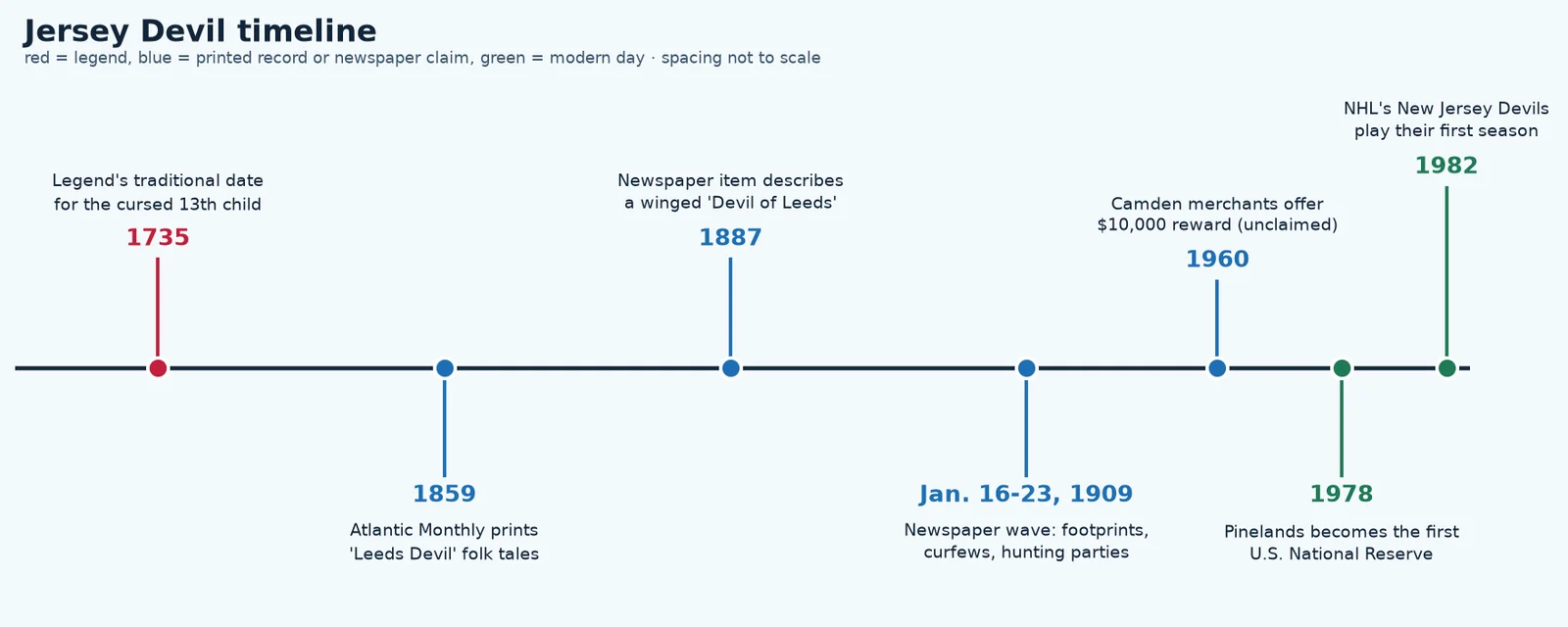
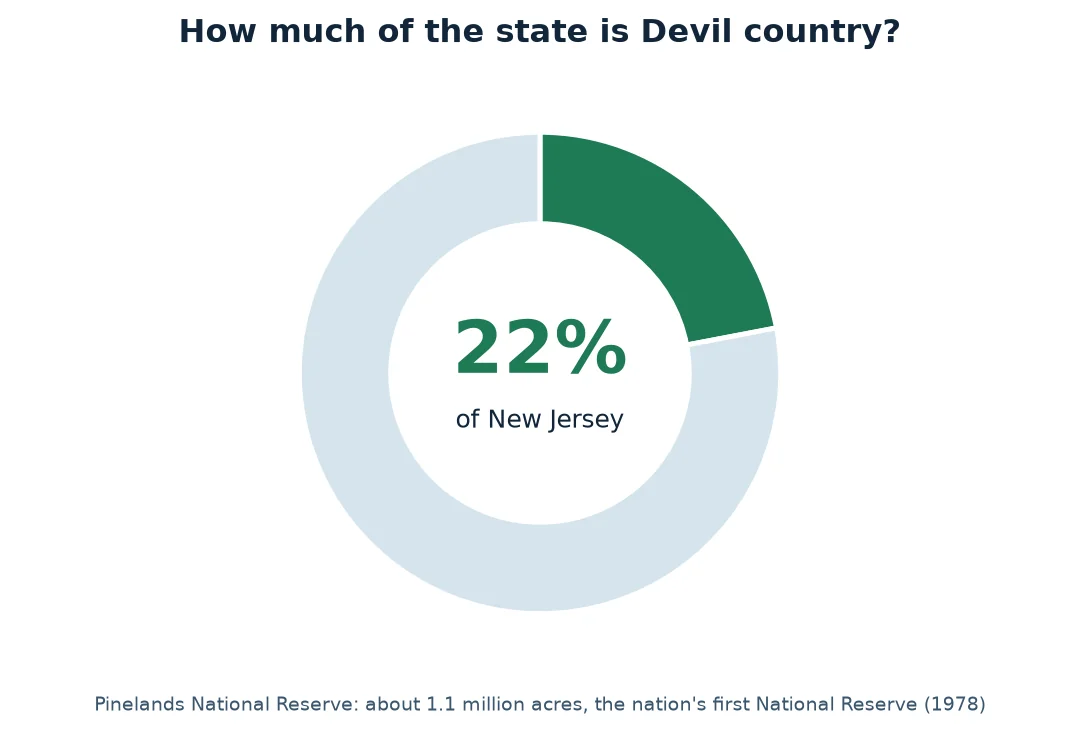
The Jersey Devil's home turf is the Pine Barrens, also called the Pinelands, a huge patch of pitch pine, sandy soil, cedar swamp and tea-dark streams in southern New Jersey. The Pinelands National Reserve covers about 1.1 million acres, roughly 22 percent of the state, and Congress made it the nation's first National Reserve in 1978. It also sits on top of an enormous aquifer, which is rather more impressive than any monster.
It is also remarkably empty for a place squeezed between Philadelphia and the Atlantic City boardwalks. Old bog-iron villages such as Batsto have been quiet for generations, cranberry bogs glow red around Chatsworth, and the sandy tracks run on for miles. Plenty of room, in other words, for a story to wander off and grow wings.
The Leeds Devil legend: the cursed thirteenth child
The most common version goes like this. A woman known as Mother Leeds, already the mother of twelve children, learns she is expecting a thirteenth. In one telling she curses the child during a painful labour; in another she simply mutters "may it be a devil" when she discovers the news. The baby is born normally, then sprouts wings, hooves and a tail, and flies up the chimney into the Pine Barrens. The traditional date for all this is 1735.
That is the legend. The record is thinner. The New Jersey Historical Society notes that most tellers trace the story to a Mrs. Leeds of Leeds Point in the Pine Barrens, and that several versions exist, including a family curse and a Quaker woman who refused to convert. Some historians have suggested a real Deborah Leeds, whose husband Japhet Leeds named twelve children in a 1736 will, but that is a proposed match and not a proven one. Another telling places the birth near Mays Landing around 1855. Nobody can pin it to one household, which is exactly how a good legend likes it.
A family with a reputation
Here is the interesting bit. Historian Brian Regal, with Frank Esposito of Kean University, links the legend to the Leeds family's standing in colonial New Jersey. Daniel Leeds, born around 1652 in England to Quaker parents, settled in Burlington and surveyed land; in the 1690s he bought land on the Atlantic coast that became Leeds Point. He also published an almanac stuffed with astrological symbols, which went down badly with his Quaker neighbours, who called him evil and "Satan's harbinger." His son Titan Leeds was later mocked in print by Benjamin Franklin. The family crest, Regal notes, shows a wyvern, a winged dragon-ish beast that looks suspiciously like the later monster.
That is a theory, and a clever one, but not a smoking gun. No seventeenth-century source calls any of Daniel Leeds's wives "Mother Leeds," so the woman at the heart of the tale is still unidentified. A family that other families gossiped about plus a coastline of fog and swamp is a fine recipe for a bogeyman, and that may be all there is to it.
Early sightings and the stories that fall apart
The Jersey Devil picked up famous visitors along the way, most of them on shaky ground. Commodore Stephen Decatur is said to have fired a cannonball at a flying creature near Hanover Mill Works, and Joseph Bonaparte, Napoleon's brother, is said to have seen it while hunting near Bordentown around 1820. Historians went looking for original sources in their papers and could not find them. Treat both as legend with excellent name recognition.
The paper trail starts later. An 1859 Atlantic Monthly article described Leeds Devil folk tales, and an 1887 newspaper item described a winged "Devil of Leeds" in Burlington County. Livestock killings were blamed on the creature in 1840 and 1841, and an 1893 New York Sun article quoted a railroad engineer who claimed it attacked his train. These are reported accounts, printed but unverified. The creature also collected other names along the way, including the Leeds Devil, the Hoodle-Doodle Bird and the Wozzle Bug, none of which are strictly terrifying.
The 1909 Jersey Devil panic
Then came the week that made the monster famous. In early January 1909, newspapers gave prominent coverage to strange footprints in the Pine Barrens. Trenton councilman E.P. Weeden said he woke to the sound of flapping wings outside his window and found cloven prints in the snow. After that, according to the New Jersey Historical Society, hundreds if not thousands of people claimed sightings within about a week. The peak ran from January 16 to 23, and reports reached Pennsylvania and Delaware.
The claims were wonderfully specific. A winged creature was said to have attacked a trolley car in Haddon Heights and a social club in Camden. Police in Camden and in Bristol, Pennsylvania reportedly fired at it, with Bristol sightings dated to January 16 and 17. Local governments imposed curfews, steel traps went out in Burlington, farmers combed the woods, schools closed and vigilante parties formed. Newspapers took to describing the beast as a "winged kangaroo," which does rather lower the tone.
Rumour added a $10,000 reward from the Philadelphia Zoo; that is described as a rumour, and it prompted hoaxes whether or not it was ever real. Historians Robert Bartholomew and Peter Hassall cite the episode as an example of mass hysteria.
The kangaroo in the museum
The hoax side has colour, too. National Geographic reports that a Philadelphia huckster displayed a painted kangaroo with fake wings at the Ninth and Arch Street Dime Museum, billing it as the Jersey Devil, and that the New York Times exposed the stunt in late January 1909, after which the hysteria faded. One writer names publicist Norman Jeffries as the man behind it, claiming he glued claws and bat wings onto a kangaroo and admitted it some twenty years later; that detail rests on a single author's telling, so take it with a pinch of pine sap. As for the footprints, Gordon Stein's Encyclopedia of Hoaxes says they looked like horse hooves, and that one man later admitted faking some.
Later reports of the Jersey Devil
The monster never really left. In December 1925 a farmer in Greenwich Township said he shot an unidentified animal and photographed it, and claimed none of the hundred people he showed it to could name it. In 1951 boys in Gibbstown reported a "monster." In 1960 strange tracks and noises near Mays Landing were pinned on the Devil, and Camden merchants offered a $10,000 reward for its capture. Nobody collected. In 1978 two teenagers skating near Chatsworth reported a smell like dead fish and a pair of red eyes. All of these are reports, not verified finds, and none has produced a body, a bone or a clear photograph that survives scrutiny.
Theories: what was the Jersey Devil?
- A folklore bogeyman. Skeptics point to bogeyman stories and to prejudice against Pine Barrens residents, nicknamed "Pineys," as a source. The Leeds family reputation fits neatly here.
- A deformed child and 1700s superstition. The New Jersey Historical Society suggests a baby with a birth defect, combined with the belief that such things signalled a curse, may have started it. This is speculation, and a sad one.
- Misidentified animals. Jeff Brunner of the Humane Society of New Jersey has proposed that stray sandhill cranes, unfamiliar in the region, explain some sightings. Others have noted a resemblance to the hammer-headed bat, an African species that has no business anywhere near New Jersey.
- Mass hysteria and hoaxes. For 1909, this is the best-supported explanation: newspaper coverage, copycat footprints and a dime museum display feeding each other.
- Something nobody has explained. Fans of cryptids are welcome to this one. No evidence supports it, but nothing disproves it either, which is the entire business model of a cryptid.
Visiting Jersey Devil country today
The Pine Barrens are real, large and open to visitors, but much of the land is protected state forest, wildlife area or part of the Pinelands reserve, where development is tightly controlled by the independent New Jersey Pinelands Commission. Stick to marked trails and posted rules, as in any state forest. Batsto Village, a former bog-iron works restored to its mid-nineteenth-century look, is a state historic site and an easy place to start. Chatsworth and Whitesbog country still grows cranberries, as New Jersey ranks third in the nation for them.
As for the creature, it has long since moved into the culture. The Jersey Devils of the Eastern Hockey League played from 1964 until the league folded in 1973, the NHL's New Jersey Devils have played since 1982, and Six Flags Great Adventure opened a Jersey Devil Coaster in 2021. A beast nobody can prove exists now has a better sports and theme park record than most actual animals.
...and if you find it, remember who encouraged your questionable life choices.
Prefer to watch? Find more stories like this on YouTube at @TenToeExpress.
Deep dive yourself
- Legend of the New Jersey Devil · New Jersey Historical Society
- The Devil went down to ... New Jersey? · National Geographic
- Jersey Devil · Wikipedia
- New Jersey Pine Barrens · Wikipedia
- The Time The Jersey Devil Came To Bristol · Levittown Now