 Ten Toe Express
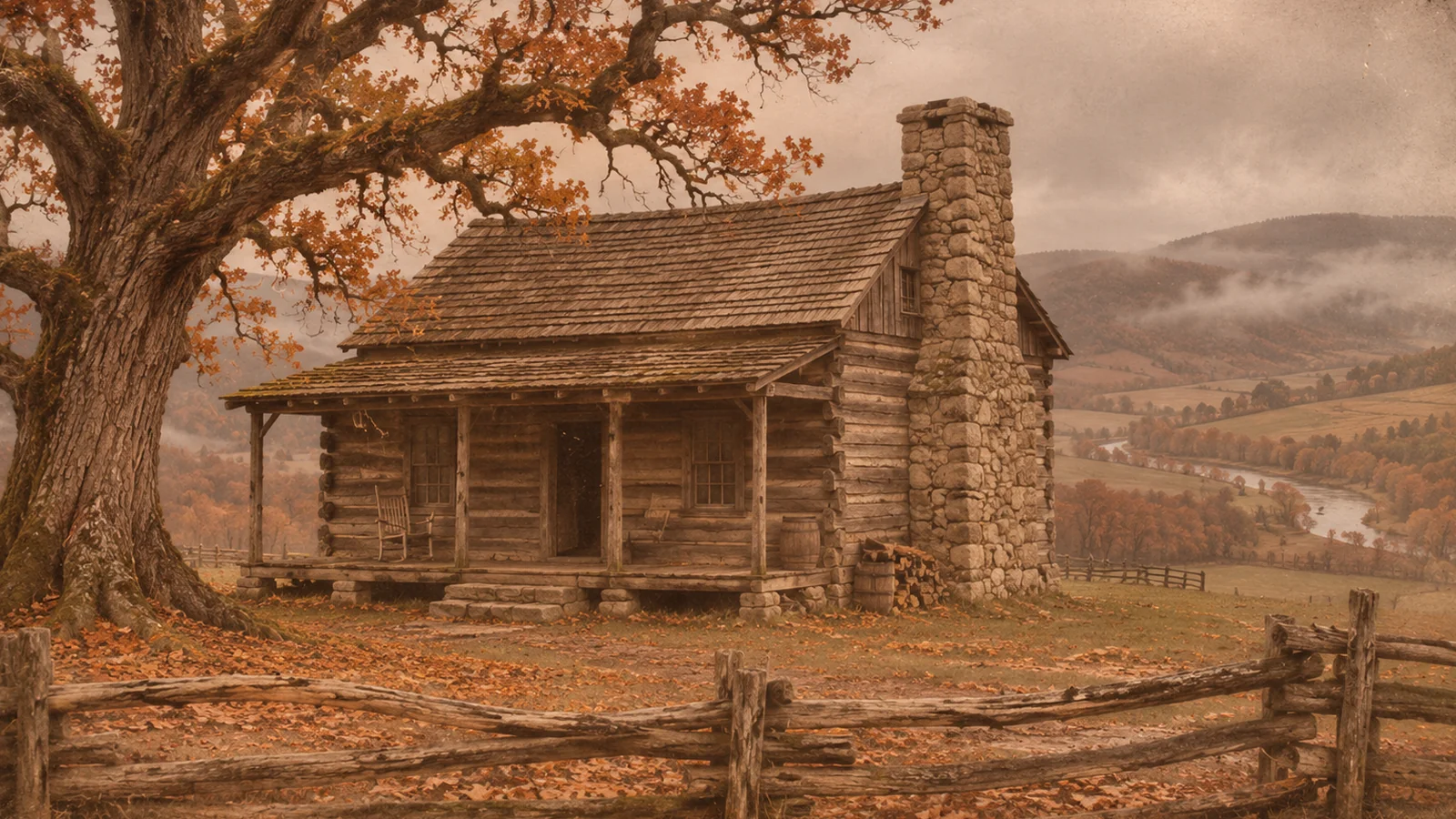
Picture a log farmhouse on the Red River in Robertson County, Tennessee, some time around 1817. A farmer named John Bell has just shot at a strange animal in his cornfield, and it has vanished. That night something starts knocking on the walls. By the end of the year, so the story goes, the thing in the house is pulling blankets off beds, slapping the youngest daughter and, eventually, talking. Welcome to the Bell Witch of Adams, Tennessee: the most famous haunting in the American South, and a proper mystery for a slightly awkward reason. Nobody can say for sure that any of it was written down at the time.
The legend says the spirit tormented the family for about four years, quoted two sermons word for word, and then poisoned John Bell. The record says something rather less tidy. Right then, let's sort the farm from the folklore.
The Bells of Robertson County, Tennessee
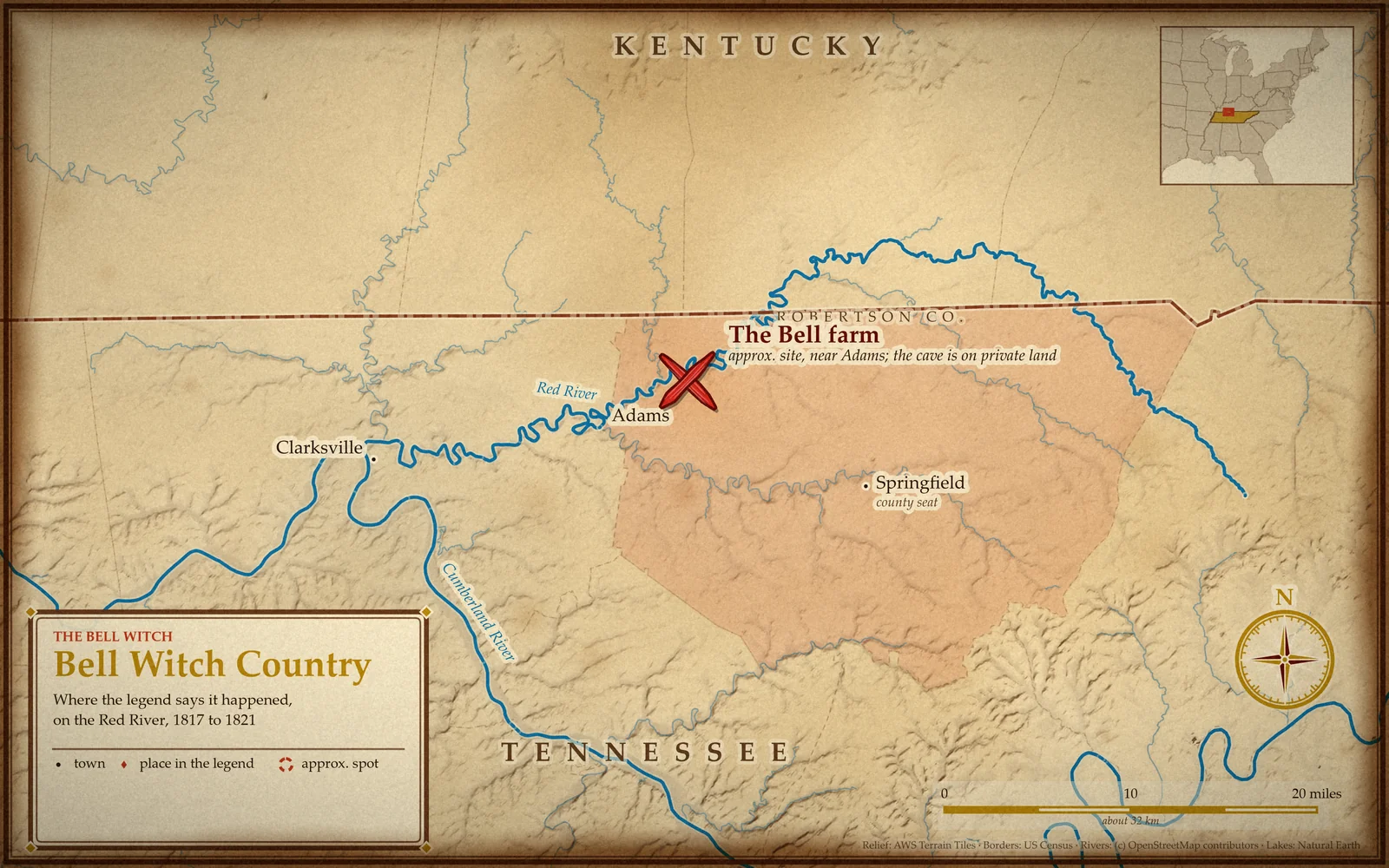
The people are the solid part. John Bell and his wife Lucy Williams Bell came from North Carolina to Middle Tennessee in 1804 and farmed along the Red River, in what is now the town of Adams. They had a large family, including a daughter named Betsy who ends up at the centre of everything. For more than a decade, by every account, they were an unremarkable farm family doing unremarkable farm things.
What the legend says happened, 1817 to 1821
In the legend, it begins in 1817 with John Bell seeing a strange creature in a field. Descriptions vary, from a dog-sized animal with a rabbit's head to a large black dog. He shoots at it, and it vanishes. After that come knocking on doors and walls, a sound like gnawing on wood, and chains rattling. Bedclothes are yanked off the sleepers. Betsy, the youngest daughter, bears the brunt: slapped, her hair pulled, according to the stories.
The family kept it quiet at first. Then, the legend continues, a neighbour named James Johnston and his wife stayed a night and reportedly had the same experience, and word got out. Visitors arrived. And the thing began to speak.
"Old Kate Batts's witch"
The spirit, the legend says, whistled, sang, argued Scripture and imitated the voices of neighbours. Asked who it was, it gave different answers. One of them was that it was "Old Kate Batts's witch." Kate Batts was a real neighbour whom some locals considered a witch, and in one version of the tale she had a land dispute with John Bell and cursed him. The spirit became known simply as Kate. Retellers admit the story works without Mrs. Batts at all, so treat the feud as part of the telling rather than part of the record.
The legend also says the spirit was kind to Lucy Bell, and cruel to John.
The engagement and the death of John Bell
Betsy was engaged to a young man named Joshua Gardner. In the legend, the spirit objected furiously, and in 1821 Betsy broke off the engagement. That much, at least, is a very human story.
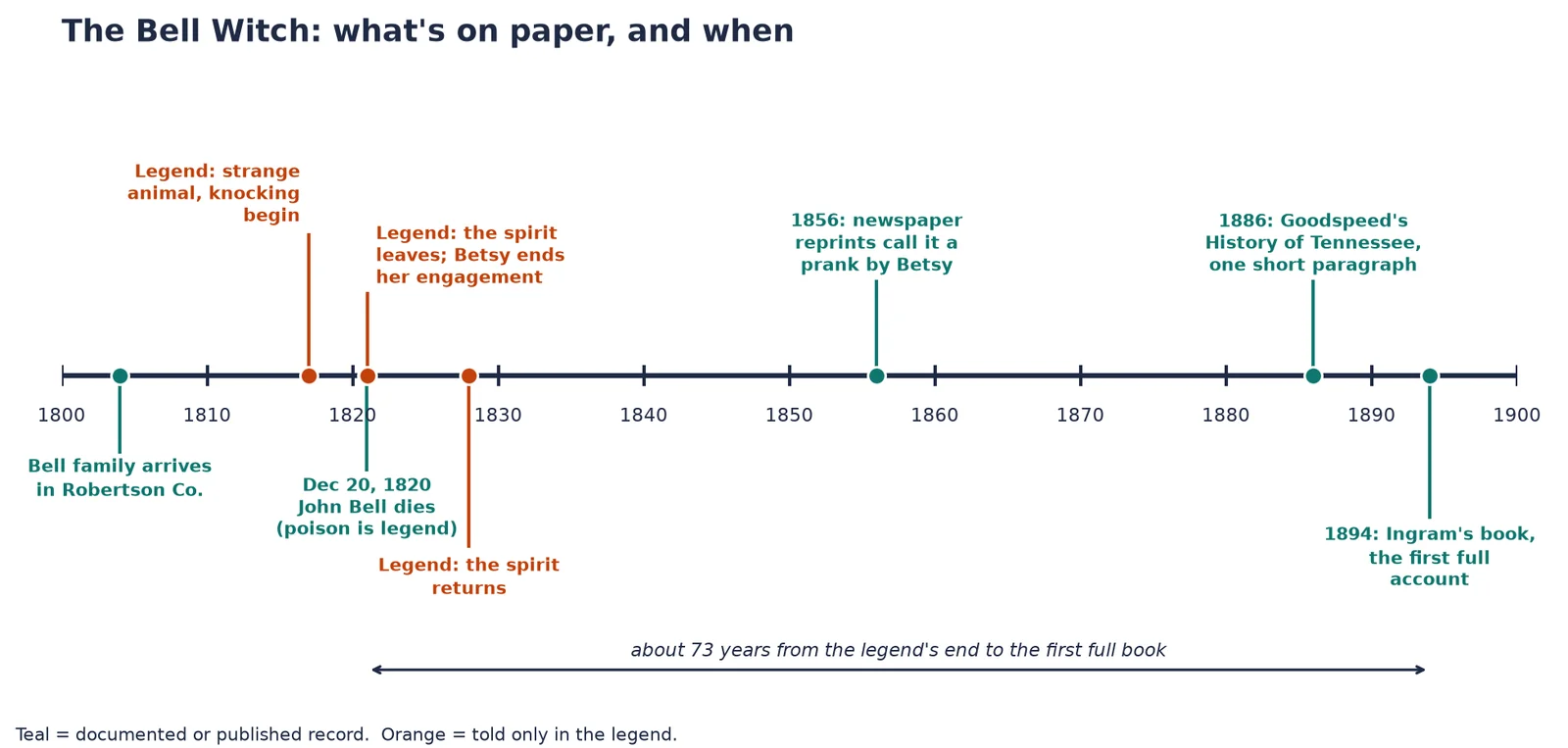
John Bell died on December 20, 1820. Told plainly: he was ill for a time and then he died. In Ingram's account the family found an unfamiliar vial of liquid near his bed, and the spirit claimed to have poisoned him. There is no independent record of the poison. The death itself is the part of this chapter you can lean on; the vial is the part you can't.
In spring 1821, says the legend, the spirit left, promising to return in seven years. In 1828, the story adds, it did, spent a while at the house and left again.
Did Andrew Jackson really meet the Bell Witch?
Every good legend needs a famous visitor. Here it is General Andrew Jackson, said to have arrived with a wagon that stuck fast on the road. Out of the dark, according to the tale, came the line "By the eternal, boys! That must be the Bell Witch!" Jackson's movements in those years are well documented, and no record places him in Robertson County in connection with the Bells. The story appears in Ingram's book, passed along through a letter, and in practice nowhere before it. Jackson himself never mentioned it. A rival in the 1824 presidential election would surely have enjoyed telling the voters about it, too. Call this one legend.
Where the Bell Witch story comes from
This is where it gets properly interesting, because the Bell Witch is a story about a ghost and also a story about a source.
Almost everything people repeat traces back to Martin Van Buren Ingram, a newspaper editor from Clarksville, who published An Authenticated History of the Famous Bell Witch in 1894. He said he drew on a diary kept by Richard Williams Bell, one of John Bell's sons, supposedly begun in the 1840s and passed through the family to Ingram himself. No one has ever turned up the diary. Ingram also cited a Saturday Evening Post article from 1849, but researchers who checked the archives have not found it. Skeptics such as Brian Dunning conclude that Ingram embellished, or invented, a good deal. Folklorists take a more generous line and read the book as a priceless record of what the region believed and how it talked.
Still, the story did not begin with Ingram. Here is what turns up earlier:
- 1820: a military officer, Captain John R. Bell, wrote of hearing about a young woman in Robertson County who had a voice. It does not name the Bell family, so it is a tantalising maybe.
- 1856: newspapers in New England, including the Green Mountain Freeman, reprinted a letter credited to the Saturday Evening Post that told the story as a ventriloquist prank played by Betsy. A researcher found this in 2019.
- 1886: Goodspeed's History of Tennessee gave the Bell Witch a short paragraph, as a bit of local superstition. It leaves out the poisoning and Andrew Jackson.
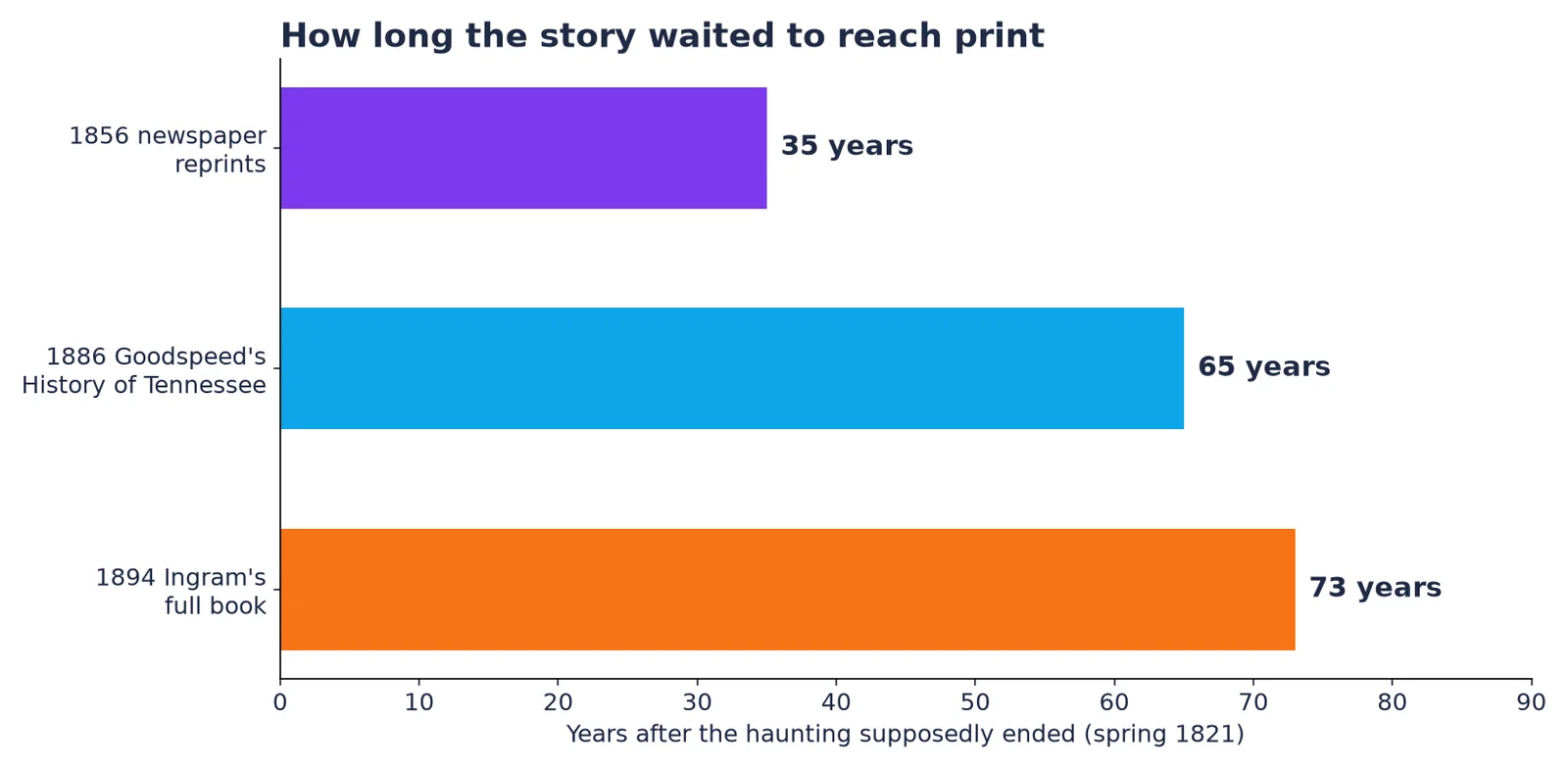
So the legend is older than the book, but the details that make it famous (the sermons, the poison, Old Hickory) sit in one source nobody can check.
The Bell Witch Cave
Ask people where the Bell Witch lives and many will say the cave. Bell Witch Cave is a karst limestone cave of about 490 feet on the former Bell farm, and it is on the National Register of Historic Places, added on March 21, 2008. Many believe the witch retreated there when she left the family. One tale has Betsy and her friends exploring it, a boy getting wedged in a hole, and an invisible voice pulling him free and then lecturing them on reckless exploring. Dunning points out that the cave plays no part in the original stories and that the cave adventures were written down many years later.
The cave is privately owned. It opens for guided tours in the summer months and in October, so check ahead before planning a trip, since the owners can close without much notice. Public stories from the cave itself include a 1937 sighting, a 1944 account and a 1986 overnight visit by journalists who left after strange noises. Those are stories, not records.
Theories, weighed
- A real spirit. The believers' answer, and the only one that explains the sermons. It needs witnesses, and the best witnesses are all in one book.
- A prank by a girl. The 1856 newspaper version blamed Betsy's ventriloquism, and some writers see classic poltergeist-faking by a child. It would not explain everything in Ingram's account, but then, much of Ingram's account is the thing in doubt.
- A feud and a rumour. A neighbour with a grudge, a witch-minded community, a family under strain. It makes for a tidy human story, though the Kate Batts link is itself part of the legend.
- A story that grew. From 1820's passing mention to the 1886 paragraph to Ingram's 1894 book to Charles Bell's 1934 retelling, the tale got bigger every time it was told. That is the skeptic's reading and it fits the paper trail best.
Ingram also wrote that the witch said she would return in 1935. She did not.
Where it stands today
The Bell Witch story is unproven, and it is also very much alive. Adams still has the farm's cemetery, a roadside historical marker on U.S. Highway 41, and a relocated log dwelling, and there are plays, films, songs and a whole cottage industry of books. Whether anything haunted the Bell farm, or whether a family, a rumour and a newspaper editor made a legend between them, the tale has outlived everyone who might have been able to settle it. Stay on the public road and the official tours, and let the spirit keep its secrets.
...and if you find it, remember who encouraged your questionable life choices.
More Ten Toe Express stories are on YouTube at @TenToeExpress.
Deep dive yourself
- Bell Witch · Wikipedia
- Bell Witch Cave · Wikipedia
- Bell Witch · Tennessee Encyclopedia
- The Bell Witch · Skeptoid
- The Bell Witch · World History Encyclopedia
- Bell Witch Cave · National Register of Historic Places