 Ten Toe Express
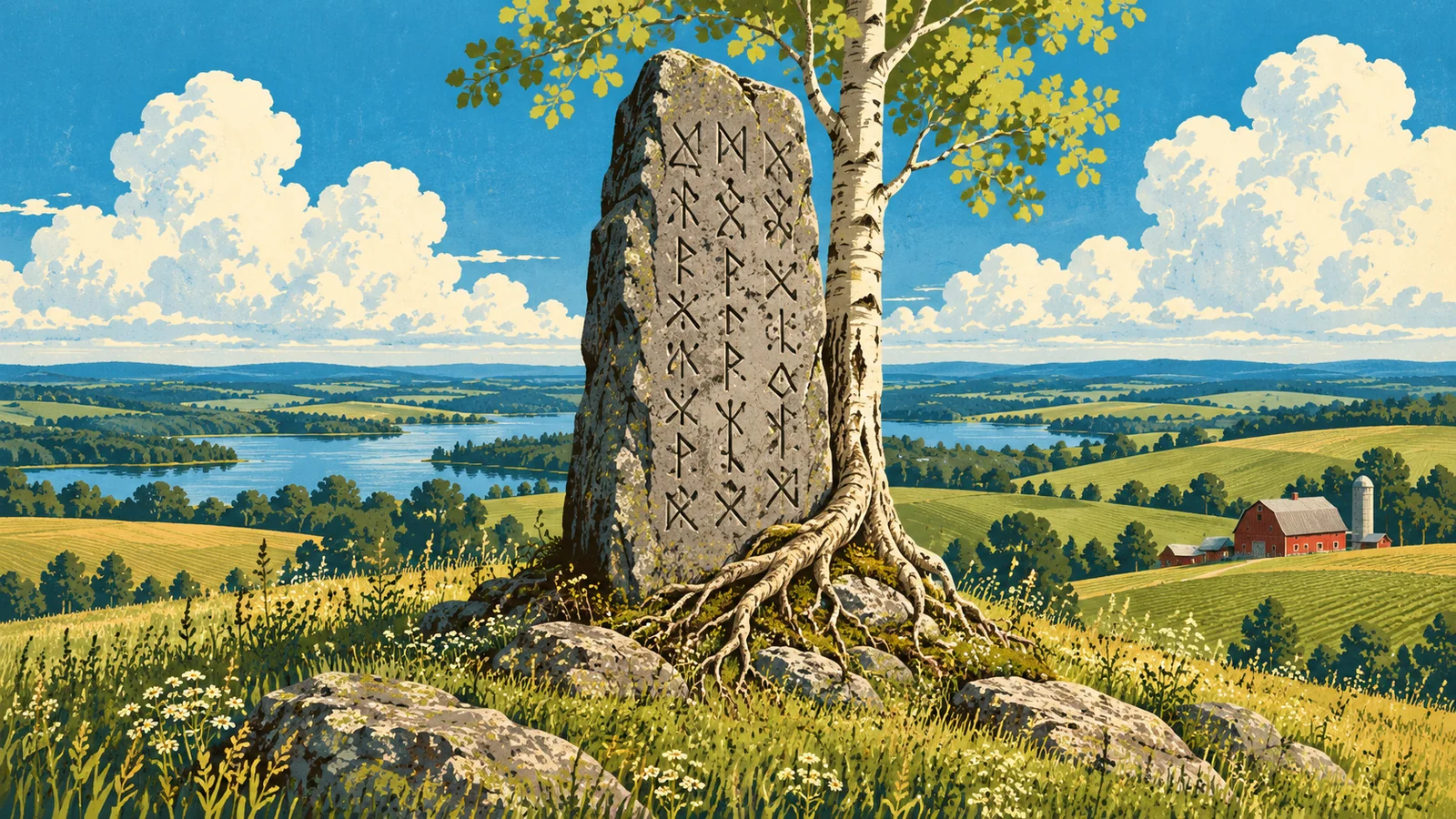
Right then. Picture a Swedish farmer in Douglas County, Minnesota, in the autumn of 1898, hacking at stumps so he can finally plough a new patch of land. Under a stunted tree, wrapped up in its roots, lies a grey slab of rock about as long as a kitchen counter is deep. One side is covered in carved marks. And the story of the Kensington Runestone, as it stands today, begins with a ten-year-old boy pointing at it.
If the carving is what it claims to be, Norse explorers marched deep into the middle of North America in 1362, some 130 years before Columbus bumbled into the Caribbean. If it isn't, somebody pulled off one of the great practical jokes in American history, and the joke is still running more than a century later. Either way it has a town, a museum, a giant Viking statue and a proper pile of scholarly name-calling attached. Fancy a look?
The Kensington Runestone: what turned up in Minnesota in 1898
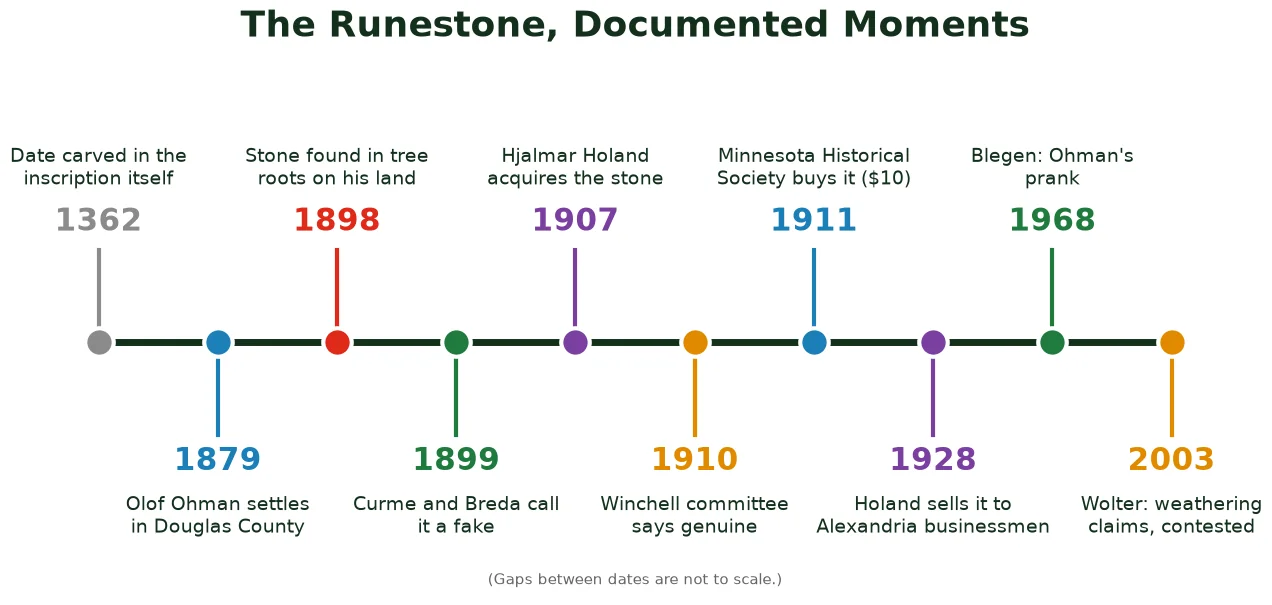
Olof Ohman was a Swedish immigrant who had come to Douglas County in 1879. According to his own account, in the fall of 1898 he was clearing trees and stumps from newly acquired land near Kensington when he found the stone near the crest of a small knoll above wetlands. It lay face down, tangled in the roots of a stunted poplar. His ten-year-old son Edward spotted the markings. Ohman later said he took them for an "Indian almanac."
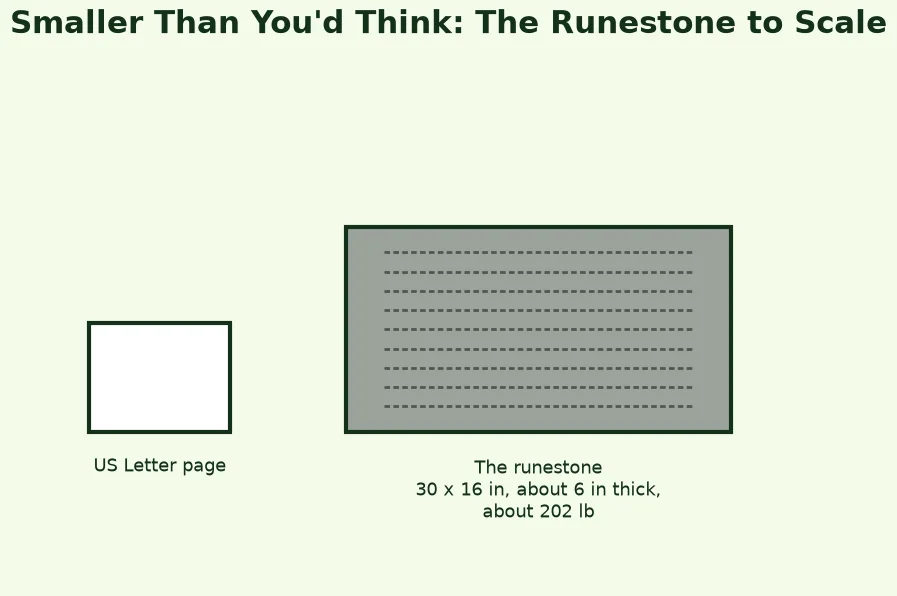
The slab is a hard grey sandstone called greywacke, and it weighs roughly what a large adult does. Markings run across nine lines on its face and three more down one side. Experts soon identified them as runes, the angular alphabet of early Scandinavia.
What the inscription says
The generally accepted translation describes a party of Swedes and Norwegians on an exploring trip out of "Vinland." Professor Olaus Breda's reading counts eight Swedes and 22 Norwegians. It mentions a massacre, a prayer for protection, men left behind to mind their ships, and the date 1362. It also contains "AVM," short for Ave Maria, in Latin capitals.
That date is the whole prize. Norse settlers are known to have been at L'Anse aux Meadows in Newfoundland around the year 1000, and nothing is confirmed in the American interior for centuries afterwards. A Norse party in Minnesota in 1362 would rewrite the schoolbooks.
The experts line up
The verdicts arrived quickly, and they did not agree.
- 1899: Rune experts George Curme and Olaus Breda judged the inscription a fake.
- 1907: Hjalmar Holand, a Norwegian-American writer, acquired the stone and defended it for more than fifty years.
- 1910: A Minnesota Historical Society committee led by geologist Newton Winchell concluded the stone was genuine. The same year the linguist George T. Flom published a study finding the runes and language inconsistent with the 14th century.
- 1911: The Minnesota Historical Society bought the stone from Ohman. The bill of sale is for $10.
Why most scholars call it a hoax
The main objection is the language. Scholars consider it closer to 19th-century Swedish than to the Swedish of 1362. Skeptoid lists specific words the stone seems to use that did not exist in Old Norse: the word for "discovery" was only borrowed from French in the 1500s, and umlauts did not turn up until the 17th century. A medieval carver cannot be expected to know words that were two centuries from existing.
Then there is the weathering. Winchell once estimated the carving was about 500 years old by comparing it with the stone's back. Later, the researcher Harold Edwards described the letters as showing virtually no weathering at all. Skeptoid makes the same point: sharp edges, and runes cleaner and lighter than the rest of the stone.
The excavations did not help. Digs in 1964 and 1981 turned up no 14th-century Norse artifacts and no remains of the men the inscription says were lost.
Ohman's own story has a wrinkle too. Skeptoid reports that he owned a Swedish book, The Well-Informed Schoolmaster, which includes a rune tutorial, and that he had signed and dated it eight years before the stone appeared. A man with a rune primer on the shelf calling the markings an "almanac" does look a little rehearsed. That is an observation, though, not a confession.
What the believers say
Defenders have made their own case. Some argue that spelling and grammar errors are what you would expect from a non-scholar carving in a hurry, and that a forger would have been tidier. Skeptoid's rebuttal is that the errors would require the forger to have somehow foreseen words from two centuries later.
In 2003 the geologist Scott F. Wolter concluded that the inscriptions were at least 200 years old. The Minnesota Historical Society's encyclopedia describes that claim as highly contested, and it is not accepted by most scholars.
Who made it, then?
Here the record gets wobbly, so tread carefully. Ohman never admitted to a hoax. Theodore Blegen's 1960 book argued that Ohman carved it as a prank. A 1967 interview with Frank Walter Gran, published in 1976, said that his father John had been told in 1927 that Ohman made the inscription, but that is a second-hand account of a second-hand account. The Minnesota Historical Society's encyclopedia also names Sven Fogelblad, a former pastor, as a possible accomplice. Nothing in the sources proves it.
There is a plausible backdrop, if not a proven motive. The 1890s were the great Viking Revival: the 1893 World's Columbian Exposition in Chicago, and a replica Viking ship sailing there the same year, got Scandinavian-Americans excited about their pre-Columbian heritage. Skeptoid notes that Ohman did not seek profit or fame from the stone, which is awkward for the "obvious moneymaker" theory.
Where the stone is today
After Holand sold it to Alexandria businessmen in 1928 for $2,000, the stone found its way to Alexandria, Minnesota, and was shown at the Smithsonian in 1949. The Runestone Museum in Alexandria, which opened in 1958 with the stone as its only artifact, is now where you can see it. The town goes all in: "Big Ole the Viking" stands there proclaiming Alexandria the "Birthplace of America," a claim that rests on the stone being real.
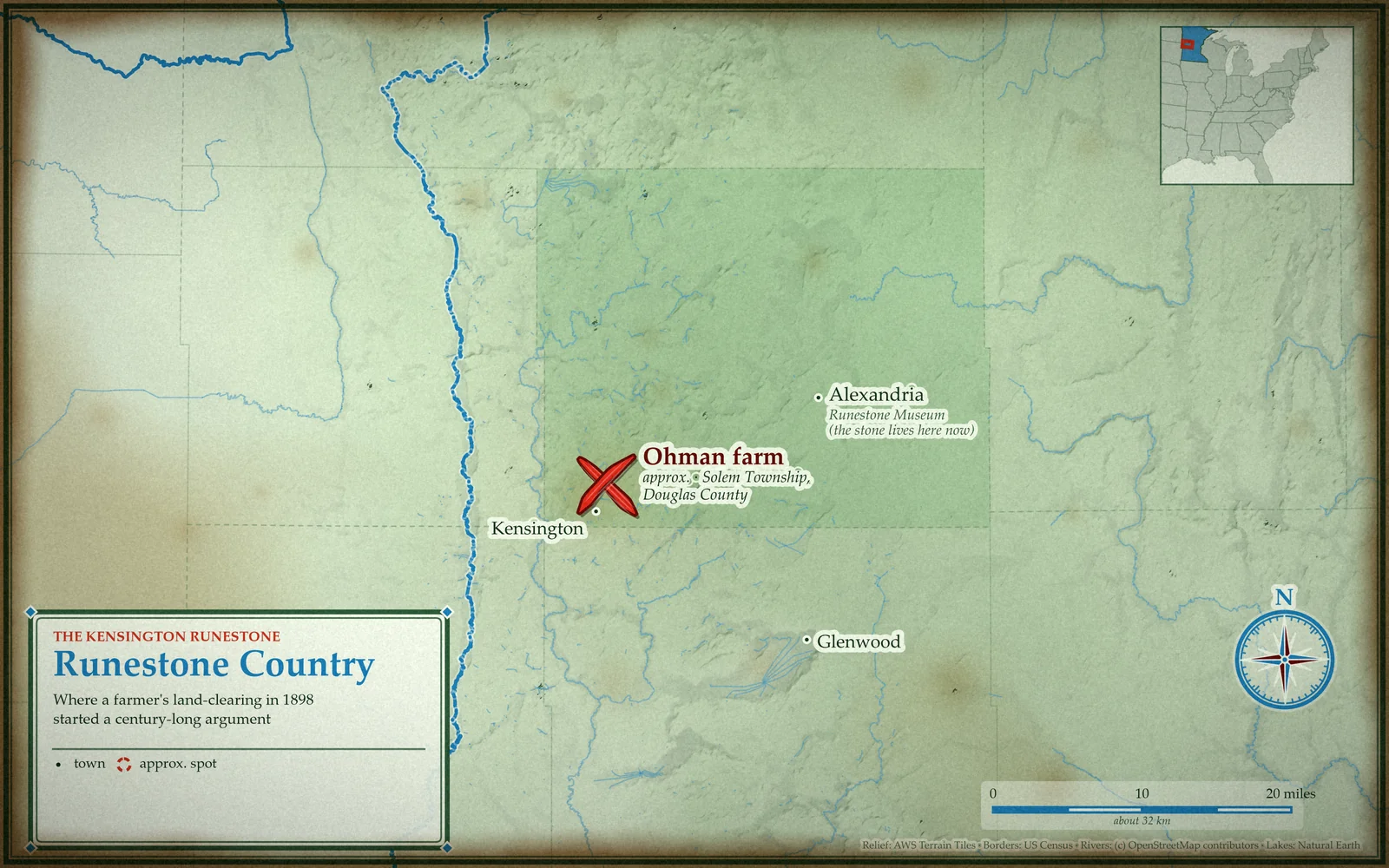
Visiting means a museum, not a field. The Ohman farm area is private land, so enjoy the stone behind glass and leave the spade at home. Check the museum's website for current hours and prices before you go.
Where this leaves you
Expert opinion, as the Minnesota Historical Society's encyclopedia puts it, favors the view that the inscription is not authentic. What nobody can say for sure is who made it, how, and why. A stone, a farmer, a missing confession and a town that has built its identity on it: that is a proper mystery, even without Vikings.
...and if you find it, remember who encouraged your questionable life choices.
The short version of this story is on YouTube at @TenToeExpress.
Deep dive yourself
- Kensington Runestone · MNopedia, Minnesota Historical Society
- Kensington Runestone · Wikipedia
- Decoding the Kensington Runestone · Skeptoid
- The Kensington Rune-Stone: an address · George T. Flom, Illinois State Historical Society, 1910
- Runestone Museum – Alexandria MN · Runestone Museum