 Ten Toe Express
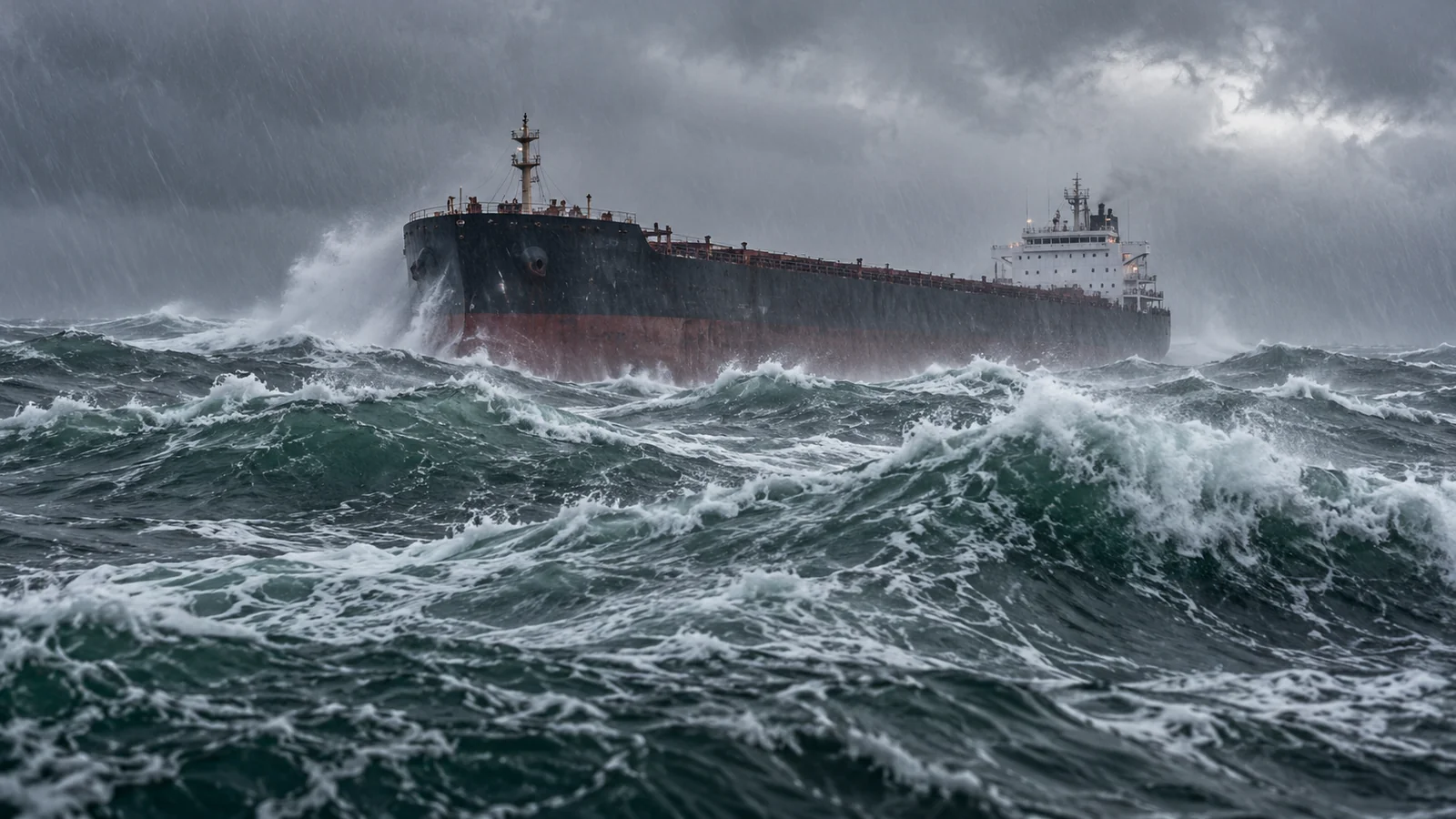
At about ten past seven on the evening of November 10, 1975, the crew of a Great Lakes freighter heard the last message anyone would ever get from the Edmund Fitzgerald, a calm report that the ship was holding her own. Minutes later one of the biggest ships on the lakes was gone from their radar screen. No distress call. No survivors. Twenty-nine people, 26,000 tons of iron-ore pellets and one very large question, sitting 530 feet down in cold, dark water.
Right then. Grab a coat. The wreck of the Edmund Fitzgerald, 17 miles off Whitefish Point, Michigan, is one of the great unsolved maritime mysteries in America, and the strange part is that nothing about it is hidden. The ship has been found, filmed, measured and argued over for fifty years. What nobody has ever pinned down is the one thing that matters: what actually happened in the last ten minutes.
The Edmund Fitzgerald: the Pride of the American Flag
The Edmund Fitzgerald was built to impress. Ordered by the Northwestern Mutual Life Insurance Company of Milwaukee and built at River Rouge, Michigan, she was launched in 1958 at 729 feet long and about 13,600 gross tons. For thirteen years, until 1971, she was the largest ship on the Great Lakes, which earned her the nickname "Pride of the American Flag". Her job was unglamorous and enormously profitable: carry taconite pellets, a processed form of iron ore, from the mines around Lake Superior to steel mills down the lakes.
She was a favourite with the people who worked her. One of her captains, Peter Pulcer, was known for piping music over the ship's intercom. In 1969 she carried a record single-trip load of 27,402 long tons. She also, over her career, ran aground once, collided with another ship once and lost an anchor in the Detroit River, which is roughly what you would expect from a vessel that spent seventeen years doing a hard job in hard water.
One detail matters later. Between 1969 and 1973 the Coast Guard raised her load lines three times, which meant she was allowed to sit lower in the water. By the final voyage her load line had been raised by more than three feet in total since launch. More cargo, less freeboard. Hold that thought.
Departure from Superior, Wisconsin
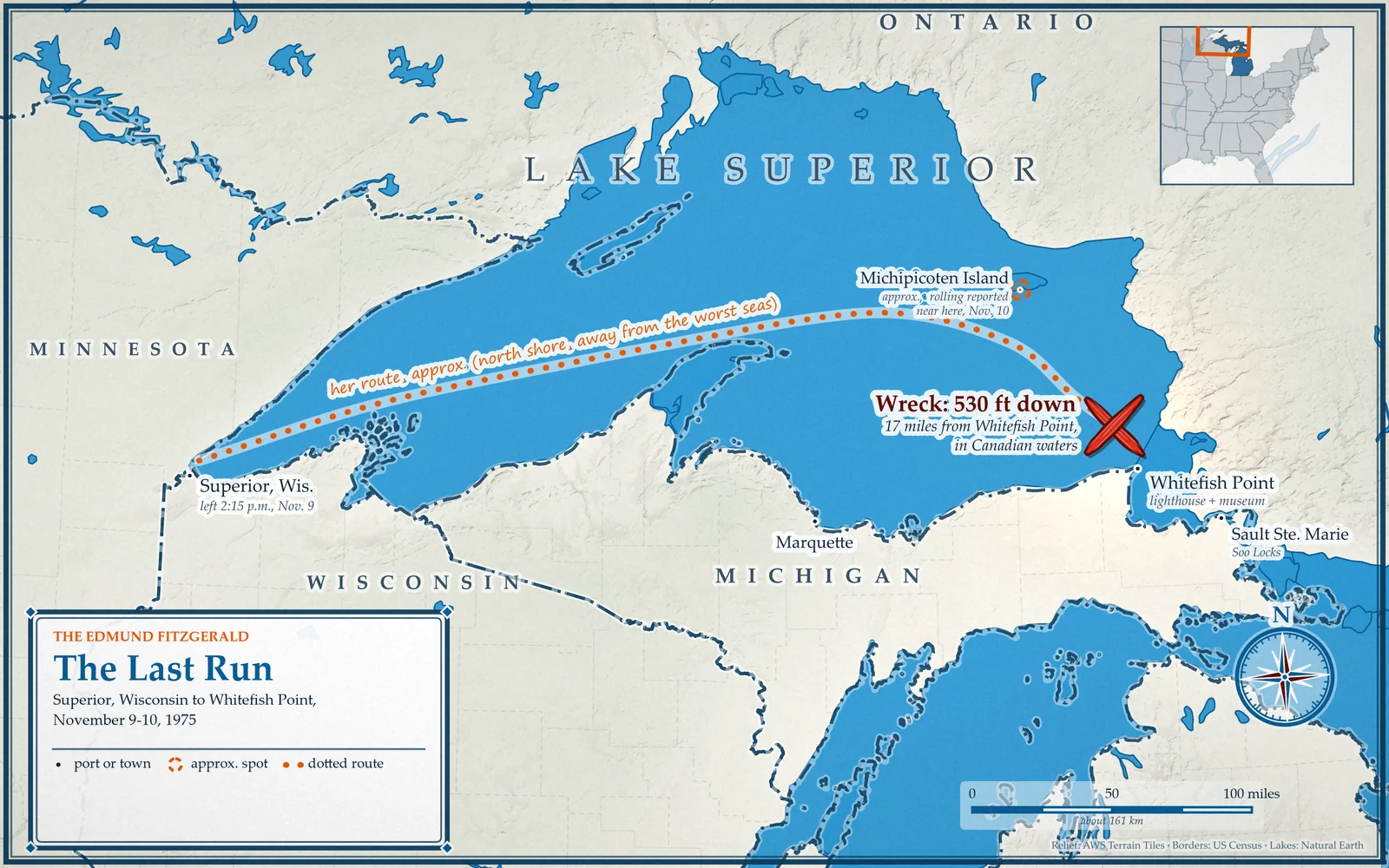
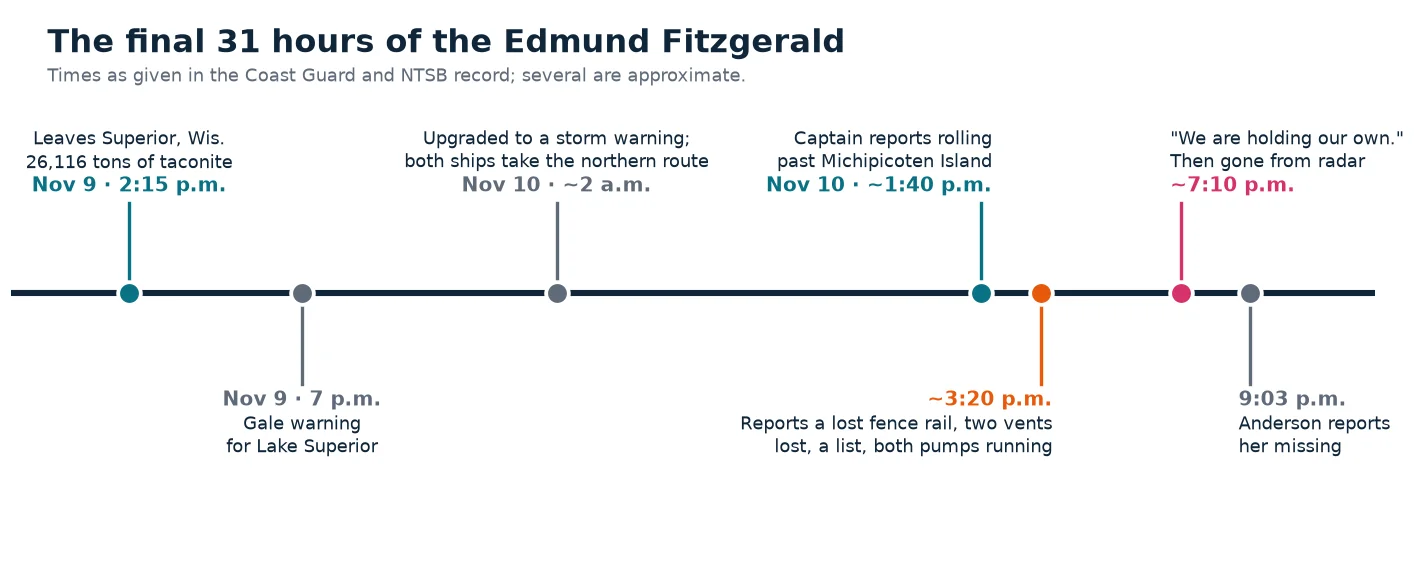
On the afternoon of November 9, 1975, the Fitzgerald left Superior, Wisconsin, at about 2:15 p.m. with 26,116 long tons of taconite, bound for Zug Island near Detroit. Her captain was Ernest McSorley, a veteran with some 44 years on the Great Lakes. Nearby, the Arthur M. Anderson, bound for Gary, Indiana, under Captain Jesse "Bernie" Cooper, was making the same run. The two ended up crossing the lake together, not quite in convoy but close enough to keep an eye on each other.
The weather was already turning. A storm that had formed over the plains was heading for the Great Lakes. A gale warning for Lake Superior went out on the evening of November 9, and by about two in the morning on the 10th it had become a storm warning. The captains of both ships chose a northern route, closer to the Canadian shore, hoping for some shelter from the worst of the seas.
November 10: the storm closes in
Then the wind swung. On the afternoon of the 10th the storm's winds shifted to the northwest and gave the waves the whole width of the lake to build up. The ships lost the shelter of the land. Winds reached something like 65 to 70 miles per hour, waves ran 18 feet and higher, and visibility fell close to nothing.
Around 1:40 p.m. McSorley reported some rolling after passing Michipicoten Island. By about 3:20 he was telling the Anderson that the Fitzgerald had lost a fence rail and two vents, had a list, and had both pumps running. Then came a message that chills the reader in hindsight: she told another ship, the Avafor, that she had a bad list, had lost both radars and was taking heavy seas over the deck. Around the same time McSorley asked the Coast Guard about the Whitefish Point light and radio beacon, which turned out to be out of action in the storm.
The Sault Ste. Marie locks had closed. The Coast Guard urged ships to find anchorage. The Fitzgerald had nowhere to hide, and she kept going.
The last message: holding her own
Between about 6:30 and 6:55 p.m., two huge waves swamped the Anderson. Then, around 7:10, came the last exchange: McSorley reported that the ship was holding her own. Shortly afterward the Fitzgerald disappeared from the Anderson's radar, and the Anderson could not raise her again.
No distress signal was ever received. That one fact has fed fifty years of theories, because it suggests whatever happened was fast. Captain Cooper reported the ship missing at 9:03 p.m. The Coast Guard had no way to mount a rescue in that storm, so the Anderson herself turned around and searched, in the same seas that had just nearly done for her, and found debris but no survivors. Later, one lifeboat was found badly damaged and part of a second was recovered, which suggests nobody had time to abandon ship.
Finding the wreck
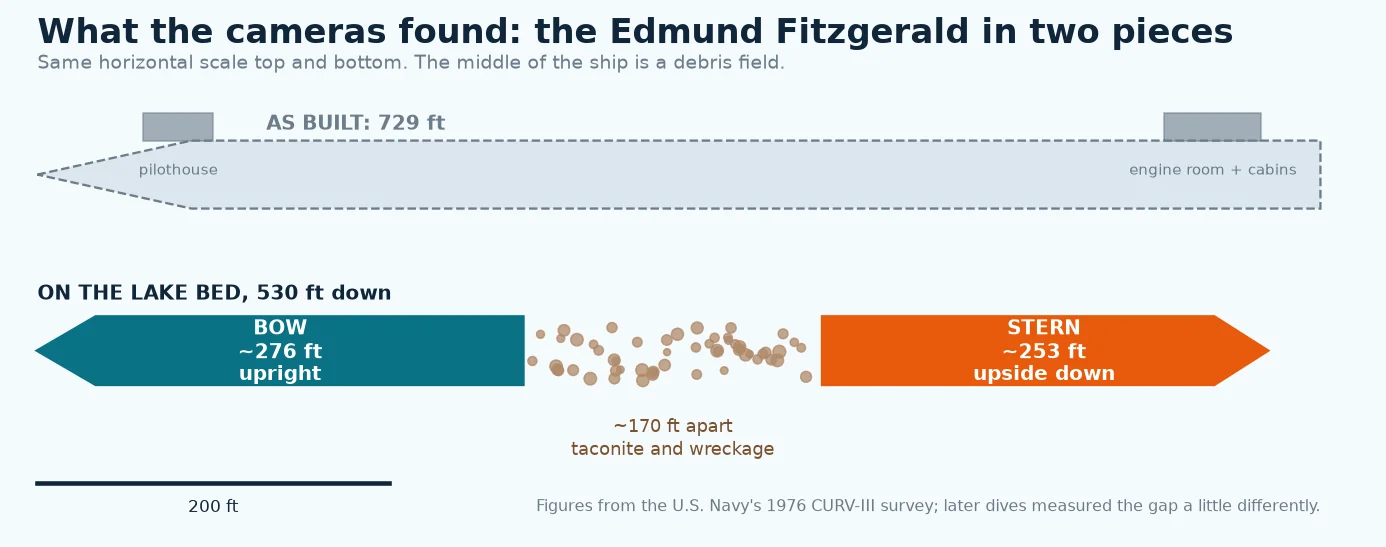
On November 14, 1975, a U.S. Navy plane using a magnetic anomaly detector located a large metal object on the lake bed about 17 miles north-northwest of Whitefish Point. It was the Fitzgerald, in 530 feet of water. In May 1976 the Navy sent down an unmanned vehicle called CURV-III, and the pictures settled one question and opened another: the ship was in two pieces. The bow, about 276 feet long, sat upright. The stern, roughly 253 feet, lay upside down, around 170 feet away, with a debris field of taconite between them.
Why did the Edmund Fitzgerald sink? The theories
Over the decades a handful of explanations have been argued over by the Coast Guard, federal safety investigators, ship owners and a lot of people with strong opinions.
The hatches (Coast Guard, 1977)
The Coast Guard's 1977 report blamed the hatch closures: the covers over the cargo holds were not sealed well enough, water crept in over many hours, and the ship slowly lost buoyancy and stability. This fits the load-line detail and the Fitzgerald's reports of damage and a list. The Lake Carriers Association, speaking for the shipping companies, objected to it strongly.
The big hit (NTSB, 1978)
The National Transportation Safety Board saw it differently. It concluded that the ship sank suddenly after one or more hatch covers failed under the crushing weight of boarding seas, flooding the hold in a hurry. The board's final wording was that the evidence was not conclusive, which is the official way of saying a very well-credentialed guess.
The shoal
Some have argued the Fitzgerald touched bottom on a shoal on the way, possibly the Six Fathom Shoal, and took damage below the waterline that nobody could see. Plausible, and impossible to prove, since a ship that touched a shoal in the dark and then took on water in a storm would look exactly like this.
The three sisters
Another idea is a freak run of unusually large waves, sometimes called the "three sisters", arriving one after another with no time to recover between them. The Anderson was swamped by two huge waves not long before the Fitzgerald vanished, so it is not a crazy suggestion.
The ship broke up
A last family of theories says the hull itself gave way, either from structural weakness or from the strain of being bent between two big waves, and broke apart at the surface. A team that dived in 1994 concluded she broke up on the surface. Others disagree. Naturally.
The honest summary: the NTSB and the Coast Guard did not agree, the shipping industry rejected the Coast Guard, and fifty years of dives have not produced a verdict that everyone accepts. Anything stated with total confidence is guesswork wearing a nice jacket.
Dives and the bell
Ship-lovers and researchers kept going back down. Jean-Michel Cousteau's team made the first crewed submersible dive to the wreck in 1980. The Great Lakes Shipwreck Historical Society, based at Whitefish Point, led expeditions in 1989, 1994 and 1995, and in 1994 another team logged dozens of hours of video. On July 4, 1995, divers brought up the Fitzgerald's bronze bell, which weighs about 200 pounds. A replica was left on the wreck, so the ship still has a bell, and the crew still has a memorial.
The ship itself was never raised, and no bodies were recovered. The wreck is widely regarded as a grave.
The song, the bells and the rules
Within a day of the sinking, the Reverend Richard Ingalls at Mariners' Church in Detroit rang the church bell 29 times, once for each person lost. A few weeks later Newsweek published a piece called "The Cruelest Month", which Gordon Lightfoot read and turned into his 1976 ballad. That song is why people far from the lakes know the name Edmund Fitzgerald, which is not a bad legacy for a mystery that began with iron-ore pellets.
The Fitzgerald lies in Canadian waters, and Ontario has tightened the rules around her. Changes to its Heritage Act allow diving and surveys to be licensed, with fines of up to a million Canadian dollars, and in 2006 a protection zone of 500 metres was set around the wreck. In other words, the wreck is off limits unless you have a licence, and you will not get one for curiosity.
The Edmund Fitzgerald today
Every November 10 the Great Lakes Shipwreck Historical Society holds a remembrance service at Whitefish Point. The 2026 ceremony is livestreamed and closed to the public, and the museum is shut that day. The recovered bell is on display at the Great Lakes Shipwreck Museum there the rest of the time. Whitefish Point, on the Michigan shore of Lake Superior, is the place to go to look out at the water where it happened.
And that is the mystery: a huge, well-built ship, a veteran captain, a bad storm, a ten-minute window, and a lake that has never given a straight answer.
...and if you find it, remember who encouraged your questionable life choices.
Stories like this one live on YouTube at @TenToeExpress.
Deep dive yourself
- The sinking of the SS Edmund Fitzgerald - November 10, 1975 · CIMSS, University of Wisconsin-Madison
- Sinking of the Edmund Fitzgerald · EBSCO Research Starters
- 50 Years Later, the Wreck of the Edmund Fitzgerald Remains a Mystery · The Maritime Executive
- Edmund Fitzgerald · Great Lakes Shipwreck Museum, Whitefish Point
- SS Edmund Fitzgerald · Wikipedia