 Ten Toe Express

Picture North Dakota at three in the morning in late October. The wheat is long gone, the wind has the whole flat horizon to itself, and a young airman in a pickup truck is heading for a missile site when a light rises off the prairie and starts following him. That, according to the people who were there, is how the strangest night in the history of Minot Air Force Base began on 24 October 1968.
Right then. What do you do with a UFO story that comes from sworn professionals guarding nuclear weapons, was logged on official forms, got a radar tape, and still ended with the Air Force blaming the star Sirius? You read the paperwork carefully, you sort what is documented from what people remembered later, and you keep a raised eyebrow handy. Here is the Minot Air Force Base UFO story, with all three.
Why Minot, North Dakota, in the 1960s?
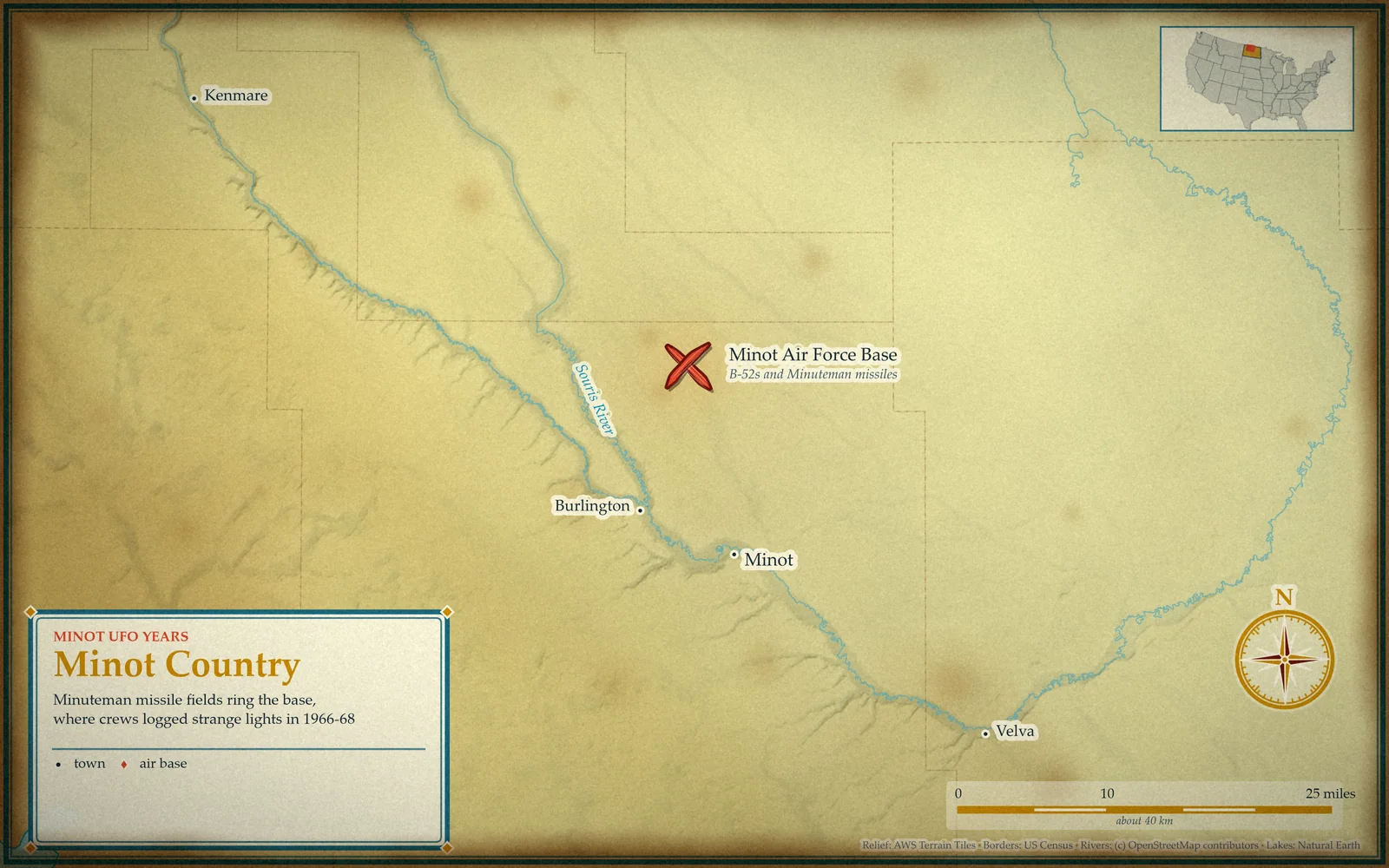
Because it was one of the most heavily armed corners of the planet. Minot Air Force Base in the 1960s was home to B-52 bombers and fields of Minuteman missiles buried in the prairie, each one watched by security teams, maintenance crews and launch officers working through long, freezing nights. Lots of trained observers, lots of dark sky, very little else to look at. If you wanted a place where odd lights would be noticed, written down and reported up the chain of command, this was it.
Strange lights at Minot in 1966 and 1967
The earliest Minot story belongs to August 1966. A report reprinted by the National Investigations Committee on Aerial Phenomena (NICAP), a civilian UFO group, comes from a Minuteman program supervisor who said he spoke with an Air Force officer who had been in a missile launch control facility in North Dakota. The officer's account, as the supervisor told it, was that radar operators tracked something manoeuvring over the base, that objects were seen at ground level near three missile sites, and that radio equipment filled with static while the object hovered overhead. Fighter jets were said to have been scrambled and to have come up empty.
The Air Force denied it. A spokesman said Strategic Air Command found nothing in its unit histories to confirm UFOs or equipment trouble on that date. Dr. J. Allen Hynek, then a scientific consultant to the Air Force's Project Blue Book, said he visited the base afterwards and believed it had been buzzed by a UFO. Note the chain here: second-hand, retold years later, and flatly denied. That is the legend end of the scale.
The 1967 story sits in the same bracket. A researcher group called the Nuclear Connection Project reports that on 5 March 1967 Minot radar tracked an unidentified target descending toward a missile site, and that security teams saw a disc ringed with flashing lights. A sergeant is said to have found a launch facility's gates open. That is how the Minot Daily News retold it in 2016, and the paper itself noted that nothing about it was ever proven. So far: tantalising, thin on paper.
The night of 24 October 1968 at Minot Air Force Base
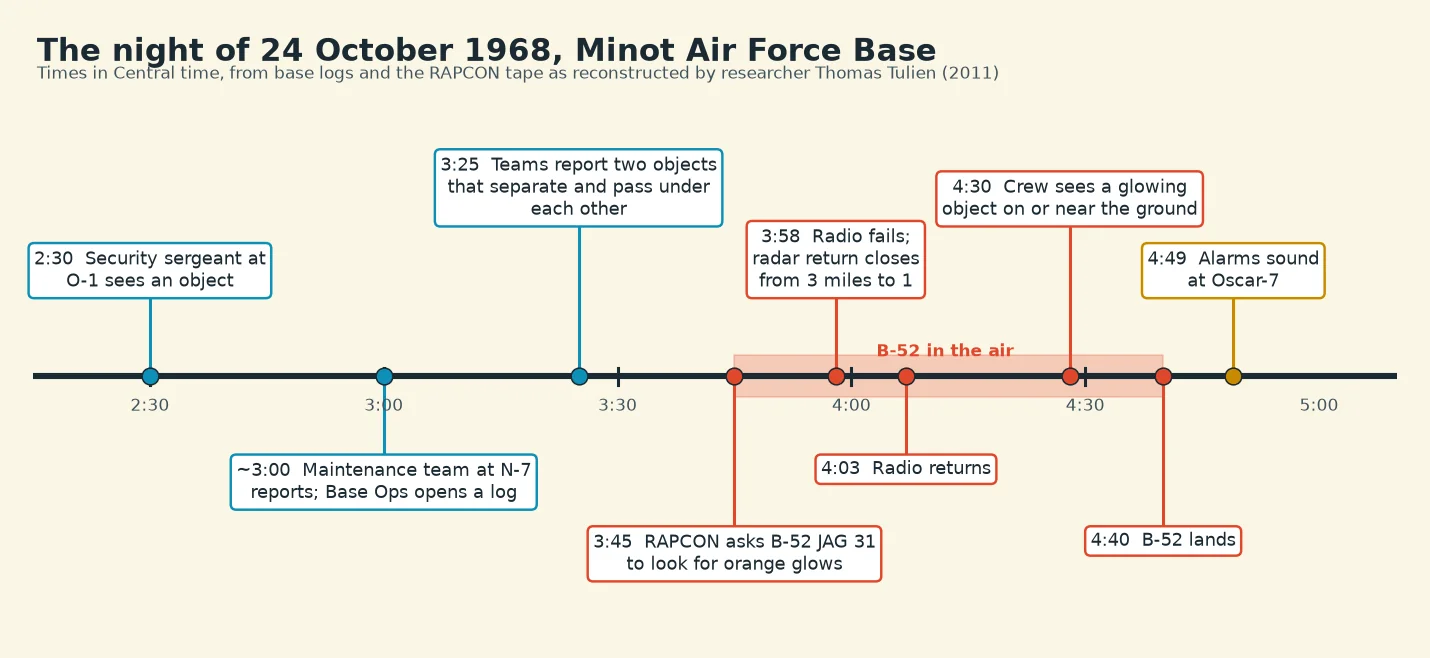
Now for the one with paperwork. Researcher Thomas Tulien spent years pulling together the logs, forms and interviews for what he calls the Minot B-52 UFO case, and his narrative is the backbone of this section. Times below are as he corrected them from the radar tape.
It starts on the ground. At about 2:30 a.m., a flight security controller at one launch control site, Oscar-1, files a form describing an object. At about the same time two airmen driving to a missile site called November-7 see a luminous object that seems to follow their truck. Later, security teams at several sites report two objects that separate and pass under each other. These are sworn-in, trained, on-duty people filling out Air Force Form 117 sighting reports. The reports exist.
The B-52 and the radar that wouldn't go away
Around 3:45 a.m., Minot's radar approach controllers asked a B-52H on a training flight, call sign JAG 31, to look out for "orange glows" ahead. Then the bomber's radio fell silent for about seven minutes.
What the crew reported afterwards, and what the transcript supports, goes like this. Around 3:52 an object showed up on the bomber's weather radar and then its main radarscope, about three miles off the right wing. Around 3:58 the radio failed altogether, and the return closed from about three miles to about one inside a single sweep of the radar. At about 4:03 the radio came back; the crew said the return then spent much of the approach about a mile and a half off the left wing. Not long after 4:06, the return vanished.
Navigator Patrick McCaslin later said the return seemed to track alongside them, then back off. Co-pilot Bradford Runyon, in a later interview, estimated the object at 200 feet wide and hundreds of feet long. Those are recollections, offered years afterwards, not entries on the tape.
Then comes the odd bit. The crew was reportedly asked by a general officer to fly back around and pass over the glowing thing on the ground. Only two crew members recall that request; the transcript does not name the officer. Between roughly 4:30 and 4:35, one pilot's own report puts the crew looking at a stationary, glowing object on or near the ground ahead of them. The B-52 landed at 4:40.
Nine minutes later, at 4:49, alarms went off at missile site Oscar-7. Airmen who drove past about ten minutes after that noticed the site lights on and an access hatch open. The Dakota Datebook retelling, drawing on Kevin Randle's book, adds that guards found an inner door's lock disturbed. Nothing in the sources says a weapon was touched, and nobody has shown the alarm and the lights are connected.
What the Air Force said about the Minot UFOs
Here is a detail that raises the eyebrow all by itself. According to an ABC News report from 2005, Project Blue Book never sent investigators to Minot, even though generals at Strategic Air Command were interested. Tulien's narrative adds that Blue Book did not interview the camper team or the regular B-52 crew, and did not follow up on the possibility of two objects.
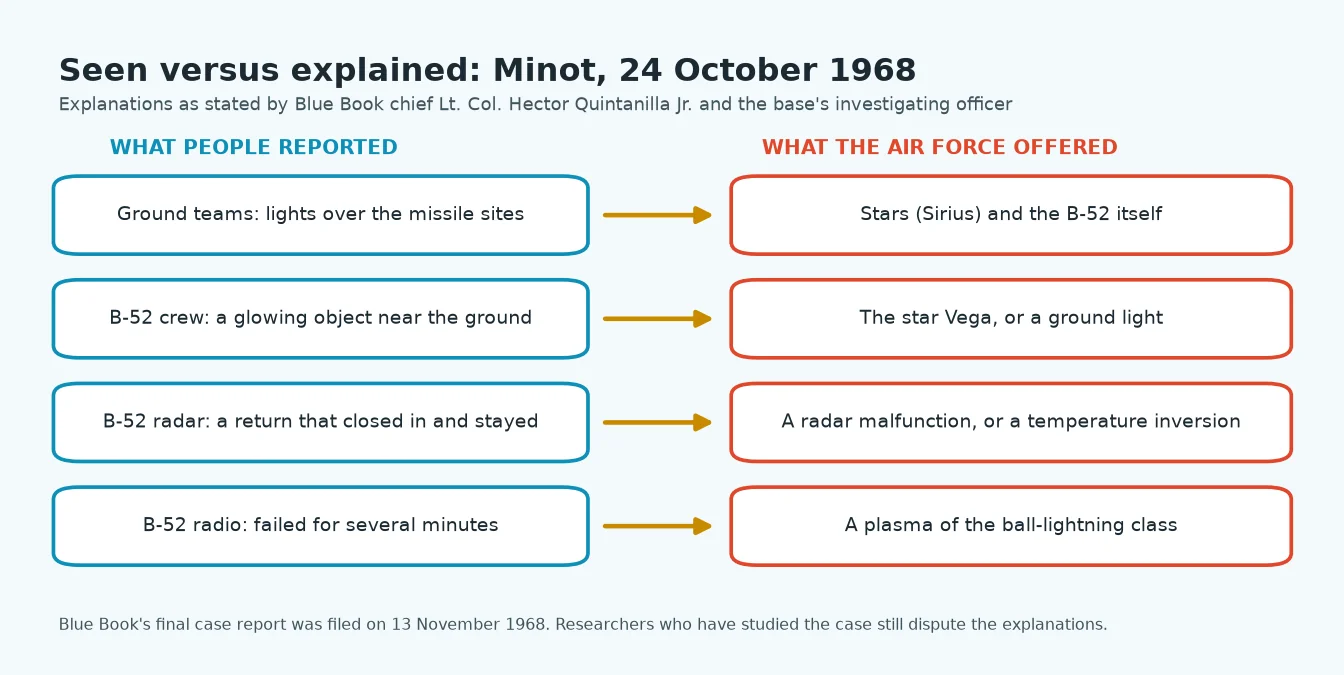
The Blue Book chief, Lt. Col. Hector Quintanilla Jr., worked from the base's own report. On 29 October he told a Strategic Air Command colonel that the radar return was either an internal radar malfunction or a temperature inversion, and that some observers were probably looking at stars. On 1 November he described the visual and ground sightings as "most probably a plasma of the ball-lightning class", and otherwise "fairly routine." His final case report, dated 13 November 1968, named the ground sightings as the star Sirius and the B-52, and the airborne sighting as the star Vega or a ground light.
Theories, weighed
- Misidentified stars and aircraft. The official line. Bright stars do fool people, especially on cold, clear nights, and the base's investigating officer thought many ground sightings were the B-52 itself. But stars do not usually appear on a bomber's radar, and nobody has explained a plasma that also silences a radio.
- Radar and weather effects. Temperature inversions can bend radar beams and create phantom returns. A fair possibility, though the crew's report of the return moving as the aircraft turned does not sit comfortably with a simple glitch.
- Something nobody identified. That is the position of the researchers who have spent years on the case, and the most that can honestly be said is that the investigation was thinner than the evidence deserved.
No source on this page claims proof of anything from beyond Earth. What the record does show is a lot of professionals, several official forms, a taped radio transcript and an investigation that, by its own reviewers' accounts, never got fully off the ground.
Minot Air Force Base today
Minot Air Force Base is still very much a working military installation, and the Minuteman fields around it are still active, so this is a story to read about rather than to wander around. The honest way to follow it is by paper: the logs, the forms and the oral histories have all been published online, and a couple of North Dakota outlets have retold the story over the years.
...and if you find it, remember who encouraged your questionable life choices.
The short version of this story is on YouTube at @TenToeExpress.
Deep dive yourself
- A Narrative of UFO Events at Minot Air Force Base, North Dakota · Thomas Tulien, Sign Oral History Project
- Investigation of UFO Events at Minot AFB · Sign Oral History Project
- Minot Missile Base UFO · Prairie Public, Dakota Datebook
- Minot's Age of UFOs · Minot Daily News
- Minot, North Dakota, 24 August 1966 · NICAP