 Ten Toe Express

Picture a summer evening in 1856, just west of Iowa City. Hundreds of canvas tents stand along a creek, wood shavings drift across the grass, and families who crossed the Atlantic a few weeks earlier are hammering together the two-wheeled carts they will push and pull about 1,300 miles to the Salt Lake Valley. Somewhere out on the road ahead, so the story goes, a few of those travelers will scrape a hole beside the trail, drop in a little hoard of gold coins, and promise themselves they'll be back for it.
They never came back. That, in one breath, is the legend of the lost gold of the Mormon Handcart Trail in Iowa: coins buried somewhere along the old road between Iowa City and Council Bluffs, waiting for a lucky plough or a lucky walker. It's a tidy little treasure tale. The trouble, as you're about to discover, is that the real people who walked that road had very little gold to bury, and a great deal more to worry about.
So grab a stout pair of boots. This one is part treasure hunt, part history lesson, and part reminder that the most valuable thing on the trail was never in a tin box.
Why anyone pushed a cart across Iowa
First, the backstory, because without it the legend makes no sense at all.
By the 1850s, the Church of Jesus Christ of Latter-day Saints had thousands of converts in Britain and Europe who wanted to gather in Utah. Most were working people from factories and farms, and most could not afford the trip. The church ran a loan scheme, the Perpetual Emigrating Fund, which paid passage for poor emigrants who would repay it when they could. By the mid-1850s the fund was running dry, and wagons and ox teams were expensive.
So on October 29, 1855, Brigham Young announced a cheaper plan. Emigrants would walk, pulling their belongings in light handcarts, with a few ox-drawn wagons carrying the heavy supplies. The idea cut the cost of the journey by roughly a third. Between 1856 and 1860, ten handcart companies made the trip, nearly 3,000 people with about 650 handcarts. Remarkable, really. Also rather a lot of walking.
Iowa City, 1856: the end of the railroad
In 1856 the railroad stopped at Iowa City. That's what made the town the starting line. Emigrants landed in American ports, rode the train west as far as the tracks went, and climbed down in Iowa City to find that the next 1,300 miles would be on foot.
A granite boulder in Coralville records that about 1,300 European emigrants arrived in Iowa City in the summer of 1856. They camped about two to three miles west of the depot, across the Iowa River on the south bank of Clear Creek, near a little settlement then called Clark's Mills, which is now Coralville. The first arrivals came in on May 12 and were housed in the depot for two nights before moving out to the camp.
The handcarts were built right there, mostly of hickory and oak, and one emigrant put the weight of a cart at about 60 pounds. The emigrants' own craftsmen did much of the work without wages, and Daniel Spencer, one of the organizers, reported high prices and scarce labor in Iowa City. In the rush, some carts were made of green, unseasoned wood, which would crack and shrink on the dry plains later. Each cart was shared by about five people and carried a few hundred pounds of food, bedding and cooking gear.

Here's the detail that matters most for a treasure hunter. Each adult was allowed just 17 pounds of personal baggage, and each child 10 pounds. That's clothes, bedding and everything else you own. If you had a family Bible, a spare pair of shoes and a shawl, you were already doing your sums.
Births, burials and the camp by the creek
The camp was not just a workshop. Families lived there for weeks while they waited for carts, and life carried on. Babies were born in the tents. A few people also died there, and the records name some of them: two infant girls in mid-May, a 60-year-old woman named Maria Shinn on May 19, and a baby, Jane Ramsay, just seven days old, on June 7. A local researcher, Charlene Nichols Hixon, estimated about six burials at the camp, all but one of them children. They were laid to rest on a bluff above the creek, and no grave markers survive.
It's worth keeping those small graves in mind. Whatever glitters in the legend, the real story of this trail is mostly about ordinary families paying a very high price to get where they were going.
The road west across Iowa
The first handcart company, led by Edmund Ellsworth, rolled out of the Clear Creek camp on June 9, 1856. A second, under Daniel McArthur, followed two days later. More went later that summer.
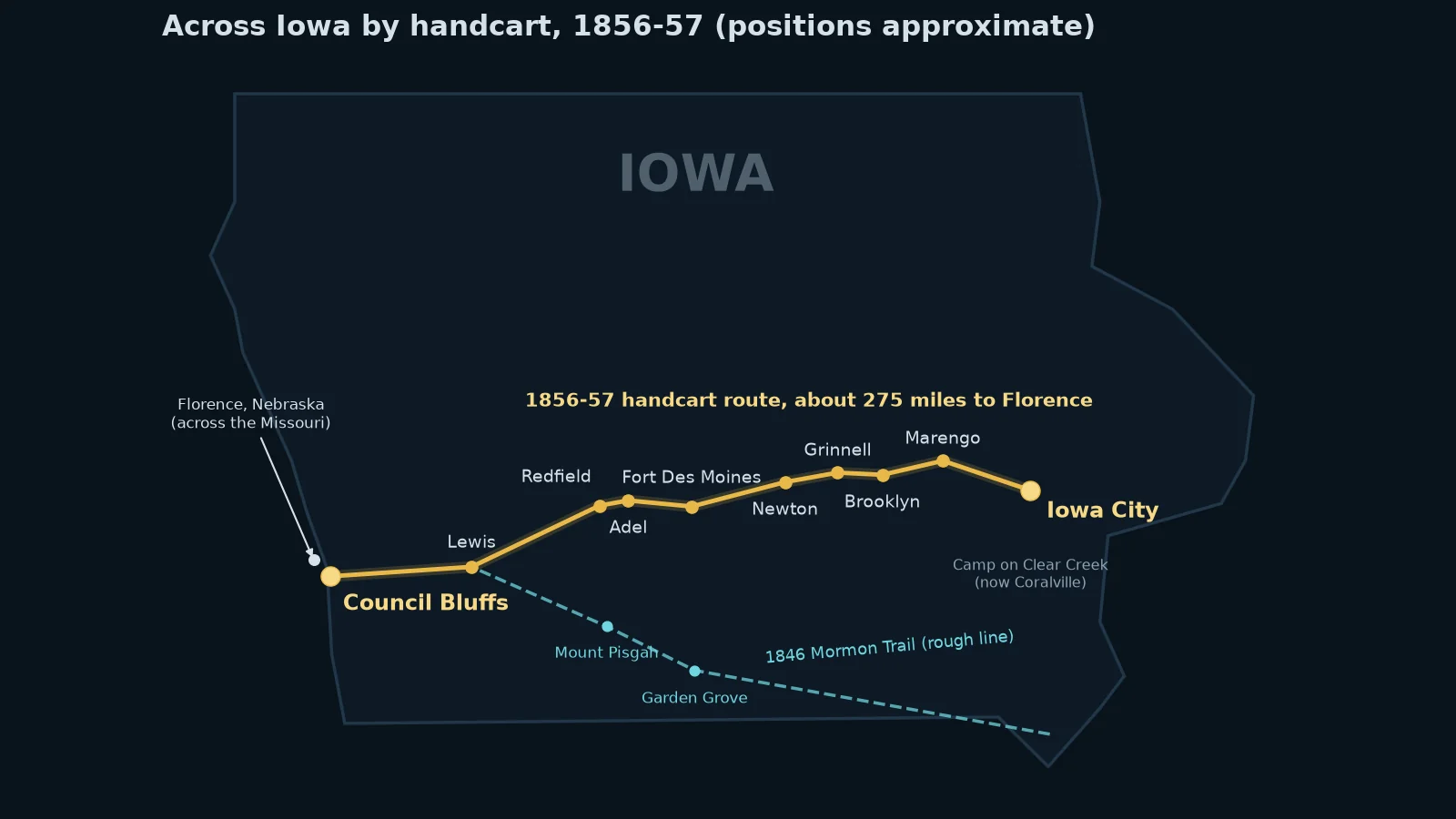
Their road was not the famous 1846 Mormon Trail, which Brigham Young's wagon companies had cut across southern Iowa ten years earlier after leaving Nauvoo, Illinois. The handcart companies took an existing road further north, one that began as a military road to Fort Des Moines and later carried mail and stagecoaches. Going west from Iowa City, the companies passed the brand-new German colonies at Homestead and South Amana, then Marengo, Brooklyn, Grinnell, Newton and Rising Sun, and reached Fort Des Moines, where the old army post stood abandoned on the west bank of the Des Moines River.
From there they pushed on to Adel and Redfield, then to a coach stop called Bear Grove, and along the old Dragoon Road to what is now Lewis in Cass County. That's where the handcart road joined the 1846 trail for the last stretch to Council Bluffs, and a ferry across the Missouri to Florence, Nebraska.
The distance from Iowa City to Florence was about 275 miles. The first seven companies took between 21 and 39 days to cover it, averaging about 25 days and roughly 11 miles a day. Most journals from those Iowa weeks are fairly cheerful about the roads. The stagecoach, by the way, would have taken you to the Missouri for about eleven dollars a head. The handcart emigrants walked, because they couldn't spare the eleven dollars.
Which leads, rather neatly, to the gold.
The legend: coins in the ground
The legend, as it's told today, is short and simple. Travelers on the Mormon Handcart Trail in Iowa are said to have buried gold coins along the way and never returned to collect them. There's no name. No company. No amount. No landmark, no carved stone, no deathbed confession, no old map. Just gold, a trail and a hole in the ground.

Hunt for the story in the usual places, and it's surprisingly hard to pin down. The detailed histories of the Clear Creek camp, the church's own accounts, the route studies and the Utah histories of the handcart companies don't mention buried gold anywhere. Iowa has plenty of buried-treasure tales, many of them collected from old-timers in interviews and gathered by the writer Charlton Laird into a book, Iowa Legends of Buried Treasure, published in 1990 after his death. But the tales that turn up most often on modern treasure lists are about outlaws like the James gang, a frightened miner in Dubuque, or an Army paymaster near Fort Atkinson.
The nearest thing to the handcart legend on those lists is a story about a nameless mid-1800s pioneer heading west through Council Bluffs, who supposedly buried gold coins for safekeeping because he was afraid of being robbed, then died before telling anyone where. No Mormons are named in it, and no source is given. It's easy to see, though, how a story like that could drift along the road and attach itself to the most famous travelers who ever used it.
Did the handcart pioneers have gold to bury?
This is where the legend starts to wobble, rather badly.
- Most of them were poor. That was the whole point of the handcarts. They were the cheap option, designed for people who could not afford a wagon. In 1856 the emigration fund helped 2,012 emigrants travel, many of them handcart pioneers.
- They couldn't carry much. Seventeen pounds per adult left no room for a strongbox. A few coins could hide in a pocket, of course, but a buried hoard means you had a hoard in the first place.
- They weren't coming back. Burying valuables makes sense if you plan to return. These families were emigrating for good, to a new home a thousand miles further west. Leaving your savings in an Iowa field would have been an odd choice for people who needed every penny at the other end.
- They traveled together. Companies of a few hundred people moved and camped as a group under a captain. Sneaking off to bury treasure without anyone noticing would have been tricky.
That said, not everyone was penniless. By 1857 the emigration fund was exhausted, and most handcart emigrants that year paid their own way. Some travelers surely carried savings sewn into a coat or tucked into a trunk. And it's a plain fact that people on the move in the 1800s, with no banks along the road, sometimes did hide money. So the legend isn't impossible. It just has no evidence, and the history leans against it.
A trail of hardship, not treasure
If there is something truly lost on this trail, it's people, and the story would be incomplete without them.
The first three companies of 1856 made it to Utah in good time. Ellsworth's and McArthur's companies reached Salt Lake City on September 26. But more emigrants arrived in Iowa City that summer than the agents had planned for, and two companies, led by James G. Willie and Edward Martin, set out dangerously late. The Willie company left Iowa City on July 15, and the Martin company on July 28. Both still had the whole of the plains and mountains ahead when winter came early.
In October 1856, snowstorms caught both companies in what is now Wyoming. People were short of food and clothing, and the carts made of green wood had broken down along the way. When word reached Salt Lake City, church leaders sent rescue wagons east, and a first party of young men left on October 7, followed by many more. The rescuers found the companies freezing and starving, and helped carry the weakest the rest of the way.
The Willie company reached Salt Lake City on November 9, and the Martin company on November 30. Counts of the dead vary between sources, from about 200 to about 220. One history puts it at 68 in the Willie company and at least 145 in the Martin company. Many of the survivors lost fingers, toes or limbs to frostbite. It remains one of the deadliest chapters of the westward migration, and it's remembered with great care by Latter-day Saints today. Most of the other handcart companies, by contrast, arrived without unusual loss of life.
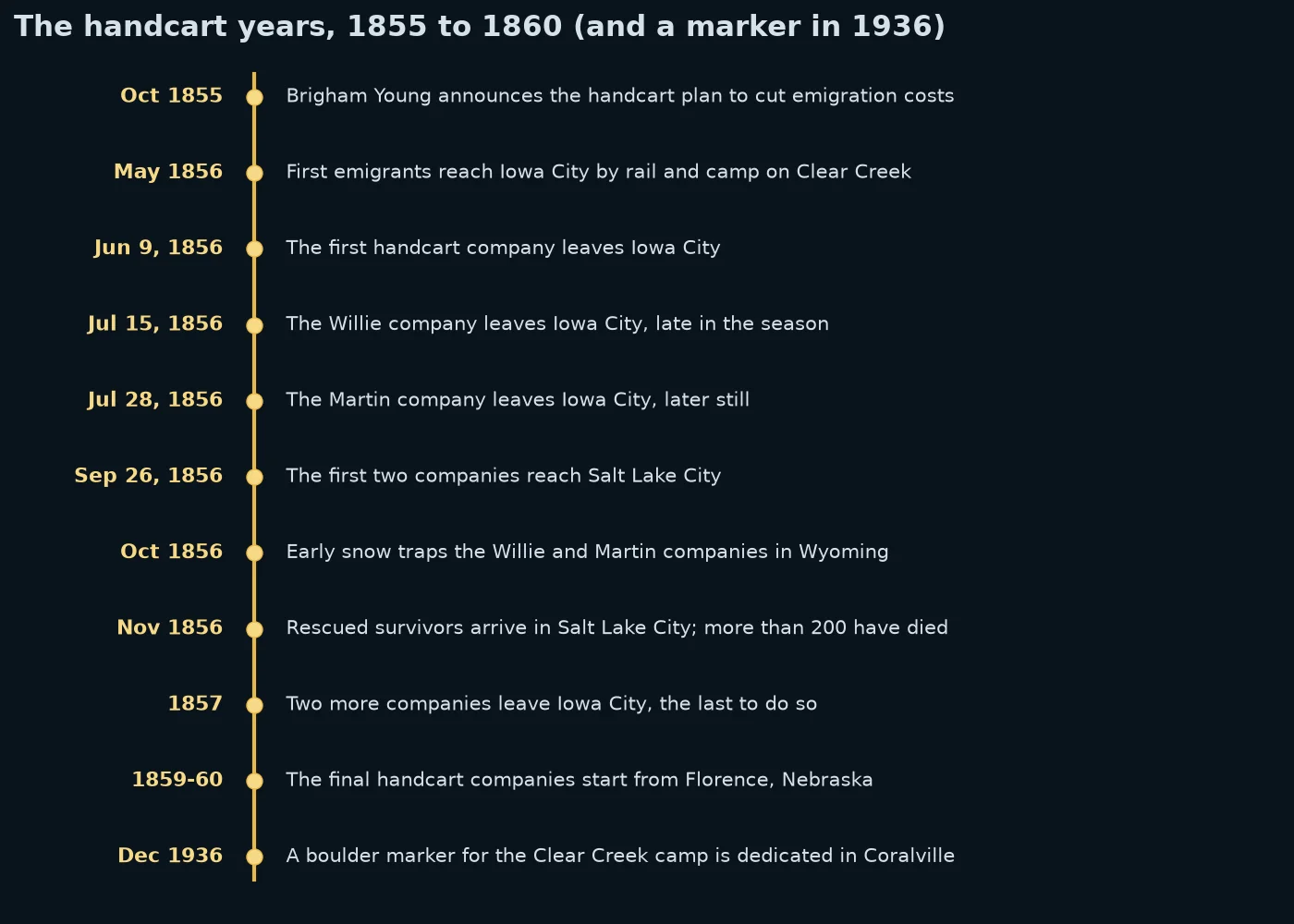
After 1857, the handcart companies stopped starting from Iowa City. The last ones, in 1859 and 1860, set off from Florence, Nebraska. Then the experiment ended, and the carts became a symbol rather than a way to travel.
Council Bluffs, the gold rush and a likely source
Here's a twist worth knowing. The western end of this road had a gold story of its own, and a real one.
Council Bluffs was first a Latter-day Saint settlement called Kanesville, the main outfitting point for the exodus to Utah. Then the California Gold Rush arrived and transformed the place. Gold seekers poured through Kanesville to buy supplies before heading west, and by around 1852, with most of the Saints gone to Utah, the town was renamed Council Bluffs.
In other words, the same stretch of riverbank saw both Mormon emigrants and gold-rush traffic within a few short years. Throw in the general sense that the West was full of gold, plus well-known tales of "Mormon gold" in Utah such as the Lost Rhoades Mine, and you have all the ingredients for a story about Mormon travelers burying coins in Iowa. Whether that's how this legend formed, nobody can say for sure. It's a reasonable guess, and that's all it is.
The theories, weighed
- Real coins, really buried. A traveler, Mormon or not, hid savings near the trail and never came back. Possible on any old road, and impossible to rule out. Also impossible to prove, with no name, date or place attached.
- A borrowed story. The nameless Council Bluffs pioneer who buried gold coins, or a gold-rush tale from Kanesville, got pinned to the handcart pioneers because they were the most famous people on that road.
- "Mormon gold" from somewhere else. Utah's lost-mine legends drifted east and landed on the trail that led there.
- Folklore, pure and simple. Every old trail grows a treasure story sooner or later. This one has the classic shape: travelers, gold and a promise to come back.
The honest verdict? The handcart pioneers are about as well documented as any group of emigrants in American history, with diaries, company rosters and church records, and none of it mentions a buried hoard in Iowa. That doesn't make the legend impossible. It does make it very, very quiet.
Following the Mormon Handcart Trail in Iowa today
Fancy seeing it for yourself? Brilliant. Leave the shovel at home, though. Here's what you can actually visit.
- Mormon Handcart Park, on the border of Iowa City and Coralville, marks the area of the 1856–57 camp on Clear Creek. It's university land, developed and kept up with church funding, and it's now a memorial park and nature preserve with native prairie, walking paths and markers about the handcart pioneers. It also includes a pioneer burial ground, which deserves the same respect as any other cemetery.
- The 1936 boulder marker in Coralville, a granite stone with a bronze plaque placed by the Daughters of the American Revolution, which notes the site of the "Mormon Handcart Brigade Camp."
- The old road west. US Highway 6 generally follows the old trans-Iowa road the handcarts used as far as Redfield. You can drive it through Marengo, Grinnell, Newton and Des Moines, where a granite marker near Riverside Drive and Southwest First Street remembers old Fort Des Moines. Unlike the 1846 Mormon Trail, the handcart route is largely unmarked.
- Council Bluffs, the old Kanesville, at the western end of the road, and the 1846 trail sites further south, part of the Mormon Pioneer National Historic Trail.
One plain fact for would-be treasure hunters: nearly all of this route is now towns, road verges and private farmland. Digging on someone's land without their permission is trespassing in Iowa, the same as anywhere else, and the camp area is a protected memorial with graves in it. Walk it, read the markers and enjoy the history. The farmers would rather you didn't bring a metal detector to their soybeans.
The gold may never have existed. The handcart pioneers certainly did, and their road across Iowa is still there for anyone curious enough to follow it.
...and if you find it, remember who encouraged your questionable life choices.
The short version of this story is on YouTube at @TenToeExpress.
Deep dive yourself
- Handcart Companies, by William G. Hartley · Utah History Encyclopedia, Utah Historical Society
- The Mormon handcart camp near Iowa City, by Charlene Nichols Hixon (1975) · Johnson County IAGenWeb Project
- Handcart Companies 1856–1860 · Utah Heritage Gateways
- Faint Footsteps of 1856–57 Retraced, by Steven F. Faux (2006) · The Annals of Iowa, University of Iowa
- Iowa City: birthplace of handcart venture (2006) · Church News
- Iowa City, Iowa, Handcart Park · Ensign Peak Foundation
- History and Culture · National Park Service, Mormon Pioneer National Historic Trail
- Mormon Handcart Tragedy of 1856 · Legends of America
- 14 Real Hidden Treasures in Iowa · Rock Chasing (a treasure-hunting list with the Council Bluffs gold coin tale; no sources given)
- Mormon handcart pioneers and Council Bluffs, Iowa · Wikipedia (good starting points with references)