 Ten Toe Express
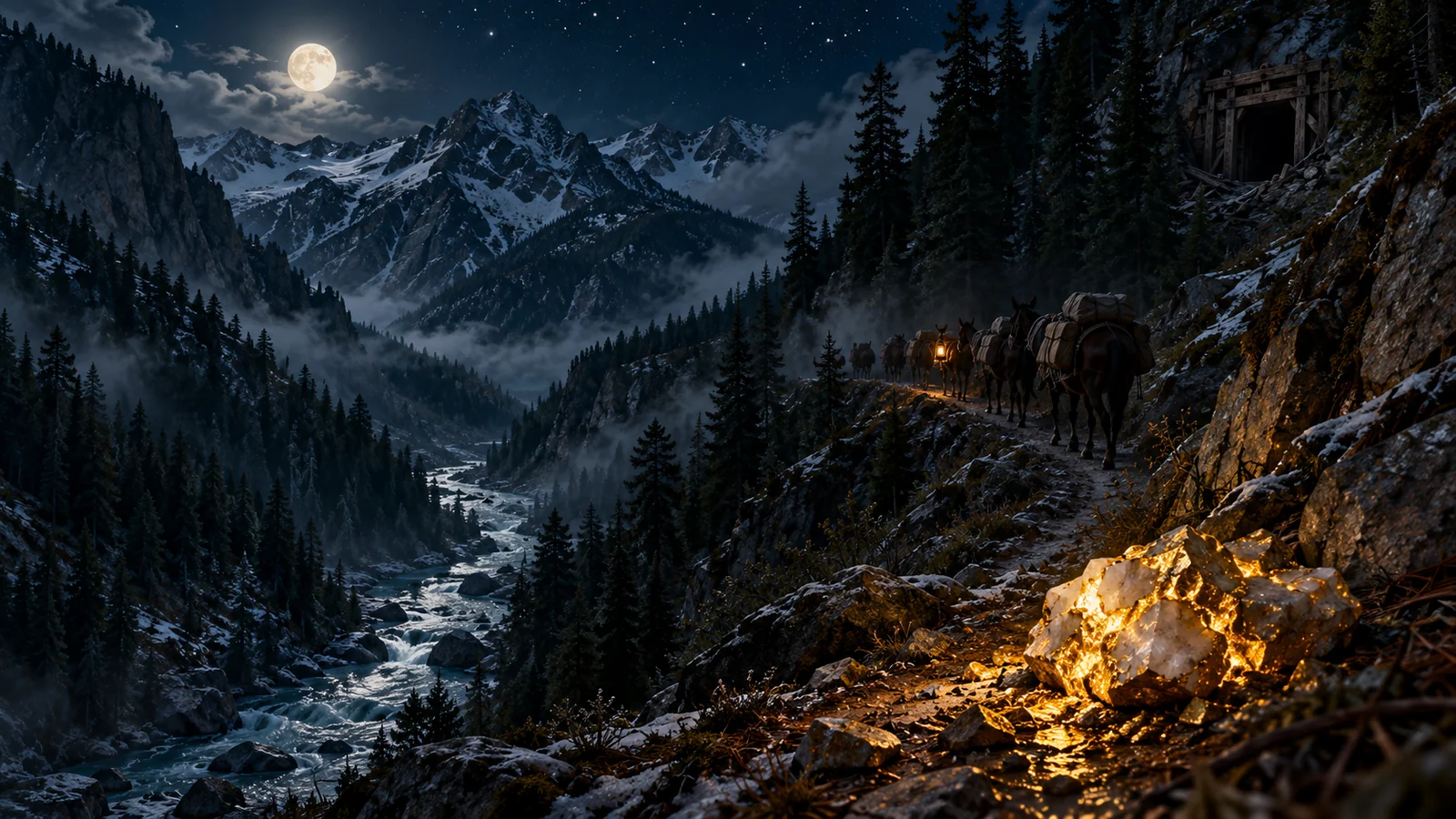
Picture a mule trail clinging to the side of a canyon in the Salmon River Mountains of central Idaho, sometime in the early mining days around Loon Creek, the gold camp that boomed in 1869. Somewhere along it, a lump of quartz is lying in the dirt, and it is shot through with gold. Not a speck. Not a maybe. The proper stuff. The man who picks it up has found what miners call "float": ore that has broken off a vein somewhere uphill and tumbled down. Follow it back up the mountain and you find the mother lode. Simple.
Except, so the story goes, he never did. He never came back to show anyone where the vein was, and the secret went with him. That's the legend of the Lost Packer Mine, one of Idaho's great lost-ledge tales, and it comes with a twist most lost mines never get: in 1902 somebody claimed to have found it. There is a real mine on the map today called the Lost Packer, with real tunnels, a real smelter in its past and real ore records. So, right then. Was the lost ledge actually found, or did a hopeful prospector simply borrow a good story for a good name?
Grab a warm coat. This one lives at about 8,600 feet.
The Loon Creek gold rush of 1869
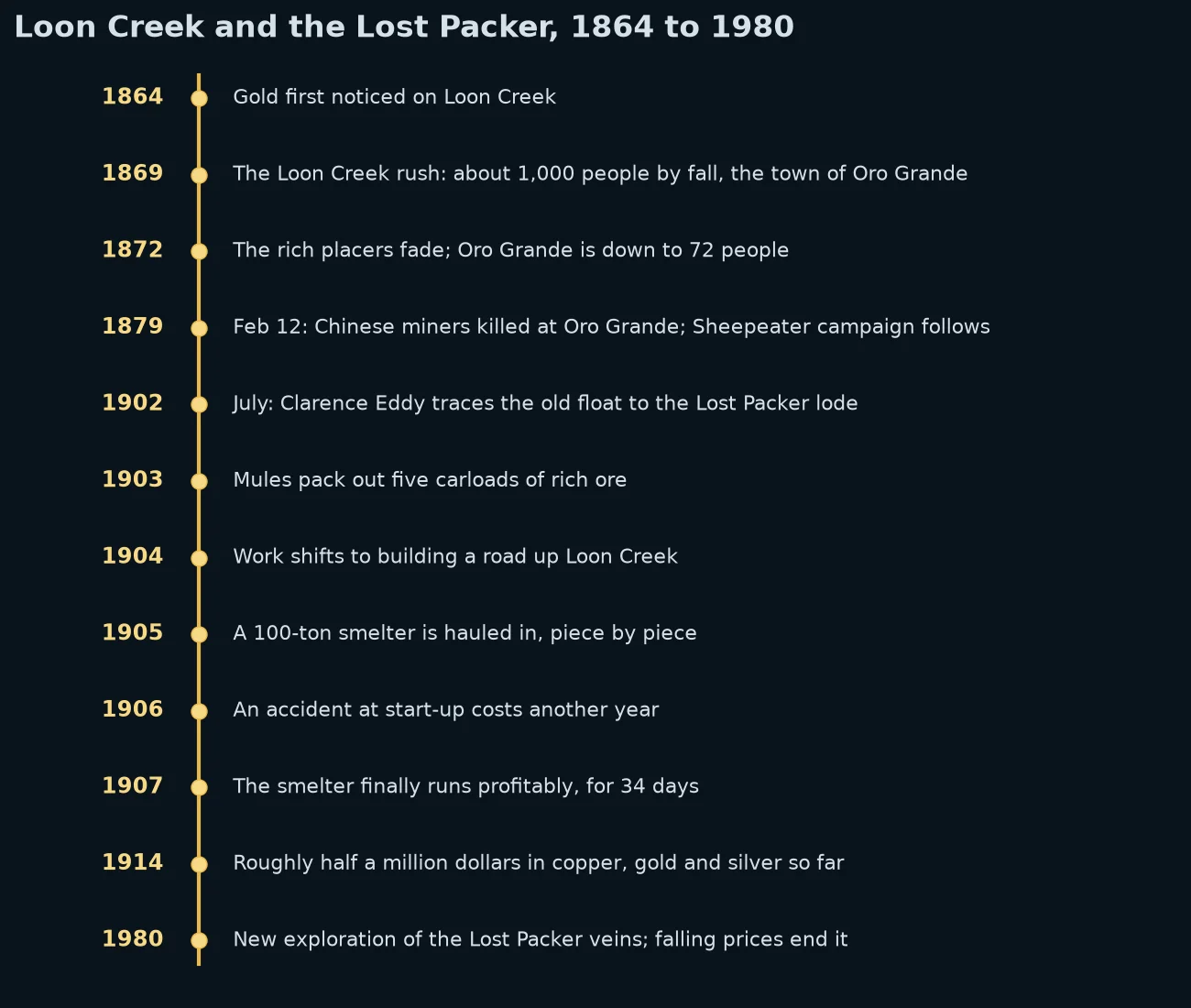
To understand a lost mine, you first need the place where everyone was looking. Gold had been noticed on Loon Creek as early as 1864, and again in 1868. In May 1869, a prospector named Nathan Smith led a party from the mining camp of Leesburg to see whether the creek was worth the trouble. According to the Idaho State Historical Society, the stream was named for a loon the men happened to meet there, which is about as romantic as Idaho place names get.
Smith liked what he saw. On July 19, 1869, he came back with sixty or seventy eager miners who stampeded out of Leesburg. They were so enthusiastic that they organised Loon Creek into three separate mining districts, which conveniently let each man hold nine claims instead of three. Brilliant accounting. When word reached the Boise Basin, Idaho City joined the rush on August 14. By the end of that summer some five hundred men had arrived, and by autumn Loon Creek's population had swelled to about a thousand.
A town called Oro Grande ("big gold") sprang up. By late September 1869 it had seven stores, seven saloons, three boarding houses and two express offices. Notice the ratio of saloons to everything else. Getting supplies in was heroic: in the spring of 1870, pack strings brought goods through the snow belt at night, because by day the snow was too soft for the horses. One express rider spent forty-six days wandering in deep snow trying to reach Oro Grande from Idaho City at the start of 1872. Remember that detail. This is country where a man with a mule could disappear for weeks and nobody would think it odd.
The good placer ground was soon worked over. By the spring of 1872, Oro Grande was down to seventy-two people, and Chinese miners, who had been pushed onto the poorer claims, came to do most of the remaining work.
The packer and the rich float: the legend
Here is where the history thins out and the campfire takes over.
In those early days, rich float turned up somewhere in the Loon Creek country. That much is in the official history. The Idaho State Historical Society, quoting an older account, says it was something that
"account of which remained a folk lore of the region for years afterwards"
And folklore is exactly what it became. The legend, as it's retold today, goes like this: a man, a packer if the mine's name is anything to go by, found gold-heavy quartz on or near the trail and was convinced a fabulously rich vein lay just above. He said as much. But he died before he could lead anyone back to it, and the ledge was lost. The lost ledge became the stuff of campfire talk.
Now for the raised eyebrow. No record turned up in the research for this story names the packer, says when or how he died, or puts a date on his find. Versions differ, and the details are exactly the sort of thing that grows a little with every telling. What's documented is the core: early rich float, a vein nobody could find, and a story the region refused to forget.

Packers really were the lifeline of this country. Everything came in and went out on the backs of mules and horses, and it went on that way for decades. A packer would have walked these trails more than almost anyone, which makes a packer finding float entirely believable. It also makes "the packer" a handy, nameless hero for a tale that needed one.
A darker winter: Oro Grande, 1879
Before the ledge was found (or "found"), Loon Creek went through something grim, and it deserves to be told straight.
By the winter of 1878 to 1879, only a handful of Chinese miners were left at Oro Grande. On February 12, 1879, they were killed there, and mining at Oro Grande was wiped out. Accounts put the number of Chinese miners killed at five. The killings were blamed on the Sheepeaters, a band of Shoshone (the Tukudeka) who lived in the Salmon River Mountains. The Sheepeaters later said they had nothing to do with it, and historians note the accusations of that year came with little or no evidence. The blame stuck anyway, and that summer the US Army launched what became known as the Sheepeater War, a campaign that ended with the band's surrender that autumn and their being driven from the mountains.
Mining on Loon Creek stopped dead. The Chinese did not go back, the ground no longer paid wages for anyone else, and for more than twenty years the creek went quiet. Whatever the packer had found, nobody was hunting for it in earnest.
1902: the Thunder Mountain rush and Clarence Eddy
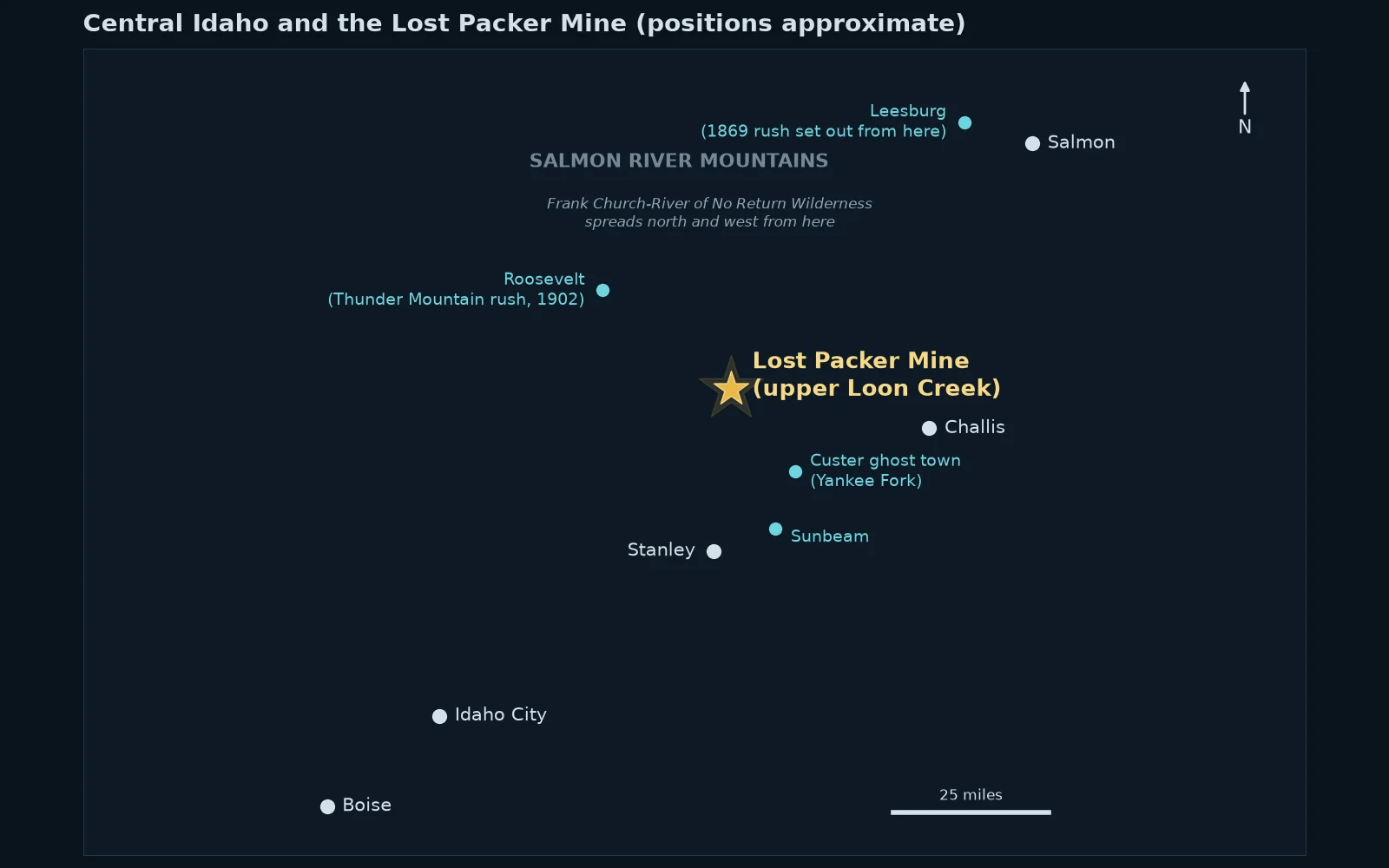
Then came the Thunder Mountain gold rush. In the spring of 1902, prospectors poured by the thousand into the mountains about thirty miles from Loon Creek, chasing reports of a mountain of gold near the new camp of Roosevelt. Thunder Mountain itself ended up attracting far more investors' money than it ever produced in gold, but the crowds spilled across the whole region, and old stories got a fresh hearing.
Among the prospectors was Clarence E. Eddy, and he was not your average pick-and-pan man. Eddy grew up on a farm above Myrtle Creek, Oregon, and worked his way around the West as a printer, newspaper editor and prospector. He wrote poems and songs about mining life and became known as the "Poet-Prospector." In the early 1900s he was rather famous for it.
In July 1902, Eddy found a vein on upper Loon Creek. According to the state's history of the district, it was the vein the old rich float had come from, finally traced to its source. It "lacked prominence on the surface", which is a polite way of saying it was hiding in plain sight, and may explain why it stayed hidden for so long. The lode was named the Lost Packer.
Eddy was delighted, and his reasons are charming. The Idaho State Historical Society says the strike meant he could at last afford to publish a book of his poems and start a newspaper. His collection The Pinnacle of Parnassus came out in 1902, printed in Salt Lake City. He and a partner, Samuel Hunt, ran the newspaper at Custer, the mining town on the Yankee Fork, and in 1904 they took their press to Roosevelt to start the Prospector and Thunder Mountain News. Few lost mines can claim to have funded a poetry career.
Mules, a mountain road and a smelter
Finding the Lost Packer turned out to be the easy part. Getting anything out of it was a proper saga.
In the summer of 1903, mules packed out five carloads of rich ore, with more the following year. That's a lot of trips down a mountain on the back of an animal with opinions. In 1904 the focus switched to building a road up Loon Creek, so that a modern smelter, with a capacity of a hundred tons, could be hauled in. That took two years. When the smelter finally started up in 1906, an accident delayed production for another year. In 1907 it ran at a profit for thirty-four days.
Thirty-four days. Two years of road building and freighting for a month and a bit of profitable smelting. You have to admire the stubbornness.

Records of the mine describe underground workings with ten levels across roughly 940 vertical feet, most of them tunnels driven in from the surface. Ore values recorded for the vein run from about $25 to $90 a ton, and the ore carried gold, silver and copper together. The property was run for years by the Ivers family, whose name stuck to the old mine site on upper Loon Creek, and the mining records list it under the Ivers Mining Co.
How much did it produce? Here the sources argue. One state history says about half a million dollars in copper, gold and silver had come out by 1914. Another puts the smelter's output from 1905 to 1914 at around $600,000 in copper and gold. A federal mining database lists $750,000. Call it somewhere between half a million and three quarters of a million dollars in the money of the day. A good mine. Not a legendary one.
The real enemy was geography. The state's history is blunt: a mine this remote simply could not be worked on a large scale during the short seasons when the high mountain road to Loon Creek was open. Only the richest ore was worth processing. In 1980, new exploration of the Lost Packer veins raised hopes of a revival, but falling metal prices ended that too. Today the mine is classed as closed.
So was the Lost Packer ever really found?
This is the delicious bit. Most lost mines stay lost. The Lost Packer is the rare legend with an official happy ending, and that's exactly why it deserves a second look.
- Yes, Eddy found it. The state's own history says the early rich float was "at last" traced to the vein Eddy discovered. If the float came from anywhere near upper Loon Creek, this is the obvious source, and the ore really was rich enough to pack out by mule.
- A borrowed name. Prospectors loved a famous name, and investors loved it even more. Calling a new claim "the Lost Packer" was marvellous advertising during a rush, whether or not anyone could prove it was the same ledge. Nobody in 1902 could check, because the man who found the original float was long gone.
- The ledge is still out there. The romantic option. The Lost Packer Mine produced well, but not like the fabulous vein of the story, so some will tell you the packer's real bonanza is still hiding further up some side gulch. There's no evidence for it, but there's no evidence against it either, which is how lost mines stay alive.
- A story that grew. Central Idaho has more than one "died before he could tell" tale. Not far away, on the Yankee Fork, the legend of Isaac Swim says he found rich gold quartz near the mouth of the Yankee Fork in 1881 and drowned crossing the Salmon River the next June with its location still in his head. Similar stories in neighbouring valleys have a way of borrowing details from each other.
The honest answer: the Lost Packer is the only lost mine that comes with tunnel maps, assay values and a smelter, and it's still not entirely clear what was lost in the first place. Rather inconvenient, and rather wonderful.
Visiting Loon Creek and the Lost Packer country today
Fancy a look? Brilliant, but this is serious backcountry, and it pays to know the rules.
- The land. Upper Loon Creek lies in the Salmon-Challis National Forest, right on the edge of the Frank Church-River of No Return Wilderness, the vast roadless area of about 2.37 million acres created in 1980. Some mineral databases place the old Lost Packer workings inside the wilderness boundary. Wilderness rules apply there, and old mining property can include patented claims, which are private land. Look, don't dig, and stay out of old tunnels, which are unstable and dangerous.
- Getting there. The Forest Service's Tin Cup Campground sits on Loon Creek at the wilderness edge, about 31 miles north of Sunbeam on Forest Road 112 and then Forest Road 007. A high-clearance vehicle is recommended for FR 007, the campground season starts in July, and there is no drinking water. The high passes on these roads close with snow.
- The wider story. The ghost town of Custer on the Yankee Fork, where Eddy ran his newspaper, is part of Land of the Yankee Fork State Park, with an interpretive centre in Challis covering the region's mining history.
- Hiking. The Loon Creek trail continues north toward the Middle Fork of the Salmon River, a long trip best suited to experienced backpackers. Check current conditions with the Salmon-Challis National Forest before you go, carry everything you need and tell someone your plans.
Stand by the creek on a summer evening and it's easy to imagine a pack string coming down the trail, bells clanking, and one man stopping to pick up a rock that would turn into a legend. Whether he ever really knew where it came from is the one thing these mountains have never told.
...and if you find it, remember who encouraged your questionable life choices.
The short version of this story is on YouTube at @TenToeExpress.
Deep dive yourself
- The Loon Creek Mines (Reference Series No. 366) · Idaho State Historical Society
- Mining in Idaho (Reference Series No. 9) · Idaho State Historical Society
- History of the Lost Packer Mine, Custer County, Idaho, by Victoria E. Mitchell (1997) · Idaho Geological Survey
- Lost Packer Mine · Western Mining History (USGS mineral resources data)
- Tin Cup Campground · USDA Forest Service, Salmon-Challis National Forest
- Frank Church-River of No Return Wilderness · Wikipedia
- Prospector-Poet's Boyhood Spent Near Myrtle Creek, Ore. · Jefferson Public Radio, As It Was
- Thunder Mountain and Roosevelt history · Yellow Pine Times (Valley County history collection)
- Sheepeater Indian War · Wikipedia
- More Idaho Treasure Tales · Legends of America